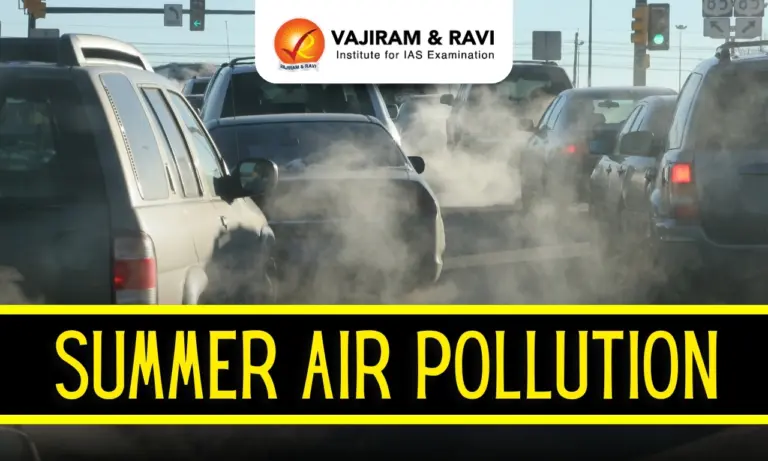
Summer Air Pollution Latest News
- The Commission for Air Quality Management in the National Capital Region and Adjoining Areas (CAQM) revoked all Graded Response Action Plan (GRAP) curbs in March 2026 — signalling the end of winter pollution.
- However, as temperatures rose in April, it reimposed Stage 1 of GRAP to combat summer air pollution — reimposing it again in May as North India reeled under heatwaves.
- Delhi recorded 54 days between April 1 and May 31, 2026 where PM10 levels exceeded national standards — highlighting that air pollution is now a year-round crisis, not just a winter problem.
Summer vs Winter Air Pollution — Key Differences
- Most people associate Indian city pollution with winter smog. Winter pollution is dominated by finer PM2.5 particles that get trapped close to the ground due to low temperatures, low wind speeds, and the basin-like topography of cities like Delhi.
- Summer, however, brings a different pollution chemistry — driven primarily by two pollutants — PM10 (coarser dust particles) and ground-level ozone.
- While summer brings stronger winds and thunderstorms that help disperse some pollutants, heat and intense sunlight create their own dangerous pollution conditions.


What is PM10 and What Causes Its Summer Spike
- PM10 refers to particulate matter smaller than 10 micrometres in diameter — coarser dust particles that can enter the respiratory tract and cause breathing problems.
- Unlike the finer PM2.5 of winter, PM10 is primarily driven by dust in summer.
- Two main mechanisms drive India’s summer PM10 spikes:
- Natural Dust Storms — Loo and Andhi – Hot conditions over the Indian subcontinent create a low-pressure area that extends toward Iran. Its interaction with surrounding high-pressure areas produces hot, windy conditions that stir up dust storms. These include: Loo and Andhi.
- Loo — Hot, dry winds that carry dust from West Asia and the Thar Desert across northern India toward the Bay of Bengal. These can elevate PM10 levels for days.
- Andhi — Shorter, localised dust storms that form when strong downward-moving air from thunderstorms hits the ground, lifts loose dust, and carries it at high speed. While loo storms are common in North India, cities like Mumbai and Hyderabad typically face dusty episodes from local thunderstorms.
- Human Activities Worsening Dust – Natural dust is compounded by human activity. Construction and demolition work — which often resumes after winter GRAP restrictions are lifted — adds significantly to PM10 without adequate dust control measures.
- Natural Dust Storms — Loo and Andhi – Hot conditions over the Indian subcontinent create a low-pressure area that extends toward Iran. Its interaction with surrounding high-pressure areas produces hot, windy conditions that stir up dust storms. These include: Loo and Andhi.
What is Ground-Level Ozone and Why Does It Rise in Summer
- Ground-level ozone is not emitted directly from vehicles or chimneys — it is a secondary pollutant that forms through a chemical reaction.
- When Nitrogen Oxides (NOx) — largely from vehicles — and Volatile Organic Compounds (VOCs) — from industrial emissions, vehicle exhaust, paints, and other sources — react under strong sunlight, ozone is formed.
- Hotter, sunnier summer days therefore provide ideal conditions for ozone formation.
- Ozone, along with particulate matter, causes respiratory illnesses and is particularly dangerous for children, the elderly, and those with pre-existing lung conditions.
The Scale of the Problem — Beyond Delhi
- Summer air pollution is not confined to Delhi. Between April 1 and May 31, 2026:
- Delhi — 54 days with PM10 exceeding national standards (100 μg/m³); 40 days with hourly ozone breaches.
- Mumbai — High PM10 and ozone levels driven by construction activity, dust, and traffic.
- Chennai — Occasional PM10 breaches; high vehicular density and hot weather make it an ozone hotspot.
- Hyderabad, Bengaluru, Kolkata — Also recorded PM10 and ozone spikes driven by local sources.
What Can Cities Do — Solutions and Way Forward
- Forecasting and Early Warning Systems
- Natural dust cannot be controlled — but it can be predicted. Delhi’s Air Quality Early Warning System (AQEWS) — created after the severe 2018 dust storms — now runs year-round and has been extended to Jaipur and Mumbai.
- It provides three-day Air Quality Index (AQI) forecasts for 140 Indian cities.
- The IMD also publishes national weather forecast bulletins multiple times daily.
- Authorities must use these systems to issue timely local alerts on dust storms, ozone, and poor air quality so citizens can reduce exposure.
- Construction Dust Control
- Construction sites need active dust management year-round — not just during winter GRAP periods.
- A CEEW study found that simply reducing heavy vehicle movement at construction sites can lower local PM levels.
- Reducing Ozone — Cutting NOx and VOC Emissions
- Tackling ozone requires cleaner transport, better industrial compliance, and attention to solvents, paints, and fuel combustion.
- Even simple behavioural campaigns like Delhi’s ‘Red Light On, Gaadi Off’ — urging drivers to switch off vehicles while waiting at traffic junctions — can meaningfully reduce idling emissions and ozone formation.
- Summer Action Plans for All Cities
- Delhi has had a Summer Action Plan since 2022.
- Other cities urgently need similar plans combining forecasting, public health advisories, construction dust control, road dust management, and action on ozone-forming emissions.
- Indian cities must plan for both winter and summer pollution seasons — treating them with equal seriousness.

 Last updated on Oct, 2026
→ UPSC 2027 Notification will be released on 13 January 2027 at upsconline.nic.in.
→ Asian Games 2026 are being held in Aichi-Nagoya, Japan, from 19 September to 4 October.
→ Check Nobel Prize 2026 Winners List here.
→ Download PIB PRiSM Monthly Magazine 2026 here.
→ Check UPSC Monthly Current Affairs Magazine The Recitals here.
→ Check out the latest UPSC Syllabus here.
→ Download UPSC Model Answers for Mains 2026
→ UPSC Mains Question Paper 2026 is out now for Essay & GS Paper 1, 2, 3 & 4.
→ UPSC Calendar 2027 has been released.
→ Enroll in Vajiram & Ravi’s UPSC Mains Test Series 2027 for structured answer writing practice, expert evaluation, and exam-oriented feedback.
→ Join Vajiram & Ravi’s UPSC Mentorship Program 2027 for personalized guidance, strategy planning, and one-to-one support from experienced mentors.
→ Go through the UPSC Mains Previous Year Papers to enhance your preparation.
→ UPSC has released UPSC Toppers List 2025 with the Civil Services final result on its official website.
→ Also check Best UPSC Coaching in India
Summer Air Pollution FAQs
Q1. What causes Summer Air Pollution in Indian Cities?+
Q2. How is Summer Air Pollution in Indian Cities different from winter pollution?+
Q3. What is PM10 and why is it important in summer?+
Q4. Why does ozone increase during summer months?+
Q5. How can cities reduce Summer Air Pollution in Indian Cities?+
Tags: mains articles Summer Air Pollution upsc current affairs upsc mains current affairs