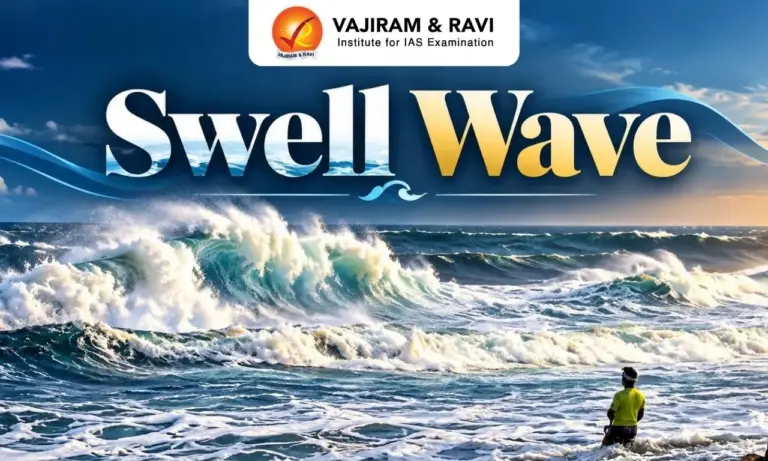
Swell Wave Latest News
Recently, the Indian National Centre for Ocean Information Services (INCOIS) has issued a Red Alert across all coastal districts in Keralam, warning residents and authorities of dangerous sea conditions caused by potential swell waves.
About Swell Wave
- Swell waves are long-wavelength ocean waves formed on the surface of the seas and travel away from their places of origin.
- These are composed of a series of surface gravity waves.
- Swell waves are also called Kallakkadal waves in India, which is a colloquial term used by Keralam fishermen.
- These waves organise themselves into groups of similar heights and periods, and then travel long distances without much change.
- Early warning systems in India: Indian National Centre for Ocean Information Services (INCOIS) Swell Surge Forecast System launched in 2020 which gives forewaring seven days in advance.
- Formation
- They are usually created by windstorms or other weather systems.
- Windstorms and other powerful air current systems transfer energy from the air to water, making swell waves more powerful than locally generated waves.
- During such storms, huge energy transfer takes place from the air into the water, leading to the formation of very high waves. Such waves can travel thousands of kilometres from the storm centre until they strike shore.
- They occur not due to the local winds, but rather due to distant storms like hurricanes, or even long periods of fierce gale winds.


Features of Swell Wave
- Swells have a narrower range of frequencies and directions than locally generated wind waves.
- It is because swell waves have dispersed from their generation area, have dissipated and therefore lost an amount of randomness, taking on a more defined shape and direction.
- These waves can propagate in directions that differ from the direction of the wind, in contrast to a wind sea.
- Their wavelengths may rarely exceed more than 150 m. Swell wavelength, also, varies from event to event. Occasionally, swells which are longer than 700 m occur as a result of the most severe storms.
- It occurs without precursors or any kind of local wind activity and as a result.
Source: TH

 Last updated on Oct, 2026
→ UPSC 2027 Notification will be released on 13 January 2027 at upsconline.nic.in.
→ Check Nobel Prize 2026 Winners List here.
→ Download PIB PRiSM Monthly Magazine 2026 here.
→ Check UPSC Monthly Current Affairs Magazine The Recitals here.
→ Check out the latest UPSC Syllabus here.
→ Download UPSC Model Answers for Mains 2026
→ UPSC Mains Question Paper 2026 is out now for Essay & GS Paper 1, 2, 3 & 4.
→ UPSC Calendar 2027 has been released.
→ Enroll in Vajiram & Ravi’s UPSC Mains Test Series 2027 for structured answer writing practice, expert evaluation, and exam-oriented feedback.
→ Join Vajiram & Ravi’s UPSC Mentorship Program 2027 for personalized guidance, strategy planning, and one-to-one support from experienced mentors.
→ Go through the UPSC Mains Previous Year Papers to enhance your preparation.
→ UPSC has released UPSC Toppers List 2025 with the Civil Services final result on its official website.
→ Also check Best UPSC Coaching in India
Swell Wave FAQs
Q1. What are Swell waves?+
Q2. Which organisation formed the Swell Surge Forecast System?+
Tags: prelims pointers swell wave upsc current affairs upsc prelims current affairs