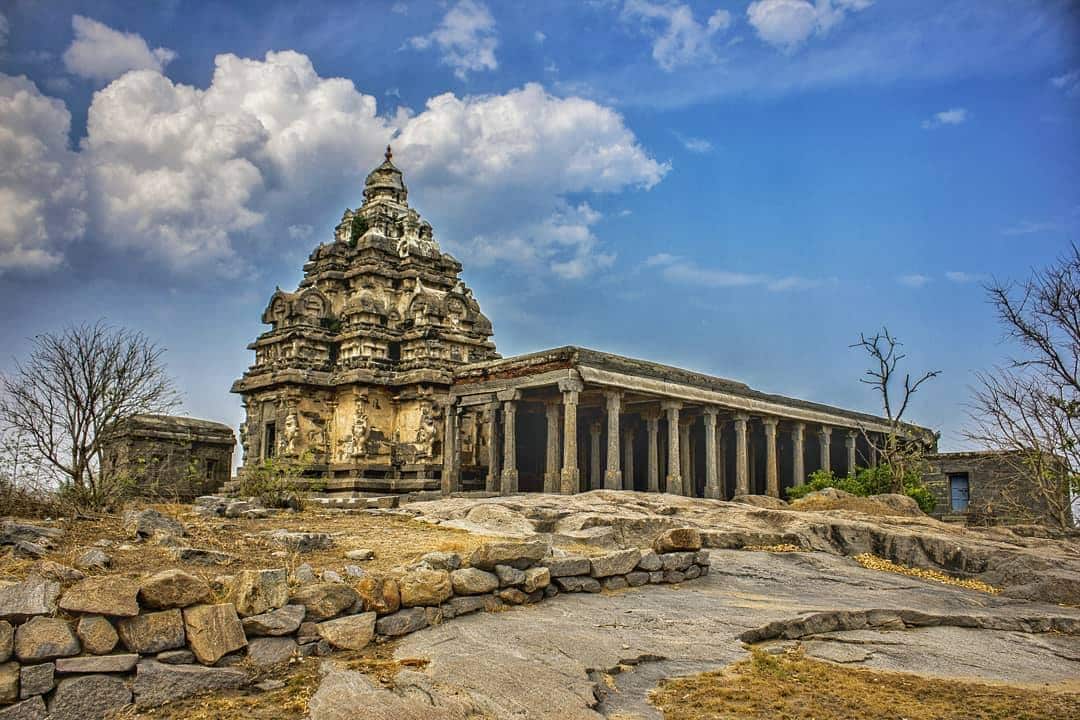
About Talagirishwara temple
- It is located in Panamalai village of Viluppuram district in TamilNadu, India.
- The temple is constructed on an insignificant small hill watching the Panamalai lake.
- The temple was constructed by Pallava king Narasimhavarman II, popularly known as Rajasimha.
- Features
- This Seventh Century structure incorporates a Vimana that resembles that of Kailasanatha temple of Kanchipuram.
- The garbhagriha stocks a Dharalingam and as in Pallava temples of that period, there is a Somaskanda section on the hindmost wall of the shrine.
- It includes an Ardhamandapam (partial Mandapam).
- The walls of the Ardhamandapam posts panels of divinities including Brahma with Saraswati and Vishnu with Lakshmi on either flank.
- The temple faces east and also the garbhagriha is enclosed on all the 3 sides by sub shrines Some more sub shrines and a Mahamandapam (a massive Mandapam) have been added in the later period to the structure.
- The Vimana is 3 layered and also the high tier has been rebuilt.
- The typical Pallava mark, pillars with crouching lions, is also found.
- Paintings in the temple
- The paintings in this temple bear a close resemblance to the paintings in Ajantha and Chithannavasal.
- The paintings are on the wall of a sub-temple on the northern side of the Talagirishwara (Siva) temple.
- There is a painting of Lord Shiva with eight hands dancing known as Latathilagabhani, being watched by Goddess Parvathi with her crown and well decorated umbrella.
- These paintings were older than Chithannavasal paintings.
- These paintings were created after covering the stonewalls with paste made of limestone and sand.
Q1) What are the key features of Ajanta cave paintings?
The paintings in the Ajanta Caves primarily depict scenes from the life of the Buddha, Jataka tales (stories of the Buddha’s previous lives), and various mythological and narrative themes. They also include images of royalty, court life, and daily activities from the ancient period.
Source: 1,300-year-old Pallava paintings in ruins at Tamil Nadu’s Panamalai


 Last updated on Oct, 2026
→ UPSC 2027 Notification will be released on 13 January 2027 at upsconline.nic.in.
→ Check Nobel Prize 2026 Winners List here.
→ Download PIB PRiSM Monthly Magazine 2026 here.
→ Check UPSC Monthly Current Affairs Magazine The Recitals here.
→ Check out the latest UPSC Syllabus here.
→ Download UPSC Model Answers for Mains 2026
→ UPSC Mains Question Paper 2026 is out now for Essay & GS Paper 1, 2, 3 & 4.
→ UPSC Calendar 2027 has been released.
→ Enroll in Vajiram & Ravi’s UPSC Mains Test Series 2027 for structured answer writing practice, expert evaluation, and exam-oriented feedback.
→ Join Vajiram & Ravi’s UPSC Mentorship Program 2027 for personalized guidance, strategy planning, and one-to-one support from experienced mentors.
→ Go through the UPSC Mains Previous Year Papers to enhance your preparation.
→ UPSC has released UPSC Toppers List 2025 with the Civil Services final result on its official website.
→ Also check Best UPSC Coaching in India