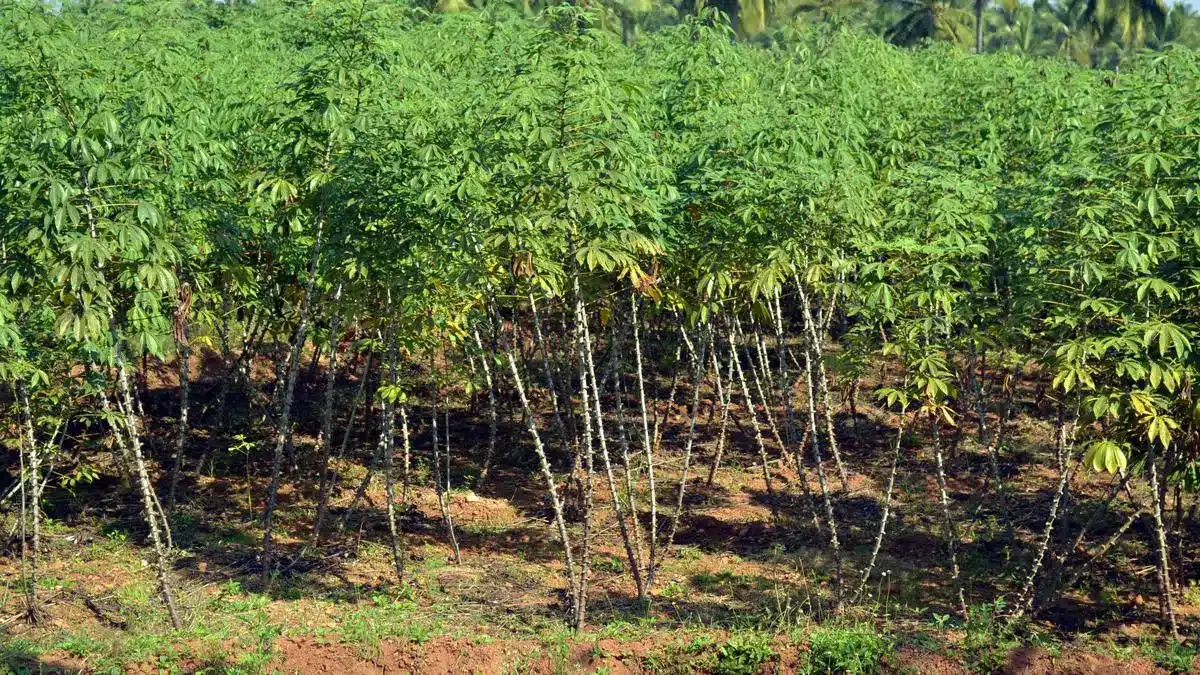
About Tapioca plant
- It is a major horticulture crop cultivated on nearly 3 lakh hectares in Tamil Nadu, producing 60 lakh tonnes of the crop.
- It is cultivated throughout the tropical world for its tuberous roots, from which cassava flour, breads, tapioca, a laundry starch, and an alcoholic beverage are derived.
- Climatic conditions required
- Soil: Any well-drained soil, preferably red lateritic loamy soil.
- It thrives best in a tropical, warm, humid climate
- Rainfall: Well-distributed rainfall of over 100 cm per annum.
- This crop can be cultivated upto an elevation of 1000 m.
- All parts of cassava/tapioca – leaves, stem, tuber and rind – contain the compounds called cyanogenic glucosides (CNGs), that is, linamarin and lotaustralin which are hydrolysed by endogenous enzyme linamarase to acetone cyanohydrin which may break down spontaneously liberating free hydrogen cyanide.
- Both acetone cyanohydrin and free cyanide are toxic.
- Its leaves contain about 10 times higher amounts of CNGs than roots.
- The CNG content of cassava leaves decreases with the increase in the age of the leaves.
- The rind contains 10-30 times higher cyanoglucoside content than the edible parts.
- Feeding crushed peels or leaves immediately after crushing or without proper drying poses a high risk of cyanide poisoning in animals.
Q1) What is Cyanide?
It is a rapidly acting, potentially deadly chemical that interferes with the body’s ability to use oxygen. Cyanide can be a colorless gas or liquid, such as hydrogen cyanide (HCN) or cyanogen chloride (CNCl). Cyanide can also be a crystal (solid) form such as sodium cyanide (NaCN) or potassium cyanide (KCN).


 Last updated on Oct, 2026
→ UPSC 2027 Notification will be released on 13 January 2027 at upsconline.nic.in.
→ Asian Games 2026 are being held in Aichi-Nagoya, Japan, from 19 September to 4 October.
→ Check out the latest UPSC Syllabus here.
→ Download UPSC Model Answers for Mains 2026
→ UPSC Mains Question Paper 2026 is out now for Essay & GS Paper 1, 2, 3 & 4.
→ UPSC Calendar 2027 has been released.
→ Enroll in Vajiram & Ravi’s UPSC Mains Test Series 2027 for structured answer writing practice, expert evaluation, and exam-oriented feedback.
→ Join Vajiram & Ravi’s UPSC Mentorship Program 2027 for personalized guidance, strategy planning, and one-to-one support from experienced mentors.
→ Go through the UPSC Mains Previous Year Papers to enhance your preparation.
→ UPSC has released UPSC Toppers List 2025 with the Civil Services final result on its official website.
→ Download PIB PRiSM Monthly Magazine 2026 here.
→ Also check Best UPSC Coaching in India