Teak Defoliator Moth Latest News
Recently, the Kerala Forest Research Institute has identified and mass-produced Hyblaea puera Nucleopolyhedrosis Virus (HpNPV) which offers eco-friendly alternative to chemical pesticides and prevents massive defoliation in teak caused by teak defoliator moth (Hyblaea puera).
About Teak Defoliator Moth
- It is a moth and cryptic species and a well-known pest which affects teak trees.
- It also attacks an alternative host plant, Avicennia marina, a prominent mangrove tree species abundant along the west coast of India, causing severe and extensive defoliation of Mangroves.
- The teak defoliator Hyblaea puera was first recognized as a pest of teak in 1898 in the Konni Forest Division in Kerala State of India.
- Distribution: It is native to South Asia and South-east Asia and mainly occurs in forests across southern Asia from India, Sri Lanka and Bangladesh, through Thailand and the rest of south-east Asia to New Guinea, and north Queensland in Australia.
- The outbreaks of this pest are a regular annual phenomenon in teak plantations.
- Impact: It causes significant economic losses on timber production from teak plantations during their seasonal outbreaks.


How does it Affect Teak Tree?
- Larvae cause damage and attack commences with onset of monsoon rain.
- When the larvae attack, the tree spends its energy regenerating leaves instead of growing.
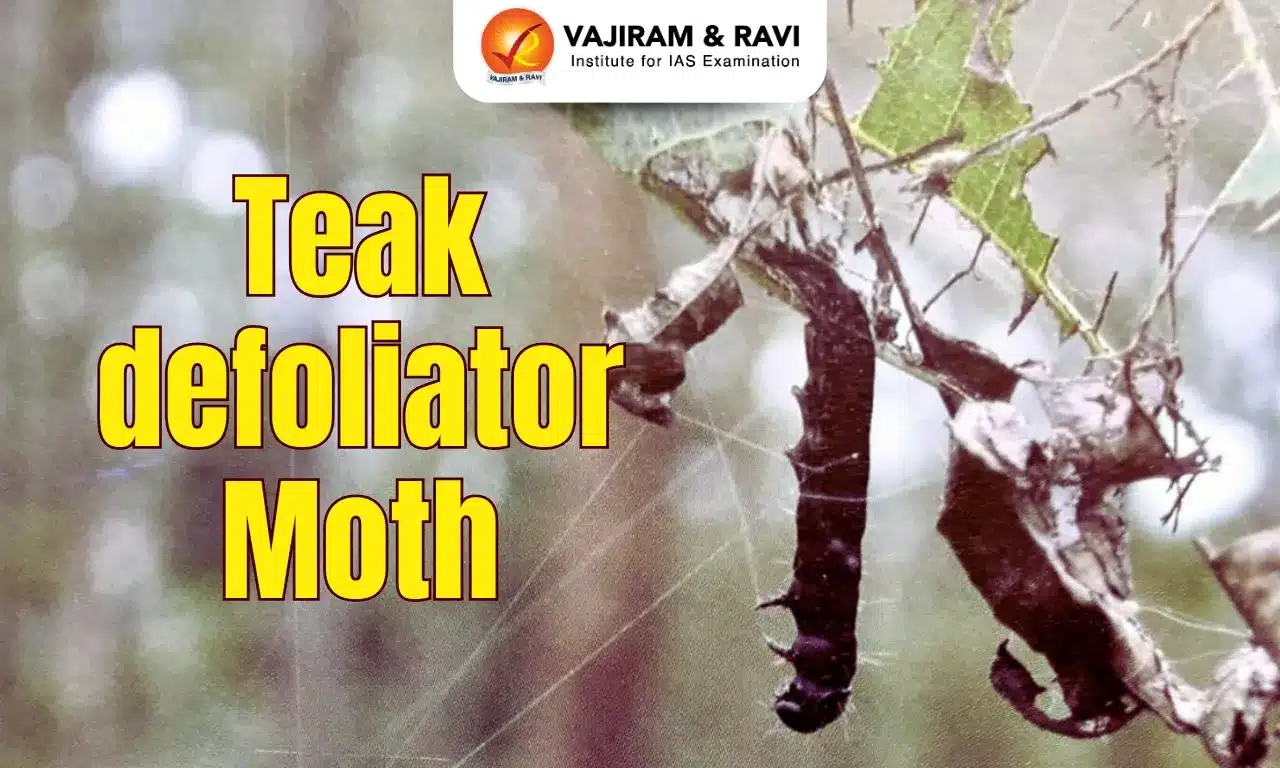
- Nature of damage: These moths defoliate trees and eat entire leaves and leave midrib.
What is Hyblaea Puera Nucleopolyhedrosis Virus?
- It is a potential biocontrol agent of the teak defoliator Hyblaea puera.
- It is considered to be the most promising biocontrol agent of this pest according to laboratory and field studies.
- It causes lethal infection in the pest larvae and prevents widespread defoliation of teak trees.
- It multiplies at least a trillion times inside a single larva. When the body breaks open, it releases huge quantities of inoculum.
- Even if the infection is sub-lethal, the virus stays in the insect, gets passed on to the next generation, and proves lethal then.
Source: TH

 Last updated on Oct, 2026
→ UPSC 2027 Notification will be released on 13 January 2027 at upsconline.nic.in.
→ Check Nobel Prize 2026 Winners List here.
→ Download PIB PRiSM Monthly Magazine 2026 here.
→ Check UPSC Monthly Current Affairs Magazine The Recitals here.
→ Check out the latest UPSC Syllabus here.
→ Download UPSC Model Answers for Mains 2026
→ UPSC Mains Question Paper 2026 is out now for Essay & GS Paper 1, 2, 3 & 4.
→ UPSC Calendar 2027 has been released.
→ Enroll in Vajiram & Ravi’s UPSC Mains Test Series 2027 for structured answer writing practice, expert evaluation, and exam-oriented feedback.
→ Join Vajiram & Ravi’s UPSC Mentorship Program 2027 for personalized guidance, strategy planning, and one-to-one support from experienced mentors.
→ Go through the UPSC Mains Previous Year Papers to enhance your preparation.
→ UPSC has released UPSC Toppers List 2025 with the Civil Services final result on its official website.
→ Also check Best UPSC Coaching in India
Teak Defoliator Moth FAQs
Q1. What is the major insect pest of teak?+
Q2. What are defoliators?+
Tags: prelims pointers teak defoliator moth upsc current affairs upsc prelims current affairs