About Tellurium
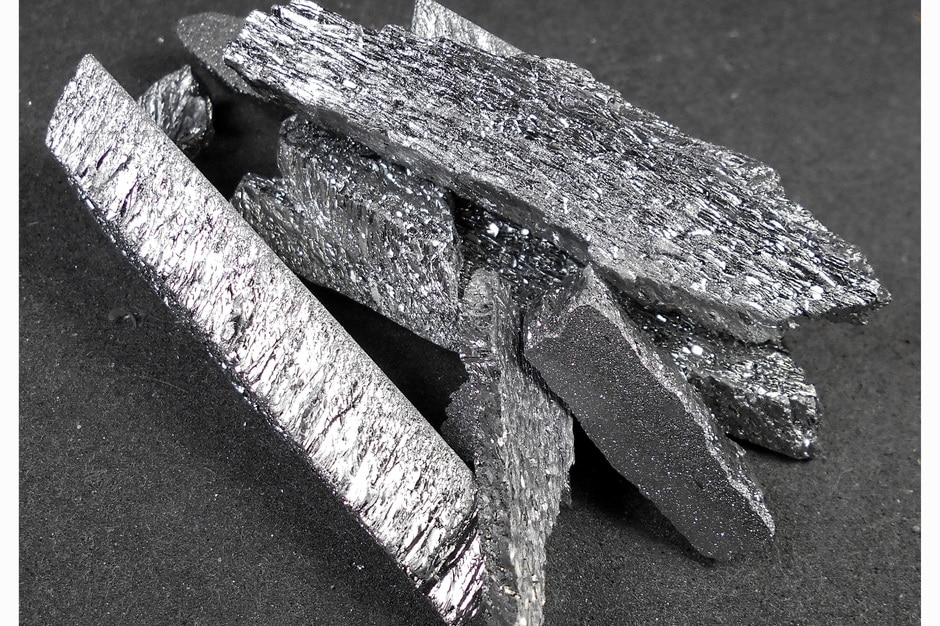
- Tellurium is a semi-metallic, lustrous, crystalline, brittle, silver-white element.
- Atomic Number: 52
- It has the properties of both the metals and the nonmetals.
- It forms many compounds corresponding to those of sulfur and selenium.
- When burned in the air, tellurium has a greenish-blue flame and forms tellurium dioxide as a result.
- Tellurium is a semiconductor material and is slightly photosensitive.
- It is one of the only elements that readily combine with gold (Au).
- Sources:
- Tellurium is sometimes found free in nature.
- More commonly, it is found combined with metals, such as in the minerals calaverite (gold telluride, AuTe2) and sylvanite (silver-gold telluride).
- Commercially, tellurium is obtained as a byproduct of electrolytic copper refining.
- Applications:
- Tellurium is alloyed with copper and stainless steel to make these metals more workable.
- It is added at very low levels to lead to decreases the corrosive action of sulfuric acid in batteries and to improve the lead’s strength and hardness.
- It is used as a coloring agent in ceramics.
- It is also used in the electronics industry, for example, with cadmium and mercury to form photosensitive semiconductors.
- It is used in vulcanizing rubber, and in catalysts for petroleum cracking, and in blasting caps for explosives.
What is a Neutron Star?
- A neutron star is an extremely dense and compact celestial object that forms after the core of a massive star collapses under its own gravity during a supernova explosion.
Q1) What is a semiconductor?
Semiconductors are materials which have a conductivity between conductors (generally metals) and nonconductors or insulators (such as most ceramics). Semiconductors can be pure elements, such as silicon or germanium, or compounds such as gallium arsenide or cadmium selenide. In a process called doping, small amounts of impurities are added to pure semiconductors causing large changes in the conductivity of the material.Semiconductors are an essential component of electronic devices, enabling advances in communications, computing, healthcare, military systems etc.
Source: Evidence found for the production of tellurium in neutron star mergers


 Last updated on Oct, 2026
→ UPSC 2027 Notification will be released on 13 January 2027 at upsconline.nic.in.
→ Asian Games 2026 are being held in Aichi-Nagoya, Japan, from 19 September to 4 October.
→ Check Nobel Prize 2026 Winners List here.
→ Download PIB PRiSM Monthly Magazine 2026 here.
→ Check UPSC Monthly Current Affairs Magazine The Recitals here.
→ Check out the latest UPSC Syllabus here.
→ Download UPSC Model Answers for Mains 2026
→ UPSC Mains Question Paper 2026 is out now for Essay & GS Paper 1, 2, 3 & 4.
→ UPSC Calendar 2027 has been released.
→ Enroll in Vajiram & Ravi’s UPSC Mains Test Series 2027 for structured answer writing practice, expert evaluation, and exam-oriented feedback.
→ Join Vajiram & Ravi’s UPSC Mentorship Program 2027 for personalized guidance, strategy planning, and one-to-one support from experienced mentors.
→ Go through the UPSC Mains Previous Year Papers to enhance your preparation.
→ UPSC has released UPSC Toppers List 2025 with the Civil Services final result on its official website.
→ Also check Best UPSC Coaching in India