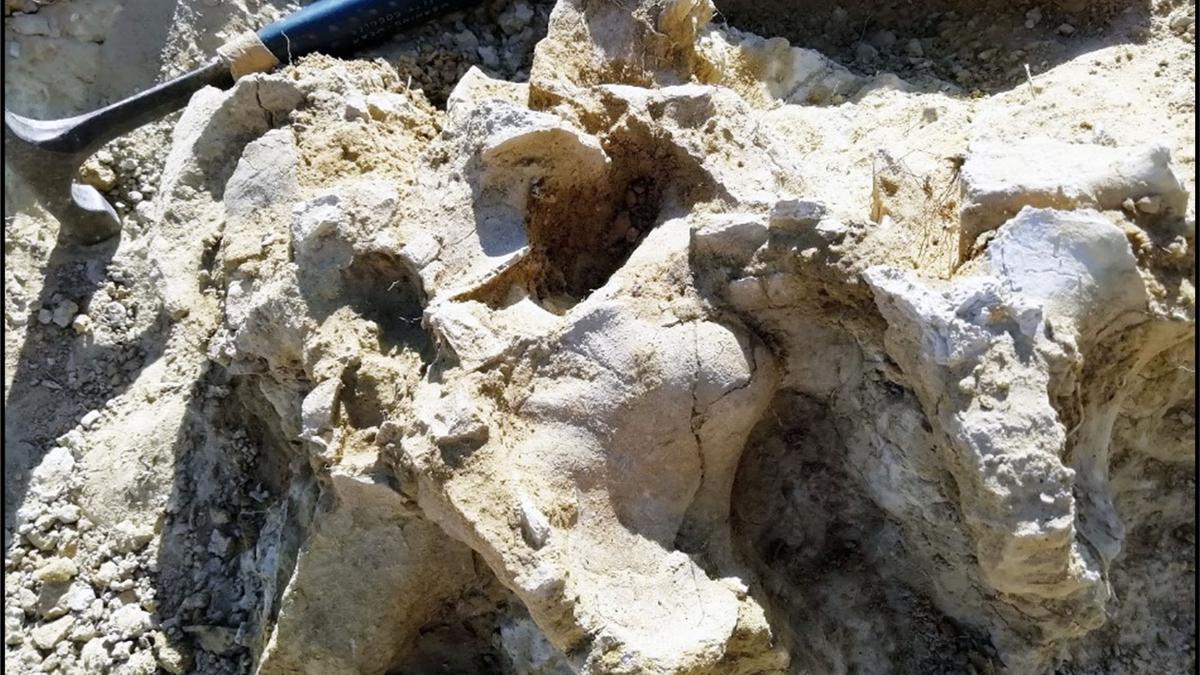
About Tharosaurus indicus:
- It belongs to the family Dicraeosauridae and from the superfamily Diplodocoidea.
- These fossils are the first dicraeosaurid sauropods to have been found in India.
- It is 167 million years old and oldest known diplodocoid fossils in the world.
- The scientists named the dinosaur Tharosaurus indicus, with Tharo deriving from the Thar desert; saurus from the Greek ‘sauros’, or lizard; and indicus from its Indian origin.
- This family was unique: its members were smaller and had shorter necks and tails compared to the other long-necked sauropods.
- Sauropods first appeared on the earth during the Jurassic period, about 200 million years ago.
- They were one of the most dominant clades of dinosaurs, surviving until the late Cretaceous period 65 million years ago, when the dinosaurs went extinct.
- According to the scientists, fossils of dicraeosaurid dinosaurs have been found previously in North and South Americas, Africa and China, but such fossils were not known from India.
Q1) What is Mesozoic Era?
It is one of the three major geological eras in Earth’s history, spanning approximately 180 million years from about 251 million years ago to 66 million years ago. It is often referred to as the “Age of Dinosaurs” because it was during this era that dinosaurs became the dominant terrestrial vertebrates.
Source: Oldest yet fossils of a plant-eating dinosaur found in Rajasthan


 Last updated on Oct, 2026
→ UPSC 2027 Notification will be released on 13 January 2027 at upsconline.nic.in.
→ Check Nobel Prize 2026 Winners List here.
→ Download PIB PRiSM Monthly Magazine 2026 here.
→ Check UPSC Monthly Current Affairs Magazine The Recitals here.
→ Check out the latest UPSC Syllabus here.
→ Download UPSC Model Answers for Mains 2026
→ UPSC Mains Question Paper 2026 is out now for Essay & GS Paper 1, 2, 3 & 4.
→ UPSC Calendar 2027 has been released.
→ Enroll in Vajiram & Ravi’s UPSC Mains Test Series 2027 for structured answer writing practice, expert evaluation, and exam-oriented feedback.
→ Join Vajiram & Ravi’s UPSC Mentorship Program 2027 for personalized guidance, strategy planning, and one-to-one support from experienced mentors.
→ Go through the UPSC Mains Previous Year Papers to enhance your preparation.
→ UPSC has released UPSC Toppers List 2025 with the Civil Services final result on its official website.
→ Also check Best UPSC Coaching in India