What’s in today’s article?
- Why in News?
- What is the Aditya-L1 Mission?
- What is the SUIT?
- Significance of the SUIT
Why in News?
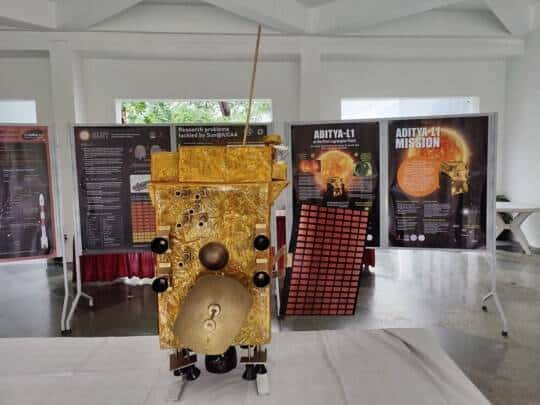
- The Solar Ultraviolet Imaging Telescope (SUIT), a unique space telescope developed by Pune’s Inter-University Center for Astronomy and Astrophysics (IUCAA), has been delivered to the Indian Space Research Organisation (ISRO).
- The telescope is set to be integrated with the ADITYA-L1 mission, expected to be launched in mid-August this year.
What is the Aditya-L1 Mission?
- Aditya (in Sanskrit means Sun) is a planned coronagraphy spacecraft to study solar atmosphere (solar corona – outermost part), being designed and developed by ISRO and various other Indian research institutes.
- It is the first dedicated Indian mission to observe the Sun, and will be launched aboard a PSLV-XL launch vehicle.
- The mission’s objectives have subsequently been broadened (since 2008 – when it was first conceptualised) and it is now intended to be a comprehensive observatory of the sun and space environment.
- It will be placed in an orbit around the Lagrange (L1) point (L1 is about 1.5 million kms from Earth) between Earth and the sun (so renamed – “Aditya-L1“).
- Lagrange points are positions in space where objects sent tend to stay there, as the gravitational pull of two large masses precisely equals the centripetal force required for a small object to move with them.
- These points in space can be used by spacecraft to reduce fuel consumption needed to remain in position.
- The first Lagrangian point of the Sun-Earth system, L1 orbit, allows Aditya-L1 to look at the Sun continuously.
○


What is the SUIT?
- SUIT is an instrument on-board Aditya-L1 mission of ISRO that will measure and monitor the solar radiation emitted in the near ultraviolet wavelength range (200-400 nm).
- SUIT will simultaneously map the photosphere and chromosphere of the Sun using 11 filters sensitive to different wavelengths and covering different heights in the solar atmosphere.
- This will help to understand the processes involved in the transfer from mass and energy from one layer to the other.
- SUIT will also allow ISRO to measure and monitor spatially resolved solar spectral irradiance that governs the chemistry of oxygen and ozone in the stratosphere of the Earth’s atmosphere.
- This is central to our understanding of the Sun-climate relationship.
Significance of the SUIT:
- It will provide a seamless measurement of solar radiation from Hard X-ray to Infrared, as well as in-situ measurements of particles in the solar wind, including the Sun’s magnetic field at the L1 point.
- SUIT will measure the UV radiation hazardous for skin cancer.
- The SUIT telescope will address fundamental questions such as
- The existence of a higher temperature atmosphere above the cooler surface of the Sun and
- The origin and variation of near-ultraviolet radiation and high-energy solar flares.
Q1) What is the Polar Satellite Launch Vehicle (PSLV)?
PSLV is the 3rd generation launch vehicle of India. It is the first Indian launch vehicle to be equipped with liquid stages. After its first successful launch in 1994, PSLV emerged as a reliable and versatile workhorse launch vehicle of India.
Q2) What is a Coronagraph?
A coronagraph is a specialized instrument designed to block out the light of the sun so that researchers can glimpse the burning star’s hot, thin, outermost layer, called the corona.
Source: Unique space telescope designed by Pune scientists ready for Sun mission

 Last updated on Oct, 2026
→ UPSC 2027 Notification will be released on 13 January 2027 at upsconline.nic.in.
→ Check Nobel Prize 2026 Winners List here.
→ Download PIB PRiSM Monthly Magazine 2026 here.
→ Check UPSC Monthly Current Affairs Magazine The Recitals here.
→ Check out the latest UPSC Syllabus here.
→ Download UPSC Model Answers for Mains 2026
→ UPSC Mains Question Paper 2026 is out now for Essay & GS Paper 1, 2, 3 & 4.
→ UPSC Calendar 2027 has been released.
→ Enroll in Vajiram & Ravi’s UPSC Mains Test Series 2027 for structured answer writing practice, expert evaluation, and exam-oriented feedback.
→ Join Vajiram & Ravi’s UPSC Mentorship Program 2027 for personalized guidance, strategy planning, and one-to-one support from experienced mentors.
→ Go through the UPSC Mains Previous Year Papers to enhance your preparation.
→ UPSC has released UPSC Toppers List 2025 with the Civil Services final result on its official website.
→ Also check Best UPSC Coaching in India