What’s in today’s article?
● Why in News?
● What is Theaterisation of Armed Forces?
● Theatre commands and India
● Current command structure in India
● Recent steps taken by India towards theaterisation
● Proposed common defence station
Why in News?
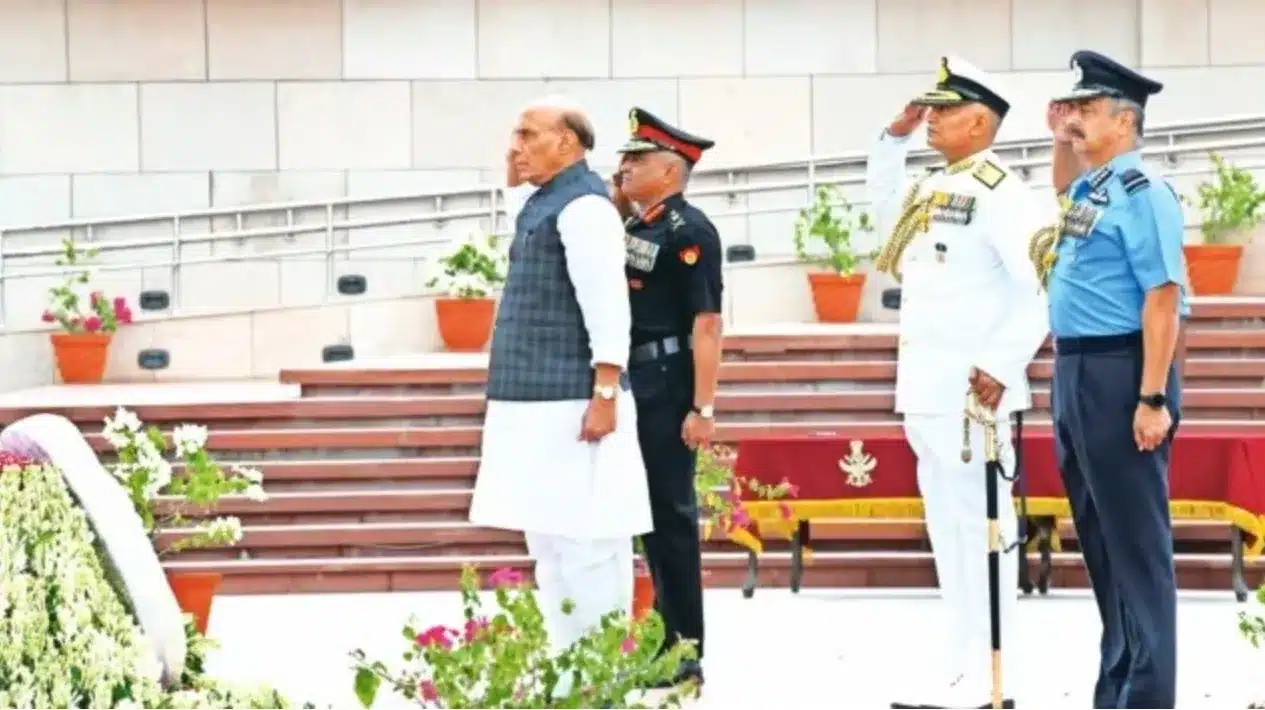
The Armed Forces are planning to turn Mumbai into the first tri-service common defence station in the country for the Army, Navy and the Indian Air Force (IAF).
This step aimed at achieving jointness among the three services ahead of the creation of integrated theatre commands.


What is Theaterisation of Armed Forces?
- Theaterisation is a concept which seeks to integrate the capabilities of the three services – army, air force and navy – in order to optimally utilise their resources for wars and operations.
- A theatre command/unit will be created by integrating elements/assets from all the three services.
- Simply put, a theatre command deploys elements of the three services under a single, unified command structure.
- Each command is assigned a specific geographical region, combining resources of the three services for operational roles.
- As of now, almost all major countries like China, Russia, the US, the UK and France work on a theatre command concept.
For example, China’s Western Theatre Command looks after the entire borders with India.
Theatre commands and India
- The Kargil Review Committee, the Naresh Chandra Committee and the Group of Ministers had called for structural changes in higher defence management.
- It was the Shekatkar committee, which had recommended the creation of the post of Chief of Defence Staff (CDS) and theatre commands.
Current command structure in India
- At present, India has 17 single service commands and only two tri-service commands.
- The 17 single service commands are divided as:
- Army – 7 commands; Airforce – 7 commands; Navy – 3 commands
- The two tri-service commands are: Andaman and Nicobar Command (ANC), and The Strategic Force Command (handles the nuclear weapons).
The Andaman and Nicobar command is a full-fledged command raised as a tri-service command in 2001.
Recent steps taken by India towards theaterisation
- Proposal to createa national defence committee
There is a proposal for theatre commanders under a national defence committee likely to be headed by the Defence Minister.
- Inter-Services Organisation (Command, Control and Discipline) Act2023
- The act empowers the commander-in-chief and the officer-in-command of inter-services organisations with disciplinary and administrative powers over personnel from the other services serving in them.
- Limited cross-postings between the Army, Navy and IAF have already been implemented to promote jointness.
- Restructuring of the headquarters and the subsequent postings will take place after the final approval from the govt.
Proposed common defence station
- Key highlights
- A common defense station would merge all Army, Navy, and Air Force facilities, like logistics and maintenance, under one leadership.
- In Mumbai, the Navy will lead due to its largest presence.
- At present, wings of the three services are spread across Mumbai and its suburbs and operate separately.
- This will mean the logistics, services, and works of the individual services will be integrated so that there is a single system of delivery of supplies such as fuel and ration and common items can be repaired at one place.
- Other proposed common defence stations
With Mumbai being the first common defence station being planned, Sulur (near Coimbatore) and Guwahati are likely to be chosen as locations for the second and third common defence stations.
While the lead service for Sulur is likely to be IAF, the Army will likely be the lead service for the Guwahati station.
Q.1. What is Strategic Force Command (SFC)?
The Strategic Forces Command (SFC) is a part of India’s Nuclear Command Authority (NCA). The SFC is responsible for managing and administering India’s tactical and strategic nuclear weapons stockpile. It was created on January 4, 2003 by the Vajpayee Government.
Q.2. What is Chiefs of Staff Committee (COSC)?
The Chiefs of Staff Committee (COSC) is a group that advises the Indian Minister of Defence and the Cabinet Committee on Political Affairs on military matters. The COSC was established in 1947, after India gained independence. The COSC is made up of the chiefs of the: Army, Navy, Air Force.

 Last updated on Oct, 2026
→ UPSC 2027 Notification will be released on 13 January 2027 at upsconline.nic.in.
→ Check Nobel Prize 2026 Winners List here.
→ Download PIB PRiSM Monthly Magazine 2026 here.
→ Check UPSC Monthly Current Affairs Magazine The Recitals here.
→ Check out the latest UPSC Syllabus here.
→ Download UPSC Model Answers for Mains 2026
→ UPSC Mains Question Paper 2026 is out now for Essay & GS Paper 1, 2, 3 & 4.
→ UPSC Calendar 2027 has been released.
→ Enroll in Vajiram & Ravi’s UPSC Mains Test Series 2027 for structured answer writing practice, expert evaluation, and exam-oriented feedback.
→ Join Vajiram & Ravi’s UPSC Mentorship Program 2027 for personalized guidance, strategy planning, and one-to-one support from experienced mentors.
→ Go through the UPSC Mains Previous Year Papers to enhance your preparation.
→ UPSC has released UPSC Toppers List 2025 with the Civil Services final result on its official website.
→ Also check Best UPSC Coaching in India