Tiangong Space Station Latest News
Pakistan is set to send its first astronaut into space under a cooperation programme with China, with one of two Pakistani candidates expected to join a short-duration mission aboard China’s Tiangong space station as a payload specialist.
About Tiangong Space Station
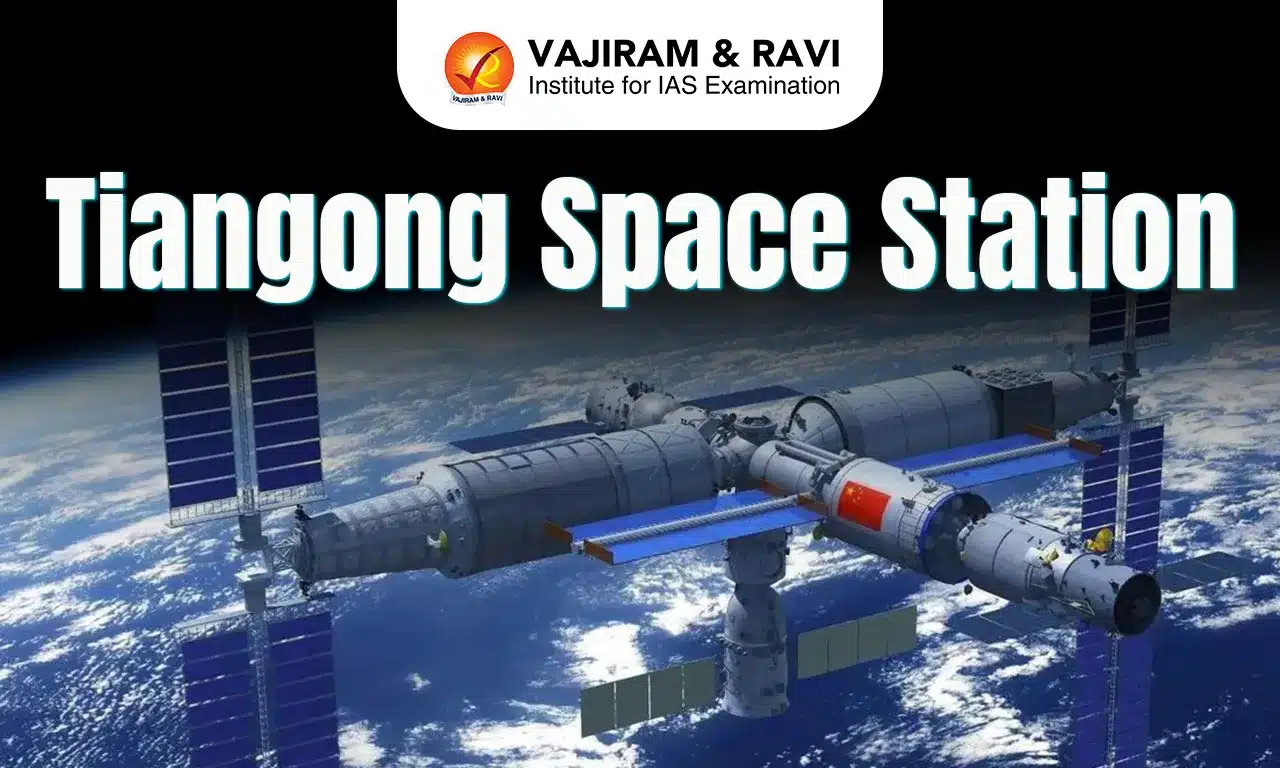
- The Tiangong Space Station, translating to ‘Sky Palace’, is a Chinese-owned and operated permanently crewed space station in Low Earth Orbit (LEO).
- It represents the third and final step of China’s Manned Space Program.
- The first module of the space station was launched in April 2021, following two precursor missions, Tiangong-1 and Tiangong-2.
- The station consists of a core module known as Tianhe, which connects two science modules, Wentian and Mengtian, as well as a planned space telescope module, Xuntian.
- Xuntian is a huge, Hubble-like space telescope, which will share the space station’s orbit and be able to dock with it for repairs, maintenance, and possibly upgrades.
- Tiangong orbits Earth at an altitude between 340 to 450 kilometers, approximately the same orbital height as the International Space Station (ISS).
- Tiangong is much smaller than the ISS, with only three modules compared with 16 modules on the ISS.
- Tiangong is also considerably lighter than the ISS, which weighs about 400 tons (450 metric tons); the Chinese station is about 20% as massive.
- But unlike the ISS, Tiangong is operated by a single nation.
- The station typically hosts three astronauts at a time for six-month stays. It can support six astronauts at a time during crew handovers.
- China plans to expand Tiangong with additional modules in the coming years.
- The aims of the Tiangong Space Station are to:
- Build a long-term, reliable space station in orbit.
- Guarantee the long-term health and safety of stationed astronauts.
- Provide conditions for scientific and technological experiments in space.
- The station serves as an in-orbit laboratory with 23 enclosed experiment racks, each covering a different proposed experiment in the fields of:
- Space life sciences and biotechnology
- Microgravity fluid physics and combustion
- Material science in space
- Fundamental physics in microgravity
- The space station also features platforms for exposed and unpressurised external experiments.
News: OUT


 Last updated on Oct, 2026
→ UPSC 2027 Notification will be released on 13 January 2027 at upsconline.nic.in.
→ Check Nobel Prize 2026 Winners List here.
→ Download PIB PRiSM Monthly Magazine 2026 here.
→ Check UPSC Monthly Current Affairs Magazine The Recitals here.
→ Check out the latest UPSC Syllabus here.
→ Download UPSC Model Answers for Mains 2026
→ UPSC Mains Question Paper 2026 is out now for Essay & GS Paper 1, 2, 3 & 4.
→ UPSC Calendar 2027 has been released.
→ Enroll in Vajiram & Ravi’s UPSC Mains Test Series 2027 for structured answer writing practice, expert evaluation, and exam-oriented feedback.
→ Join Vajiram & Ravi’s UPSC Mentorship Program 2027 for personalized guidance, strategy planning, and one-to-one support from experienced mentors.
→ Go through the UPSC Mains Previous Year Papers to enhance your preparation.
→ UPSC has released UPSC Toppers List 2025 with the Civil Services final result on its official website.
→ Also check Best UPSC Coaching in India
Tiangong Space Station FAQs
Q1. What is the Tiangong Space Station?+
Q2. When was the first module of the Tiangong Space Station launched?+
Q3. What is the core module of the Tiangong Space Station called?+
Q4. How does Tiangong compare with the International Space Station in terms of size and mass?+
Q5. How many astronauts does Tiangong typically accommodate at a time?+
Tags: prelims pointers tiangong space station upsc current affairs upsc prelims current affairs