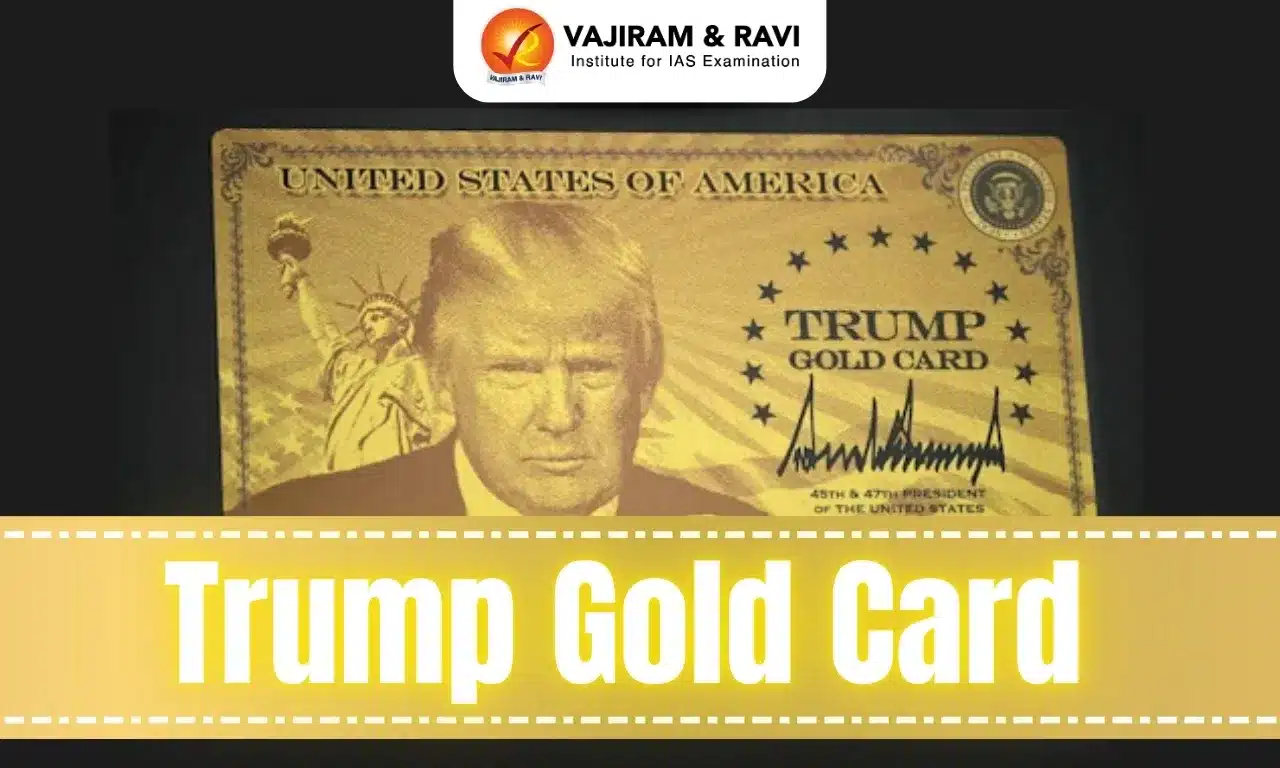
Trump Gold Card Visa Latest News
- US President Donald Trump has launched the long-awaited ‘Gold Card’ visa programme, inviting individuals and companies to invest at least $1 million.
- The initiative aims to attract global talent, generate significant revenue for the US Treasury, and offer a faster, more advantageous route compared to the conventional EB-5 visa system.
Trump Gold Card
- The Trump Gold Card is a newly launched US visa programme offering permanent residency and a pathway to citizenship in exchange for high-value investments.
- It replaces the EB-5 visa system and is designed to draw foreign capital and skilled talent into the US.
Who Can Apply
- Individuals: Must qualify for lawful permanent residency and be admissible to the US.
- Corporations: Can sponsor foreign-born employees.
- Families: Spouses and unmarried children under 21 may apply but must pay additional fees.
Costs and Fees
- Processing Fee: $15,000 per applicant or corporate sponsor (non-refundable).
- Investment/Gift: $1 million for individual applicants; $2 million per employee for corporate sponsors
- Additional Costs: Visa fees and medical exam charges.
Benefits of the Gold Card
- Grants US permanent residency through EB-1 or EB-2 categories.
- Faster processing than traditional visa routes.
- Eligible family members may join.
- Offers a direct path to US citizenship.
Key Rules and Restrictions
- Status may be revoked for security risks or serious criminal offences.
- Applicants from some countries may face year-long waits.
- All recipients must pay US taxes on global income.


Growing Interest Among Indians in Investment-Based US Residency
- With long delays in employment-based Green Card processing, many Indians — especially H-1B holders and wealthy families — are turning to investment pathways for faster US residency.
EB-5: A Favoured Route for Indian Investors
- The EB-5 visa offers a comparatively quicker route to permanent residency.
- Requires $800,000–$1,050,000 investment based on project type and location.
- Must create or preserve 10 full-time US jobs.
- Typically done through USCIS-approved regional centres, which handle over 90% of EB-5 applications.
- Begins with a conditional Green Card, later becoming permanent.
- This programme appeals strongly to Indian HNIs aiming to secure their children’s future in the US.
Gold Card vs EB-5: Key Differences
- The Trump Gold Card provides permanent residency but differs fundamentally from EB-5:
- Gold Card requires a non-refundable $1 million (individual) or $2 million (corporate) contribution directly to the US government.
- No specified job-creation requirement, unlike EB-5.
- Not an investment, offering no capital return, whereas EB-5 allows potential returns.
- Applicants must still meet EB-1A or EB-2 NIW criteria of extraordinary ability or national interest.
- Experts note that while Gold Card may offer faster processing, it does not simplify eligibility requirements or reduce costs compared to EB-5.
Why Experts Still Prefer EB-5
- Immigration specialists argue that:
- EB-5 remains the fastest, most cost-effective path to US residency for many.
- It does not require extraordinary ability, making it more accessible.
- It helps prevent dependent children from “aging out” while awaiting EB-2 or EB-3 priority dates.
- Unlike Gold Card, EB-5 offers predictability and potential investment returns.
EB-5 Stability After Legal Reforms
- The EB-5 Reform and Integrity Act (RIA) 2022 extended the Regional Centre Programme to 2027.
- Investments made before September 2026 are grandfathered, offering protection even if the programme changes later.
- This has increased investor confidence and reduced uncertainty.
Rising EB-5 Demand Among Indians
- EB-5 has seen strong Indian uptake:
- $4.1 billion invested in the first three quarters of FY2025 alone.
- 1,050–1,150 Indian applicants post-RIA, making India the second-largest source of EB-5 submissions (20–22%).
- Growing interest is driven by:
- H-1B holders frustrated with long Green Card delays.
- Wealthy families seeking secure US residency and education opportunities for their children.

 Last updated on Oct, 2026
→ UPSC 2027 Notification will be released on 13 January 2027 at upsconline.nic.in.
→ Asian Games 2026 are being held in Aichi-Nagoya, Japan, from 19 September to 4 October.
→ Check Nobel Prize 2026 Winners List here.
→ Download PIB PRiSM Monthly Magazine 2026 here.
→ Check UPSC Monthly Current Affairs Magazine The Recitals here.
→ Check out the latest UPSC Syllabus here.
→ Download UPSC Model Answers for Mains 2026
→ UPSC Mains Question Paper 2026 is out now for Essay & GS Paper 1, 2, 3 & 4.
→ UPSC Calendar 2027 has been released.
→ Enroll in Vajiram & Ravi’s UPSC Mains Test Series 2027 for structured answer writing practice, expert evaluation, and exam-oriented feedback.
→ Join Vajiram & Ravi’s UPSC Mentorship Program 2027 for personalized guidance, strategy planning, and one-to-one support from experienced mentors.
→ Go through the UPSC Mains Previous Year Papers to enhance your preparation.
→ UPSC has released UPSC Toppers List 2025 with the Civil Services final result on its official website.
→ Also check Best UPSC Coaching in India
Trump Gold Card FAQs
Q1. What is the Trump Gold Card visa programme?+
Q2. Who can apply for the Gold Card?+
Q3. How does the Gold Card differ from the EB-5 visa?+
Q4. Why do experts say EB-5 remains more attractive for Indians?+
Q5. What trends show rising Indian interest in EB-5?+
Tags: mains articles Trump Gold Card upsc current affairs upsc mains current affairs