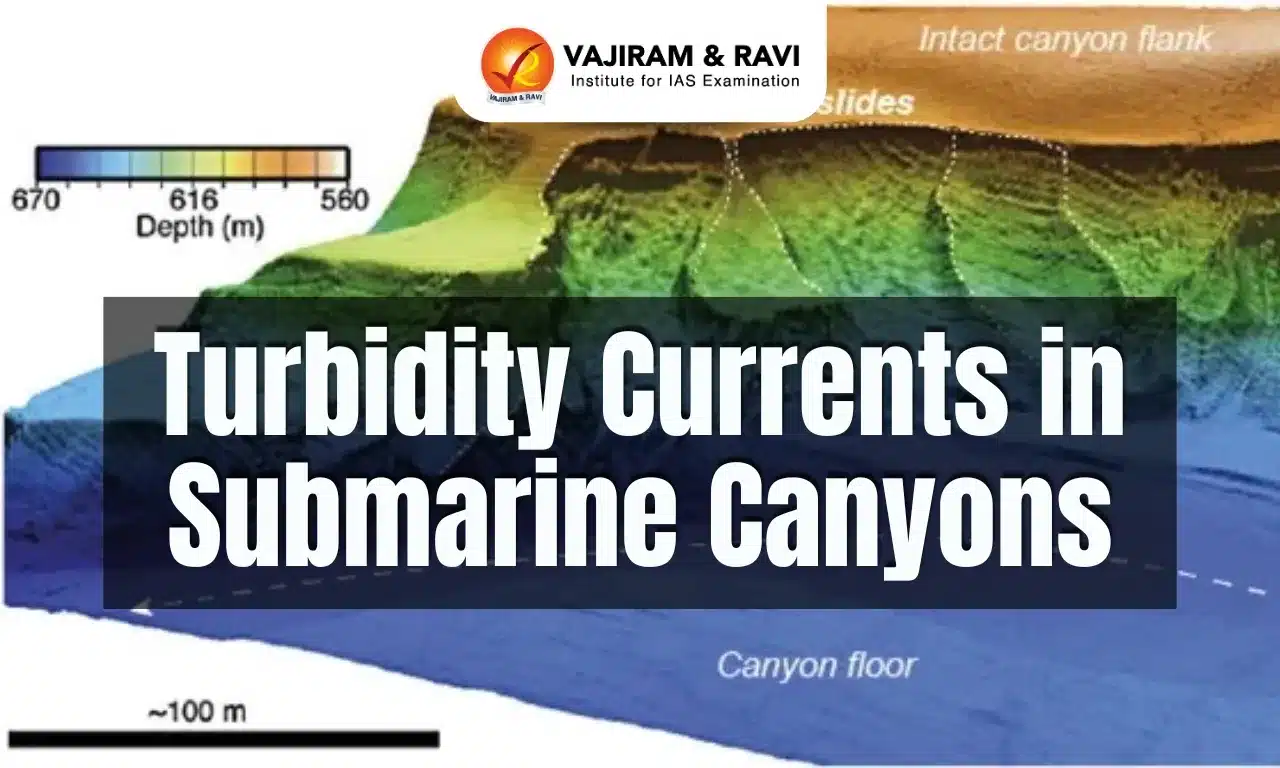
Turbidity Currents in Submarine Canyons Latest News
A recent study published in ACS Environmental Science & Technology has provided the first direct evidence of turbidity currents transporting microplastics into the deep sea through submarine canyons, even in areas not fed by rivers (e.g., Whittard Canyon off Ireland).
What are Turbidity Currents?
- Turbidity currents are rapid, downslope flows of water heavily laden with sediments, increasing the water’s density.
- They function similarly to underwater avalanches, triggered by:
- Earthquakes
- Submarine landslides
- Slope failures and other geological disturbances
- Key Features of Turbidity Currents
- As turbidity increases, water becomes denser and less transparent.
- These flows erode the seafloor, forming and enlarging submarine canyons.
- They deposit sediment in graded layers, with coarser particles settling first and finer ones later.
- Aid in deep-sea sedimentation and shaping oceanic topography.


Submarine Canyons
- Submarine canyons are narrow, steep-sided underwater valleys found on continental slopes and rises, often extending from the continental shelf into the deep ocean.
- They are carved out mainly by erosional forces like turbidity currents, similar to how river canyons are formed on land.
- Globally, there are about 9,477 known submarine canyons, covering nearly 11% of continental slope areas.
- Canyons on active margins (tectonically active zones) tend to be steeper and shorter, while those on passive margins are more gradual.
- Their walls can be nearly vertical and are prone to collapse, adding sediment to turbidity flows.
Types of Submarine Canyons
- Bank: A flat-topped elevation on continental margins, formed by erosional and depositional processes, e.g., Dogger Bank in the North Sea.
- Shoal: A shallow area of sediment accumulation, often hazardous to navigation, and generally found at depths <10 meters at low tide.
- Reef: Built from calcareous skeletons of corals and algae; coral reefs are biodiversity hotspots and prominent in the Pacific Ocean, associated with guyots and seamounts.
Source: PHY

 Last updated on Oct, 2026
→ UPSC 2027 Notification will be released on 13 January 2027 at upsconline.nic.in.
→ Check Nobel Prize 2026 Winners List here.
→ Download PIB PRiSM Monthly Magazine 2026 here.
→ Check UPSC Monthly Current Affairs Magazine The Recitals here.
→ Check out the latest UPSC Syllabus here.
→ Download UPSC Model Answers for Mains 2026
→ UPSC Mains Question Paper 2026 is out now for Essay & GS Paper 1, 2, 3 & 4.
→ UPSC Calendar 2027 has been released.
→ Enroll in Vajiram & Ravi’s UPSC Mains Test Series 2027 for structured answer writing practice, expert evaluation, and exam-oriented feedback.
→ Join Vajiram & Ravi’s UPSC Mentorship Program 2027 for personalized guidance, strategy planning, and one-to-one support from experienced mentors.
→ Go through the UPSC Mains Previous Year Papers to enhance your preparation.
→ UPSC has released UPSC Toppers List 2025 with the Civil Services final result on its official website.
→ Also check Best UPSC Coaching in India
Turbidity Currents in Submarine Canyons FAQs
Q1. What are turbidity currents?+
Q2. How do turbidity currents form submarine canyons?+
Q3. Where are major submarine canyons located?+
Tags: prelims pointers turbidity currents in submarine canyons upsc prelims current affairs