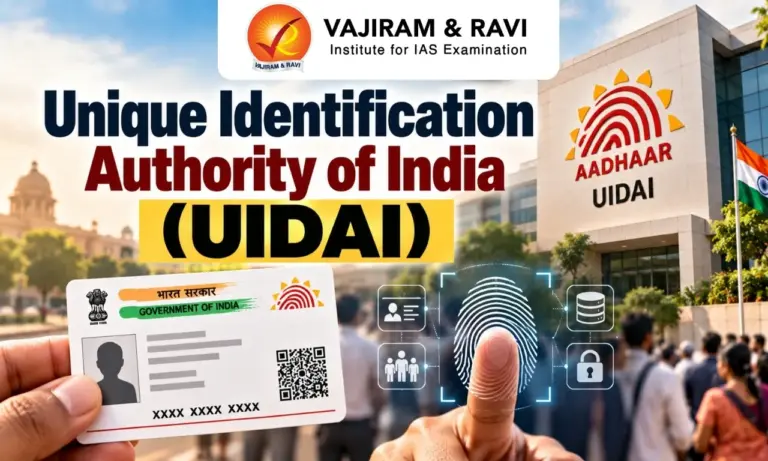
Unique Identification Authority of India (UIDAI) is a statutory authority responsible for issuing and managing Aadhaar, India’s unique identity system. It plays an important role in improving identity verification, targeted delivery of government benefits and digital service delivery. UIDAI functions under the Ministry of Electronics and Information Technology (MeitY).
What is UIDAI?
UIDAI is the organisation responsible for the enrolment, authentication, updating and security of Aadhaar information. It was established as a statutory authority under the Aadhaar (Targeted Delivery of Financial and Other Subsidies, Benefits and Services) Act, 2016 on 12 July 2016.
Aadhaar provides residents with a 12-digit unique identification number based on demographic and biometric information. Its main objective is to create a reliable identity that can be easily verified and authenticated.
History of Unique Identification Authority of India (UIDAI)
The idea of a unique identification system in India developed before UIDAI became a statutory authority.
- In 2006, the government initiated work on a Unique ID for BPL families.
- In 2009, UIDAI was constituted as an attached office under the then Planning Commission.
- Nandan Nilekani was appointed as the first Chairperson of UIDAI in 2009.
- UIDAI became a statutory authority on 12 July 2016 under the Aadhaar Act, 2016.
- The Aadhaar and Other Laws (Amendment) Act, 2019 further amended the Aadhaar framework.


Unique Identification Authority of India (UIDAI) Objectives
The major objectives of UIDAI are:
- To provide a unique identity number to residents.
- To reduce duplicate and fake identities.
- To enable easy and reliable identity authentication.
- To improve the delivery of government subsidies and welfare benefits.
- To develop secure systems for Aadhaar enrolment and authentication.
- To protect the identity information of Aadhaar holders.
- To provide a scalable and reliable digital identity infrastructure.
Functions of UIDAI
UIDAI is responsible for managing the entire Aadhaar ecosystem, from enrolment and Aadhaar generation to authentication, updating information and ensuring the security of Aadhaar data.
- Aadhaar Enrolment: Establishes standards and processes for Aadhaar enrolment and issuance.
- Aadhaar Generation: Generates and assigns unique Aadhaar numbers to eligible residents.
- Authentication: Provides secure Aadhaar authentication services to authorised entities.
- Data Management: Maintains and updates Aadhaar-related demographic and biometric information.
- Data Security: Ensures the security and confidentiality of Aadhaar information.
- e-KYC Services: Enables authorised entities to use Aadhaar-based electronic KYC services.
- Regulation: Regulates and monitors enrolment agencies, authentication agencies and other service providers.
- Grievance Redressal: Provides mechanisms for resolving Aadhaar-related complaints and grievances.
- Technology Management: Develops and maintains the technological infrastructure required for Aadhaar services.
Importance of UIDAI
UIDAI plays an important role in welfare delivery, preventing fund leakage, improving authentication and strengthening digital governance in India.
- Prevents Fund Leakage: Reduces duplicate, fake and ineligible beneficiaries in welfare schemes.
- Ration Distribution: Aadhaar authentication helps ensure subsidised foodgrains reach genuine beneficiaries.
- LPG Subsidy: Helps identify genuine consumers and prevent duplicate or ineligible LPG connections.
- Direct Benefit Transfer: Enables direct transfer of subsidies and benefits into beneficiaries’ bank accounts.
- Welfare Schemes: Supports beneficiary identification for pensions, scholarships, subsidies and other government schemes.
- Railway Ticket Booking: Aadhaar authentication helps prevent misuse and fraudulent booking of Tatkal tickets.
- Financial Inclusion: Simplifies identity verification for banking and other financial services.
- Portability of Benefits: Helps migrant workers access eligible welfare services across states.
- Transparency: Creates a verifiable identity system for monitoring public service delivery.
- Digital Governance: Provides a common digital identity infrastructure for secure and convenient authentication.
- Better Targeting: Helps government agencies ensure that subsidies and benefits reach the intended beneficiaries.
- Reduction in Duplication: Biometric authentication makes it more difficult to maintain multiple identities for the same person.

 Last updated on Oct, 2026
→ UPSC 2027 Notification will be released on 13 January 2027 at upsconline.nic.in.
→ Check Nobel Prize 2026 Winners List here.
→ Download PIB PRiSM Monthly Magazine 2026 here.
→ Check UPSC Monthly Current Affairs Magazine The Recitals here.
→ Check out the latest UPSC Syllabus here.
→ Download UPSC Model Answers for Mains 2026
→ UPSC Mains Question Paper 2026 is out now for Essay & GS Paper 1, 2, 3 & 4.
→ UPSC Calendar 2027 has been released.
→ Enroll in Vajiram & Ravi’s UPSC Mains Test Series 2027 for structured answer writing practice, expert evaluation, and exam-oriented feedback.
→ Join Vajiram & Ravi’s UPSC Mentorship Program 2027 for personalized guidance, strategy planning, and one-to-one support from experienced mentors.
→ Go through the UPSC Mains Previous Year Papers to enhance your preparation.
→ UPSC has released UPSC Toppers List 2025 with the Civil Services final result on its official website.
→ Also check Best UPSC Coaching in India
Unique Identification Authority of India (UIDAI) FAQs
Q1. What is UIDAI?+
Q2. When was UIDAI established?+
Q3. Under which Ministry does UIDAI function?+
Q4. Which Act governs UIDAI?+
Q5. What is Aadhaar?+
Q6. What are the main functions of UIDAI?+
Q7. How does Aadhaar help prevent fund leakage?+
Tags: UIDAI unique identification authority of india