Upper Ganga No-Dam Consensus Latest News
- The Union Government has informed the Supreme Court that it does not support new hydroelectric projects on the Alaknanda and Bhagirathi rivers, the main headstreams of the Ganga, marking a significant policy shift.
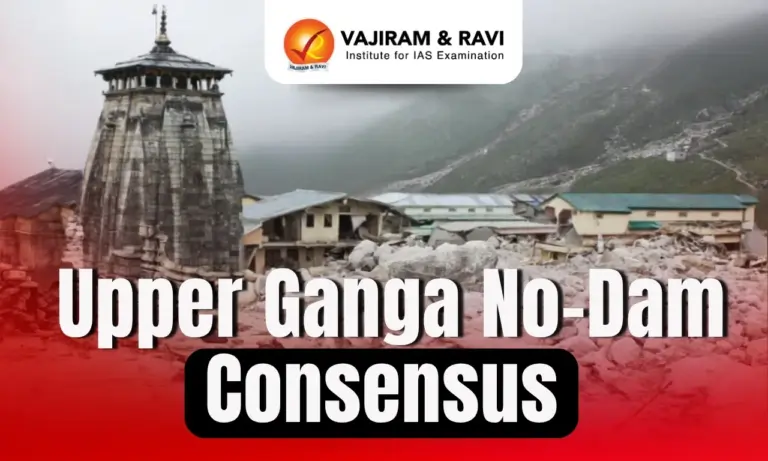
- The issue gained prominence after the 2013 Kedarnath disaster, following which the Supreme Court ordered a review of existing and proposed hydropower projects in Uttarakhand and halted fresh environmental and forest clearances.
- The government’s current unified position comes after more than a decade of internal disagreements, balancing Uttarakhand’s economic interests, the need to preserve ecological flow in the Ganga, and concerns over the fragile Himalayan ecosystem.
Committees, Reviews and Policy Deadlock
- Following the Supreme Court’s 2013 order, the Environment Ministry set up an expert panel led by Ravi Chopra to assess whether hydropower projects worsened the Kedarnath disaster and threatened biodiversity in the upper Ganga basin.
- The committee concluded that 23 of 24 proposed hydroelectric projects would harm biodiversity, a view supported by the Environment Ministry.
Institutional Disagreement
- The Central Electricity Authority (CEA) and Central Water Commission (CWC) opposed this conclusion, arguing that hydropower had a minimal ecological footprint and was not linked to the 2013 disaster.
- Meanwhile, project developers approached the Supreme Court seeking removal of the clearance freeze.
Second Expert Committee (EB-II)
- In 2015, the Supreme Court directed the formation of a second panel under B.P. Das to examine:
- Cumulative environmental impact
- Carrying capacity of the Ganga basin
- Glacial movement and seismic risks
- Socio-economic implications
Continued Policy Deadlock
- EB-II initially cleared the six disputed projects. However, internal differences emerged between the Environment Ministry, Jal Shakti Ministry, and Power Ministry, delaying a final decision.
- In its broader review of 70 hydropower projects, EB-II found:
- 19 already operational
- Recommended 28 of the remaining 51 projects
- However, the Jal Shakti Ministry opposed these recommendations in 2019, prolonging the deadlock.
- In 2021, the Centre adopted a compromise position, supporting only seven projects that were already substantially completed or had advanced financial investments.


Revisiting Hydropower Assessments in Upper Ganga
- In 2024, the Supreme Court directed a committee headed by Cabinet Secretary T.V. Somanathan to reconsider the recommendations of the EB-II, stating that if the Centre rejected them, it must provide clear reasons.
- After consulting the Uttarakhand government, central ministries, and civil society, the committee recommended only five hydropower projects:
- Bowala Nandprayag
- Devsari
- Bhyundar Ganga
- Jhalakoti
- Urgam-II
Key Concerns Considered
- Disaster Vulnerability – The committee flagged the threat from glacial lake outburst floods (GLOFs), citing the 2023 Sikkim disaster as evidence of severe downstream risks.
- Ecological Impact – Projects with significant ecological consequences were excluded from consideration.
Centre’s Final Position
- In January 2026, the Supreme Court gave the Centre three months for a final decision.
- The government ultimately argued against new hydropower projects, describing the Alaknanda and Bhagirathi basins as unique (‘sui generis’) due to their ecological, geological, and cultural significance.
Evidence of Fragility
- The Centre cited recent disasters such as:
- 2021 Rishi Ganga floods
- Joshimath flash floods
- Land subsidence in Joshimath
- It also highlighted the region’s rich ecological sensitivity, including:
- Nanda Devi National Park
- Valley of Flowers National Park
- Gangotri National Park
- Kedarnath Wildlife Sanctuary
- Bhagirathi Eco-Sensitive Zone
Conclusion
- The Centre’s evolving stance on hydropower projects in the upper Ganga reflects a broader shift from development-first thinking to ecological caution in fragile Himalayan regions.
- The long policy journey underscores the challenge of balancing energy needs, economic interests, and environmental sustainability.
- As climate risks intensify and disasters become more frequent, the upper Ganga may emerge as a defining test case for environmentally responsible infrastructure planning in India.
Source: IE

 Last updated on Oct, 2026
→ UPSC 2027 Notification will be released on 13 January 2027 at upsconline.nic.in.
→ Check Nobel Prize 2026 Winners List here.
→ Download PIB PRiSM Monthly Magazine 2026 here.
→ Check UPSC Monthly Current Affairs Magazine The Recitals here.
→ Check out the latest UPSC Syllabus here.
→ Download UPSC Model Answers for Mains 2026
→ UPSC Mains Question Paper 2026 is out now for Essay & GS Paper 1, 2, 3 & 4.
→ UPSC Calendar 2027 has been released.
→ Enroll in Vajiram & Ravi’s UPSC Mains Test Series 2027 for structured answer writing practice, expert evaluation, and exam-oriented feedback.
→ Join Vajiram & Ravi’s UPSC Mentorship Program 2027 for personalized guidance, strategy planning, and one-to-one support from experienced mentors.
→ Go through the UPSC Mains Previous Year Papers to enhance your preparation.
→ UPSC has released UPSC Toppers List 2025 with the Civil Services final result on its official website.
→ Also check Best UPSC Coaching in India
Upper Ganga No-Dam Consensus FAQs
Q1. Why has the Upper Ganga No-Dam Consensus emerged after years of debate?+
Q2. How did the Kedarnath disaster influence the Upper Ganga No-Dam Consensus?+
Q3. What environmental concerns shaped the Upper Ganga No-Dam Consensus?+
Q4. Why is the Upper Ganga No-Dam Consensus significant for India’s environmental policy?+
Q5. What does the Upper Ganga No-Dam Consensus mean for future hydropower planning?+
Tags: mains articles Upper Ganga No-Dam Consensus upsc current affairs upsc mains current affairs