Review of India’s Model Bilateral Investment Treaty (BIT)

Review of India’s Model Bilateral Investment Treaty (BIT)

Bilateral Investment Treaty (BIT) Latest News

  • The Union Finance Ministry is reviewing India's 2015 Model Bilateral Investment Treaty (BIT) to make it more investor-friendly while safeguarding India's sovereign interests.
  • The revised Model BIT is expected to be placed before the Union Cabinet soon. 
  • The review gains significance amid rising Overseas Direct Investment (ODI) by Indian firms, changing global investment patterns, and declining net Foreign Direct Investment (FDI) into India.

Why the Model BIT is Being Reviewed

  • The government is reassessing the 2015 Model BIT based on the -
    • Experience from past investment treaty negotiations.
    • Global best practices in investment protection.
    • Increasing outward investments by Indian companies.
    • Need to attract higher-quality FDI without compromising regulatory autonomy.
  • Unlike earlier years when India primarily sought to protect foreign investors, negotiations must now also safeguard Indian companies investing abroad.

A New Dimension - Protecting Indian Investors Overseas

  • According to the Economic Affairs Secretary, rising Overseas Direct Investment (ODI) has fundamentally changed India's negotiating priorities.
  • Key implications:
    • Indian companies are increasingly investing in foreign markets.
    • Future BITs must provide investment protection for Indian enterprises abroad.
    • Certain investor-protection clauses, earlier viewed cautiously, may now be retained to secure Indian investments overseas.
  • This marks India's transition from being primarily a capital-importing economy to one that is also a significant capital exporter.

What is a Bilateral Investment Treaty (BIT)?

  • A BIT is an agreement between two countries to - 
    • Promote and protect investments made by investors of each country.
    • Guarantee fair and equitable treatment.
    • Protect against unlawful expropriation.
    • Enable Investor-State Dispute Settlement (ISDS) through international arbitration when disputes arise.
  • BIT vs trade agreement:
    • Under BIT, an investor can directly sue the host government through arbitration. However, disputes under trade agreements are settled between governments (State-to-State).
    • BITs focuses on investment protection, while trade agreements focuses on trade in goods and services.
    • BITs involve greater legal exposure for sovereign governments, while trade agreements provide greater diplomatic flexibility.

Key Issues in the Existing 2015 Model BIT

  • One of the most debated provisions is the Local Remedies Clause, which requires foreign investors to exhaust domestic legal remedies for five years before approaching international arbitration.
  • Concerns:
    • Considered restrictive by several developed countries and foreign investors.
    • Has slowed India's ability to conclude new BITs.
    • Many countries have been reluctant to accept the existing Model BIT.
  • The government is now reviewing not only this provision but several other clauses and is considering a negative-list approach.
    • Under this, only critical sovereign concerns would remain non-negotiable while greater flexibility is offered elsewhere.

FDI and ODI Trends

  • Gross FDI: Increased from $82 billion (2020-21) to a record $95 billion (2025-26).
  • Net FDI: Declined sharply to nearly $44 billion (2020-21), and less than $1 billion (2024-25), while recovering to about $7 billion (2025-26).
  • ODI: Indian companies' overseas investments increased substantially. For example, from $11 billion (2020-21) to $28 billion (2024-25), and further to $34 billion (2025-26).
  • The fall in net FDI has also been driven by large-scale repatriation of foreign investments, exceeding $105 billion during 2024-25 and 2025-26.

Reasons Behind Declining Net FDI

  • According to Chief Economic Adviser V. Anantha Nageswaran,
    • Global supply-chain localisation has intensified.
    • Developed countries are promoting onshoring of manufacturing.
    • Indian firms increasingly invest abroad to establish a local presence rather than export alone.
    • Rising ODI reflects the growing competitiveness and global expansion of Indian businesses.
  • Government's stand on enforcement agencies:
    • Responding to concerns that agencies such as the Enforcement Directorate (ED) discourage investment, the government stated -
      • Gross FDI has continued to reach record levels.
      • Enforcement actions are becoming more transparent and procedure-driven.
      • Frivolous or excessive actions are being curtailed.
      • Investors primarily seek stable policies, predictable regulation and attractive returns, all of which India aims to provide.
    • The government also emphasised the need for greater investor outreach to address any remaining concerns.

Significance and Challenges for India

  • Significance of revision:
    • Helps modernise India's investment treaty framework.
    • Improves India's attractiveness as an investment destination.
    • Protects growing overseas investments by Indian companies.
    • Supports India's long-term Balance of Payments (BoP) stability.
    • Balances investor confidence with regulatory sovereignty.
    • Strengthens India's integration into global investment and production networks.
  • Challenges ahead:
    • Balancing investor protection with sovereign regulatory powers.
    • Making BITs acceptable to developed countries while safeguarding national interests.
    • Preventing excessive investor litigation under ISDS.
    • Reversing the decline in net FDI amid changing global investment patterns.
    • Ensuring policy certainty without compromising public-interest regulation.

Source: IE

Bilateral Investment Treaty (BIT) FAQs

Q1: Why is India reviewing its 2015 Model Bilateral Investment Treaty (BIT)?

Ans: To make it more investor-friendly while balancing regulatory sovereignty and protecting the growing overseas investments.

Q2: How has rising ODI changed India's approach to BIT negotiations?

Ans: India now seeks to secure investment protection not only for foreign investors in India but also for Indian companies investing abroad

Q3: Why has India's net FDI declined despite record gross FDI inflows?

Ans: Due to increased repatriation of foreign investments and a sharp rise in overseas investments by Indian firms.

Q4: Why is the five-year Local Remedies Clause in India's 2015 Model BIT considered contentious?

Ans: It requires foreign investors to exhaust domestic legal remedies before international arbitration.

Q5: What reforms can enhance the effectiveness of India's BIT framework?

Ans: Adopting globally aligned, balanced BIT provisions, ensuring faster dispute resolution, etc.

UPI Fee Debate: What Is Changing, Who Pays MDR and Will UPI Remain Free?

The UPI Fee Debate - What's Actually Changing

UPI Fee Debate Latest News

  • The Lok Sabha passed the Taxation and Other Laws (Amendment) Bill, 2026 recently, opening the door for banks and payment system providers to charge fees on UPI and RuPay debit card transactions. 
  • This sparked fears that merchants would pass the cost on to consumers. Responding to the controversy, the Finance Ministry "categorically" clarified that UPI will remain free for citizens, with only a nominal fee possibly applying to certain merchants.

About Merchant Discount Rate (MDR)

  • Merchant Discount Rate (MDR) is a fee merchants pay banks and payment processors for using their networks. 
  • It has four components:
    • Interchange fee — paid to the card-issuing bank
    • Processing charges — paid to payment gateways (RazorPay, PayU, CCAvenue, etc.)
    • Network fee — paid to payment networks (Visa, Mastercard, NPCI)
    • Tax — GST paid to the government
  • Since 2020, the government has mandated zero MDR on UPI and RuPay debit card transactions. 
  • Other payment modes, however, do attract MDR: 
    • 0.4-0.9% on non-RuPay debit cards, 
    • 1.5-2.2% on domestic credit cards, 
    • 1-1.5% on netbanking, and 
    • 3-4.5% on international credit cards.

Who Pays for UPI Today?

  • Currently:
    • Banks and payment processors absorb part of the cost.
    • Taxpayers bear the rest through government subsidy.
  • Under the 'Incentive Scheme for Promotion of Low-Value BHIM-UPI Transactions (P2M)', launched in December 2021, the government subsidises UPI transactions below ₹2,000. 
  • This subsidy is capped at 0.15% of transaction value and shared among banks, payment service providers, and third-party apps. 
  • The government paid ₹1,389 crore in 2021-22, rising to ₹3,631 crore by 2023-24, but this has since fallen, with only ₹2,000 crore budgeted for 2026-27. 
  • Notably, from 2021-22 to 2024-25, the total subsidy of ₹8,730 crore covered just 11% of the actual cost incurred by the payments industry, as per the Standing Committee on Finance.

What the New Bill Changes

  • The Payment and Settlement Systems Act, 2007 currently bars banks from charging for payments made via modes listed under Section 269SU of the Income Tax Act, 1961 — which includes RuPay debit cards, UPI, and BHIM-UPI (including QR code payments).
  • The 2026 Amendment Bill modifies this provision, empowering the government to notify which transactions can attract an MDR charge in future.
  • Section 269SU — the provision being amended — currently applies to businesses with an annual turnover above ₹50 crore. 
  • However, this is not the threshold likely to be used for the new MDR charge. Government sources indicate the actual MDR would apply to a much smaller category of merchants — those with turnover above roughly ₹1-1.5 crore — and only on individual transactions above ₹2,000. 
    • In other words, the fee is expected to target a narrower, lower-turnover set of merchants than what Section 269SU currently covers, not a wider one.
  • A possible MDR of 0.25-0.4% (industry sources) or "nominal, far lower than card MDRs" (Finance Ministry) is being discussed — this would exclude roughly 95% of current UPI transactions.
  • Notably, though only 4% of person-to-merchant (P2M) UPI transactions in 2025-26 exceeded ₹2,000 in value, these accounted for around two-thirds of total UPI payment value — meaning the fee, if applied, would target high-value transactions disproportionately.

Government's Reassurance

  • The Finance Ministry stated:
    • All person-to-person UPI transactions will remain free, with no charges on ordinary consumers.
    • Small merchants (kirana stores) will not face MDR.
    • Any MDR, if introduced, will be threshold-based, not blanket, and far lower than debit/credit card MDR rates.
    • The Payments Council of India (PCI) also clarified that consumers won't pay extra even for UPI transactions to large merchants.
  • Experts note that while the Bill technically gives the government power to levy MDR on any UPI transaction, it is unlikely to impose broad charges. 
  • Digital and financial inclusion remain central to government policy, and UPI's biggest appeal has been that it is free — making a broad rollback risky, as it could push users back toward cash.

Why the Government Wants a Change

  • UPI has grown explosively — from its 2016 launch to over 24,000 crore transactions worth ₹314 lakh crore in 2025-26 (up 30% and 21% respectively from the previous year), making it the world's largest real-time payment system. 
  • The Finance Ministry argues that subsidies alone cannot sustain the next phase of growth, especially expansion into rural and semi-urban areas, and that a "balanced framework" is needed to keep UPI "robust, inclusive, and future-ready."

Conclusion

  • While the Amendment Bill legally enables UPI charges, the government's assurances and India's digital inclusion priorities suggest ordinary users and small merchants will stay protected. 
  • The real question going forward is how a "self-sustainable" UPI can be built without undermining the very affordability that made it a global success story.

Source: IE | TH

UPI Fee Debate FAQs

Q1: What is the UPI Fee Debate about?

Ans: The UPI Fee Debate centres on whether Merchant Discount Rate charges should be introduced for selected transactions while keeping ordinary UPI payments free.

Q2: Who could pay fees under the proposed UPI changes?

Ans: The UPI Fee Debate indicates that certain larger merchants may pay MDR on transactions above ₹2,000, while consumers and small merchants remain protected.

Q3: Will consumers have to pay for UPI transactions?

Ans: According to the UPI Fee Debate, person-to-person transactions will remain free, while the government says consumers will not face additional charges.

Q4: Why does the government want to change the UPI fee framework?

Ans: The UPI Fee Debate reflects concerns that rising transaction volumes and infrastructure costs make the existing subsidy-based model difficult to sustain.

Q5: How much of UPI transactions could potentially attract MDR?

Ans: The UPI Fee Debate suggests roughly 95% of current UPI transactions could remain outside MDR, with charges potentially targeting higher-value merchant transactions.

DPDP Act and RTI: Supreme Court Examines Impact on Transparency and Journalism

Supreme Court to Examine Impact of DPDP Act on RTI and Investigative Journalism

DPDP Act and RTI Latest News

  • The Supreme Court has agreed to examine whether the Digital Personal Data Protection (DPDP) Act, 2023 can be used to weaken the Right to Information (RTI) Act, 2005, by classifying all data as "personal," and whether it separately curtails investigative journalism. 
  • The Court is hearing multiple petitions challenging DPDP Act provisions, primarily Section 44(3).

The Core Legal Question

  • The Court noted that both the DPDP Act and the RTI Act are central legislations, and there is a need to harmonise them. 
  • It observed that while the RTI Act granted access to information with certain conditions, the DPDP Act imposes an "en bloc embargo" — a blanket restriction. 
  • The Court will examine whether this later law is repugnant to the earlier RTI law, treating the matter with "extreme circumspection" since both are central statutes.

Different Scope of the Two Laws

  • The apex court pointed out that the RTI Act operates in a much larger domain, covering all forms of data — physical and digital. 
  • The DPDP Act, by contrast, is concerned only with data in digital form
  • The Court acknowledged that most data today is overwhelmingly digital, but this distinction remains legally significant. 
  • The Court will examine whether the DPDP Act's restrictive "cautionary approach" to sharing data effectively repeals earlier transparency legislation like the RTI Act.

Section 44(3) of the DPDP Act: What It Changes in the RTI Act

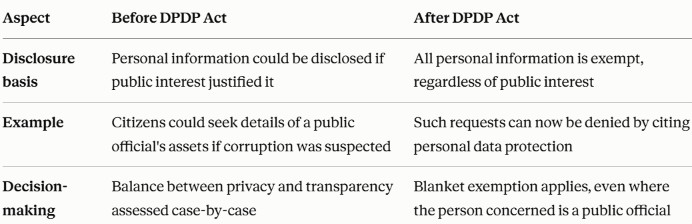
  • Section 44(3) of the DPDP Act directly amended Section 8(1)(j) of the RTI Act 2005 - — expanding the scope for denying information on grounds of protecting personal data.
  • Original RTI provision: Authorities could deny personal information only if it had no relation to public activity or if disclosure amounted to unwarranted invasion of privacy — but even then, information had to be disclosed if public interest outweighed privacy. 
    • This balancing was done by a Public Information Officer or First Appellate Authority, weighing both privacy and transparency.
  • After the amendment: The "larger public interest" clause has been removed. All personal information is now broadly exempt from RTI disclosure, regardless of whether disclosure would serve the public interest.

How This Affects RTI Requests

  • Experts contend that this inverts the right to privacy — a right meant to protect citizens from State overreach — into a shield that instead protects the State and public functionaries from RTI disclosures.

How This Affects RTI Requests

  • By removing the public-interest override, the amendment shifts the RTI framework from a case-by-case balancing test to a blanket, one-size-fits-all exemption
  • This means information that was previously accessible — such as details relevant to exposing corruption or misconduct by public officials — can now be denied simply by labelling it "personal data," without any assessment of whether disclosure would actually serve the public good.

Impact on Investigative Journalism

  • As per the experts, the DPDP Act poses a grave threat to investigative journalism:
    • The Act grants no exemption to journalists.
    • Journalists reporting on individuals would need to seek the consent of the "data principal" (the person the data belongs to).
    • If the data principal demands erasure of data, they can do so — directly undermining investigative reporting that relies on retaining and using such information.

No Special Category for Journalists

  • The Court clarified that journalists cannot be treated as a "special category" with unrestricted access to data. 
  • It noted that neither the landmark Subhash Chandra Agarwal case (on public transparency) nor the Indian Express Bombay Pvt Ltd case (on press freedom), nor the RTI Act itself, had ever granted journalists such special status. 
  • Even so, the Court agreed to examine the broader impact of the DPDP Act on journalistic activity.

Conclusion

  • This case sets up a crucial test of how India balances two constitutional values — the right to privacy and the right to information. 
  • The Court's eventual ruling will determine whether data protection safeguards meant for citizens can be used by the State to shield itself from public scrutiny and accountability.

Source: TH

DPDP Act and RTI FAQs

Q1: What is the Supreme Court examining about the DPDP Act and RTI?

Ans: The Supreme Court is examining whether the DPDP Act and RTI can be harmonised or whether data protection provisions weaken existing transparency rights.

Q2: How does the DPDP Act affect RTI disclosures?

Ans: The DPDP Act and RTI conflict centres on Section 44(3), which removes the larger public-interest override for disclosure of personal information.

Q3: What changed in the RTI Act after the DPDP Act amendment?

Ans: The DPDP Act and RTI amendment broadly exempts personal information from disclosure, replacing the earlier case-by-case balance between privacy and larger public interest.

Q4: How could the DPDP Act affect investigative journalism?

Ans: The DPDP Act and RTI debate includes concerns that journalists may need consent to use personal data, while erasure rights could undermine investigations.

Q5: Why is the DPDP Act and RTI case significant?

Ans: The DPDP Act and RTI case will test how India balances privacy, transparency, public accountability, and investigative journalism within its legal framework.

Jantar Mantar – Astronomical Heritage and the Debate Over Its Role as Delhi’s Protest Site

Jantar Mantar - Astronomical Heritage and the Debate Over Its Role as Delhi's Protest Site

Jantar Mantar Latest News

  • The Delhi High Court has questioned the continued use of Jantar Mantar Road as Delhi's designated protest venue, reviving the debate over balancing the right to protest with public order.

Jantar Mantar: An Architectural and Scientific Heritage

  • Jantar Mantar is an 18th century astronomical observatory built by Maharaja Sawai Jai Singh II of Jaipur, one of medieval India's foremost astronomers and patrons of science. 
  • It reflects India's rich tradition of astronomy, mathematics, and scientific observation.
  • Historical Background
    • Maharaja Sawai Jai Singh II constructed five astronomical observatories between 1724 and 1735 at Delhi, Jaipur , Ujjain, Varanasi and Mathura (now demolished).
    • The observatory at Delhi was the first Jantar Mantar to be built and later served as the model for the larger observatory at Jaipur.
  • The term "Jantar Mantar" is believed to be derived from the Sanskrit words:
    • Yantra: Instrument 
    • Mantra: Formula or calculation 
  • Together, the name refers to instruments used for astronomical observations and calculations.

Architectural Features

  • Unlike modern observatories that rely on optical instruments, Jantar Mantar consists of large masonry structures designed for naked-eye astronomical observations.
  • These instruments were constructed with remarkable geometric precision to measure celestial movements and improve the accuracy of astronomical calculations.
  • Some important instruments include:
    • Samrat Yantra: A giant sundial used to measure time and the Sun's declination 
    • Jai Prakash Yantra: Used to determine the position of celestial bodies 
    • Ram Yantra: Measures the altitude and azimuth of celestial objects 
    • Misra Yantra: Used to determine the shortest and longest days of the year and compare local time with other locations 

Cultural and Scientific Significance

  • Jantar Mantar represents the fusion of:
    • Indian astronomical traditions 
    • European scientific developments available during the 18th century 
  • The observatories demonstrate India's advanced understanding of astronomy before the widespread use of telescopes in the subcontinent.
  • Among the five observatories, the Jantar Mantar at Jaipur has been designated a UNESCO World Heritage Site (2010) due to its outstanding scientific and architectural significance.
  • The Delhi Jantar Mantar is protected by the Archaeological Survey of India (ASI) as a monument of national importance.

News Summary

  • On 7th August, while hearing a petition seeking permission for a protest at Jantar Mantar, the Delhi High Court expressed concern over the continued use of the site for demonstrations. 
  • The Court observed that Delhi should not be "put to ransom unnecessarily" through repeated protests.
  • The hearing followed a recent Supreme Court direction asking the Centre to consider a plea seeking the removal of Jantar Mantar as Delhi's designated protest site and to instead make Ramlila Maidan the principal venue for demonstrations.
  • It is important to note that protests are not held inside the historic Jantar Mantar monument. 
  • The designated protest site is located on the road opposite the monument, at the intersection of Jantar Mantar Road and Sansad Marg, allowing demonstrators to remain close to Parliament while staying outside the high-security zone.

Evolution of Jantar Mantar as Delhi's Protest Site

  • During the first few decades after Independence, Boat Club lawns (now along Kartavya Path) served as Delhi's principal venue for political rallies.
  • A turning point came in 1988, when a massive farmers' rally led by Mahendra Singh Tikait attracted lakhs of protesters. Along with heightened security concerns during the Ram Janmabhoomi-Babri Masjid movement, this prompted the Delhi administration to discontinue large demonstrations at the Boat Club.
  • By 1993, Delhi Police had begun directing protests towards Jantar Mantar, primarily to improve traffic management and crowd control.
  • Initially, there was no statutory notification declaring Jantar Mantar the official protest site. Instead, it gradually acquired this status through administrative practice before being formally recognised through Delhi Police Standing Orders.

Regulatory Framework for Protests

  • The protest site was formally regulated through Delhi Police Standing Order 309 (2003).
  • The order prescribed different venues based on the expected size of the gathering:
    • Up to 5,000 participants: Jantar Mantar 
    • 5,000 to 50,000 participants: Ramlila Maidan 
    • Above 50,000 participants: Burari Grounds 
    • Larger gatherings: Narela 
  • Following the National Green Tribunal (NGT) order in 2017 and the Supreme Court judgment in 2018, Delhi Police issued Standing Order 10 (2018).
  • Under the revised framework:
    • Jantar Mantar can accommodate protests of up to 1,000 people.
    • Larger demonstrations are permitted only at Ramlila Maidan. 
    • Organisers must comply with conditions relating to crowd size, duration, loudspeakers, and security arrangements. 

Why Has the Site Become Contentious?

  • Jantar Mantar has become synonymous with several major public movements, including:
    • Anna Hazare's anti-corruption movement 
    • Nirbhaya protests 
    • One Rank One Pension (OROP) protests 
    • Demonstrations by farmers, students, women, persons with disabilities, and civil society organisations 
  • However, its central location has also generated concerns regarding Traffic congestion, Noise pollution, Security near key government institutions and Inconvenience to nearby residents.
  • In 2017, the National Green Tribunal (NGT) directed that protests be stopped at Jantar Mantar, citing three reasons:
    • No executive order formally declaring it a protest site. 
    • The area is being designated as residential under the Delhi Master Plan. 
    • Noise pollution caused by prolonged demonstrations. 
  • The order was criticised by activists, who argued that it curtailed the constitutional right to peaceful protest.
  • In 2018, the Supreme Court held that protests could not be completely prohibited at either Jantar Mantar or Boat Club. 
  • Instead, it directed authorities to frame guidelines that balance the right to peaceful protest with the rights of local residents and the need to maintain public order.
  • Today, Jantar Mantar remains Delhi's primary protest venue, while Ramlila Maidan continues to serve as the preferred location for larger demonstrations. 
  • Unlike Jantar Mantar, however, Ramlila Maidan is a paid venue, with charges of approximately Rs. 50,000 per day.

Source: TH

Jantar Mantar FAQs

Q1: Who built the Jantar Mantar in Delhi?

Ans: It was built by Maharaja Sawai Jai Singh II in the 18th century.

Q2: Is the protest site located inside the Jantar Mantar monument?

Ans: No. The designated protest site is located on the road opposite the monument, at the intersection of Jantar Mantar Road and Sansad Marg.

Q3: Which court held that protests cannot be completely banned at Jantar Mantar?

Ans: The Supreme Court, in 2018, held that public protests cannot be completely prohibited and directed authorities to frame appropriate guidelines.

Q4: Which organisation protects the Delhi Jantar Mantar monument?

Ans: The Archaeological Survey of India (ASI) protects it as a monument of national importance.

Q5: Which Jantar Mantar has been designated a UNESCO World Heritage Site?

Ans: The Jantar Mantar at Jaipur was inscribed as a UNESCO World Heritage Site in 2010.

Enquire Now