


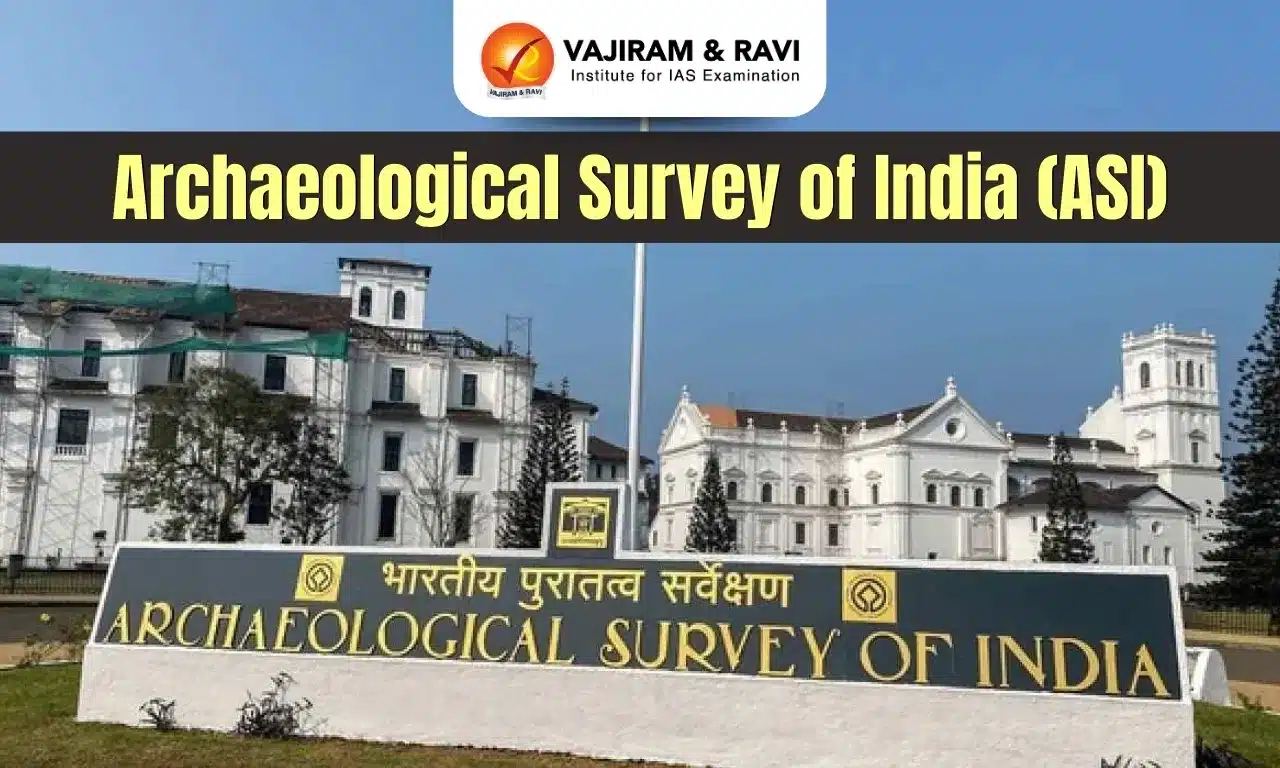
Archaeological Survey of India (ASI) is the premier organisation responsible for archaeological research and the conservation of ancient monuments and archaeological sites of national importance in India. It functions under the Ministry of Culture, Government of India.
Archaeological Survey of India (ASI)
Established in 1861 under Sir Alexander Cunningham, the Archaeological Survey of India works to protect India’s historical heritage, including ancient temples, forts, tombs, sculptures and archaeological remains. It conducts scientific excavations, studies inscriptions, maintains protected monuments and helps preserve evidence of India’s past.
The headquarters of the Archaeological Survey of India is in New Delhi. Its work is governed by important laws, including the Ancient Monuments and Archaeological Sites and Remains Act, 1958, and the Antiquities and Art Treasures Act, 1972.
Archaeological Survey of India (ASI) History
Archaeological Survey of India (ASI) was established in 1861 under Sir Alexander Cunningham to study and preserve India’s ancient monuments and archaeological remains. Over time, it developed into the country’s main organisation for archaeological research and the protection of historical monuments.
- Early Archaeological Studies (1784): The Asiatic Society was established in Calcutta by Sir William Jones. It encouraged the study of India’s history, ancient buildings, inscriptions and cultural heritage.
- Establishment in 1861: Sir Alexander Cunningham established the Archaeological Survey and became its first Archaeological Surveyor. He studied ancient sites, inscriptions and historical remains.
- Temporary Closure (1866): The Archaeological Survey’s work was temporarily stopped due to administrative and financial difficulties.
- Revival in 1871: The Archaeological Survey was revived as a separate government department, with Alexander Cunningham as its first Director-General. Its work expanded to cover more historical sites across India.
- Development under John Marshall (1902-1928): Sir John Marshall strengthened archaeological research and conservation. During this period, excavations at Harappa and Mohenjo-daro helped reveal the importance of the Indus Valley Civilisation.
- Scientific Excavations (1944-1948): Sir Mortimer Wheeler introduced more systematic excavation methods and improved archaeological training and research practices.
- After Independence (1947 onwards): The ASI expanded its work to protect historical monuments, conduct excavations and preserve India’s archaeological heritage.
- Present Role: Today, the ASI functions under the Ministry of Culture, Government of India. It protects centrally protected monuments, conducts archaeological research, studies ancient inscriptions and manages site museums across the country.


Archaeological Survey of India (ASI) Functions
Archaeological Survey of India (ASI) is responsible for studying, protecting and preserving India’s archaeological and historical heritage. Its major functions include:
- Conservation of Monuments: Protects and maintains ancient temples, forts, tombs, palaces and other historical structures.
- Archaeological Excavations: Conducts scientific excavations to discover ancient settlements, artefacts and remains of past civilisations.
- Historical Research: Studies archaeological evidence to understand India’s history, culture and ancient civilisations.
- Protection of Archaeological Sites: Maintains centrally protected archaeological sites and monuments of national importance.
- Study of Inscriptions: Examines ancient inscriptions on stones, pillars, copper plates and temple walls to understand historical events, rulers and languages.
- Protection of Antiquities: Supports the identification, documentation and preservation of historical objects such as coins, sculptures, paintings and pottery.
- Maintenance of Site Museums: Manages museums at selected archaeological sites to preserve and display artefacts discovered during excavations.
- Scientific Conservation: Uses scientific methods to repair damaged monuments and protect historical structures from pollution, weather and ageing.
- Documentation of Heritage: Records archaeological discoveries, historical buildings and ancient remains for research and future reference.
- Regulation of Activities Near Protected Monuments: Implements relevant legal provisions concerning construction and other activities around centrally protected monuments.
- Public Awareness: Encourages people to understand the importance of historical monuments and participate in heritage protection.
- Promotion of Cultural Tourism: Helps preserve historical sites that attract visitors, researchers and students from India and abroad.
Important Laws Related to the Archaeological Survey of India
Archaeological Survey of India (ASI) works under important laws that help protect India’s historical monuments, archaeological sites and antiquities. These laws regulate conservation activities and help prevent the illegal trade and export of historical objects.
- Ancient Monuments and Archaeological Sites and Remains Act, 1958: Provides for the preservation of ancient monuments and archaeological sites declared to be of national importance. It also regulates certain activities around protected monuments.
- Ancient Monuments and Archaeological Sites and Remains (Amendment and Validation) Act, 2010: Introduced changes to the 1958 Act, including provisions for regulating construction and development around protected monuments through prohibited and regulated areas.
- Antiquities and Art Treasures Act, 1972: Regulates the trade in antiquities and art treasures and restricts their export from India, helping prevent the illegal movement of historically important objects.
- Indian Treasure Trove Act, 1878: Deals with the discovery and reporting of certain valuable objects found buried in the ground, subject to the Act’s provisions. It is relevant to the legal handling of some historical finds.
Importance of the Archaeological Survey of India
The ASI plays an important role in preserving India’s history and making archaeological knowledge available to researchers and the public.
- Heritage conservation: Protects monuments and archaeological sites of national importance.
- Historical research: Provides evidence for understanding ancient civilisations and historical developments.
- Cultural identity: Preserves structures and artefacts associated with India’s diverse history.
- Education: Helps students, researchers and historians study the country’s past.
- Tourism: Well-maintained monuments attract visitors and support local economic activities.
- Scientific research: Encourages archaeological investigation and the documentation of historical remains.
- International heritage: Supports the preservation of India’s cultural legacy and its recognition worldwide.

 Last updated on Oct, 2026
→ UPSC 2027 Notification will be released on 13 January 2027 at upsconline.nic.in.
→ Check Nobel Prize 2026 Winners List here.
→ Download PIB PRiSM Monthly Magazine 2026 here.
→ Check UPSC Monthly Current Affairs Magazine The Recitals here.
→ Check out the latest UPSC Syllabus here.
→ Download UPSC Model Answers for Mains 2026
→ UPSC Mains Question Paper 2026 is out now for Essay & GS Paper 1, 2, 3 & 4.
→ UPSC Calendar 2027 has been released.
→ Enroll in Vajiram & Ravi’s UPSC Mains Test Series 2027 for structured answer writing practice, expert evaluation, and exam-oriented feedback.
→ Join Vajiram & Ravi’s UPSC Mentorship Program 2027 for personalized guidance, strategy planning, and one-to-one support from experienced mentors.
→ Go through the UPSC Mains Previous Year Papers to enhance your preparation.
→ UPSC has released UPSC Toppers List 2025 with the Civil Services final result on its official website.
→ Also check Best UPSC Coaching in India
Archaeological Survey of India FAQs
Q1. What is the Archaeological Survey of India (ASI)?+
Q2. When was the Archaeological Survey of India established?+
Q3. Where is the headquarters of the ASI?+
Q4. Under which ministry does the ASI function?+
Q5. What are the main functions of the ASI?+
Q6. Which laws are important for the Archaeological Survey of India?+
Tags: archaeological survey of india upsc current affairs