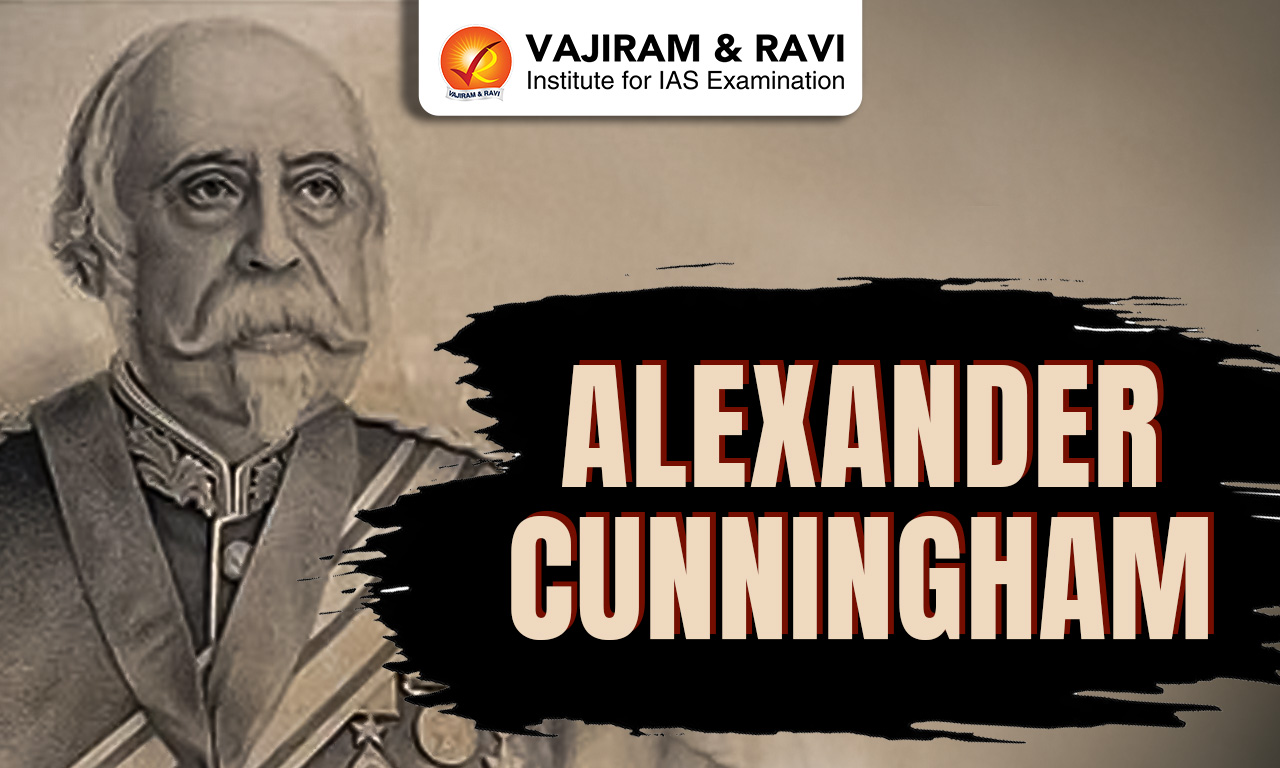
Alexander Cunningham was a British officer and archaeologist who is known as the “Father of Indian Archaeology.” He played an important role in discovering and studying many ancient historical sites in India. He was the first Director-General of the Archaeological Survey of India and helped preserve India’s rich cultural heritage. His work greatly improved our understanding of India’s ancient history.
About Alexander Cunningham
- Alexander Cunningham was a British army officer and archaeologist who is known as the “Father of Indian Archaeology.” He played a major role in studying and preserving India’s ancient past.
- He was born on 23 January 1814 in London and joined the Bengal Engineers at a young age. He spent many years working in India and later retired as a Major General in 1861.
- His interest in Indian history began after meeting James Prinsep, who inspired him to study ancient coins, inscriptions, and historical sites.
- Cunningham carried out important excavations at places like Sarnath and Sanchi, which are major Buddhist sites. He carefully studied sculptures, monuments, and temple structures.
- He also explored regions like Kashmir and Ladakh and wrote books such as The Bhilsa Topes (1854), which helped trace Buddhist history through monuments.
- In 1861, he became the first Director-General of the Archaeological Survey of India. Although the department was closed for some time, he returned when it was restarted in 1870 and continued his work for many years.
- During his career, he travelled widely across northern India, studying ancient ruins, inscriptions, and historical geography. His book The Ancient Geography of India (1871) was one of his most important works.
- He also studied the edicts of Ashoka and wrote about important sites like Bharhut.
- Cunningham collected a large number of ancient Indian coins, many of which were later kept in the British Museum. After retiring in 1885, he focused mainly on studying coins (numismatics).
- He helped identify many ancient sites mentioned by Chinese travellers like Xuanzang. He also played a role in bringing attention to places like Harappa, which later became very important archaeological sites.
- For his contributions, he was honoured with a knighthood in 1887. He passed away on 28 November 1893 in London.
- Overall, Cunningham’s work laid the foundation for systematic archaeological research in India, and his reports and studies are still important for understanding India’s ancient history.
About Archaeological Survey of India (ASI)
- The Archaeological Survey of India is the main government organization responsible for studying, protecting, and preserving India’s historical monuments and cultural heritage, helping us understand the country’s ancient past in a better way.
- It was established in 1861 by Alexander Cunningham during the time of Lord Canning, and later reorganised as a separate department in 1871, where Cunningham became its first Director-General.
- The headquarters of ASI is located in New Delhi, and it works under the Ministry of Culture, which oversees cultural and heritage-related activities in the country.
- The logo of ASI is inspired by the Sanchi Stupa, symbolizing India’s rich architectural and archaeological heritage.
- One of its main goals is to protect and conserve ancient monuments and sites of national importance, while also exploring and documenting important historical locations on land as well as underwater.
- ASI carries out scientific surveys and excavations to discover and study ancient remains, which help historians and researchers learn more about India’s history and culture.
- It is responsible for maintaining and preserving more than 3,600 protected monuments under the Ancient Monuments and Archaeological Sites and Remains Act, 1958, ensuring their safety for future generations.
- The organisation also focuses on research and regularly publishes reports, books, and journals such as Indian Archaeology – A Review, which provide detailed information about archaeological findings.
- Through its Underwater Archaeology Wing, ASI also studies submerged sites in seas, rivers, and other water bodies, expanding knowledge about hidden historical remains.
- ASI works in collaboration with various state departments, the Indian Navy, IITs, and international organizations to improve research, technology, and conservation methods.


 Last updated on Oct, 2026
→ UPSC 2027 Notification will be released on 13 January 2027 at upsconline.nic.in.
→ Check Nobel Prize 2026 Winners List here.
→ Download PIB PRiSM Monthly Magazine 2026 here.
→ Check UPSC Monthly Current Affairs Magazine The Recitals here.
→ Check out the latest UPSC Syllabus here.
→ Download UPSC Model Answers for Mains 2026
→ UPSC Mains Question Paper 2026 is out now for Essay & GS Paper 1, 2, 3 & 4.
→ UPSC Calendar 2027 has been released.
→ Enroll in Vajiram & Ravi’s UPSC Mains Test Series 2027 for structured answer writing practice, expert evaluation, and exam-oriented feedback.
→ Join Vajiram & Ravi’s UPSC Mentorship Program 2027 for personalized guidance, strategy planning, and one-to-one support from experienced mentors.
→ Go through the UPSC Mains Previous Year Papers to enhance your preparation.
→ UPSC has released UPSC Toppers List 2025 with the Civil Services final result on its official website.
→ Also check Best UPSC Coaching in India
Alexander Cunningham FAQs
Q1. Who was Alexander Cunningham?+
Q2. What is Alexander Cunningham famous for?+
Q3. What is the Archaeological Survey of India (ASI)?+
Q4. When was ASI established and by whom?+
Q5. What are the main functions of ASI?+
Tags: alexander cunningham history history notes