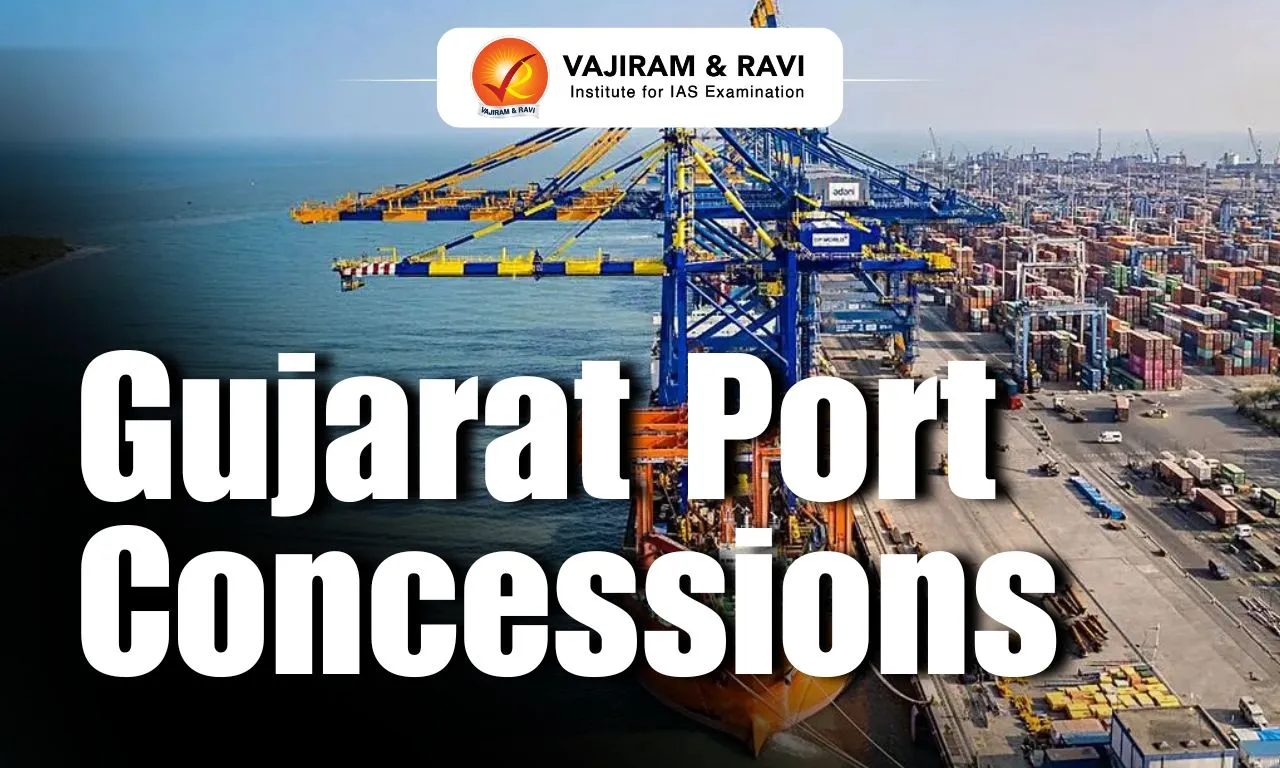
Gujarat Port Concessions Latest News
- Gujarat's first generation of privately developed ports — Pipavav and Mundra — are approaching the end of their original 30-year concession periods.
- Despite the approaching deadlines, the state government has not yet announced a formal policy framework for extending operating rights, putting Gujarat's next phase of port policy under scrutiny.
BOOT Model
- BOOT (Build-Own-Operate-Transfer) is a public-private partnership (PPP) mode used for developing infrastructure projects. Under this model:
- A private developer builds the infrastructure (like a port, highway, or power plant) using its own capital.
- The developer owns and operates the asset for a fixed concession period (typically 20-30 years), earning revenue through user charges, tariffs, or tolls.
- At the end of the concession period, ownership of the asset transfers back to the government, usually free of cost or at a nominal value.
- It is a variant of the broader BOT (Build-Operate-Transfer) family of models, distinguished by the explicit "ownership" phase held by the private developer during the concession period.
How It Works: The Logic
- The government lacks the capital or technical capacity to build large infrastructure alone.
- Under BOOT, it invites private players to fund, construct, and run the project, allowing them to recover costs and earn profit over the concession period.
- Since the asset eventually reverts to the state, public ownership of strategic infrastructure is preserved in the long run.
Background: Gujarat's Port Privatisation Model
- In the late 1990s, Gujarat opened its coastline to private investors under a 1997 Build-Own-Operate-Transfer (BOOT) framework.
- Private developers were given rights to build and operate ports for an initial concession period of 30 years, after which assets would revert to the government unless agreements were extended.
- This model helped Gujarat emerge as India's largest maritime State, attracting billions of dollars in investment and handling a substantial share of the country's cargo traffic.
The Two Ports in Focus
- Pipavav Port: Operated by APM Terminals Pipavav (part of Netherlands-based APM Terminals group). Its 30-year BOOT concession, signed in 1998, is scheduled to end on September 29, 2028 — making it the first of Gujarat's original private ports to reach the end of its term.
- Mundra Port: Operated by Adani Ports and Special Economic Zone (APSEZ). Its concession expires on February 16, 2031.
Why the Delay Matters: An Investment Concern
- The lack of clarity is increasingly seen as an investment issue, not just a contractual one.
- Port infrastructure requires continuous investment in dredging, mechanisation, deeper berths, rail connectivity, and cargo-handling facilities.
- Without certainty on post-concession operations, developers may hesitate to commit fresh capital with long payback periods.
- This concern has already surfaced publicly:
- In October 2025, APM Terminals Pipavav signed a non-binding ₹17,000-crore investment memorandum with the Gujarat government, but indicated major investments would follow only after concession clarity.
- APSEZ's Whole-time Director and CEO said the company expects the Pipavav decision to precede Mundra's, given Pipavav's earlier 2028 deadline, and that discussions are underway.
How Other States Compare
- Newer port projects across India have adopted longer concession horizons than Gujarat's original 30-year model:
- Andhra Pradesh (Gangavaram, Krishnapatnam) - 30 years + 20-year extension = up to 50 years
- Kerala (Vizhinjam) - 40 years + 20-year extension = up to 60 years
- Odisha (Dhamra) - 34-year initial period (including construction), extendable
- Notably, both Gangavaram and Krishnapatnam are now part of APSEZ's own portfolio, following Adani Group's acquisition of controlling stakes.
A Signal from Gujarat's New Shipbuilding Policy
- Gujarat's newly unveiled shipbuilding policy offers the clearest hint yet of the state's direction.
- Developers setting up new shipyards can now secure waterfront concessions of up to 50 years, replacing the earlier 30-year tenure.
- Industry executives interpret this as recognition that large maritime infrastructure needs long-term policy certainty to justify multi-billion-rupee investments.
- This longer-concession approach is also shaping Gujarat's upcoming greenfield port projects.
- For six new ports planned along the coastline — Nana Layja (Kutch), Vadhera (Amreli), Vadodra Jhala (Gir Somnath), Damka (Surat), Lakhanka (Bhavnagar), and Bhogat (Devbhumi Dwarka) — the GMB has indicated concession periods could range between 30 and 50 years, with the final tenure decided during bidding.
- These will also follow the BOOT model.
Conclusion
- As Gujarat's pioneering port concessions approach expiry, its policy response will test whether the state can match the longer-term certainty now offered by rivals like Andhra Pradesh and Kerala.
- The outcome will shape not just coastal investment in Gujarat, but the broader template for India's maritime infrastructure growth.
Source: TH
Gujarat Port Concessions FAQs
Q1: What are Gujarat Port Concessions and why are they important?
Ans: Gujarat Port Concessions determine private operators' rights to develop and operate ports, making policy certainty crucial for long-term maritime infrastructure investment.
Q2: Which ports are central to the Gujarat Port Concessions debate?
Ans: The Gujarat Port Concessions debate centres on Pipavav, whose concession ends in 2028, and Mundra, whose concession expires in 2031.
Q3: What is the BOOT model behind Gujarat Port Concessions?
Ans: Gujarat Port Concessions use the BOOT model, where private developers build, own, and operate infrastructure before transferring ownership to government.
Q4: Why does uncertainty over Gujarat Port Concessions concern investors?
Ans: Uncertainty over Gujarat Port Concessions can discourage fresh investment because port infrastructure requires large capital commitments with long payback periods.
Q5: What does Gujarat's new shipbuilding policy indicate about Port Concessions?
Ans: Gujarat's new policy suggests longer Gujarat Port Concessions, allowing shipyards up to 50-year waterfront terms and signalling greater emphasis on long-term investment certainty.