
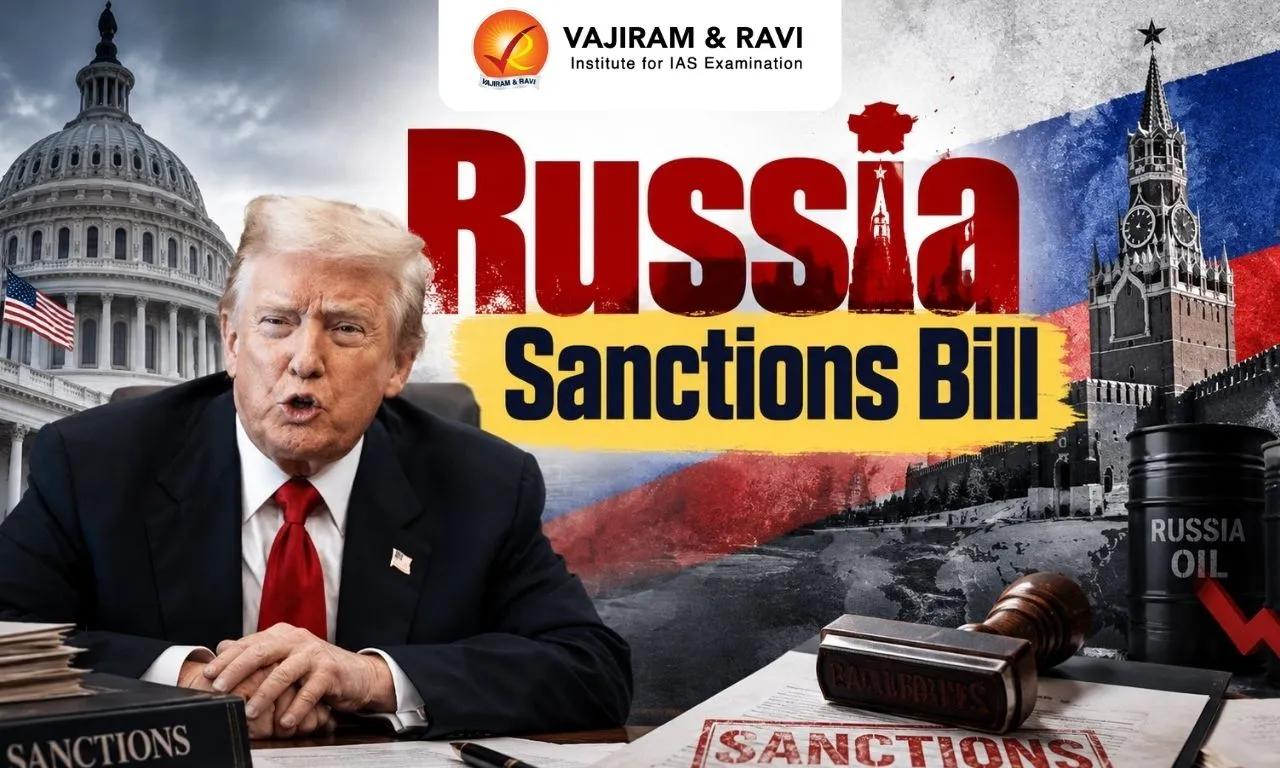
US Russia Sanctions Bill – Impact on India’s Oil Imports and Trade

Russia Sanctions Bill

Russia Sanctions Bill Latest News

  • The US House of Representatives has passed the Lindsey O. Graham Sanctioning Russia and Iran Act of 2026, a Bill that could allow the US President to impose tariffs of up to 100% on countries purchasing Russian oil and natural gas.
  • The legislation is particularly significant for India because Russia currently accounts for nearly half of India's crude oil imports.

Background: India’s Dependence on Imported Crude Oil

  • India is heavily dependent on imports to meet its energy requirements. According to the attached report, the country imports more than 88% of its crude oil needs.
  • Russia's position as India's major crude supplier emerged after the February 2022 Russia-Ukraine conflict. As several Western countries reduced purchases of Russian crude, Russia offered discounted oil to willing buyers, including Indian refiners.
  • This resulted in Russia becoming India's largest source of crude oil, replacing traditional suppliers from West Asia.
  • The arrangement also became an important energy-security hedge, particularly during disruptions in West Asian oil supplies.
  • India imported approximately 2.08 million barrels per day (bpd) of Russian crude in August 2026, accounting for around 45% of India's total oil imports. The share was above 50% during the preceding two months.

What Does the US Bill Propose?

  • The latest version of the Bill gives the US President discretionary powers to impose tariffs of up to 100% on the five largest buyers of Russian oil and natural gas.
  • This represents a substantial reduction from the original proposal, which had contemplated a 500% tariff on countries purchasing Russian energy.
  • If the legislation becomes law, the US Trade Representative would identify the countries subject to the measures and recommend applicable tariff rates.
  • Targeted countries would normally receive 180 days to reduce their Russian energy imports or negotiate with Washington, although the President could shorten this period.

Russia’s Importance for India’s Energy Security

  • The importance of Russian crude is linked to both availability and competitiveness.
  • Indian refiners increased purchases of Russian crude because discounted supplies provided an economically attractive source of oil. 
  • With the West Asia conflict affecting regional energy flows, replacing Russian supplies has become more difficult.
  • India therefore faces a policy challenge involving three interconnected objectives:
    • Maintaining energy security
    • Managing the cost of imported crude
    • Protecting India's wider trade and economic interests
  • A rapid reduction in Russian imports could require India to source additional crude from alternative suppliers, potentially affecting procurement costs and refining economics.

Potential Impact on India

  • Higher Energy Costs
    • If India faces punitive tariffs or significantly reduces Russian oil purchases, it may need to source additional crude from other markets.
    • Given India's high import dependence, higher international crude prices could increase the country's import bill and domestic inflationary pressures.
  • Refinery Economics
    • Indian refiners have benefited from access to discounted Russian crude. A disruption in these supplies could alter refinery margins and procurement costs.
    • The impact would depend on the availability and prices of alternative crude grades.
  • Trade Negotiations with the US
    • The legislation could provide Washington with an additional instrument during ongoing India-US trade negotiations.
    • India and the US have already been negotiating a bilateral trade agreement, and the possibility of tariffs linked to Russian energy purchases could influence the negotiating environment.
    • The attached reports note that India had already made several concessions of interest to the US, including measures relating to digital services, data centres, energy imports, nuclear-sector access and selected import duties.

India’s Position

  • The Ministry of External Affairs stated that India remains committed to ensuring energy security through diversified sourcing and evolving market dynamics.
  • India has also communicated to US representatives its concerns regarding the proposed legislation and its potential implications for both the India–US relationship and the global energy market.
  • The government has indicated that it will take necessary measures to protect India's trade and economic interests and work with Indian trade and industry bodies to address the consequences of the legislation.

Global Energy Market Considerations

  • The proposed sanctions come at a time when global energy markets are already experiencing supply pressures because of the West Asia conflict.
  • Removing a major volume of Russian crude from international markets could potentially tighten global supplies further. 
  • This creates a policy dilemma for countries attempting to impose economic pressure on Russia while simultaneously managing energy prices.

US Domestic Economic Context

  • The proposed measures also come amid concerns over inflation and energy prices in the United States.
  • The report highlights that Brent crude had risen above $100 per barrel, while US fuel prices were increasing. The United States is also approaching its November midterm elections.
  • These domestic economic considerations could influence how aggressively the new sanctions framework is eventually implemented.

Way Forward for India

  • India's response is likely to require a combination of energy diversification and diplomatic engagement. Key priorities include:
    • Diversifying crude suppliers and import routes
    • Maintaining adequate strategic petroleum reserves
    • Increasing cooperation with traditional and emerging energy suppliers
    • Engaging Washington on possible exemptions or waivers
    • Strengthening domestic refining and energy efficiency
    • Assessing the impact of sanctions on Indian exporters and financial institutions
  • The situation also highlights the importance of maintaining strategic autonomy while managing India's economic relationships with major global powers.

Source: IE | IE

Russia Sanctions Bill FAQs

Q1: What is the US Russia sanctions Bill of 2026?

Ans: The Lindsey O. Graham Sanctioning Russia and Iran Act of 2026 is a US Bill that could allow tariffs of up to 100% on major buyers of Russian oil and natural gas.

Q2: Why is the Bill significant for India?

Ans: The Bill is significant because Russia accounts for nearly half of India's crude oil imports, making any restrictions on Russian supplies relevant to India's energy security.

Q3: How much Russian crude did India import in August 2026?

Ans: India imported approximately 2.08 million barrels per day of Russian crude in August 2026, equivalent to around 45% of its total oil imports.

Q4: Can the US President waive the proposed tariffs?

Ans: Yes, the latest version of the Bill gives the US President discretionary authority to waive its application.

Q5: Why did Russian crude become important for India after 2022?

Ans: Russia offered discounted crude after Western countries reduced purchases following the Russia-Ukraine conflict, making Russian oil an important and competitive supply source for Indian refiners.


Orangutans in Odisha: CITES, Indian Law and Exotic Pet Trade

Orangutans in Odisha

Orangutans in Odisha Latest News

  • Recently, the Odisha Forest Department rescued five baby orangutans, a critically endangered species, from a forest in Balasore district. 
  • Orangutans are native only to the rainforests of Indonesia and Malaysia, so their presence in India raises strong suspicion of transnational wildlife smuggling. The animals, all under two years of age, are now at Nandankanan Zoological Park near Bhubaneswar. 
  • The case has raised questions about how they reached India, whether India must return them, and what it reveals about India's growing demand for exotic pets.

The Orangutan Species

  • There are three living orangutan species: Bornean, Sumatran and Tapanuli
  • All are found only on the islands of Borneo and Sumatra. All three are listed under CITES Appendix I. 
  • Based on physical characteristics, the Odisha animals are suspected to be Sumatran, but DNA testing is required to confirm species and genetic origin.

CITES: The Global Framework for Wildlife Trade

  • International wildlife trade is not banned but strictly regulated under the Convention on International Trade in Endangered Species of Wild Fauna and Flora (CITES)
  • Key facts:
    • Entered into force in 1975; India became a party in 1976.
    • Aims to ensure cross-border trade in wildlife and plants is legal, sustainable and traceable.
    • Works as a licensing system controlling import, export and re-export of live animals, plants, body parts and trophies.
    • Protects around 6,700 animal species, including 339 mammals, 159 birds, 113 reptiles, 24 amphibians, 26 fish and 69 invertebrates.
    • Species are listed in three Appendices according to the level of protection.
  • Appendix I covers species threatened with extinction. Trade is generally prohibited and allowed only in exceptional, non-commercial cases such as research, transfers between recognised zoos and breeding programmes.
    • Captive-bred Appendix I species may be traded with valid permits for conservation purposes. 
  • Appendix II species face strict controls. Listings are updated at Conferences of Parties.

Indian Law: The 2022 Amendment

  • India's Wild Life (Protection) Act, 1972 was amended in 2022 to harmonise it with CITES by adding a Schedule of CITES-listed species. 
  • Section 49Q lays down specific mechanisms for living CITES-listed animals:
    • Authorities must first establish that the animals were illegally imported
    • Legal import of an Appendix I species requires CITES import documentation and valid export or re-export papers from the exporting country.
    • If repatriation is feasible, the animals are returned to the country of origin at that country's expense.
    • If return is not feasible, they must be housed and cared for at a recognised zoo or rescue centre.

Does India Have to Repatriate Them?

  • CITES recommends that the management authority, in India's case the Environment Ministry, consult scientific authorities and, where possible, the state of origin before deciding on repatriation. 
  • The treaty does not make return to the wild obligatory. It also requires the confiscating authority to ensure recipient states understand the impacts of repatriation.
  • Indonesia's Ministry of Forestry has offered support and is preparing technical requirements for repatriation if investigations confirm Indonesian origin. 
  • However, Odisha officials stress that the offer does not establish ownership. 
  • India has completed initial steps: securing the animals, veterinary care and quarantine. DNA analysis is the next step, and Indonesia's request cannot be acted upon until origin is confirmed.

The Assam Precedent: Four Years of Limbo

  • In 2022, two baby orangutans were found in a cardboard box at the Lailapur checkpost near the Assam-Mizoram border. 
  • Named Panoi and Jonki, they were confirmed as Sumatran orangutans by the Central Zoo Authority's inventory and remain at the Assam State Zoo. 
  • They could not be returned because the investigation into the smuggling network stalled. 
  • Experts blame inadequate investigation, late tip-offs and the involvement of some forest and police staff in trafficking networks.

Why Repatriation Is Difficult

  • Consignments change many hands across geographies, making origin hard to trace.
  • Many species are captive-bred with no known geographic origin.
  • The place of seizure often differs from the animal's natural range.
  • Enforcement staff need specialised training in science, conservation, welfare and law.
  • Airport seizures are simpler: under July 2025 DGCA guidelines, airlines must immediately send back illegally transported live animals.

India's Rising Demand for Exotic Pets

  • Experts warn that India is no longer merely a transit route but a source of demand
  • Key findings:
    • A July 2026 report by Humane World for Animals India identifies two main smuggling routes: overland through Northeast India's borders with Bangladesh and Myanmar, and by air via Chennai, Bengaluru and Mumbai airports.
    • In May 2022, 468 animals of six to seven species were seized in Mizoram's Champhai district.
    • Wild-caught animals are laundered as captive-bred with fake paperwork.
    • The trade risks zoonotic disease spillover and, as per the 2024 World Wildlife Crime Report, has links to narcotics networks.
    • A 2021 voluntary disclosure scheme drew 43,693 amnesty applications from 30 states and UTs, including lemurs, kangaroos, rhinoceroses and iguanas. 
    • This remains the only official data on exotic species in India.

Conclusion

  • The Odisha orangutans highlight the gap between legal frameworks and enforcement capacity. CITES and Section 49Q provide a clear path for repatriation, but weak investigation, as the Assam case shows, can leave rescued animals in limbo for years. 
  • India must strengthen wildlife crime investigation, build an inventory of exotic species and curb domestic demand.

Source: IE | TP

Orangutans in Odisha FAQ

Q1: Why were orangutans in Odisha rescued?

Ans: Orangutans in Odisha were rescued after the Forest Department found five baby orangutans in Balasore, raising suspicion of transnational wildlife smuggling.

Q2: What does CITES say about orangutans in Odisha?

Ans: CITES places all three orangutan species in Appendix I, where international commercial trade is generally prohibited except under specific exceptional circumstances.

Q3: What does Indian law require for orangutans in Odisha?

Ans: Indian law requires authorities to establish illegal import; if repatriation is feasible, rescued animals can be returned to their origin country at its expense.

Q4: Why is repatriating orangutans in Odisha difficult?

Ans: Repatriating orangutans in Odisha can be difficult because consignments change hands, origins become unclear and enforcement agencies require specialised scientific and legal expertise.

Q5: What do orangutans in Odisha reveal about India’s exotic pet trade?

Ans: Orangutans in Odisha highlight India’s growing demand for exotic pets, with smuggling routes, fake captive-bred paperwork and potential links to wildlife crime networks.

Himalayan Glaciers and Peak Water: Why India’s GDP Is at Risk

Himalayan Glaciers

Himalayan Glaciers Latest News

  • The recent floods along the Trishuli River in Nepal have put the Himalayas' melting glaciers back in focus. 
  • But the damage from a warming Himalaya is not only sudden disasters. It is also a slow economic drain as glaciers retreat, water supplies grow unreliable and rivers that sustain agriculture, industry, cities and hydropower change course. 
  • A new report puts a number on this dependence: more than one-fifth of India's GDP is underpinned by the Himalayas.

The Report

  • The report, "A Resilient Himalaya: Protecting a Region at Risk and Securing Future Prosperity", was compiled by the global consultancy Systemiq in partnership with the Integrated Mountain Initiative. 
  • It was supported by the International Centre for Integrated Mountain Development (ICIMOD), Nepal, and the GB Pant National Institute of Himalayan Environment, Uttarakhand.

The 21.5 Per Cent Figure

  • The report estimates that Rs 64.8 lakh crore, or 21.5 per cent of India's FY24 GDP, depends on the Himalayas. This does not mean glacier melt would erase 21.5 per cent of GDP. 
  • The figure measures economic activity traceable to Himalayan water, not projected climate damage. 
  • It was calculated in three layers:
    • Direct: Gross State Domestic Product of Himalayan states.
    • Indirect: Downstream agriculture, manufacturing, hydropower and services that rely on Himalayan-fed rivers and groundwater recharge (rain-fed production excluded).
    • Induced: Supply-chain effects (such as tractors sold from southern states to the Indo-Gangetic Plains) and wage-spending effects (money spent on food and services).

Why Glaciers Matter to the Economy

  • Glaciers act as natural water stores. They hold water as ice and release meltwater into rivers, especially during the dry season. 
  • The Himalayas feed the Indus, Ganga and Brahmaputra river systems, which support:
    • Wheat and rice cultivation across the Indo-Gangetic plain
    • Tea in Assam and Bengal
    • Hydropower in the Northeast
    • Pilgrimage economies in downstream towns
  • The Gangotri glacier, for instance, is the primary source of the Bhagirathi, which becomes the Ganga.

Understanding "Peak Water"

  • As warming accelerates melting, glaciers release extra water into rivers. But this cannot continue forever. Himalayan river basins are expected to reach "Peak Water" around the middle of this century. 
  • This is the point at which glacier meltwater reaches its maximum. After that, flows begin to decline as the ice reserve shrinks. 
  • On current trajectories, the Hindu Kush Himalaya could lose up to 80 per cent of its present glacier volume by 2100.

The Himalayas as a Disaster Hotspot

  • The Himalayas account for 18 per cent of India's land area but around 35 per cent of its disasters. Disasters trigger a damaging cycle:
    • Food and water insecurity
    • Disrupted supply chains
    • Displacement of people
    • Rising macroeconomic and sovereign-debt pressures
    • Reconstruction spending that leaves less money for future resilience

The Black Carbon Connection

  • While much of the damage stems from global warming, the report identifies a local source of emissions India can control quickly: black carbon, the soot produced by incomplete combustion. 
  • Key findings:
    • Recent modelling attributes about one-third of Himalayan glacier mass loss to South Asian black carbon.
    • Industry, primarily brick kilns, contributes 32–42 per cent of South Asian anthropogenic black carbon deposition across the region.
    • Cutting kiln emissions tackles local air pollution and glacier melt through the same plume.
  • When black carbon settles on snow, it darkens the surface. The snow then absorbs more sunlight instead of reflecting it. 
  • As per the reports, this "snow darkening" effect alone adds about 40 watts per square metre of surface heating across the Himalaya in spring.

The Brick Kiln Solution

  • The report proposes a targeted fund to modernise brickmaking by upgrading viable kilns, retiring the worst-performing ones and reducing demand for fired bricks.
  • Zigzag kiln technology, which burns fuel more efficiently, cuts black carbon and particulate emissions by roughly 70 per cent and fuel use by 20–30 per cent. 
  • But adoption is uneven:
    • Punjab and Haryana have completed the switch to zigzag kilns.
    • Uttar Pradesh, India's largest brick producer, is at only 56 per cent.
    • The rest of India still runs on traditional technology.

Beyond Brick Kilns

  • Experts caution that kilns are not the whole story. 
  • Real progress requires tackling kilns, cookstoves, transport and crop-residue burning together, coordinated at the airshed scale rather than kiln by kiln or city by city.

Conclusion

  • The Himalayas are both a water tower and a disaster hotspot for India, underpinning over a fifth of its GDP. With "peak water" approaching mid-century and glacier loss of up to 80 per cent possible by 2100, the threat is structural. 
  • While global warming needs global action, black carbon from brick kilns is a lever India can pull now, with immediate gains for both air quality and glacier health.

Source: IE

Himalayan glaciers FAQs

Q1: Why are Himalayan glaciers important to India’s economy?

Ans: Himalayan glaciers act as natural water stores, feeding rivers that support agriculture, hydropower, industries, cities and downstream economic activities across India.

Q2: What does peak water mean for Himalayan glaciers?

Ans: Peak water occurs when Himalayan glaciers release maximum meltwater before declining flows begin as shrinking ice reserves reduce long-term water availability.

Q3: How much of India’s GDP depends on the Himalayas?

Ans: The report estimates that economic activity worth ₹64.8 lakh crore, equivalent to 21.5 per cent of FY24 GDP, depends on the Himalayas.

Q4: How does black carbon affect Himalayan glaciers?

Ans: Black carbon darkens snow surfaces, increasing sunlight absorption and heating; modelling attributes about one-third of Himalayan glacier mass loss to South Asian black carbon.

Q5: How can India reduce risks to Himalayan glaciers?

Ans: India can reduce risks to Himalayan glaciers by cutting black carbon emissions, modernising brick kilns and addressing emissions from cookstoves, transport and crop burning.

Enquire Now

