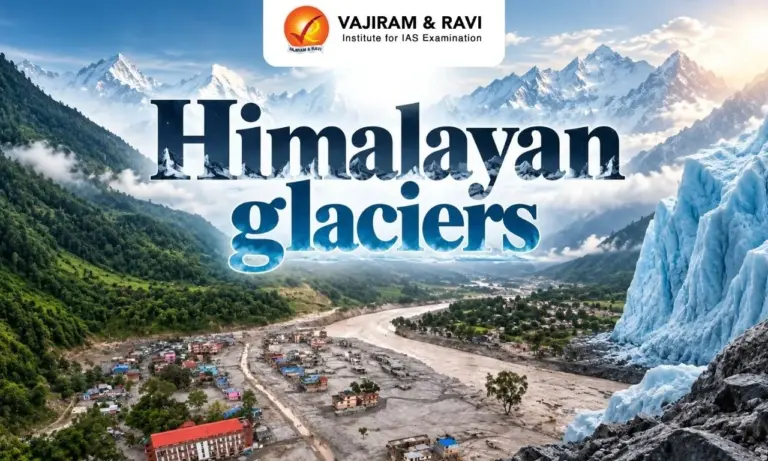
Himalayan Glaciers Latest News
- The recent floods along the Trishuli River in Nepal have put the Himalayas’ melting glaciers back in focus.
- But the damage from a warming Himalaya is not only sudden disasters. It is also a slow economic drain as glaciers retreat, water supplies grow unreliable and rivers that sustain agriculture, industry, cities and hydropower change course.
- A new report puts a number on this dependence: more than one-fifth of India’s GDP is underpinned by the Himalayas.
The Report
- The report, “A Resilient Himalaya: Protecting a Region at Risk and Securing Future Prosperity“, was compiled by the global consultancy Systemiq in partnership with the Integrated Mountain Initiative.
- It was supported by the International Centre for Integrated Mountain Development (ICIMOD), Nepal, and the GB Pant National Institute of Himalayan Environment, Uttarakhand.


The 21.5 Per Cent Figure
- The report estimates that Rs 64.8 lakh crore, or 21.5 per cent of India’s FY24 GDP, depends on the Himalayas. This does not mean glacier melt would erase 21.5 per cent of GDP.
- The figure measures economic activity traceable to Himalayan water, not projected climate damage.
- It was calculated in three layers:
- Direct: Gross State Domestic Product of Himalayan states.
- Indirect: Downstream agriculture, manufacturing, hydropower and services that rely on Himalayan-fed rivers and groundwater recharge (rain-fed production excluded).
- Induced: Supply-chain effects (such as tractors sold from southern states to the Indo-Gangetic Plains) and wage-spending effects (money spent on food and services).
Why Glaciers Matter to the Economy
- Glaciers act as natural water stores. They hold water as ice and release meltwater into rivers, especially during the dry season.
- The Himalayas feed the Indus, Ganga and Brahmaputra river systems, which support:
- Wheat and rice cultivation across the Indo-Gangetic plain
- Tea in Assam and Bengal
- Hydropower in the Northeast
- Pilgrimage economies in downstream towns
- The Gangotri glacier, for instance, is the primary source of the Bhagirathi, which becomes the Ganga.
Understanding “Peak Water”
- As warming accelerates melting, glaciers release extra water into rivers. But this cannot continue forever. Himalayan river basins are expected to reach “Peak Water” around the middle of this century.
- This is the point at which glacier meltwater reaches its maximum. After that, flows begin to decline as the ice reserve shrinks.
- On current trajectories, the Hindu Kush Himalaya could lose up to 80 per cent of its present glacier volume by 2100.
The Himalayas as a Disaster Hotspot
- The Himalayas account for 18 per cent of India’s land area but around 35 per cent of its disasters. Disasters trigger a damaging cycle:
- Food and water insecurity
- Disrupted supply chains
- Displacement of people
- Rising macroeconomic and sovereign-debt pressures
- Reconstruction spending that leaves less money for future resilience
The Black Carbon Connection
- While much of the damage stems from global warming, the report identifies a local source of emissions India can control quickly: black carbon, the soot produced by incomplete combustion.
- Key findings:
- Recent modelling attributes about one-third of Himalayan glacier mass loss to South Asian black carbon.
- Industry, primarily brick kilns, contributes 32–42 per cent of South Asian anthropogenic black carbon deposition across the region.
- Cutting kiln emissions tackles local air pollution and glacier melt through the same plume.
- When black carbon settles on snow, it darkens the surface. The snow then absorbs more sunlight instead of reflecting it.
- As per the reports, this “snow darkening” effect alone adds about 40 watts per square metre of surface heating across the Himalaya in spring.
The Brick Kiln Solution
- The report proposes a targeted fund to modernise brickmaking by upgrading viable kilns, retiring the worst-performing ones and reducing demand for fired bricks.
- Zigzag kiln technology, which burns fuel more efficiently, cuts black carbon and particulate emissions by roughly 70 per cent and fuel use by 20–30 per cent.
- But adoption is uneven:
- Punjab and Haryana have completed the switch to zigzag kilns.
- Uttar Pradesh, India’s largest brick producer, is at only 56 per cent.
- The rest of India still runs on traditional technology.
Beyond Brick Kilns
- Experts caution that kilns are not the whole story.
- Real progress requires tackling kilns, cookstoves, transport and crop-residue burning together, coordinated at the airshed scale rather than kiln by kiln or city by city.
Conclusion
- The Himalayas are both a water tower and a disaster hotspot for India, underpinning over a fifth of its GDP. With “peak water” approaching mid-century and glacier loss of up to 80 per cent possible by 2100, the threat is structural.
- While global warming needs global action, black carbon from brick kilns is a lever India can pull now, with immediate gains for both air quality and glacier health.
Source: IE

 Last updated on Oct, 2026
→ UPSC 2027 Notification will be released on 13 January 2027 at upsconline.nic.in.
→ Asian Games 2026 are being held in Aichi-Nagoya, Japan, from 19 September to 4 October.
→ Check Nobel Prize 2026 Winners List here.
→ Download PIB PRiSM Monthly Magazine 2026 here.
→ Check UPSC Monthly Current Affairs Magazine The Recitals here.
→ Check out the latest UPSC Syllabus here.
→ Download UPSC Model Answers for Mains 2026
→ UPSC Mains Question Paper 2026 is out now for Essay & GS Paper 1, 2, 3 & 4.
→ UPSC Calendar 2027 has been released.
→ Enroll in Vajiram & Ravi’s UPSC Mains Test Series 2027 for structured answer writing practice, expert evaluation, and exam-oriented feedback.
→ Join Vajiram & Ravi’s UPSC Mentorship Program 2027 for personalized guidance, strategy planning, and one-to-one support from experienced mentors.
→ Go through the UPSC Mains Previous Year Papers to enhance your preparation.
→ UPSC has released UPSC Toppers List 2025 with the Civil Services final result on its official website.
→ Also check Best UPSC Coaching in India
Himalayan glaciers FAQs
Q1. Why are Himalayan glaciers important to India’s economy?+
Q2. What does peak water mean for Himalayan glaciers?+
Q3. How much of India’s GDP depends on the Himalayas?+
Q4. How does black carbon affect Himalayan glaciers?+
Q5. How can India reduce risks to Himalayan glaciers?+
Tags: Himalayan glaciers mains articles upsc current affairs upsc mains current affairs