India Electric Mobility Index Latest News
- NITI Aayog has released the India Electric Mobility Index (IEMI) 2025, with Delhi emerging as the top performer in electric vehicle adoption and e-mobility ecosystem development, followed by Maharashtra and Karnataka.
About the India Electric Mobility Index
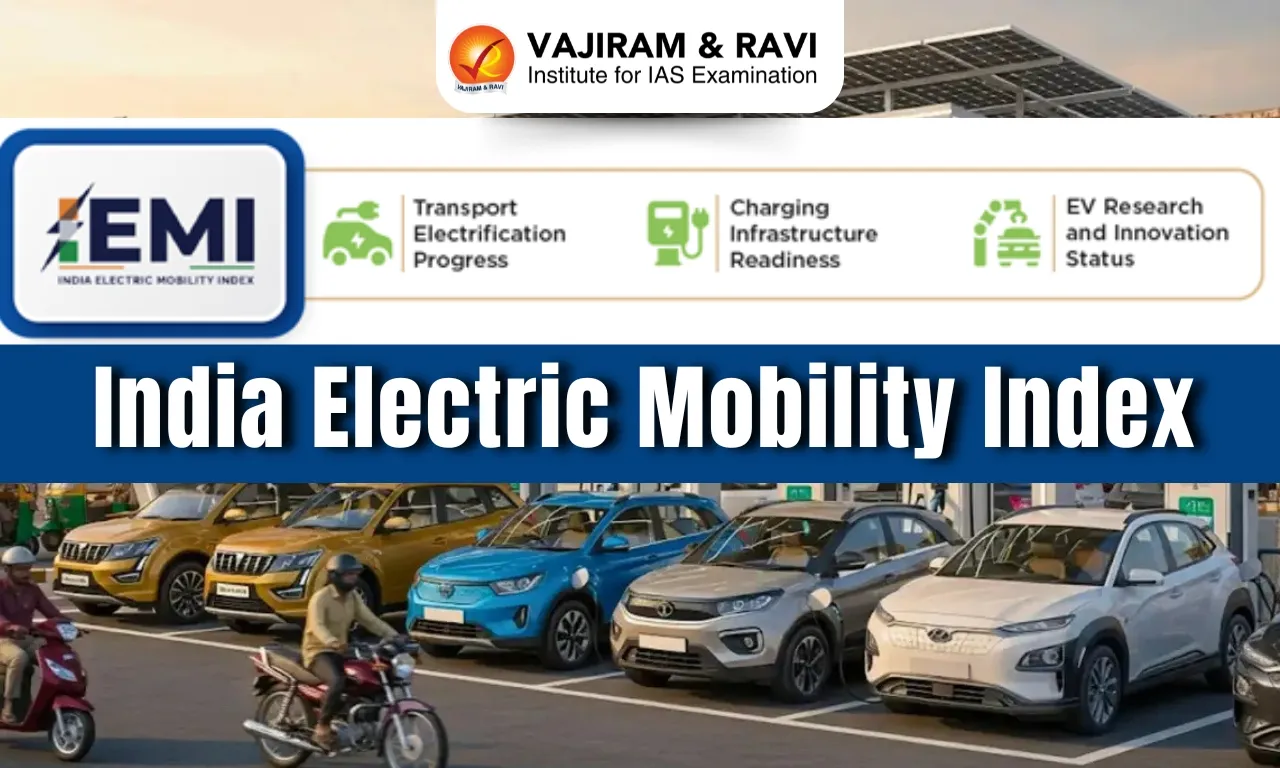
- The India Electric Mobility Index (IEMI) is a composite index that assesses both the policy framework and implementation outcomes for electric mobility at the state level.
- It was developed by NITI Aayog in collaboration with WRI India. This is the second edition of the index, following the 2024 version.
- Purpose: The index tracks, evaluates and scores all Indian States and Union Territories out of 100. Its objectives are to:
- Inform decision-making at the state level
- Foster healthy competition among states
- Promote sharing of best practices


Structure of the Index
- The IEMI assesses performance across 16 indicators grouped under three core themes, each carrying different weightage:
- Transport Electrification Progress (50% weightage): Evaluates market absorption, consumer acceptance and demand-side momentum by measuring how effectively EVs are being adopted and supported.
- Charging Infrastructure Readiness (30% weightage): Captures charger-to-vehicle ratio, subsidies for charging infrastructure, building bye-laws for charging, and power availability.
- EV Research and Innovation Status (20% weightage): Covers EV startups, research and development initiatives, and patents.
News Summary: Key Findings
- Composite scores across all 36 States and Union Territories range from 10 to 84, with a median score of 40. The top performers are: Delhi (84), Maharashtra (78), Karnataka (73), Chandigarh (71) and Goa (65).
- Compared with the 2024 index, Delhi and Maharashtra retained the top two positions. Karnataka moved up to third, overtaking Chandigarh, while Goa climbed ten spots to fifth place.
- The most notable improvement came from Madhya Pradesh, which rose from 23rd to seventh rank.
- The top score itself improved from 77 in 2024 to 84 in 2025, indicating that leading states are continuing to advance rather than plateauing.
Performance Among Large States
- Of the 17 large states, only Maharashtra and Karnataka featured among the top performers.
- Eight large states qualified as frontrunners, scoring between 50 and 64 out of 100:
- Tamil Nadu, Madhya Pradesh, Odisha, Andhra Pradesh, Telangana, Haryana, Rajasthan and Uttar Pradesh
- Seven large states were classified as emerging performers, scoring between 35 and 49:
- Chhattisgarh, West Bengal, Bihar, Kerala, Jharkhand, Punjab and Gujarat
Theme-Wise Performance
- Transport Electrification Progress
- This carries the highest weightage at 50%, and performance here was the weakest overall.
- Only three States and UTs, Delhi, Chandigarh and Maharashtra, qualified as top performers in this category.
- The report notes that for most States and UTs, transport electrification progress remains the largest opportunity for improving overall performance.
- Charging Infrastructure Readiness
- Karnataka recorded the highest score nationwide at 97, followed closely by Goa (92) and Maharashtra (91).
- This indicates that some states have built charging networks faster than they have converted vehicle fleets, creating a mismatch between infrastructure and adoption.
- EV Research and Innovation
- Delhi achieved the top score of 94 in this category, reflecting strength in EV startups, R&D activity and patents.
Identified Barriers
- The report identifies three main obstacles to progress:
- Limited charging infrastructure in many states
- Dispersed settlements, which make charging networks harder and costlier to build
- A nascent innovation ecosystem outside a few leading states
- A key observation is that charging rollout and EV adoption are moving at different speeds across the country, a sign that the transition remains uneven.
- With foundational EV policy now in place for most States and UTs, the report argues that the focus must shift from policy formulation to effective implementation.
Why Electrification Matters
- Road transport accounts for roughly 12% of India’s energy-related carbon dioxide emissions, making the sector central to climate goals.
- Beyond emissions, the transition also carries economic and strategic significance.
- Reducing dependence on imported crude oil improves energy security and eases pressure on the current account, a concern that has grown sharper with elevated global oil prices.
- NITI Aayog has framed the transition to electric mobility as an economic, environmental and strategic imperative for the Viksit Bharat 2047 ambition.
India’s EV Adoption Trajectory
- The report documents substantial growth in EV uptake:
- EV penetration, the share of EVs in total vehicles registered, reached 8.25% in 2025-26, up from just 0.5% in 2018.
- Over 8.7 million EVs were running on Indian roads in 2025-26.
- Close to 2.5 million EVs were registered during 2025-26 alone, a rise of about 25% over the previous year.
The Global Comparison
- India’s 8.25% penetration rate should be read against international benchmarks.
- In 2025, electric cars accounted for:
- Around one-tenth of new car sales in the United States
- More than a quarter in the European Union
- Over half in China
- Projections suggest that by 2040, around 40% of all new car sales globally would be electric.
- India’s position reflects both the distance still to cover and the distinct shape of its transition, driven predominantly by two- and three-wheelers rather than passenger cars, which is a pattern suited to Indian mobility patterns and income levels.
Significance of the Index
- The IEMI serves three practical functions.
- It creates comparative pressure among states by making performance visible and ranked, which has proven effective in other policy areas.
- It disaggregates the challenge by separating adoption from infrastructure from innovation, allowing states to identify where specifically they lag.
- It shifts attention to implementation. With most states having formulated EV policies, the constraint is no longer policy design but execution, charger deployment, subsidy disbursement, building code enforcement and grid readiness.

 Last updated on Oct, 2026
→ UPSC 2027 Notification will be released on 13 January 2027 at upsconline.nic.in.
→ Asian Games 2026 are being held in Aichi-Nagoya, Japan, from 19 September to 4 October.
→ Check Nobel Prize 2026 Winners List here.
→ Download PIB PRiSM Monthly Magazine 2026 here.
→ Check UPSC Monthly Current Affairs Magazine The Recitals here.
→ Check out the latest UPSC Syllabus here.
→ Download UPSC Model Answers for Mains 2026
→ UPSC Mains Question Paper 2026 is out now for Essay & GS Paper 1, 2, 3 & 4.
→ UPSC Calendar 2027 has been released.
→ Enroll in Vajiram & Ravi’s UPSC Mains Test Series 2027 for structured answer writing practice, expert evaluation, and exam-oriented feedback.
→ Join Vajiram & Ravi’s UPSC Mentorship Program 2027 for personalized guidance, strategy planning, and one-to-one support from experienced mentors.
→ Go through the UPSC Mains Previous Year Papers to enhance your preparation.
→ UPSC has released UPSC Toppers List 2025 with the Civil Services final result on its official website.
→ Also check Best UPSC Coaching in India
India Electric Mobility Index FAQs
Q1. Who developed the India Electric Mobility Index?+
Q2. Which state topped the IEMI 2025?+
Q3. What are the three themes of the index and their weightage?+
Q4. What is India's current EV penetration rate?+
Q5. Which state scored highest in charging infrastructure readiness?+
Tags: india electric mobility index mains articles upsc current affairs upsc mains current affairs