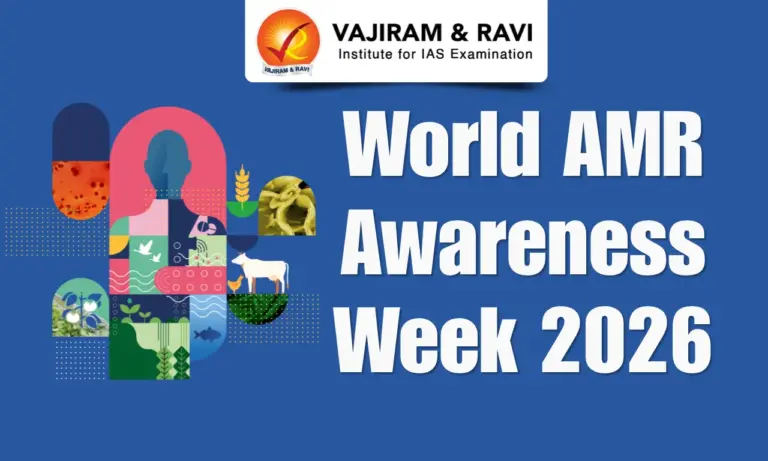
World AMR Awareness Week 2026 will be observed from November 18 to 24, 2026, to raise awareness about antimicrobial resistance (AMR) and encourage responsible use of life-saving medicines. The campaign highlights the growing threat of drug-resistant infections to human health, animals, agriculture and the environment. The World AMR Awareness Week 2026 theme, “One Health, one action: Prevent AMR now,” emphasises collective efforts to prevent AMR and protect the effectiveness of antimicrobial medicines for future generations.
World AMR Awareness Week 2026 Theme
The World AMR Awareness Week 2026 theme is “One Health, one action: Prevent AMR now.” It emphasises the One Health approach, recognising the close connection between human, animal, plant and environmental health.
- One Health Approach: Encourages coordinated efforts across healthcare, agriculture, veterinary services and environmental sectors to prevent drug-resistant infections.
- Shared Responsibility: Calls on governments, healthcare workers, farmers, researchers and communities to promote the responsible use of antimicrobial medicines.
- Preventing AMR: Focuses on vaccination, hygiene, sanitation, accurate diagnosis and safe disposal of medicines to reduce antimicrobial misuse.
- Global Health Threat: Bacterial AMR is associated with over 4.7 million deaths annually and could cause up to 39 million deaths by 2050, with annual economic costs potentially exceeding US$3.4 trillion.
World AMR Awareness Week 2026 History and Objectives
World AMR Awareness Week (WAAW) is an annual global health campaign observed from November 18 to 24. It aims to improve public understanding of antimicrobial resistance and encourage action to prevent the spread of drug-resistant infections.
- History: The campaign began in 2015 as World Antibiotic Awareness Week. It was renamed World Antimicrobial Awareness Week in 2020 and later became World AMR Awareness Week in 2023 to highlight the wider challenge of antimicrobial resistance.
- Global Coordination: The campaign is jointly supported by four international organisations known as the Quadripartite: WHO, FAO, UNEP and WOAH, promoting cooperation across human, animal and environmental health.
- Raising Awareness: It educates the public and healthcare professionals about antimicrobial resistance, its causes and risks, while discouraging the unnecessary use of antibiotics and other antimicrobial medicines.
- Encouraging Global Action: WAAW promotes responsible medicine use, infection prevention, scientific research and international cooperation to control AMR and protect public health.


What is Antimicrobial Resistance (AMR)?
Antimicrobial Resistance (AMR) occurs when bacteria, viruses, fungi and parasites develop resistance to medicines used to treat infections. As a result, medicines such as antibiotics, antivirals, antifungals and antiparasitics become less effective, making infections harder to treat and increasing the risk of severe illness and death.
Major Causes of Antimicrobial Resistance
- Misuse of Antibiotics: Taking antibiotics without medical advice, using them for viral infections such as the common cold, or taking incorrect doses can encourage drug resistance.
- Excessive Use in Agriculture: Unnecessary use of antimicrobials in livestock, poultry and food production can contribute to the emergence and spread of resistant microorganisms.
- Poor Hygiene and Sanitation: Inadequate clean water, sanitation, infection control and healthcare hygiene allows resistant infections to spread more easily.
- Environmental Pollution: Improper disposal of antibiotics, pharmaceutical waste and untreated wastewater can introduce antimicrobial residues and resistant microorganisms into the environment.
- Lack of Awareness and Diagnosis: Limited access to accurate diagnostic tests and public awareness can lead to unnecessary prescriptions and inappropriate antimicrobial treatment.
What Are the Global and Indian Initiatives to Combat Antimicrobial Resistance?
Several global organisations and the Government of India have introduced initiatives to control antimicrobial resistance through better monitoring, responsible medicine use, infection prevention and the One Health approach.
Global Initiatives
Global Initiatives
- Global Action Plan on AMR (2026-2036): Promotes international cooperation to reduce AMR-related deaths, excessive antimicrobial use in agriculture and environmental pollution.
- Quadripartite Collaboration: WHO, FAO, UNEP and WOAH coordinate efforts to tackle AMR across human, animal and environmental health.
- World AMR Awareness Week: An annual campaign promoting awareness, infection prevention and responsible antimicrobial use.
Indian Initiatives
- National Action Plan on AMR 2.0 (2025-2029): Launched in November 2025, it strengthens AMR surveillance, laboratory testing, infection control, public awareness and coordination among government departments.
- National Programme on AMR Containment: Introduced in 2013 and coordinated by the National Centre for Disease Control (NCDC), it focuses on monitoring drug resistance and promoting appropriate antimicrobial use.
- National AMR Surveillance Network (NARS-Net): Established to track drug-resistant pathogens across hospitals and laboratories, helping authorities identify resistance trends and improve treatment practices.

 Last updated on Nov, 2026
→ UPSC 2027 Notification will be released on 13 January 2027 at upsconline.nic.in.
→ Check Nobel Prize 2026 Winners List here.
→ Download PIB PRiSM Monthly Magazine 2026 here.
→ Check UPSC Monthly Current Affairs Magazine The Recitals here.
→ Check out the latest UPSC Syllabus here.
→ Download UPSC Model Answers for Mains 2026
→ UPSC Mains Question Paper 2026 is out now for Essay & GS Paper 1, 2, 3 & 4.
→ UPSC Calendar 2027 has been released.
→ Enroll in Vajiram & Ravi’s UPSC Mains Test Series 2027 for structured answer writing practice, expert evaluation, and exam-oriented feedback.
→ Join Vajiram & Ravi’s UPSC Mentorship Program 2027 for personalized guidance, strategy planning, and one-to-one support from experienced mentors.
→ Go through the UPSC Mains Previous Year Papers to enhance your preparation.
→ UPSC has released UPSC Toppers List 2025 with the Civil Services final result on its official website.
→ Also check Best UPSC Coaching in India
World AMR Awareness Week 2026 FAQs
Q1. When is World AMR Awareness Week 2026 observed?+
Q2. What is the theme of World AMR Awareness Week 2026?+
Q3. What is Antimicrobial Resistance (AMR)?+
Q4. What are the major causes of Antimicrobial Resistance?+
Q5. What is the main objective of World AMR Awareness Week?+
Q6. What is the One Health approach in antimicrobial resistance?+
Tags: world amr awareness week 2026