Article 371K for Ladakh: Understanding Article 371 and Special Safeguard

Article 371K

Article 371K Latest News

  • The Union government has proposed inserting a new Article 371K in the Constitution to give special safeguards to Ladakh. 
  • The proposal follows an "in-principle understanding" between the Ministry of Home Affairs (MHA) and representatives of the Apex Body, Leh (ABL) and the Kargil Democratic Alliance (KDA). 
  • It envisages a directly elected Union Territory-level body with legislative, executive, financial and planning powers.

What Article 371 Originally Was

  • Article 371 is now associated with special protections for the Northeast and tribal regions. But that was not its original purpose.
  • At Independence, India comprised not just British-administered provinces but also hundreds of princely states that had acceded under very different circumstances. 
  • The Constitution classified these — Hyderabad, Mysore, Jammu and Kashmir, Rajasthan and others — as Part B States.
  • The original Article 371, adopted in 1950, was a transitional provision.
  • It placed Part B State governments under the general control of the President for 10 years, or a period Parliament could adjust.
  • Its purpose was Central supervision during integration, not cultural protection.

The 1956 Turning Point

  • Six years later, the States Reorganisation Act and the Seventh Constitutional Amendment of 1956 abolished the Part A, B and C classification, creating a uniform structure of states and Union Territories.
  • The original Article 371 disappeared. Parliament replaced it with a new version — the one that exists today — providing special arrangements for Maharashtra and Gujarat, focused on equitable development of regions like Vidarbha, Marathwada, Saurashtra and Kutch.

How 371 Became a Family of Provisions

  • From here, India's Constitutional system showed its flexibility. 
  • Parliament repeatedly built bespoke arrangements for regions whose history, social structure or political demands differed from the rest of the country. This is often called asymmetric federalism.
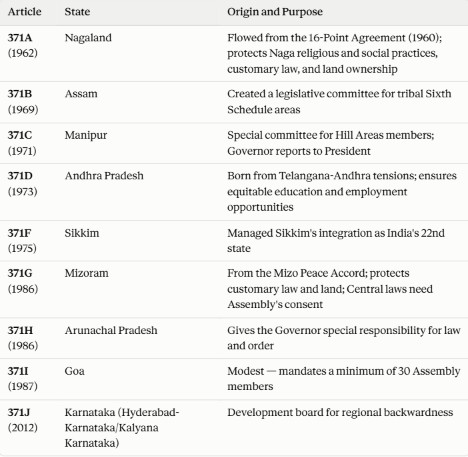
  • Each provision, notably, emerged from a distinct political settlement — an insurgency, a peace accord, a regional grievance, or an integration process. There is no single template.

What Ladakh Is Seeking

  • Ladakh's demand does not fit neatly into any existing 371 model, for a key reason: it would apply to a Union Territory without a legislature — something unprecedented.
  • The emerging proposal includes:
    • A directly elected UT-level body with legislative, executive, budgetary, planning and financial powers.
    • Legislative powers over land, culture, language, forests, environment and natural resources, and other subjects reserved for the UT under Article 240.
    • Control over civil servants, including their APARs (performance appraisals), for subjects under the elected body's jurisdiction.
    • Control over law and order — notably the opposite of Article 371H, which gives Arunachal Pradesh's Governor special responsibility over law and order.
    • Land protection resembling the philosophy of 371A and 371G, where certain Parliamentary laws don't apply automatically.

What Would Make 371K Strong or Weak

  • The final strength of 371K depends entirely on its drafting.
    • If it merely creates an elected body and lists subjects it can legislate on, protection would be relatively limited. Manipur is a cautionary example — hill tribes argue Article 371C has failed to deliver meaningful autonomy.
    • If it constitutionally protects the elected body's control over land, natural resources, recruitment and administration, it would be considerably stronger.
    • If it specifies that certain Central laws won't apply to Ladakh without the elected body's approval, it would resemble the stronger protections under 371A and 371G.
    • If law and order and the bureaucracy come under the elected executive, Ladakh's head of government would be more powerful than the J&K Chief Minister.
  • This is precisely why the promised draft matters, and why Ladakh's leaders have been pressing for it.

Conclusion

  • Article 371 was never one idea — it is a constitutional habit of bespoke bargains. Each version answered a specific political demand of its time. 
  • Ladakh's 371K would be the first attempt to give a Union Territory without legislature real legislative teeth. Its ultimate strength lies not in the number 371K, but in the words finally written into it.

Source: IE

Article 371K FAQs

Q1: What is Article 371K proposed to achieve for Ladakh?

Ans: Article 371K is proposed to provide Ladakh special safeguards through a directly elected Union Territory-level body with legislative, executive, financial and planning powers.

Q2: How is Article 371K different from the original Article 371?

Ans: The original Article 371 was a transitional provision for former Part B States, whereas Article 371K is proposed as protection for Ladakh.

Q3: What powers could Article 371K give Ladakh's elected body?

Ans: Article 371K could provide powers over land, culture, language, forests, environment, natural resources, civil servants, administration and law and order.

Q4: Why does the drafting of Article 371K matter?

Ans: The strength of Article 371K would depend on whether constitutional protection covers land, resources, recruitment, administration and applicability of Central laws.

Q5: Why would Article 371K be significant in India's constitutional system?

Ans: Article 371K would represent an unprecedented attempt to provide meaningful legislative powers to a Union Territory currently without its own legislature.

India-New Zealand Bilateral Relationship – Free Trade Agreement

Free Trade Agreement

Free Trade Agreement Latest News

  • The India-New Zealand Free Trade Agreement has been ratified and will come into effect on October 20, with both sides aiming to double bilateral trade to Rs. 35,000 crore over the next four to five years.

India-New Zealand Bilateral Relationship

  • India and New Zealand share a relationship grounded in Commonwealth membership, parliamentary democracy, and growing economic complementarity, though the two countries have historically engaged less intensively than India has with other partners in the region.

Trade and Economic Ties

  • Bilateral trade between the two countries stood at $1.3 billion in 2024-25, with India being New Zealand's 9th largest export market.
  • India's exports to New Zealand include pharmaceuticals, engineering goods, textiles, ceramics, carpets, automobiles and auto components. 
  • New Zealand's exports to India consist largely of agricultural products, timber, wool and specialised manufactured goods.
  • New Zealand currently maintains tariffs of up to 10% on key Indian goods, including ceramics, carpets, automobiles, textiles and auto components, precisely the categories where the FTA delivers gains.

Agriculture and Sensitive Sectors

  • Agriculture has been the most delicate area in negotiations. New Zealand is a highly competitive agricultural exporter with advanced dairy and horticultural capabilities. India has consistently protected its dairy sector and vulnerable farm segments in trade negotiations, and this agreement follows that pattern.
  • New Zealand's expertise in specific areas, notably kiwifruit farming and apiculture, offers potential for technology collaboration rather than purely commercial competition.

People-to-People and Diaspora Links

  • The Indian community is the third-largest ethnic group in New Zealand.
  • Cricket and Commonwealth sporting ties sustain regular contact, and New Zealand has been a preferred destination for Indian skilled migrants in sectors such as IT, healthcare and engineering.

News Summary: The FTA and Its Provisions

  • Union Commerce and Industry Minister Piyush Goyal announced the agreement's entry into force, describing it as the next important milestone in the bilateral economic partnership.

Trade Liberalisation

  • According to New Zealand's foreign trade office, the agreement is set to:
    • Erase import levies on all Indian goods entering New Zealand
    • Allow 95% of New Zealand's exports to India to enter either tariff-free or at sharply reduced levies
  • For India, this provides duty-free access to 100% of its exports, a substantial improvement given existing tariffs of up to 10% on major categories.

Protection of Sensitive Sectors

  • The Union Minister emphasised that India has safeguarded its sensitive sectors, granting no concessions on: Dairy, Onions, Almonds, Chickpeas, Peas, Artificial honey, Sugar and other agricultural produce.
  • This is significant because dairy access has been the single most contentious issue in India's recent trade negotiations, including with the European Union and in the India-EFTA talks.

Investment Commitments

  • New Zealand has committed $20 billion in foreign direct investment into India as part of the deal, directed toward sectors including startups, manufacturing & infrastructure.
  • The investment is expected to flow over the next 15 years.

Agricultural Productivity Partnership

  • The agreement establishes an agricultural productivity partnership, under which New Zealand's technology will combine with India's scale and growing demand. 
  • The Union Minister pointed to kiwi farming and apiculture as areas of particular promise.

Benefits for MSMEs and Artisans

  • The Minister noted that the deal will benefit India's micro, medium and small enterprises, along with farmers, handloom artisans and weavers, sectors where New Zealand's tariff structures have previously created barriers.

Technology and Manufacturing Collaboration

  • The Minister observed that New Zealand possesses technological expertise in engineering and other manufacturing. 
  • He suggested that New Zealand companies could support Indian firms, invest, or set up manufacturing in India to capture global markets.
  • A key argument he advanced was that in several countries, including New Zealand, labour is scarce and expensive, making manufacturing in India more economical. 
  • Partner countries, he said, are looking for destinations where they can export technology to a trusted partner where intellectual property is respected.
  • He added that global investors are interested in manufacturing in India not only for the large domestic market but also to export seamlessly to about two-thirds of the global economy where India has preferential market access.

Significance

  • For India's export sectors: Duty-free access removes a competitive disadvantage for ceramics, carpets, textiles and auto components, categories where Indian producers compete directly with suppliers from countries already having preferential access to New Zealand.
  • For sensitive agriculture: By excluding dairy and major farm products, India has demonstrated a consistent negotiating template, liberalising manufactured goods while protecting politically sensitive agricultural segments.
  • For investment diversification: The $20 billion commitment adds to India's efforts to attract FDI amid weak global flows, though the fifteen-year horizon means the impact will be gradual.
  • For India's broader trade strategy: The simultaneous progress with New Zealand, Canada and Chile suggests an accelerating push to expand preferential market access, reflecting a strategic response to global tariff uncertainty and the disruption of established trade patterns.

Source: TOI | TH

Free Trade Agreement FAQs

Q1: When does the India-New Zealand FTA come into effect?

Ans: It comes into effect on October 20, following ratification.

Q2: What are the key tariff outcomes of the agreement?

Ans: India's exports get duty-free access to 100% of the New Zealand market, while 95% of New Zealand's exports to India will be tariff-free or at sharply reduced levies.

Q3: Which sectors has India protected in the deal?

Ans: Dairy, onions, almonds, chickpeas, peas, artificial honey, sugar and other sensitive agricultural produce.

Q4: How much investment has New Zealand committed?

Ans: $20 billion in FDI into India over the next 15 years, in sectors including startups, manufacturing and infrastructure.

Q5: What is the bilateral trade target under the agreement?

Ans: Doubling bilateral trade to ₹35,000 crore over the next four to five years.

Article 22: Supreme Court Rules on Illegal Arrest and Re-Arrest

Article 22

Article 22 Latest News

  • The Supreme Court has held that an arrested person denied the grounds of arrest or access to a lawyer must be released immediately. 
  • A Bench of Justices Ujjal Bhuyan and Atul S. Chandurkar delivered a 69-page ruling that also laid down strict guidelines for when such a person can be re-arrested.

What Article 22(1) Guarantees

  • Article 22 is a fundamental right protecting personal liberty at the moment of arrest. It requires that an accused be:
    • Produced before a magistrate within 24 hours of arrest.
    • Informed of the grounds of arrest, in writing, in a language they understand.
    • Given access to a lawyer of their choice.
  • The Court called these "fundamental principles" governing personal liberty, not mere procedural requirements.

"Sacrosanct" and Non-Negotiable

  • SC bench said that the Article 22(1) "cannot be breached under any situation." Any violation makes the arrest itself unconstitutional, entitling the person to immediate release.
  • Key clarifications from the judgment:
    • The right applies across the board — ordinary offences under the BNS as well as special laws like those on terrorism and money laundering. It is not statute-specific.
    • Probe agencies cannot dismiss a breach as a "mere procedural lapse."
    • A violation does not depend on the gravity of the offence or on proving actual prejudice to the accused.
    • Even a later chargesheet or cognisance order cannot cure an illegal arrest.
  • Crucial distinction: When a person is released for this reason, they are not "enlarged on bail." They are released from illegal and unconstitutional detention — a fundamentally different legal status.

Rules for Re-Arrest

  • The Court accepted that a blanket immunity from future arrest cannot exist, since some cases involve grave offences. 
  • But it insisted that any re-arrest must pass through strict judicial oversight, so the same authority that violated the right does not also decide on re-arrest.
  • The procedure laid down:
    • The accused must first be given the written grounds of arrest.
    • The police must file an application before a magistrate, giving recorded reasons for seeking re-arrest and explaining why grounds were not furnished the first time.
    • The application must be endorsed by a senior/immediate superior officer, so the superior is put on notice of the earlier lapse.
    • The magistrate may permit re-arrest only if satisfied there were bona fide reasons for the earlier failure.
    • The magistrate must decide the application within a week.
    • The investigation must be handed to another officer, and a departmental inquiry ordered into the original lapse. An adverse finding brings departmental action, recorded in the officer's service book.
  • As per the apex court, once Article 22(1) is breached, the power to re-arrest "must not be left to the discretion of the very same authority who had violated" it. It must carry "judicial imprimatur."
  • The Bench also directed High Courts to grant "suitable mandatory compensation" wherever arrests violate these procedural safeguards.

Background: The Case Behind the Ruling

  • The judgment arose from a POCSO case in Punjab. The accused was released by a magistrate for not being given arrest grounds. 
  • The police then sought to re-arrest him the same day; a different magistrate dismissed that plea. The matter went to the Punjab and Haryana High Court, which allowed re-arrest, and the accused then approached the Supreme Court.

Building on Recent Precedent

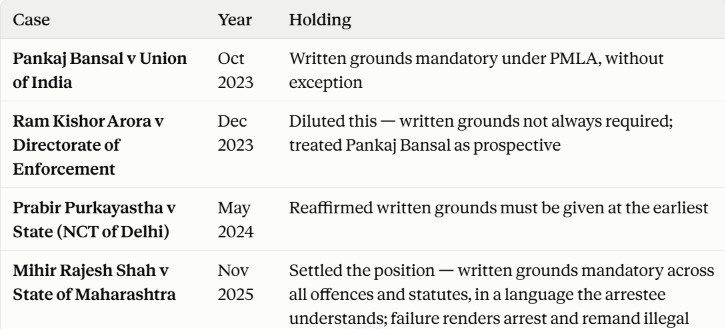
  • This ruling is the latest in a line of cases over the past three years strengthening the requirement to communicate arrest grounds in writing.

  • Monday's judgment builds directly on this trajectory, extending it specifically to the question of re-arrest after an illegal arrest.

Conclusion

  • The ruling closes a loophole where police could treat an illegal arrest as a technical error to be quietly corrected. 
  • By requiring magisterial sanction, a senior officer's endorsement, and a departmental inquiry before any re-arrest, the Court has placed liberty above administrative convenience. Article 22, the Bench makes clear, is a wall, not a formality.

Source: IE | TH

Article 22 FAQs

Q1: What does Article 22 guarantee to an arrested person?

Ans: Article 22 guarantees timely production before a magistrate, written grounds of arrest in an understood language, and access to a lawyer.

Q2: What happens when Article 22 is violated during arrest?

Ans: When Article 22 is violated, the arrest becomes unconstitutional and the person must be immediately released from illegal detention.

Q3: Does Article 22 apply to special laws?

Ans: Yes, Article 22 applies across ordinary offences and special laws, including terrorism and money-laundering statutes, regardless of the offence's seriousness.

Q4: What are the Supreme Court's rules for re-arrest after violating Article 22?

Ans: Re-arrest requires written grounds, a police application to the magistrate, senior-officer endorsement, judicial approval, and an inquiry into the original violation.

Q5: Why is Article 22 important for personal liberty?

Ans: Article 22 protects personal liberty by preventing authorities from treating constitutional safeguards as procedural formalities and requiring judicial oversight after unlawful detention.

Enquire Now