Article 22 Latest News
- The Supreme Court has held that an arrested person denied the grounds of arrest or access to a lawyer must be released immediately.
- A Bench of Justices Ujjal Bhuyan and Atul S. Chandurkar delivered a 69-page ruling that also laid down strict guidelines for when such a person can be re-arrested.
What Article 22(1) Guarantees
- Article 22 is a fundamental right protecting personal liberty at the moment of arrest. It requires that an accused be:
- Produced before a magistrate within 24 hours of arrest.
- Informed of the grounds of arrest, in writing, in a language they understand.
- Given access to a lawyer of their choice.
- The Court called these “fundamental principles” governing personal liberty, not mere procedural requirements.


“Sacrosanct” and Non-Negotiable
- SC bench said that the Article 22(1) “cannot be breached under any situation.” Any violation makes the arrest itself unconstitutional, entitling the person to immediate release.
- Key clarifications from the judgment:
- The right applies across the board — ordinary offences under the BNS as well as special laws like those on terrorism and money laundering. It is not statute-specific.
- Probe agencies cannot dismiss a breach as a “mere procedural lapse.”
- A violation does not depend on the gravity of the offence or on proving actual prejudice to the accused.
- Even a later chargesheet or cognisance order cannot cure an illegal arrest.
- Crucial distinction: When a person is released for this reason, they are not “enlarged on bail.” They are released from illegal and unconstitutional detention — a fundamentally different legal status.
Rules for Re-Arrest
- The Court accepted that a blanket immunity from future arrest cannot exist, since some cases involve grave offences.
- But it insisted that any re-arrest must pass through strict judicial oversight, so the same authority that violated the right does not also decide on re-arrest.
- The procedure laid down:
- The accused must first be given the written grounds of arrest.
- The police must file an application before a magistrate, giving recorded reasons for seeking re-arrest and explaining why grounds were not furnished the first time.
- The application must be endorsed by a senior/immediate superior officer, so the superior is put on notice of the earlier lapse.
- The magistrate may permit re-arrest only if satisfied there were bona fide reasons for the earlier failure.
- The magistrate must decide the application within a week.
- The investigation must be handed to another officer, and a departmental inquiry ordered into the original lapse. An adverse finding brings departmental action, recorded in the officer’s service book.
- As per the apex court, once Article 22(1) is breached, the power to re-arrest “must not be left to the discretion of the very same authority who had violated“ it. It must carry “judicial imprimatur.”
- The Bench also directed High Courts to grant “suitable mandatory compensation“ wherever arrests violate these procedural safeguards.
Background: The Case Behind the Ruling
- The judgment arose from a POCSO case in Punjab. The accused was released by a magistrate for not being given arrest grounds.
- The police then sought to re-arrest him the same day; a different magistrate dismissed that plea. The matter went to the Punjab and Haryana High Court, which allowed re-arrest, and the accused then approached the Supreme Court.
Building on Recent Precedent
- This ruling is the latest in a line of cases over the past three years strengthening the requirement to communicate arrest grounds in writing.
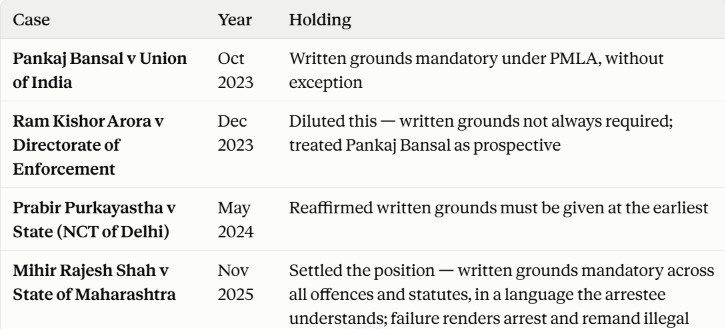
- Monday’s judgment builds directly on this trajectory, extending it specifically to the question of re-arrest after an illegal arrest.
Conclusion
- The ruling closes a loophole where police could treat an illegal arrest as a technical error to be quietly corrected.
- By requiring magisterial sanction, a senior officer’s endorsement, and a departmental inquiry before any re-arrest, the Court has placed liberty above administrative convenience. Article 22, the Bench makes clear, is a wall, not a formality.

 Last updated on Oct, 2026
→ UPSC 2027 Notification will be released on 13 January 2027 at upsconline.nic.in.
→ Check Nobel Prize 2026 Winners List here.
→ Download PIB PRiSM Monthly Magazine 2026 here.
→ Check UPSC Monthly Current Affairs Magazine The Recitals here.
→ Check out the latest UPSC Syllabus here.
→ Download UPSC Model Answers for Mains 2026
→ UPSC Mains Question Paper 2026 is out now for Essay & GS Paper 1, 2, 3 & 4.
→ UPSC Calendar 2027 has been released.
→ Enroll in Vajiram & Ravi’s UPSC Mains Test Series 2027 for structured answer writing practice, expert evaluation, and exam-oriented feedback.
→ Join Vajiram & Ravi’s UPSC Mentorship Program 2027 for personalized guidance, strategy planning, and one-to-one support from experienced mentors.
→ Go through the UPSC Mains Previous Year Papers to enhance your preparation.
→ UPSC has released UPSC Toppers List 2025 with the Civil Services final result on its official website.
→ Also check Best UPSC Coaching in India
Article 22 FAQs
Q1. What does Article 22 guarantee to an arrested person?+
Q2. What happens when Article 22 is violated during arrest?+
Q3. Does Article 22 apply to special laws?+
Q4. What are the Supreme Court's rules for re-arrest after violating Article 22?+
Q5. Why is Article 22 important for personal liberty?+
Tags: article 22 mains articles upsc current affairs upsc mains current affairs