Indian Craft Latest News
- Indian crafts and weaves are skills and visual languages carried across generations, rooted in specific regions and communities.
- Yet when they enter the global luxury fashion system, the people and places behind them become invisible.
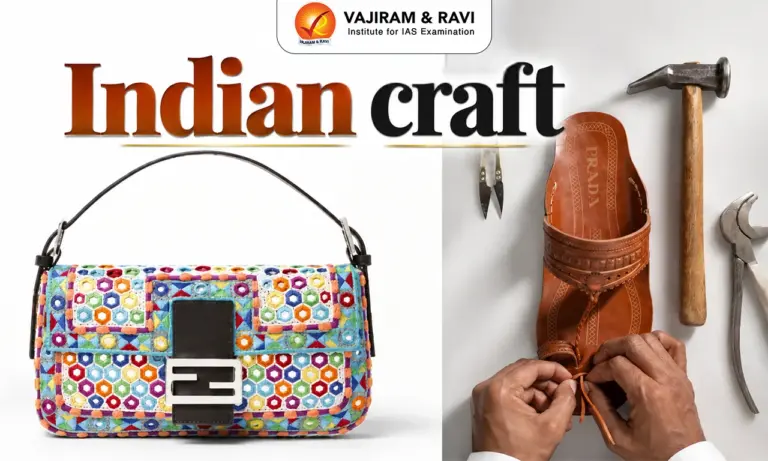
- After the controversy over Prada’s Kolhapuri chappals, two more instances have drawn criticism.
- Recently, Ralph Lauren presented a pink evening gown featuring aari work — hook embroidery from Gujarat. It was described only as hand-applied embellishment.
- Fendi’s autumn collection includes a mirror-work Baguette bag, made in Italy over 138 hours, using 39,500 beads and 475 mirrors, priced at $10,000. It closely resembles the mirrored purses sold at Indian craft fairs.
- The pattern raises a sharp question. Why is it so easy to commercially appropriate a traditional Indian craft, and so hard for the community behind it to claim recognition, ownership or a share of the value?
The Core Legal Contradiction
- Experts identify the root problem. Intellectual property is territorial, while culture is not. Laws stop at borders; crafts do not.
- A centuries-old technique does not fit conventional IP categories. There may be a specific artistic expression, a design, a geographical identity or a protected name.
- But the underlying tradition belongs to a community and has evolved over generations.
- Hence, traditional crafts have cultural provenance but no clearly identifiable legal owner.
- That gap is what gets exploited.


What GI Can and Cannot Do
- A Geographical Indication (GI) protects the name, origin and reputation of a qualifying product.
- It does not necessarily protect every motif, stitch or visual element associated with a craft. This is the crucial limitation.
- Analysts argue that the guiding principle should be representation and custodianship.
- Those who have sustained and transmitted a tradition should have a meaningful role in decisions about its commercial use.
- Key points on the GI framework:
- Under India’s GI Act, both registered proprietors and authorised users can seek relief for infringement.
- Remedies include injunctions, damages and account of profits.
- But recognising a right and giving a community the capacity to exercise it are two different things.
- Cross-border litigation is resource-intensive, placing it beyond most artisan groups.
- Institutional capacity therefore matters. Producer organisations, cooperatives and representative bodies can document provenance, organise authorised users, negotiate collectively and pursue enforcement.
- Also, the government should assist with registration, recognition and enforcement. Ownership must remain with the community.
The Problem of Authorship
- Traditional craft unsettles the very idea of an author. The first creator of a technique may be unknown, unidentifiable, or simply irrelevant to how the tradition actually grew.
- Each generation passes knowledge on and alters it slightly. The community keeps practising it.
- However, the absence of an identifiable author cannot become an invitation to appropriate. The law must recognise the community as custodian wherever a continuing relationship exists between a cultural expression and the people who preserved it.
- Provenance could be established through historical records, regional practice, oral testimony and community knowledge.
Documentation: Necessary but Delicate
- Traditional knowledge cannot simply be recorded and handed to an outside institution.
- Some knowledge is sacred or restricted. Documentation must not become a route to external control.
- Experts propose a carefully maintained digital registry covering motifs, techniques, names, regions and custodial communities.
- Such a registry would not grant ownership over every visual similarity. But it would make it far harder for a company to claim that a centuries-old Indian tradition originated in a European design studio.
The ‘Inspiration’ Escape Route
- As per the experts, the place of origin must be credited, not absorbed into a brand’s own creative vocabulary.
- European brands rely on the language of “inspiration.” Their design and copyright frameworks are also stronger than those of developing countries.
- A further loophole exists in technique itself. If work is fully machine-made, it is not aari but computerised crewel work — and that relabelling becomes an escape route.
The Risk of Over-Protection
- There is a real danger in protecting crafts too aggressively. The law meant to preserve them could freeze them.
- Techniques have always moved between communities. Artisans have adapted motifs, colours, materials and methods.
- The aim, therefore, should be to prevent extraction, false authorship and unacknowledged exploitation — not to stop culture from moving. Protection should not turn a living craft into a museum piece.
Towards a Sui Generis Framework
- This is why a sui generis — specially designed — legal framework for traditional cultural expressions is being debated.
- It could answer questions conventional copyright and design law cannot:
- Who represents the community?
- When is consent required?
- When is attribution mandatory?
- When must a commercial user share economic benefits?
- How is legitimate inspiration distinguished from misappropriation?
International developments
- The World Intellectual Property Organisation (WIPO) is negotiating rules on misappropriation, attribution, community rights and benefit-sharing.
- Its 2024 treaty on genetic resources and associated traditional knowledge shows international IP law is beginning to move beyond conventional copyright and patents.
- The Berne Convention also offers some avenues to challenge unauthorised use.
Conclusion
- The debate is not about halting cultural exchange. It is about ending extraction without acknowledgement.
- India needs collective legal identity for artisan communities, documented provenance, and enforceable attribution with benefit-sharing. Inheritance must not enrich everyone except those who kept it alive.

 Last updated on Oct, 2026
→ UPSC 2027 Notification will be released on 13 January 2027 at upsconline.nic.in.
→ Check Nobel Prize 2026 Winners List here.
→ Download PIB PRiSM Monthly Magazine 2026 here.
→ Check UPSC Monthly Current Affairs Magazine The Recitals here.
→ Check out the latest UPSC Syllabus here.
→ Download UPSC Model Answers for Mains 2026
→ UPSC Mains Question Paper 2026 is out now for Essay & GS Paper 1, 2, 3 & 4.
→ UPSC Calendar 2027 has been released.
→ Enroll in Vajiram & Ravi’s UPSC Mains Test Series 2027 for structured answer writing practice, expert evaluation, and exam-oriented feedback.
→ Join Vajiram & Ravi’s UPSC Mentorship Program 2027 for personalized guidance, strategy planning, and one-to-one support from experienced mentors.
→ Go through the UPSC Mains Previous Year Papers to enhance your preparation.
→ UPSC has released UPSC Toppers List 2025 with the Civil Services final result on its official website.
→ Also check Best UPSC Coaching in India
Indian Craft FAQ
Q1. Why do Indian crafts face legal challenges when used by luxury brands?+
Q2. Can geographical indications protect Indian crafts?+
Q3. Why is community ownership important for Indian crafts? +
Q4. How can Indian crafts be better documented?+
Q5. What legal framework could better protect Indian crafts?+
Tags: Indian craft mains articles upsc current affairs upsc mains current affairs