
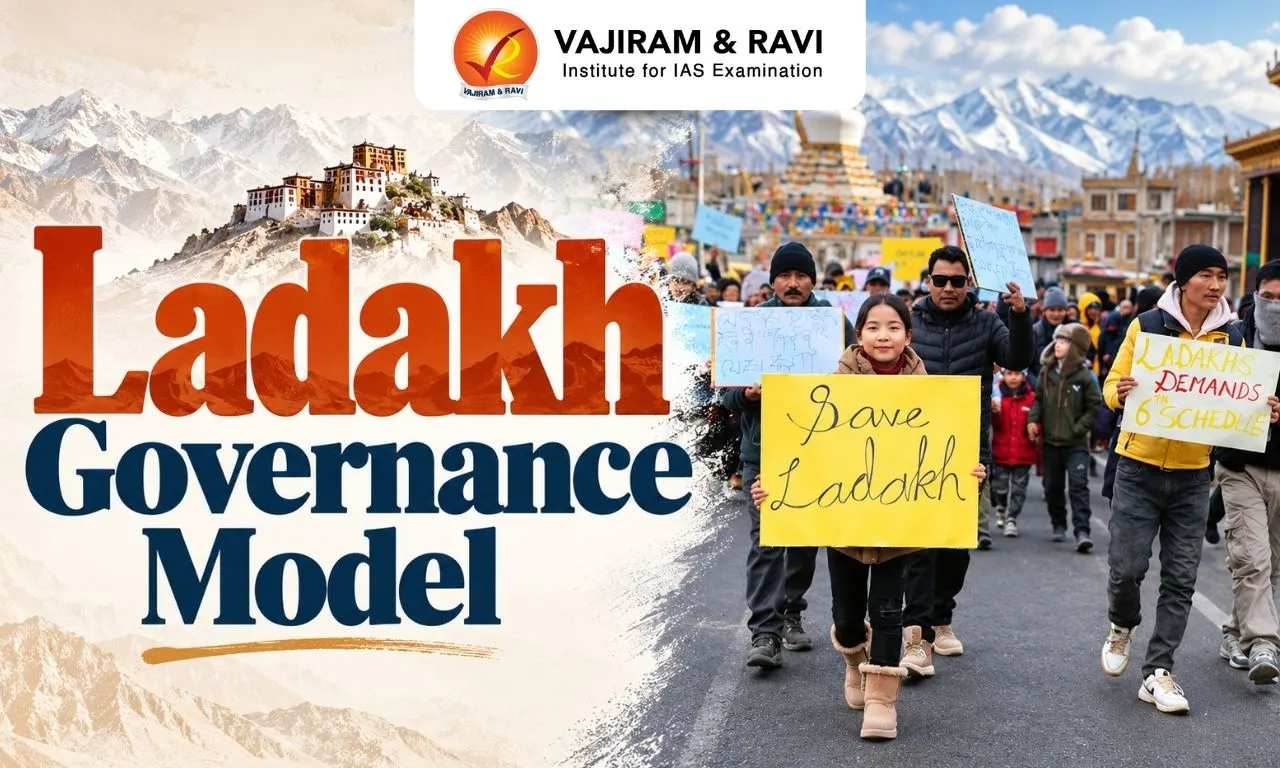
Ladakh Governance Model – Sixth Schedule and Article 371-K Explained

Ladakh Governance Model

Ladakh Governance Model Latest News

  • Ladakh’s demand for Sixth Schedule status has been accompanied by a proposal to create a directly elected legislative body through a new constitutional provision, Article 371-K.

Ladakh’s Governance Context

  • Ladakh became a Union Territory without a Legislative Assembly under the Jammu and Kashmir Reorganisation Act, 2019. 
  • The change generated concerns among local groups regarding protection of the region’s culture, language, traditions, customary practices and land rights, along with demands for greater political representation.
  • The Sixth Schedule emerged as a major demand because it provides constitutionally recognised mechanisms for autonomous local governance, particularly in areas with significant tribal populations.
  • The current debate therefore concerns how Ladakh can receive greater local participation and institutional protection while retaining its status as a Union Territory.

About the Sixth Schedule

  • The Sixth Schedule is implemented through Articles 244(2) and 275(1) of the Constitution and currently applies to specified tribal areas in Assam, Meghalaya, Tripura and Mizoram.
  • It provides for Autonomous District Councils with substantial powers over local governance. 
  • A district council can have a maximum of 30 members, with the institutional structure designed to provide greater autonomy to communities in designated areas.
  • The historical basis of the Sixth Schedule lies partly in the administrative treatment of several tribal areas during British rule. Meghalaya, Tripura and Mizoram subsequently became separate States while retaining Sixth Schedule protections in specified areas.
  • The underlying objective is to provide institutional mechanisms through which distinct tribal communities can participate in governing matters affecting their social, cultural and economic interests.

Why Has Ladakh Demanded Sixth Schedule Status?

  • Ladakh has a distinctive ethnic, cultural and geographical character, which has contributed to demands for stronger constitutional safeguards.
  • The major concerns include:
    • Protection of local languages, traditions and customary practices. 
    • Safeguarding local land rights against excessive acquisition by outsiders. 
    • Greater political representation for the local population. 
    • Greater participation in decisions affecting development and governance. 
  • The demand also reflects the broader constitutional objective of accommodating India's diverse social and cultural communities within democratic institutions.

Proposed Article 371-K

  • Instead of extending Sixth Schedule provisions to Ladakh, the Central Government has proposed inserting Article 371-K into Part XXI of the Constitution, which deals with temporary, transitional and special provisions.
  • The proposed framework seeks to create a directly elected legislative authority for Ladakh while maintaining the Union Territory's existing constitutional position.
  • The proposed institution could potentially be placed above the existing Ladakh Autonomous Hill Development Councils (LAHDCs) while retaining panchayats and other district-level institutions.
  • The objective is to establish a governance structure that combines local democratic participation with Union-level administration.

Key Questions Under the Proposed Model

  • Role of the Lieutenant Governor
    • The precise relationship between the proposed legislative authority and the Lieutenant Governor would need to be defined, particularly regarding executive and administrative powers.
  • Financial Autonomy
    • The extent of financial powers available to the proposed authority is another important issue. This includes questions concerning taxation, expenditure and control over financial resources.
  • Relationship with Existing Institutions
    • The proposed body would have to function alongside the LAHDCs, panchayats and district-level institutions. Clear allocation of functions would be necessary to avoid overlapping jurisdictions.
  • National Security
    • Ladakh's strategic geographical location makes national security an important consideration in designing its governance framework. The proposed model therefore seeks to balance local autonomy with the Union's responsibilities relating to territorial security.

Is Special Constitutional Status for a UT Possible?

  • Providing a special governance arrangement to a Union Territory is constitutionally possible.
  • India's constitutional framework does not follow a completely uniform model for every territorial unit. 
  • Parliament has previously created special arrangements for Union Territories, including the National Capital Territory of Delhi under Articles 239AA and 239AB.
  • Therefore, a special constitutional provision for Ladakh would represent another example of differentiated governance within India's federal structure.

Balancing Local Autonomy and National Administration

  • The Ladakh debate illustrates an important feature of Indian federalism: constitutional governance can accommodate different institutional arrangements for different territories.
  • The challenge is to create sufficient space for local democratic participation and protection of cultural interests while maintaining administrative coordination and national responsibilities.
  • A directly elected legislative authority under a special constitutional provision could potentially provide a framework for this balance, although its effectiveness would depend on the precise distribution of legislative, administrative and financial powers.

Source: TH

Ladakh Governance Model FAQs

Q1: When did Ladakh become a Union Territory?

Ans: Ladakh became a Union Territory without a Legislative Assembly under the Jammu and Kashmir Reorganisation Act, 2019.

Q2: Which States are currently covered by the Sixth Schedule?

Ans: The Sixth Schedule applies to specified tribal areas in Assam, Meghalaya, Tripura and Mizoram.

Q3: Which Articles govern the Sixth Schedule?

Ans: The Sixth Schedule operates primarily through Articles 244(2) and 275(1).

Q4: What is proposed under Article 371-K?

Ans: Article 371-K has been proposed to provide Ladakh with a directly elected legislative authority for local governance.

Q5: What are the existing major local governance institutions in Ladakh?

Ans: The Ladakh Autonomous Hill Development Councils, panchayats and district-level institutions are among the existing local governance structures.
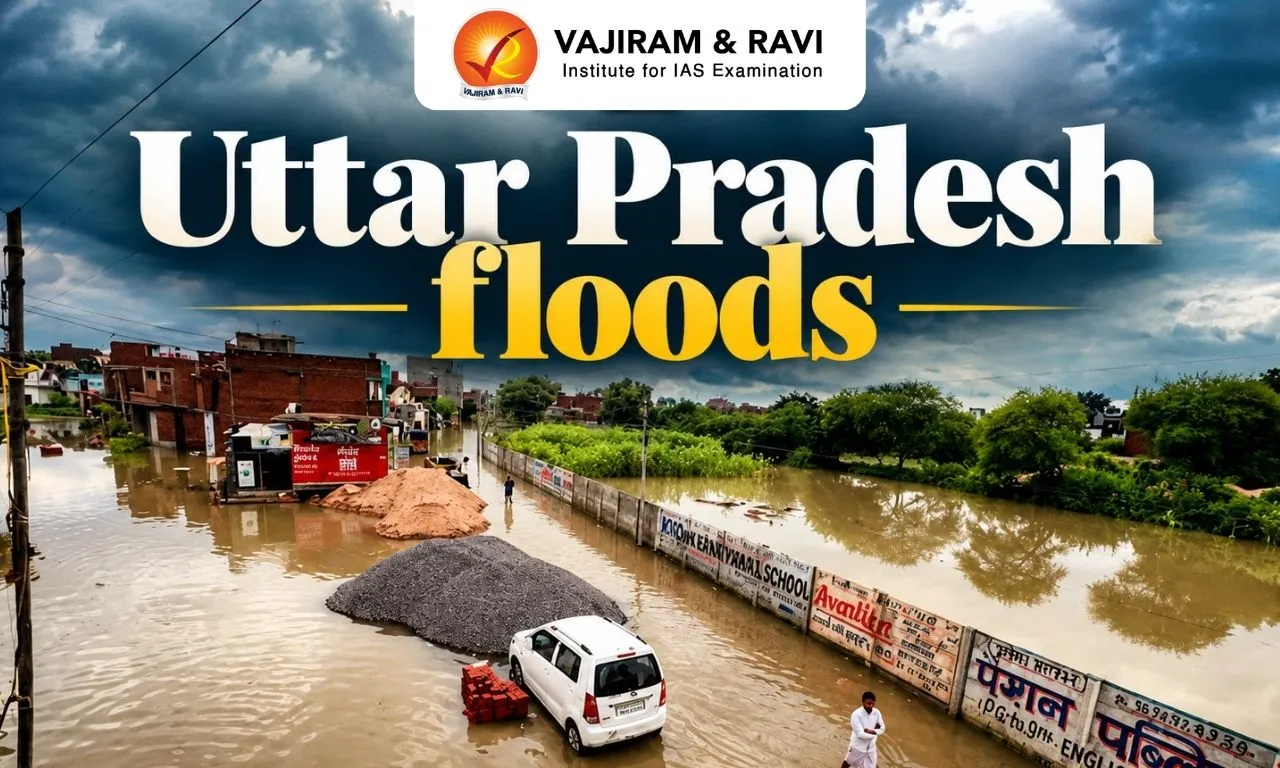

Uttar Pradesh Floods: How Two Weather Systems Collided

Uttar Pradesh Floods

Uttar Pradesh Floods Latest News

  • An intense three-day wet spell in Uttar Pradesh has left several districts facing a flood-like situation, disrupting normal life and damaging crops. 
  • Between September 25 and September 27 morning, 56 people died and 46 were injured in rain and storm-related incidents, according to the state's Office of Relief Commissioner. As many as 1,021 houses were damaged.

The Scale of the Impact

  • Heavy rain lashed Kanpur, Varanasi, Prayagraj, Gorakhpur, Bareilly, and several other parts of the state.
  • Strong winds reaching 30–40 kmph accompanied the downpour, uprooting trees and electric poles and inundating roads, lanes and villages.
  • The state received 45.1 mm of rainfall in the 24 hours ending September 27, against a normal of just 1.8 mm — a massive deviation.
  • 56 of Uttar Pradesh's 75 districts recorded excessive rainfall.
  • According to the India Meteorological Department (IMD), the flood-like situation stems from the likely interaction of two different weather systems.

The First System: A Deep Depression from the Bay of Bengal

  • The IMD noted that a deep depression lay centred over parts of north-eastern Madhya Pradesh and adjoining south-eastern Uttar Pradesh.
  • The depression had formed over the Bay of Bengal, crossed the North Andhra Pradesh–South Odisha coast, and then weakened.

What is a Depression?

  • It is an organised low-pressure weather system.
  • A low-pressure area forms where atmospheric pressure is lower than surroundings, typically due to localised heating over a landmass from greater sunshine.
  • The heated air becomes less dense, rises, and lowers atmospheric pressure further.
  • Simultaneously, warm, moist air flows inward toward the low-pressure centre and moves upward, where it cools and condenses into clouds and rain (or snow).

Effects and Trajectory

  • Depressions typically produce strong winds and heavy rain.
  • As a depression degrades into a well-marked low-pressure area, it loses strength — wind speeds drop, reducing rain intensity.
  • By 5:30 am on Sunday, the IMD noted the system had moved north-northwestwards and weakened into a well-marked low-pressure area.
  • It was expected to continue in the same direction across Uttar Pradesh, gradually weakening further into a low-pressure area over the following 12 hours.

The Second System: A Western Disturbance

  • The IMD's note also flagged a "likely interaction" with a Western Disturbance (WD), which could bring:
    • Strong gusty surface winds.
    • Heavy to very heavy rainfall, with isolated extremely heavy rainfall in the central Terai belt.
    • Exceptionally heavy rainfall (>30 cm) at one or two places.

What is a Western Disturbance (WD)?

  • WDs are weather systems that typically travel into northern India from the west.
  • They are east-moving, rain-bearing wind systems originating beyond Afghanistan and Iran.
  • They gather moisture from the Mediterranean Sea, Black Sea, Caspian Sea, and the Arabian Sea.
  • WDs are essentially extra-tropical cyclones, formed through interactions between polar and tropical winds.

How WDs reach India

  • The subtropical westerly jet stream — a high-altitude, fast-moving west-to-east air current — carries WDs toward the Himalayan and Tibetan highlands.
  • As moisture-laden WDs strike the Himalayas, they rise and cool, producing cloudy weather, rain, and thunderstorms, especially over north and northwest India.

Current Status

  • The IMD's weather bulletin for Uttar Pradesh noted this WD was present high up in the atmosphere as a trough — an elongated zone of relatively lower pressure — over northwestern India.

Why the Interaction Matters

  • The interaction between the Western Disturbance and the deep depression, occurring even as the southwest monsoon withdraws across north and northwestern India, is what has produced these intense spells of rainfall over specific areas of Uttar Pradesh.
  • This timing is significant: two independent weather systems — one tropical (from the Bay of Bengal) and one extra-tropical (from west/central Asia) — converged over the same region during the monsoon withdrawal phase, a period that already tends to be meteorologically unstable.

Conclusion

  • Uttar Pradesh's floods illustrate how India's weather is shaped by systems from opposite directions — a Bay of Bengal depression from the east, and a Western Disturbance from the west — meeting over the same terrain. 
  • As the monsoon's retreat becomes less predictable, such cross-system interactions may become a more frequent source of extreme, localised rainfall events.

Source: IE

Uttar Pradesh Floods FAQs

Q1: What caused the recent Uttar Pradesh floods and flood-like conditions?

Ans: The Uttar Pradesh floods resulted from the interaction of a Bay of Bengal depression and a Western Disturbance during the monsoon withdrawal phase.

Q2: What was the first weather system behind the Uttar Pradesh floods?

Ans: The first system was a deep depression formed over the Bay of Bengal that moved across Andhra Pradesh, Odisha and Uttar Pradesh.

Q3: What is a Western Disturbance associated with Uttar Pradesh floods?

Ans: A Western Disturbance is an east-moving, rain-bearing extra-tropical weather system originating beyond Afghanistan and Iran and affecting northern India.

Q4: Why did the two systems intensify rainfall during the Uttar Pradesh floods?

Ans: Their convergence brought tropical and extra-tropical systems together over Uttar Pradesh, producing intense rainfall while the southwest monsoon was withdrawing.

Q5: How severe was the rainfall associated with the Uttar Pradesh floods?

Ans: Uttar Pradesh received 45.1 mm rainfall in 24 hours against a normal 1.8 mm, while 56 districts recorded excessive rainfall.

Rare-Disease Drugs: Can India Become a Global Drug Hub?

Rare-Disease Drugs

Rare-Disease Drugs Latest News

  • India transformed global healthcare by making generic drugs affordable. Experts argue that the next frontier for India is to make rare-disease drugs accessible. 
  • With a streamlined regulatory pathway and government procurement, India could build a globally competitive rare-disease pharmaceutical sector.

Understanding the Scale of the Problem

  • Each rare disease affects very few people, but collectively the numbers are staggering.
  • There are around 8,000 rare diseases worldwide, cumulatively affecting hundreds of millions of people.
  • In India, 1,004 rare genetic disorders have been reported so far.
  • Because patient numbers for any single disease are tiny, pharmaceutical interest has historically been limited — hence the term "orphan drugs."

How Other Countries Solved This: The Orphan Drug Act

  • To overcome industry hesitancy, several governments introduced incentives.
  • The US Orphan Drug Act (1983) offered tax incentives, seven years of market exclusivity, grants, and regulatory fee waivers.
  • Impact: Before the Act, only 38 relevant drugs had been approved in the US. By 2022, this rose to 1,122 approvals.
  • Japan, Australia, and the European Union later adopted similar legislation.
  • The catch: Because markets remain small, companies set very high prices. A year's treatment can cost $100,000 (₹1 crore) or more — putting it out of reach without insurance or government support.

India's Current Support System — and Its Limits

  • The Indian government supports rare disease patients with up to ₹50 lakh total for treatment.
  • This is often insufficient to cover even a year's costs, forcing patients toward crowdfunding.
  • Example: In mid-2025, ₹9 crore was crowdfunded for gene therapy for a 16-month-old child in Kolkata.
  • Nearly 4,000 children are listed on a Government of India crowdfunding platform, with cumulative annual treatment costs exceeding ₹9,000 crore.
  • Existing drugs cover only about 5% of rare diseases — most patients have no suitable drug at all, even at high cost.

The Two Core Challenges in Drug Development

  • Finding a patient cohort large enough for clinical trials.
  • Determining trial endpoints — what "success" means for a very rare condition.
  • Beyond approval, affordable, high-quality small-scale manufacturing and distribution remain major hurdles.

India's Advantage: A Natural Trial Ground

  • India's demographics make it uniquely suited for rare-disease research.
  • With a population exceeding 1.4 billion, India has large absolute numbers of patients even for very rare conditions.
  • High rates of endogamy in certain communities raise disease prevalence further. For instance, beta-thalassemia prevalence is 10.5% in specific ethnic groups, versus 3.7% in India's general population (2023 review).
  • The Indian diaspora's gene pool carries unique mutations across ethnicities, adding further research value.

The Gap

  • Indian patients rarely participate in international orphan-drug trials, despite this potential. 
  • Analysts suggest government-fostered collaboration between foreign companies and local organisations — similar to India's approach in chip manufacturing — and inviting multinational firms to set up rare-disease drug-development centres with patient groups.

A Benefit-Sharing Model for Pricing

  • Experts propose a key principle: Indian patients participating in drug development should be beneficiaries of the resulting drugs, not just data sources.
  • Proposal: India should be allowed to decide the price of drugs sold domestically or in the Global South, while companies remain free to set prices elsewhere.
  • This echoes the benefit-sharing concept discussed under the WHO's Pandemic Agreement, where pathogen information shared globally must lead to fair, equitable access to resulting drugs and vaccines.
  • US and Chinese firms are already racing on rare-disease drugs, with China leveraging patient access and low-cost manufacturing. Western companies may find India an attractive collaboration partner too.

India's Manufacturing Strength

  • India is already the "pharmacy of the world" for generics.
    • India fills 47% of US generic prescriptions.
    • It has the largest number of US-regulator-approved manufacturing sites outside the US.
    • Indian firms supply 15% of all biosimilars sold in the US.
    • Indian facilities now produce CAR-T therapy — a personalised cancer treatment — to international standards.
  • Regulatory shortcut: Under Rule 101 of the New Drugs and Clinical Trials Rules, 2019, the CDSCO allows drugs already approved in six specified countries (including the US and UK) to skip a fresh Indian clinical trial before regulatory approval. 
  • This is a strong incentive for manufacturing such drugs locally — though the authors call for greater transparency and guidance documents to ease the application process. 

What the Government Should Do

  • Analysts propose a policy package modelled on Production-Linked Incentive (PLI) schemes:
    • Tax incentives for investing in orphan drug manufacturing.
    • Production-linked incentives for approved orphan drugs.
    • Support for technology transfer with national laboratories.
    • Advance Market Commitments (AMCs) — government pre-committing to buy a certain output at a set price.
    • Distribution through Centres of Excellence on Rare Diseases, the Central Government Health Scheme, and Pradhan Mantri Bhartiya Jan Aushadhi Kendras.
    • Incentives for exporting to low- and middle-income countries.
  • The Underlying Philosophy: The goal shouldn't be simply subsidising companies, but de-risking initial investment enough to make orphan drug manufacturing commercially viable on its own.

Source: TH | RD

Rare-Disease Drugs FAQs

Q1: Why are rare-disease drugs difficult to develop commercially?

Ans: Rare-disease drugs have limited patient populations, making clinical trials difficult and reducing pharmaceutical companies' commercial incentives to develop them.

Q2: What incentives did the US Orphan Drug Act provide for rare-disease drugs?

Ans: The US Orphan Drug Act provided tax incentives, market exclusivity, grants and regulatory fee waivers to encourage rare-disease drugs development.

Q3: What support does India currently provide for rare-disease treatment?

Ans: India provides up to ₹50 lakh for rare-disease treatment, but the support can remain inadequate against extremely high treatment costs.

Q4: Why could India become a research hub for rare-disease drugs?

Ans: India's large population, diverse genetic groups and manufacturing capabilities provide opportunities for clinical research and production of rare-disease drugs.

Q5: What policies could strengthen India's rare-disease drugs ecosystem?

Ans: Proposed measures include tax incentives, production-linked incentives, technology transfer, advance market commitments and distribution through specialised health centres.

Enquire Now

