
Great Indian Bustard Conservation: Rewilding and Recovery Challenges

Great Indian Bustard conservation

Great Indian Bustard conservation Latest News

  • Recently, India achieved a conservation milestone — two captive-bred male Great Indian Bustards (GIBs) were released into the wild for the first time, at Desert National Park, near Jaisalmer, Rajasthan. 
  • This rewilding pilot is part of Project GIB, run by the Centre, Wildlife Institute of India (WII), and the governments of Rajasthan and Gujarat. While historic, experts caution that population recovery remains a long-term challenge.

The Great Indian Bustard: Why It Matters

  • The GIB is a large, ground-dwelling bird found in savannahs, grasslands, and deserts. 
  • Until the late 19th/early 20th century, it was spread across 11 states — from Haryana in the north to Tamil Nadu in the south, and Rajasthan in the west to Odisha in the east.

Causes of Decline

  • Hunting and egg poaching.
  • Conversion of open habitats into croplands and mining areas.
  • Collisions with renewable energy power lines — the GIB’s poor frontal vision and heavy body make it hard to detect or avoid overhead wires.

Population Collapse

  • From an estimated 1,260–1,400 birds in the early 1970s, numbers have crashed to just around 150 today.
  • Of these, around 130 (±20) are in Rajasthan — the rest scattered across Gujarat, Maharashtra, Karnataka, Telangana, and Andhra Pradesh, facing local extinction risk.

Project GIB: The Conservation Breeding Effort

  • A long-term bustard and lesser florican conservation project was launched by the Centre and Rajasthan government in 2012–13, expanded from 2014 with funding for a conservation breeding programme.
  • From 2019, wild GIB eggs were collected from Desert National Park and nearby areas, artificially incubated at two centres — Sam and Ramdevra (Rajasthan) — and hand-reared.
  • These hand-reared birds have since bred at the centres, producing 98 birds so far.
  • Of these: 2 released (Oct 4, 2026); 11 earmarked for future wild release; the rest remain in captivity for continued breeding.

What Does Rewilding Involve?

  • Rewilding means transitioning captive-bred birds back into natural habitats. 
  • Key steps taken:
    • A rewilding aviary was set up at Ramdevra Centre, and a soft-release facility developed by WII inside Desert National Park.
    • Unlike hand-reared adult birds (used to humans), chicks aged 3–4 months were released here, allowing them to adapt naturally without human imprinting.
    • Released birds are fitted with transmitters, sending location/movement alerts three times daily; teams also monitor them remotely.
    • Release sites were chosen for their grassland cover and freedom from human/technological interference.

Challenges to Long-Term Recovery

  • Scaling Beyond Rajasthan: Similar rewilding efforts will be needed in Maharashtra, Madhya Pradesh, Karnataka, and Andhra Pradesh — but only after habitat improvement. 
  • Experts noted that grassland restoration and protection outside Rajasthan is crucial for wider revival, with Gujarat likely to follow if the Rajasthan pilot succeeds.

The Grassland Protection Gap

  • Unlike forests, grasslands are not traditionally treated as “protected areas” in public or policy perception, making them vulnerable to land-use conversion.
  • This also affects livelihoods of pastoralists and livestock-rearing communities.
  • Bustard expert had flagged this concern as early as 2008 in Hornbill magazine — warning that forest departments, not graziers, posed the bigger threat by converting grasslands into forests through afforestation and artificial waterhole creation, misunderstanding the bustard’s actual habitat needs.

Legal Safeguards and Persistent Threats

  • Following a landmark Supreme Court case on GIB protection, the Court accepted an expert panel’s recommendations and ordered:
    • Demarcation of “priority areas” — 14,013 sq km in Rajasthan and 740 sq km in Gujarat.
    • Undergrounding of 80 km of power lines in Rajasthan, to be completed between 2027 and 2028.
    • Creation of “powerline corridors” to accommodate re-routed overhead lines.

Remaining Threats

  • Experts warn rewilding won’t be sustainable unless power lines are undergrounded soon.
  • Limestone mining threatens the open, flat terrain bustards need — the Supreme Court did not order specific anti-mining measures, and mining operations are proposed on the northern side of Desert National Park, near the release site itself.

Conclusion

  • The release of two captive-bred bustards marks a symbolic breakthrough, but survival of the species hinges on far more than breeding success — it depends on protecting grasslands long dismissed as “wastelands,” undergrounding power lines on schedule, and curbing mining in critical habitats. 
  • Unless these systemic threats are addressed with the same urgency as captive breeding, rewilding risks becoming a short-lived experiment rather than a lasting recovery.

Source: IE

Great Indian Bustard Conservation FAQ

Q1: Why is Great Indian Bustard conservation important?

Ans: Great Indian Bustard conservation is critical because the species has declined from an estimated 1,260–1,400 birds in the early 1970s to around 150 today.

Q2: What is Project GIB?

Ans: Project GIB is a long-term conservation initiative involving the Centre, Wildlife Institute of India and Rajasthan and Gujarat governments to support breeding and recovery.

Q3: What does rewilding involve in Great Indian Bustard conservation?

Ans: Rewilding involves transitioning captive-bred birds into natural habitats, using soft-release facilities, young birds and transmitters for monitoring their movements.

Q4: What are the major threats to Great Indian Bustard conservation?

Ans: Major threats include habitat conversion, hunting, egg poaching, collisions with overhead power lines and limestone mining near critical grassland habitats.

Q5: What measures are needed to strengthen Great Indian Bustard conservation?

Ans: Great Indian Bustard conservation requires grassland restoration, timely undergrounding of power lines, control of mining and expansion of rewilding beyond Rajasthan.

Right to Protest in India: Constitutional Safeguards and Legal Remedies

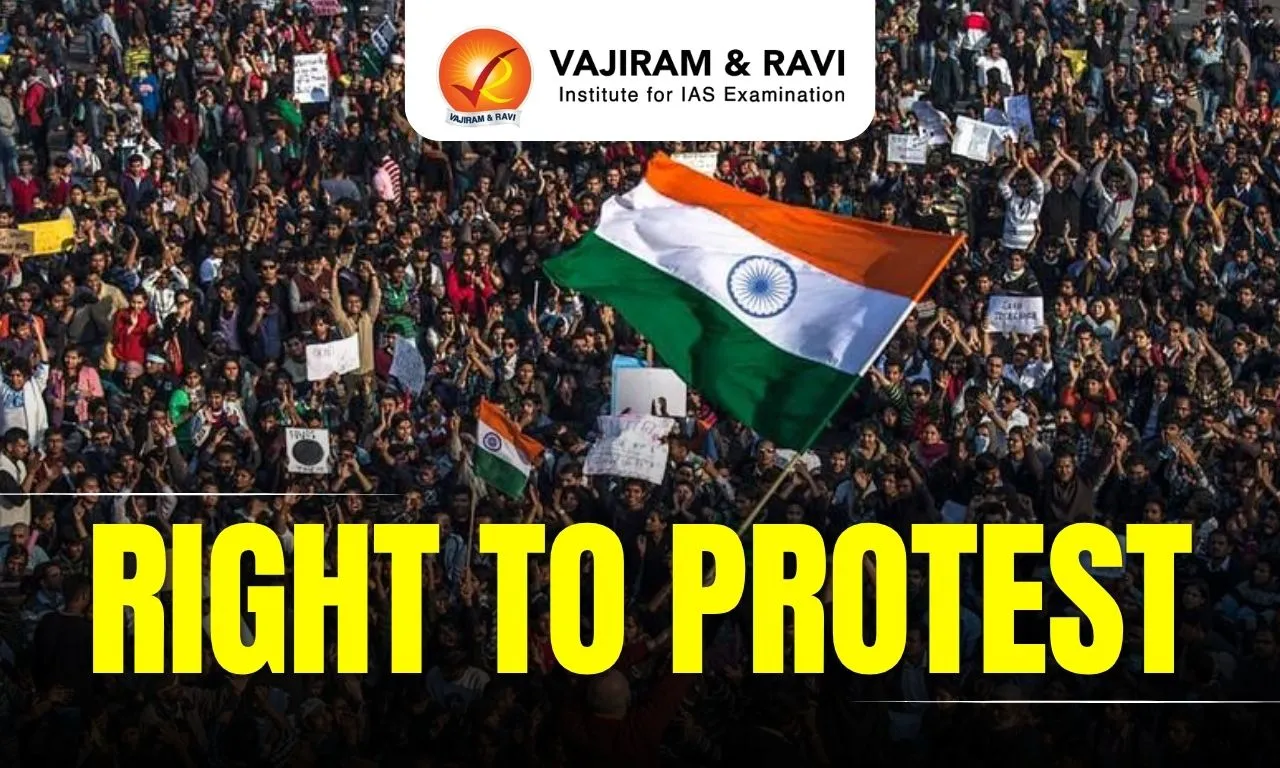
Right to Protest

Right to Protest Latest News

  • The Delhi Police recently denied permission to the Cockroach Janta Party (CJP) to protest at Jantar Mantar, citing short notice — the group had applied just three days before the march, against a required 10-day notice period. 
  • The protest sought the resignation of Chief Election Commissioner Gyanesh Kumar over alleged irregularities in the Special Intensive Revision (SIR) exercise. 
  • This episode brings back a recurring constitutional question: how far does the right to protest extend, and what can organisers do when police deny permission?

The Constitutional Right to Protest

  • The right to protest flows from Article 19(1)(a) and 19(1)(b) of the Constitution:
    • Article 19(1)(a): Protects freedom of speech and expression.
    • Article 19(1)(b): Guarantees the right to assemble peacefully and without arms.
  • However, neither right is absolute:
    • Article 19(2) permits restrictions on speech, including on grounds of public order.
    • Article 19(3) allows “reasonable restrictions” on peaceful assembly in the interest of public order.

Key Supreme Court Precedent

  • Mazdoor Kisan Shakti Sangathan (2018): The apex court held that holding peaceful demonstrations is a fundamental right, essential for citizens to air grievances. 
  • The Court found that authorities had failed to adequately regulate demonstrations and permitted a system of prior permission, to be sought from the Police Commissioner or a delegated authority.

How the Permission System Works

  • Delhi Police guidelines for protests at Jantar Mantar require:
    • Applications submitted to the Deputy Commissioner of Police (DCP), ordinarily at least 10 days before the event.
    • Late applications “may also be considered” depending on space availability and time for arrangements — the 10-day rule is not an absolute bar.
    • Applications assessed on a “first-come, first-serve” basis, reviewed by the Special Branch, traffic police, and New Delhi district police.
    • The DCP weighs whether the protest could obstruct traffic, endanger safety, or disturb public tranquillity.
    • Permission may be revoked for unforeseen reasons (VIP security, intelligence inputs), but reasons must be recorded and conveyed to organisers.
    • Protests are capped at 1,000 people at Jantar Mantar; larger gatherings must shift to Ramlila Ground (capacity: 50,000).
  • Experts noted that the permission mechanism is meant to be facilitative, not prohibitive.

Recourse When Permission Is Denied

  • Step 1 — Approach Police Again: Organisers can seek reconsideration, respond to the stated reasons, or propose a smaller gathering, shorter duration, or alternative venue.
  • Step 2 — No Formal Appeal Exists: The DCP’s decision is “final and binding” under the standing order — there is no built-in appeal against refusal (as distinct from revocation, which requires recorded reasons).
  • Step 3 — Judicial Remedy: If refusal appears arbitrary, unsupported by guidelines, or inconsistent with the right to peaceful assembly, organisers can approach the Delhi High Court under Article 226 of the Constitution.
  • Consequences of Defying Denial: Protesting despite denial can attract Section 223 of the Bharatiya Nyaya Sanhita (BNS) (formerly Section 188 IPC) — disobeying a lawful order by a public servant, inviting imprisonment or fine. 
    • However, this must be read alongside the constitutional right to protest; the absence of a genuine alternative venue could be challenged as an unreasonable restriction.

Prohibitory Orders: A Separate Legal Track

  • A prohibitory order is a magistrate’s order barring specified activities (e.g., assembly of five or more persons) under Section 163 of the BNSS (earlier Section 144 CrPC).
  • Remedies against such orders:
    • Section 163(5): An aggrieved person can apply to the issuing magistrate to rescind or alter the order.
    • Section 163(7): The magistrate must give the applicant an early opportunity to be heard; if rejected, reasons must be recorded in writing.

Key Judicial Precedents

  • Babulal Parate v. State of Maharashtra (1961): Constitution Bench held affected persons have a right to challenge such orders, even if passed without a hearing.
  • Ramlila Maidan Incident (2012): The Court held that preventive orders must be based on “actual and prominent threat” to public order, and the power must be exercised with “great caution and free from arbitrariness.”
  • Mazdoor Kisan Shakti Sangathan (2018): Reaffirmed that permission requirements cannot become a tool to reject every protest. In the Court’s words: “Total extinction is not balancing.”

The Core Legal Tension

  • Legal experts argue that blanket restrictions without offering an alternative venue amount to a constitutional violation. 
  • They emphasised that any alternative location must be in the vicinity of those in authority — protest sites far from decision-makers defeat the purpose of dissent. 
  • Blocking without providing an alternative is illegal, he argued, even when done under Section 163.

Source: IE

Right to Protest FAQs

Q1: Which constitutional provisions protect the right to protest in India?

Ans: The right to protest derives from Article 19(1)(a), protecting free expression, and Article 19(1)(b), guaranteeing peaceful assembly without arms.

Q2: What are the Delhi Police guidelines for protests at Jantar Mantar?

Ans: Delhi Police guidelines ordinarily require applications at least ten days beforehand, with permissions assessed according to space, traffic, safety and public tranquillity.

Q3: What can organisers do if permission to protest is denied?

Ans: Organisers can seek reconsideration, propose changes to the gathering or venue, or approach the Delhi High Court under Article 226 if refusal appears arbitrary.

Q4: How can citizens challenge prohibitory orders restricting protests?

Ans: Under Section 163(5) of the BNSS, affected persons can request the issuing magistrate to rescind or modify an order restricting assembly.

Q5: What limits has the Supreme Court placed on restrictions on protests?

Ans: The Supreme Court has held that restrictions must address genuine public-order concerns and cannot arbitrarily eliminate peaceful demonstrations or deny meaningful opportunities for dissent.

US Section 301 Investigation – Impact on India’s Trade and Tariffs

US Section 301 Investigation

US Section 301 Latest News

  • India has joined a joint statement by 14 countries and the European Union acknowledging concerns over global structural overcapacity, a development that could influence the outcome of the US Section 301 investigation and proposed tariffs on Indian goods.

Understanding Global Manufacturing Overcapacity

  • Global manufacturing overcapacity refers to a situation in which an economy or industry produces more goods than domestic and international markets can absorb at prevailing prices.
  • It can emerge because of excessive investment, government support, weak demand, inefficient allocation of capital or the expansion of production beyond sustainable market requirements. Overcapacity may lead to:
    • Price distortions: Excess supply can depress international prices and affect competing producers.
    • Trade tensions: Countries may accuse competitors of using subsidies or other non-market practices to gain an unfair advantage.
    • Industrial disruption: Domestic manufacturers may struggle to compete with cheaper imports, potentially affecting employment and investment.
    • Trade protectionism: Governments may introduce tariffs or other restrictions to protect domestic industries.
  • Sectors identified as areas of concern in the recent international discussions include automobiles, electric vehicles, batteries, chemicals, foundational semiconductors and solar panels. China is frequently accused of having excess capacity in several of these sectors.
  • However, determining whether excess capacity exists, and whether it results from unfair trade practices, requires sector-specific evidence and careful economic assessment.

US Section 301 Investigation

  • Section 301 of the US Trade Act of 1974 provides a mechanism through which the United States investigates foreign government practices that it considers unreasonable, discriminatory or restrictive to US commerce.
  • The process can have significant implications for international trade because it may lead to trade restrictions or additional tariffs, depending on the findings and actions taken by the US authorities.

Key Developments

  • International consultations: At the G20 Trade Ministers’ Meeting held in Milwaukee on September 30 and October 1, 2026, participating countries discussed the impact of global overcapacity.
  • Joint statement: The United States announced on October 7 that participating countries had acknowledged the challenges posed by structural excess capacity and production.
  • Technical discussions: The countries committed to meeting before December 2026 to develop terms of reference, exchange non-confidential information and identify gaps in available data.
  • Potential tariff implications: Experts cited in the report suggested that India's participation could influence the US Trade Representative's decision on proposed tariffs. However, this outcome remains uncertain pending the investigation's results.
  • The investigation covers multiple economies, including China, India, Japan, South Korea, several Southeast Asian countries and members of the European Union.

Why Is India’s Position Significant?

  • India's participation reflects an attempt to engage with international concerns over manufacturing while protecting its domestic industrial interests.
  • Commerce Minister Piyush Goyal has maintained that India's manufacturing capacity in the sectors identified by the G20 Presidency serves domestic and global demand, and that the country does not have structural excess capacity in these sectors.
  • India's position is significant for three reasons.
    • First, tariff exposure: Cooperation with the United States could potentially reduce the likelihood of additional trade restrictions, although this is not guaranteed.
    • Second, export competitiveness: More favourable tariff treatment could help Indian exporters compete with manufacturers from China and ASEAN economies in the US market.
    • Third, industrial policy: India must ensure that international cooperation does not undermine legitimate efforts to expand domestic manufacturing, attract investment and develop strategic industries.

Challenges and Concerns for India

  • Despite the potential benefits of cooperation, the investigation raises several concerns.
  • Risk of collateral damage
    • Measures designed to address global overcapacity may affect countries beyond those primarily associated with the problem. India's industrial expansion could come under scrutiny if production growth is interpreted as creating excess capacity.
  • Conflict between industrialisation and trade restrictions
    • Developing economies often expand manufacturing to generate employment, improve productivity and reduce import dependence. Restrictions based on broad interpretations of overcapacity could constrain these objectives.
  • Unequal treatment of subsidies
    • The report raises the concern that international discussions should also examine agricultural overcapacity and subsidised exports in developed economies, particularly their effects on farmers and rural livelihoods in developing countries.
  • Impact on domestic industrial corridors
    • An August 2026 US report criticised several global manufacturing hubs, including the Pune-Gujarat-Chennai industrial corridor. 
    • Such criticism highlights the potential for trade investigations to become connected with wider competition over industrial capacity and manufacturing investment.

Way Forward

  • Evidence-based assessment: Use sector-specific production, demand, capacity utilisation and export data to demonstrate that manufacturing expansion is commercially justified.
  • Constructive negotiations: Engage with the United States to seek clarity on the criteria used to identify structural overcapacity and the potential consequences for Indian exporters.
  • Protect policy space: Ensure that international cooperation does not automatically imply acceptance of allegations against Indian manufacturing or restrict legitimate industrial development.
  • Strengthen competitiveness: Improve logistics, infrastructure, skills, technology adoption and productivity to make Indian manufacturing competitive without relying on trade distortions.
  • Promote multilateral solutions: Use platforms such as the G20 and OECD-related forums to develop transparent and balanced approaches to global trade imbalances.

Source: IE

US Section 301 FAQs

Q1: What is the US Section 301 investigation?

Ans: It is a US trade investigation examining foreign government practices considered unreasonable, discriminatory or restrictive to US commerce, with the current probe focusing on structural manufacturing overcapacity.

Q2: What does global manufacturing overcapacity mean?

Ans: It refers to a situation in which production exceeds the demand that domestic and international markets can absorb at prevailing prices.

Q3: Why is India participating in discussions on global overcapacity?

Ans: India is engaging in international discussions that could influence trade relations and tariff decisions while maintaining that its manufacturing capacity serves domestic and global demand.

Q4: Which sectors are under scrutiny in the overcapacity discussions?

Ans: The sectors identified include automobiles, electric vehicles, batteries, chemicals, foundational semiconductors and solar panels.

Q5: Could the investigation lead to additional tariffs on India?

Ans: Additional tariffs remain a possibility, but India's participation in the joint statement could influence the US decision; the final outcome depends on the investigation and subsequent action.

India’s Bilateral Investment Treaties (BITs) – Balancing Investor Protection with State Sovereignty

Bilateral Investment Treaties

Bilateral Investment Treaties (BITs) Latest News

  • After terminating several bilateral investment treaties (BITs) in 2016–17, India is revamping its investment treaty framework to attract sustained foreign direct investment (FDI) while safeguarding its regulatory autonomy. 
  • Following the announcement in the Union Budget 2025–26 to review the 2016 Model BIT, the government is preparing a revised template, with four to five investment agreements expected to be finalised by the end of 2026.
  • India has already concluded agreements with countries such as Saudi Arabia, Israel and the UAE, reflecting a gradual shift towards a more investor-friendly approach.

What is a Bilateral Investment Treaty (BIT)?

  • A BIT is an agreement between two countries that establishes the rules for protecting and promoting investments made by investors of one country in the territory of the other.
  • Key objectives:
    • Provide legal certainty and protection against discriminatory or arbitrary treatment.
    • Build investor confidence and encourage cross-border investment.
    • Establish mechanisms for resolving investment disputes.
    • Balance investor protection with the host country's right to regulate in the public interest.
  • Evolution of India’s BIT framework:
    • 1993 Model BIT: India began concluding BITs under its original model, subsequently amended in 2003.
    • 2016 Model BIT: 
      • India adopted a revised framework emphasising the State's right to regulate and imposing stricter conditions on access to ISDS - Investor-State Dispute Settlement.
      • ISDS allows foreign investors to bring claims against host governments for alleged violations of investment treaty obligations.
      • India had signed BITs with 83 countries, of which 74 were ratified (as per data presented in Parliament in March 2023).
    • 2016–17: India issued termination notices to numerous treaty partners (~68 countries) and sought renegotiation under the revised model. 
  • Recent developments: India has signed BITs with countries including Belarus, Kyrgyz Republic, Brazil, UAE, Uzbekistan, and Taiwan.

India’s Evolving Approach to Investment Treaties

  • Relaxation of the Exhaustion of Local Remedies (ELR) requirement:
    • ELR requires foreign investors to approach the host country's domestic courts or administrative authorities before initiating international arbitration.
    • India’s 2016 Model BIT introduced a five-year local-remedies requirement, which was criticised by investors for delaying access to international dispute settlement.
    • Recent agreements indicate greater flexibility - 
      • UAE: The 2024 BIT reduced the local-remedies period to three years.
      • Saudi Arabia: The recently concluded agreement provides for a two-year period before investors can approach international arbitration.
    • Some trading partners have sought a one-year period, but India has not accepted such demands so far.
    • The Saudi agreement is particularly significant amid expectations of investment in India's refinery sector. 
    • The government argues that the revised approach improves investor access to dispute settlement while preserving the State's regulatory authority.
  • Need for a Consistent Treaty Framework:
    • India should adopt a more uniform approach to ELR provisions. 
    • A period of one to two years for pursuing domestic remedies could improve investor confidence. 
    • The overall limitation period for initiating investor-state claims should also be practical rather than excessively restrictive.

Investor Rights versus State Sovereignty

  • India's decision to terminate several BITs followed concerns that adverse international arbitral awards could constrain domestic policymaking. 
  • Developing countries like South Africa and Indonesia have also withdrawn from or restructured investment treaty arrangements to preserve regulatory autonomy.
  • Key concerns associated with BITs and ISDS:
    • Erosion of policy space: Treaty obligations may constrain governments' ability to regulate in the public interest.
    • High litigation costs: Defending international investment claims can impose a substantial financial burden on governments.
    • Regulatory chilling effect: Governments may hesitate to introduce legitimate regulations for fear of costly arbitration.
    • Constraints on technology transfer: Treaty protections may limit the policy instruments available to developing countries seeking to strengthen domestic productive capabilities through FDI.
    • These concerns have fuelled demands for reforming the international investment regime, particularly in the Global South.
  • Changing international practices:
    • The debate is not confined to developing countries. For example,
    • These developments illustrate growing scrutiny of the balance between investment protection, climate action and domestic regulatory autonomy.

Importance of Domestic Dispute Resolution

  • Requiring investors to exhaust domestic remedies can give governments an opportunity to understand grievances and resolve disputes before they escalate to international arbitration.
  • However, this approach will work only if investor disputes are resolved efficiently. A treaty provision alone cannot compel domestic courts to prioritise foreign investors over Indian investors.
  • A possible way forward is to establish a statutory, time-bound grievance-redressal mechanism accessible to both domestic and foreign investors. 
  • Faster dispute resolution could prevent disputes from escalating, reduce litigation costs and improve India's investment climate.

Conclusion

  • India's investment treaty reform must strike a careful balance between investor confidence and sovereign regulatory autonomy. 
  • A predictable, transparent and time-bound dispute-resolution framework, supported by a modern and consistent Model BIT, can help attract long-term FDI without compromising legitimate public-interest regulation.

Source: IE

Bilateral Investment Treaties (BITs)

Q1: What are Bilateral Investment Treaties (BITs)?

Ans: BITs establish rules for protecting cross-border investments, provide legal certainty, facilitate dispute resolution and strengthen investor confidence.

Q2: Why did India revise its Model BIT in 2016?

Ans: India revised its Model BIT in 2016 to protect regulatory autonomy and prevent excessive investor claims.

Q3: What is Investor-State Dispute Settlement (ISDS)?

Ans: ISDS enables foreign investors to bring treaty-based claims against host governments.

Q4: How does the Exhaustion of Local Remedies (ELR) requirement affect foreign investment disputes?

Ans: ELR requires investors to seek domestic remedies before international arbitration.

Q5: How can India balance investor protection with its sovereign right to regulate?

Ans: India should adopt a predictable Model BIT, establish statutory time-bound grievance redressal, etc.

Enquire Now