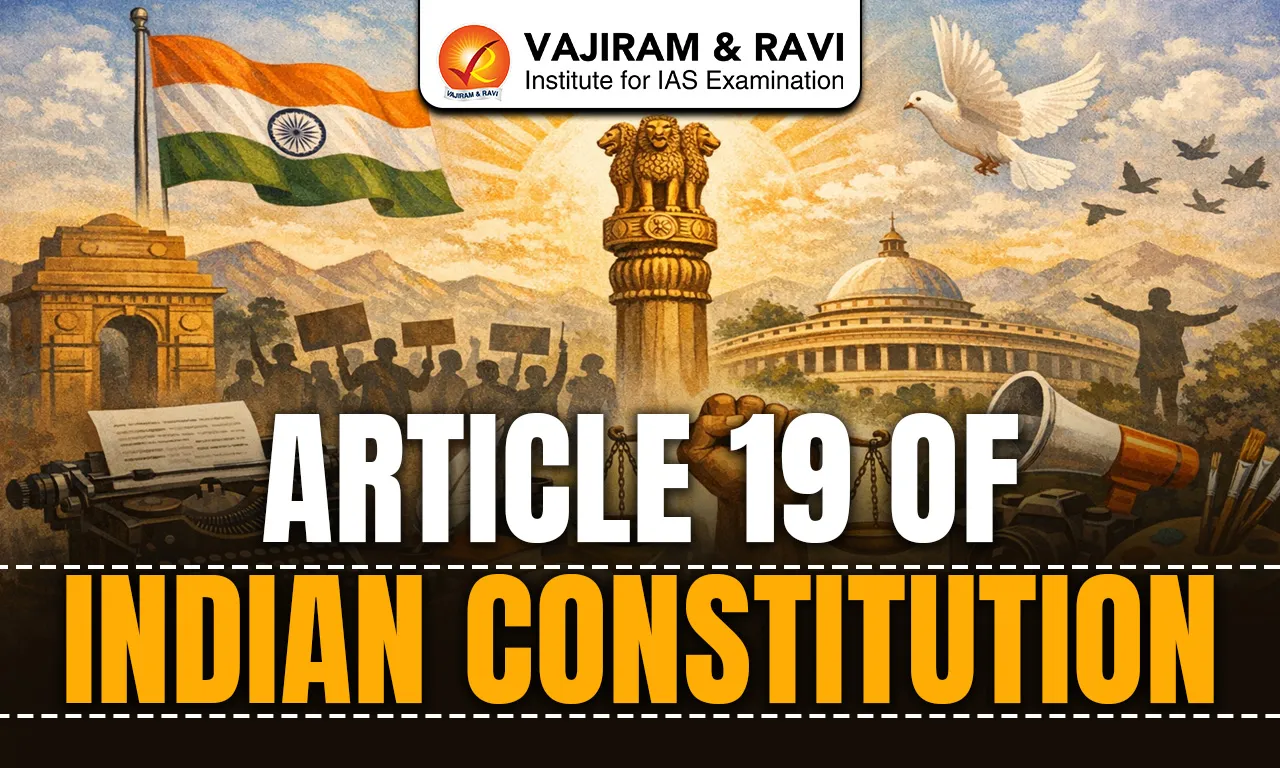
Article 19 of Indian Constitution guarantees certain important freedoms to citizens. It gives six basic rights: freedom of speech and expression, peaceful assembly, forming associations or unions, moving freely throughout India, residing and settling anywhere in India, and practicing any profession or business. These freedoms are essential for democracy and personal development. However, they are not absolute. The State can impose reasonable restrictions in the interest of security, public order, morality and sovereignty of India.
Article 19 of Indian Constitution
Article 19 guarantees six fundamental freedoms to every citizen of India. We have discussed below in brief.
Article 19(1)(a) Freedom of Speech and Expression
Article 19(1)(a) guarantees every Indian citizen the freedom to express thoughts, opinions, beliefs, and ideas through lawful means. It is the foundation of democracy, enabling citizens to participate in governance, hold authorities accountable, and exchange information freely.
- Guarantees the right to express opinions through speech, writing, printing, painting, films, electronic media, and digital platforms.
- Protects the freedom of the press, allowing the media to report news and criticize government policies within constitutional limits.
- Includes the right to receive and disseminate information, which strengthens transparency and informed decision-making.
- Recognizes the right to peaceful political dissent, criticism, debate, and discussion on public issues.
- Covers commercial speech, artistic expression, academic freedom, and symbolic expression.
- Includes the right to remain silent, as recognized by judicial interpretation.
- Encourages free exchange of ideas, innovation, and democratic participation.
Reasonable Restrictions (Article 19(2))
The freedom of speech and expression is not absolute. The State may impose reasonable restrictions by law to protect larger public and national interests. Such restrictions can be imposed on the grounds of:
- Sovereignty and Integrity of India
- Security of the State
- Friendly Relations with Foreign States
- Public Order
- Decency or Morality
- Contempt of Court
- Defamation
- Incitement to an Offence
Article 19(1)(b) Freedom to Assemble Peaceably and Without Arms
Article 19(1)(b) gives every citizen the right to gather peacefully for meetings, rallies, demonstrations, protests, and public discussions without carrying weapons. It enables citizens to collectively express their opinions and participate in democratic activities.
- Guarantees the right to peaceful assembly without arms.
- Permits public meetings, demonstrations, rallies, protests, and processions.
- Enables citizens to collectively voice their opinions on social, political, and economic issues.
- Strengthens democratic participation and public engagement.
- Protects peaceful gatherings organized for lawful purposes.
- Does not protect violent gatherings or assemblies involving weapons.
- Citizens may require prior permission from authorities for assemblies at public places as prescribed by law.
Reasonable Restrictions (Article 19(3))
The State may impose reasonable restrictions to maintain public peace and protect national interests. Restrictions can be imposed on the grounds of:
- Sovereignty and Integrity of India
- Public Order
Article 19(1)(c) Freedom to Form Associations, Unions or Cooperative Societies
Article 19(1)(c) guarantees citizens the right to form associations, unions, cooperative societies, political parties, clubs, and organizations for lawful purposes. It promotes collective action and protects organizational freedom in a democratic society.
- Guarantees the right to form associations and unions voluntarily.
- Includes the formation of political parties, trade unions, professional bodies, NGOs, clubs, and cooperative societies.
- Enables citizens to work collectively for social, cultural, economic, educational, or political objectives.
- Protects the autonomy and functioning of lawful organizations.
- Supports collective bargaining and representation of workers and professionals.
- Promotes democratic participation through organized groups.
Reasonable Restrictions (Article 19(4))
The State may regulate or restrict this freedom when necessary to safeguard constitutional values and public welfare. Restrictions may be imposed on the grounds of:
- Sovereignty and Integrity of India
- Public Order
- Morality
Article 19(1)(d) Freedom to Move Freely Throughout the Territory of India
Article 19(1)(d) ensures that every Indian citizen can move freely throughout the territory of India without unnecessary interference. The freedom promotes national integration and equal opportunities across the country.
- Guarantees free movement across all States and Union Territories.
- Allows citizens to travel for employment, education, business, tourism, and personal reasons.
- Promotes national unity by removing regional barriers.
- Ensures equal access to opportunities throughout India.
- Facilitates economic and social mobility.
- Does not extend to unrestricted access to prohibited or protected areas notified by law.
Reasonable Restrictions (Article 19(5))
The State may impose restrictions where necessary for protecting public welfare and vulnerable communities. Restrictions may be imposed:
- In the Interest of the General Public
- For the Protection of the Interests of Scheduled Tribes
- To regulate entry into protected, restricted, or environmentally sensitive areas
- During emergencies, epidemics, or situations affecting public safety
Article 19(1)(e) Freedom to Reside and Settle in Any Part of India
Article 19(1)(e) guarantees every citizen the freedom to reside and permanently settle in any part of the country. It encourages national integration and provides equal opportunities irrespective of regional boundaries.
- Guarantees the right to reside anywhere within India.
- Allows citizens to permanently settle in any State or Union Territory.
- Facilitates migration for employment, education, business, and better living conditions.
- Promotes equality among citizens irrespective of their place of origin.
- Prevents discrimination based solely on residence, except where permitted by law.
- Supports economic development through free movement of labour and skills.
Reasonable Restrictions (Article 19(5))
This freedom is subject to reasonable restrictions to protect public interests and preserve the rights of vulnerable communities. Restrictions may be imposed:
- In the Interest of the General Public
- For the Protection of the Interests of Scheduled Tribes
- To safeguard ecologically fragile or protected regions
- To preserve the cultural identity and traditional rights of tribal communities
Article 19(1)(g) Freedom to Practice Any Profession or Carry on Any Occupation, Trade or Business
Article 19(1)(g) guarantees every citizen the freedom to choose and pursue any lawful profession, occupation, trade, or business. It forms the constitutional basis of economic freedom and the right to livelihood.
- Guarantees the freedom to choose any lawful profession or occupation.
- Allows citizens to establish and operate businesses, industries, and commercial enterprises.
- Promotes entrepreneurship, innovation, and economic development.
- Protects the right to earn a livelihood through lawful means.
- Encourages fair competition and economic participation.
- Covers self-employment, professional practice, trade, commerce, and business activities.
- Subject to licensing, regulatory requirements, and professional standards where applicable.
Reasonable Restrictions (Article 19(6))
The State may regulate professional and commercial activities to protect public welfare and maintain standards. Reasonable restrictions include:
- Prescribing professional or technical qualifications for certain professions.
- Imposing reasonable restrictions in the interest of the general public.
- Regulating or licensing businesses dealing with public health, safety, or essential services.
- Creating a State monopoly in any trade, business, industry, or service where permitted by law.
- Regulating hazardous, environmentally sensitive, or socially significant commercial activities.
Article 19 of Indian Constitution Case Laws
- Romesh Thappar v. State of Madras (1950): The Supreme Court held that freedom of speech includes the right to circulate ideas, which is essential for democracy.
- Bennett Coleman & Co. v. Union of India (1972): Freedom of the press is part of Article 19(1)(a); restrictions on newspaper circulation were declared unconstitutional.
- Bijoe Emmanuel v. State of Kerala (1986): Upheld the right to remain silent; no citizen can be forced to express views against their beliefs.
- Union of India v. Naveen Jindal (2004): Hoisting the national flag is a form of expression under Article 19(1)(a).
- S.R. Bommai v. Union of India (1994): The right to form associations includes the right to form political parties.
- Kharak Singh v. State of UP (1963): Police surveillance and domiciliary visits violate the right to free movement and privacy.
- State of Gujarat v. Mirzapur Moti Kureshi (2005): Reasonable restrictions on trade, such as prohibiting cow slaughter for public welfare, are valid.
- Shreya Singhal v. Union of India (2015): Struck down Section 66A of the IT Act, protecting online speech from arbitrary restrictions.


Article 19 of Indian Constitution Key Amendments
Article 19 of the Indian Constitution guarantees six fundamental freedoms, but over time, certain amendments have expanded the State’s power to impose reasonable restrictions or changed the rights themselves. The most important amendments are the 1st, 16th, 44th, and 97th.
- 1st Amendment (1951): Introduced new grounds for restricting freedom of speech and expression, such as public order, friendly relations with other countries, and preventing incitement to an offence.
- 16th Amendment (1963): Added “sovereignty and integrity of India” as a reason to impose restrictions on the freedoms of speech, assembly, and association.
- 44th Amendment (1978): Removed the right to property (Article 19(1)(f)) from the list of fundamental rights, reducing the total freedoms under Article 19 from seven to six.
- 97th Amendment (2011): Added the right to form cooperative societies under Article 19(1)(c).
These amendments balance individual freedoms with public interest and national security, shaping the way citizens can exercise their rights today.
Suspension of Article 19 during National Emergency
- Article 19 of Indian Constitution, which guarantees six fundamental freedoms such as speech, assembly, and movement, is automatically suspended under Article 358 when a National Emergency is declared on the grounds of war or external aggression. This means the State can make laws or take actions that would otherwise violate these rights, and such actions cannot be challenged in court, as long as they are directly connected to the emergency.
- The 44th Amendment Act (1978) clarified that this automatic suspension applies only to external emergencies (war or aggression) and not to internal disturbances like armed rebellion. The suspension remains in effect for the entire duration of the National Emergency.

 Last updated on Oct, 2026
→ UPSC 2027 Notification will be released on 13 January 2027 at upsconline.nic.in.
→ Check Nobel Prize 2026 Winners List here.
→ Download PIB PRiSM Monthly Magazine 2026 here.
→ Check UPSC Monthly Current Affairs Magazine The Recitals here.
→ Check out the latest UPSC Syllabus here.
→ Download UPSC Model Answers for Mains 2026
→ UPSC Mains Question Paper 2026 is out now for Essay & GS Paper 1, 2, 3 & 4.
→ UPSC Calendar 2027 has been released.
→ Enroll in Vajiram & Ravi’s UPSC Mains Test Series 2027 for structured answer writing practice, expert evaluation, and exam-oriented feedback.
→ Join Vajiram & Ravi’s UPSC Mentorship Program 2027 for personalized guidance, strategy planning, and one-to-one support from experienced mentors.
→ Go through the UPSC Mains Previous Year Papers to enhance your preparation.
→ UPSC has released UPSC Toppers List 2025 with the Civil Services final result on its official website.
→ Also check Best UPSC Coaching in India
Article 19 of Indian Constitution FAQs
Q1. What does Article 19 guarantee?+
Q2. Can foreigners claim rights under Article 19?+
Q3. What are “reasonable restrictions” under Article 19?+
Q4. Is Article 19 suspended during an emergency?+
Q5. How are restrictions applied?+
Tags: Article 19 of Indian Constitution indian polity polity polity notes