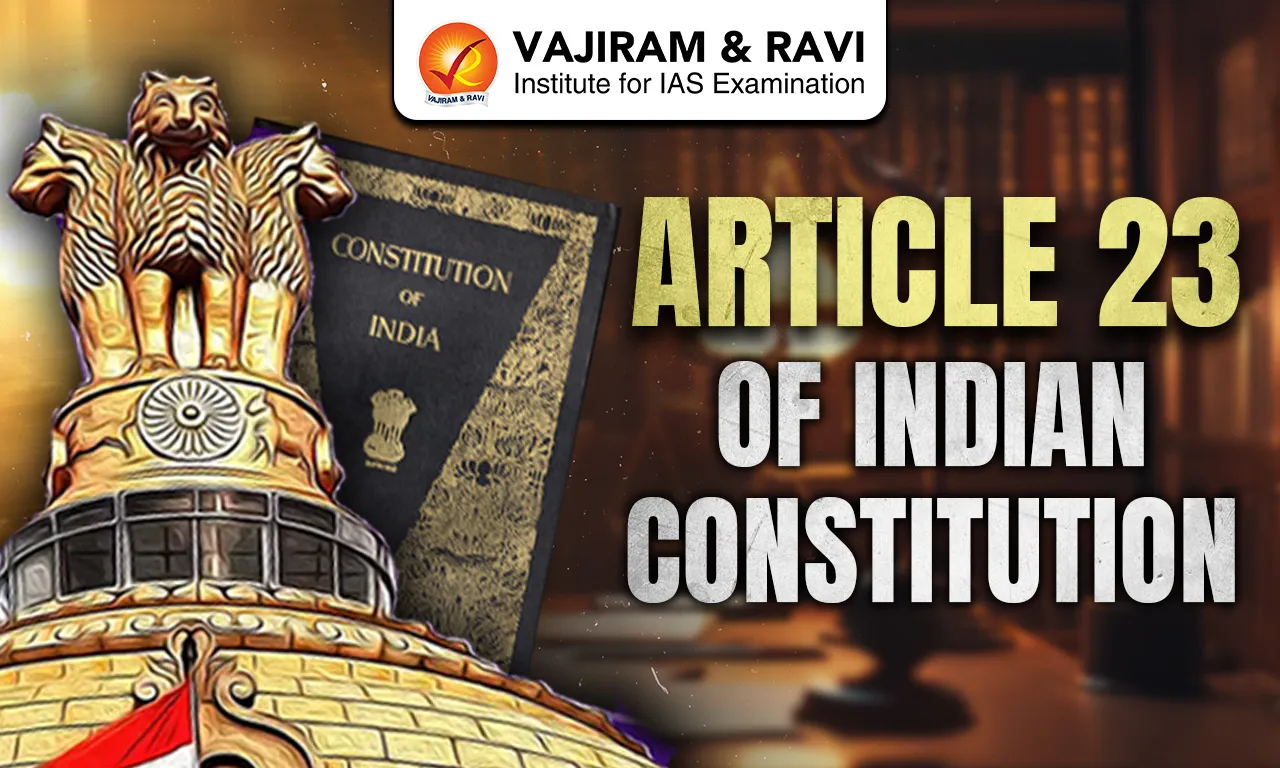
Article 23 of Indian Constitution forms a core part of the Fundamental Rights under Part III of the Constitution of India. It guarantees protection against exploitation by prohibiting human trafficking and all forms of forced labour. This provision reflects India’s commitment to dignity, equality, and social justice. It protects every individual, whether citizen or non citizen, against coercion, abuse, and practices that reduce human beings to commodities or unpaid labour.
Article 23 of Indian Constitution
Article 23 of Indian Constitution clearly declares that trafficking in human beings, begar, and other similar kinds of forced labour are strictly prohibited. Any violation of this mandate is treated as a punishable offence under law. The Article also permits the State to impose compulsory service for public purposes, but only without discrimination on grounds of religion, race, caste, or class. It applies against both State authorities and private individuals, ensuring that exploitation in any form is constitutionally forbidden.
Article 23 of Indian Constitution Provisions
Article 23 of Indian Constitution contains two clauses defining prohibition and a limited exception with safeguards against discrimination.
- Article 23 (1)- Prohibition:
- Traffic in human beings, begar, and similar forced labour are banned, and violation becomes a punishable offence under law.
- Traffic: It includes buying and selling men, women, and children as commodities, immoral trafficking, prostitution rackets, devadasi practice, and slavery like systems.
- Begar: Begar refers to compulsory unpaid work historically imposed by landlords or rulers without any remuneration to labourers.
- Forced Labour: It covers physical force, legal pressure, and economic compulsion forcing a person to work against his or her will.
- Minimum Wage: Paying less than minimum wages has been treated judicially as a form of forced labour under this Article.
- Applicability: Protection is available to citizens and non citizens alike and operates against both government authorities and private persons.
- Article 23 (2)- Exception:
- The State may impose compulsory service for public purposes such as military or social service.
- Non Discrimination: While imposing compulsory service, discrimination solely on religion, race, caste, or class is constitutionally prohibited.
- Age: The text of Article 23 does not specify any age limit within its wording.
- Legislative Support: Laws such as the Bonded Labour System Abolition Act 1976 and Immoral Traffic Prevention Act 1956 were enacted to implement its mandate.


Article 23 of Indian Constitution Case Laws
Judiciary has interpreted Article 23 of Indian Constitution broadly to expand protection against exploitation.
- People’s Union for Democratic Rights v. Union of India: Supreme Court held that force includes economic compulsion, and paying below minimum wages amounts to forced labour.
- Sanjit Roy v. State of Rajasthan: Court ruled that exemption from Minimum Wages Act in famine relief works was unconstitutional under Article 23.
- Bandhua Mukti Morcha v. Union of India: Supreme Court directed states to identify, release, and rehabilitate bonded labourers systematically.
- Deena v. Union of India: Forced prison labour without remuneration was held violative of Article 23 protections.
- Chandra v. State of Rajasthan: Rajasthan High Court invalidated compulsory unpaid village service ordered by a Sarpanch.
- Dulal Samanta v. D.M. Howrah: Court upheld compulsory police service as valid public purpose, not begar or trafficking.
- Devendra Nath Gupta v. State of Madhya Pradesh: Educational survey and election duties without extra pay were treated as valid public service.
- Vishal Jeet v. Union of India: Court emphasized protection of victims of trafficking and recognised wage denial as forced labour.

 Last updated on Oct, 2026
→ UPSC 2027 Notification will be released on 13 January 2027 at upsconline.nic.in.
→ Check Nobel Prize 2026 Winners List here.
→ Download PIB PRiSM Monthly Magazine 2026 here.
→ Check UPSC Monthly Current Affairs Magazine The Recitals here.
→ Check out the latest UPSC Syllabus here.
→ Download UPSC Model Answers for Mains 2026
→ UPSC Mains Question Paper 2026 is out now for Essay & GS Paper 1, 2, 3 & 4.
→ UPSC Calendar 2027 has been released.
→ Enroll in Vajiram & Ravi’s UPSC Mains Test Series 2027 for structured answer writing practice, expert evaluation, and exam-oriented feedback.
→ Join Vajiram & Ravi’s UPSC Mentorship Program 2027 for personalized guidance, strategy planning, and one-to-one support from experienced mentors.
→ Go through the UPSC Mains Previous Year Papers to enhance your preparation.
→ UPSC has released UPSC Toppers List 2025 with the Civil Services final result on its official website.
→ Also check Best UPSC Coaching in India
Article 23 of Indian Constitution FAQs
Q1. What does Article 23 of the Indian Constitution prohibit?+
Q2. Does Article 23 of Indian Constitution apply only to citizens?+
Q3. Is compulsory service allowed under Article 23 of Indian Constitution?+
Q4. What is meant by begar under Article 23 of Indian Constitution?+
Q5. Can paying less than minimum wages violate Article 23 of Indian Constitution?+
Tags: article 23 of indian constitution constitution