

SIR of Electoral Rolls, Comparison of 2002-04 and 2025-26

SIR of Electoral Rolls

SIR of Electoral Rolls Latest News

  • The ongoing debate over the Special Intensive Revision of electoral rolls has renewed scrutiny of the current process, particularly in comparison with the procedures followed during the 2002-04 revision.

Overview of the Special Intensive Revision

  • The Special Intensive Revision (SIR) is an exercise conducted by the Election Commission of India (ECI) to comprehensively review and update electoral rolls.
  • Section 21(3) of the Representation of the People Act, 1950, authorises the ECI to conduct a special revision of the electoral roll for any constituency or part of a constituency in a manner it considers appropriate.
  • The objective is to maintain accurate electoral rolls by identifying deceased electors, duplicate entries, changes of residence and eligible voters whose names may have been omitted.
  • The ECI initiated a nationwide SIR in June 2025, beginning with Bihar. 

SIR Process During 2002-04

  • The previous SIR, conducted between 2002 and 2004, followed detailed procedures for household verification, supervision and the treatment of electors who had changed residence.
  • Door-to-door enumeration
    • Enumerators conducted household visits using a preliminary electoral roll. Elected Panchayat members could voluntarily assist with the process.
  • Multi-level supervision
    • The guidelines prescribed substantial supervisory checks:
    • Supervisors were required to randomly verify at least 25% of the households covered by enumerators.
    • Supervisors had to personally verify houses reported as locked after repeated visits.
    • Assistant Electoral Registration Officers (AEROs), Electoral Registration Officers (EROs) and District Election Officers were required to check at least 12%, 5% and 2% of households, respectively.
  • Treatment of shifted electors
    • Electors who had changed residence were treated as transfers rather than immediate deletions. Their entries were retained in the preliminary list and marked with an “S” to indicate that they had shifted.
    • Enumerators were required to record information about the reported shift and the elector's new address or constituency. Where an entire family had moved, supervisors had to verify the case personally.
    • Since enumeration took place across areas during the same exercise, shifted electors could be enrolled at their new addresses. The Chief Electoral Officer coordinated the removal of old entries from the final roll.
  • Citizenship verification and objections
    • The guidelines placed the burden of proving citizenship on applicants seeking first-time inclusion, while also referring to Supreme Court guidance requiring EROs to give adequate evidentiary value to an applicant's presence on an existing electoral roll.
    • Bulk claims and objections submitted by individuals, organisations or political parties were to be rejected summarily. The final electoral roll was to be prepared only after all claims and objections had been disposed of.

Key Concerns Regarding the 2025-26 SIR

  • Exclusion of Electors: Electors unavailable during enumeration or who failed to submit forms were excluded from draft rolls, including previous voters. Unlike the 2002-04 exercise, shifted electors were not necessarily enrolled at their new addresses. This raises concerns about compliance with the ECI’s 2023 Manual on Electoral Rolls, which prescribes notice before deleting untraceable shifted electors.
  • Reduced Supervisory Verification: Random verification by supervisors was reduced to 10% in the Bihar SIR notification, compared with 25% during 2002-04, potentially increasing enumeration errors.
  • Burden of Establishing Eligibility: Electors were required to trace their or their parents’ names in earlier electoral rolls or submit citizenship documents, raising concerns about excessive responsibility being placed on voters.
  • Software-Generated Discrepancies: Automated flags, including spelling variations, more than six voters linked to one ancestor, and parent-child age gaps outside 15-45 years, reportedly contributed to eligible voters’ exclusion without adequate verification.
  • Bulk Objections and Appeals: Bulk Form 7 objections raised concerns about potential misuse, prompting the ECI to limit the number of objections an individual could file on October 9. Concerns also persist regarding Form 6 declarations, re-enrolment of omitted electors and delays in resolving appeals.

Scale and Implications of Voter Deletions

  • Approximately 13.3 crore voter entries were deleted across the three phases of the current SIR.

Image Caption: Categories of Deleted Voters

  • The largest category comprises electors classified as absent, shifted or falling under other reasons. Most of these individuals could remain eligible for re-enrolment once the revision process.

Reform Priorities for Electoral Roll Integrity

  • Experts recommend a set of measures to improve the accuracy, transparency and fairness of the SIR process.
    • Detailed audit: Conduct an audit of electoral rolls finalised so far to identify procedural errors and potential wrongful exclusions.
    • Door-to-door verification: Make household enumeration a prescribed procedure in States where the SIR is ongoing.
    • Expedited re-enrolment: Process eligible claims quickly through home visits, verification and timely updating of rolls.
    • Effective supervision: Strengthen field-level monitoring and verification to reduce errors during enumeration.
    • Timely disposal of claims: Finalise electoral rolls only after all claims and objections have been duly considered.
    • Continuity of electoral rolls: The proviso to Section 21(3) of the Representation of the People Act, 1950, allows existing pre-SIR rolls to remain in force for upcoming State elections while the revision is completed through due process.

Source: TH

SIR of Electoral Rolls FAQs

Q1: What is the Special Intensive Revision (SIR)?

Ans: SIR is an electoral roll revision exercise conducted by the Election Commission of India to verify voter details and update electoral rolls.

Q2: Which law authorises the ECI to conduct SIR?

Ans: Section 21(3) of the Representation of the People Act, 1950, authorises the ECI to conduct a special revision of electoral rolls.

Q3: How did the 2002–04 SIR treat voters who had shifted residence?

Ans: It treated them as transfers, retained their entries in the preliminary list and sought to enrol them at their new addresses during the same exercise.

Q4: What are the main concerns regarding the current SIR?

Ans: The concerns include exclusion of electors who were not located, reduced supervisory verification, burdensome eligibility requirements, software-generated discrepancies and bulk objections.

Q5: What measures can improve the SIR process?

Ans: Detailed audits, door-to-door verification, stronger supervision, expedited re-enrolment and timely disposal of claims and objections can improve electoral roll integrity.
Macroeconomic Stabilisation, Nobel Prize in Economics 2026 Explained

Macroeconomic Stabilisation

Macroeconomic Stabilisation Latest News

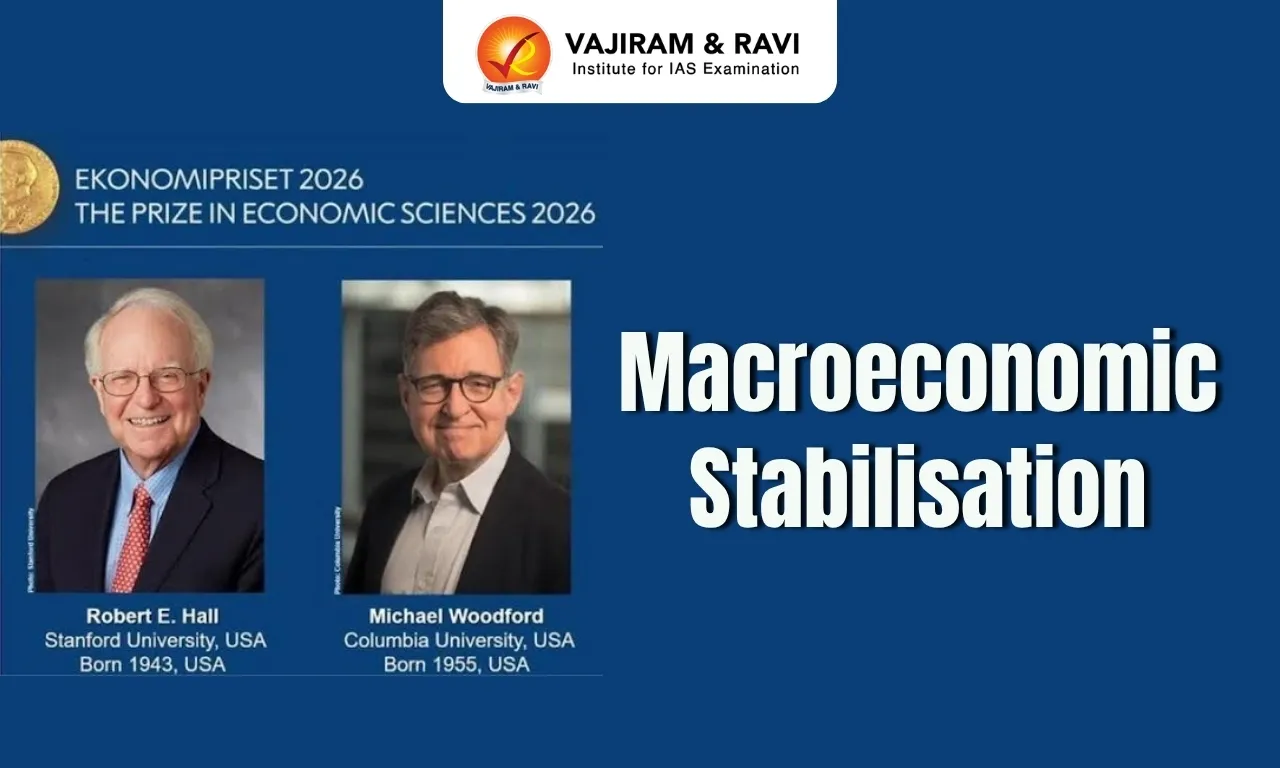
  • The 2026 Sveriges Riksbank Prize in Economic Sciences in Memory of Alfred Nobel — commonly known as the Economics Nobel — has been jointly awarded to American economists Robert E. Hall (Stanford University) and Michael Woodford (Columbia University). 
  • The official citation honours them for establishing the “microeconomic foundations of macroeconomic stabilisation.”

About Nobel Prize in Economics

  • The Economics Nobel (officially the Sveriges Riksbank Prize in Economic Sciences in Memory of Alfred Nobel) is not one of the original five Nobel Prizes. 
  • It was established by Sweden’s central bank in 1968 and first awarded in 1969.
  • This prize is administered by the Royal Swedish Academy of Sciences, honouring outstanding contributions to economics.

What Is Macroeconomic Stabilisation?

  • Stabilisation policy refers to the tools governments and central banks use to control wild swings in growth, inflation, unemployment, and business cycles.
    • E.g., the RBI raising interest rates to contain inflation, or the Indian government cutting taxes to boost consumption during slowdowns like the COVID-19 pandemic. 
  • Without such interventions, economic recovery could take far longer, with business failures and job losses spiralling further.

The Historical Backdrop: From Keynes to Crisis

  • The dominant pre-1929 view was that governments should not intervene, letting markets self-correct.
  • The 1929 stock market crash triggered the Great Depression: US GDP fell 30%, unemployment soared to 25%, and thousands of banks/businesses collapsed.
  • British economist John Maynard Keynes proposed a solution that reshaped 20th-century economics: governments should actively stabilise economies — cutting interest rates/taxes and increasing spending (even via deficits) during slowdowns, and tightening policy during overheating/inflation.
  • This Keynesian framework worked for decades — until the 1970s, when economies faced high inflation and high unemployment simultaneously (a situation called stagflation), driven by repeated oil price shocks.
  • Efforts to boost growth worsened inflation; efforts to curb inflation worsened unemployment. This crisis made many see Keynesian intervention itself as the problem.

Hall and Woodford’s Contribution: Rebuilding the Framework

  • From the late 1970s onward, Hall and Woodford revitalised Keynesian economics by grounding it in real household and firm-level data, rather than Keynes’s assumed straight-line relationships between variables.

Robert Hall — The Demand Side

  • Studied how households decide how much to consume and when to adjust spending.
  • The old assumption: consumption moves mechanically with disposable income.
  • Hall’s 1978/1982 research, using microdata from individual households, found that expectations about the future matter almost as much as current income.
  • Crucially, he showed not everyone behaves the same way — households living hand-to-mouth do not adjust consumption based on future income expectations the way wealthier households do.

Michael Woodford — The Supply Side

  • Focused on how firms set prices — showing prices are not adjusted continuously; firms fix prices for a period (e.g., ice-cream prices set at the start of summer, unchanged through the season).
  • This introduced “forward-lookingness” into supply-side theory: firms must anticipate future conditions when fixing prices now.
  • Woodford derived a formula linking aggregate inflation to expectations and current output, combining it with Hall’s demand-side insights.
  • He laid out the complete framework in his 2003 monograph, Making Things Happen: A Theory of Causal Explanation — explaining business cycles and the critical role of policy transparency.

Why Transparency Matters: The Key Policy Insight

  • Woodford’s central insight: stabilisation should not be viewed as policymakers “pulling levers” independent of public understanding. 
  • Because consumer and firm expectations about future policy directly shape economic outcomes, central banks must clearly communicate their intentions.
  • As Woodford explained at the announcement: creating a framework to talk to people about why the things being done are being done was a key goal — not merely to use the framework on people, but to engage and inform them.
  • Central bank communication (e.g., RBI policy statements, forward guidance) is now recognised as integral to policy effectiveness, not a mere add-on.

Significance Today

  • In recent years, the global economy has faced extraordinary shocks — a pandemic, multiple wars spiking commodity prices, and policy missteps like tariffs. 
  • Yet, growth has largely avoided severe recession, partly because policymakers worldwide now design interventions informed by Hall and Woodford’s research — grounded in real behavioural data and backed by transparent communication.

Source: IE | TH | TNP

Macroeconomic Stabilisation FAQs

Q1: What is macroeconomic stabilisation?

Ans: Macroeconomic stabilisation refers to government and central-bank policies designed to reduce sharp fluctuations in economic growth, inflation, unemployment and business cycles.

Q2: Who received the 2026 Nobel Prize in Economics, according to the article?

Ans: Macroeconomic stabilisation research by American economists Robert E. Hall of Stanford University and Michael Woodford of Columbia University was recognised by the 2026 Economics Nobel.

Q3: How did Keynesian economics change government responses to economic crises?

Ans: Macroeconomic stabilisation drew on Keynesian ideas, encouraging governments to increase spending and reduce taxes during downturns while tightening policies during inflationary overheating.

Q4: What were Robert Hall’s contributions to macroeconomic stabilisation?

Ans: Macroeconomic stabilisation benefited from Hall’s household-level research showing that consumption depends not only on current income but also on expectations about future income.

Q5: Why is transparency important for macroeconomic stabilisation?

Ans: Macroeconomic stabilisation becomes more effective when central banks communicate policy intentions clearly, because household and business expectations influence consumption, pricing decisions and economic outcomes.

Jantar Mantar Protest Restrictions: Who Decides Where India Can Protest?

Jantar Mantar

Jantar Mantar Latest News

  • The Delhi Police have de-notified Jantar Mantar as a designated protest site, naming Ramlila Maidan, Burari Ground (north Delhi), and CBD Ground (east Delhi) as alternatives. 
    • Earlier framework: Organisers needed to apply 10 days in advance to protest at Jantar Mantar (capped at 1,000 people); Ramlila Maidan could accommodate ~50,000 people.
  • The move followed a recommendation by a committee constituted by the Ministry of Home Affairs (MHA), with a revised SOP for the new venues to be issued separately. 
  • This comes amid heavy barricading and crackdowns on protesters in central Delhi since October 10, with demonstrators gathering even near areas under prohibitory orders under Section 163 of the BNSS.

Why Delhi Is Different: Who Controls Its Police?

  • Unlike other states, Delhi’s police and public order fall outside the legislative powers of the Delhi Legislative Assembly.
  • Under Article 239AA(3)(a) of the Constitution, the Delhi Assembly can legislate on NCT matters except those under Entries 1, 2, and 18 of the State List — covering public order, police, and land.
  • As a result, Delhi Police functions under the MHA, not the Delhi government, giving the Centre effective control over protest regulation in the capital.

The Crucial Distinction: Law and Order vs. Public Order

  • Police often invoke “law and order” to regulate protests, but Article 19 permits restrictions on fundamental rights specifically on grounds of “public order” — and the Supreme Court has treated these as distinct concepts.
  • Landmark precedent — Ram Manohar Lohia v. State of Bihar (1966):
    • The Court described three concentric circles:
      • Law and order — the largest circle.
      • Public order — a narrower circle within it.
      • Security of the State — the smallest, innermost circle.
    • An act can affect law and order without affecting public order, just as an act can affect public order without threatening state security.
  • In Re: Ramlila Maidan Incident (2012): The Court held that restrictions for law and order should be least intruding on fundamental freedoms, while restrictions for public order may justify greater restriction, since public order is of greater social concern. 
  • Crucially: Public order is something distinct from order or orderliness in a local area — a disturbance must cause actual public disorder, not just a local breach of peace.

Expert Clarification

  • Law and order = localised disturbances (e.g., two people fighting, a car blocking a road).
  • Public order = disruptions affecting the wider community (e.g., large-scale disruption of transport or communication).
  • Law and order is not a valid basis to limit the right to speech and expression.
  • Police cannot invoke public order on their own — a law must first grant them that power, and police must identify the specific law under which they act.

How Are Protest Sites Legally Designated?

  • Himat Lal K. Shah v. Commissioner of Police, Ahmedabad (1972)
    • The Court held police can require prior permission for public meetings on streets — “nothing wrong” with that.
    • However, the State cannot abridge the right of assembly by prohibiting assembly on every public street or place.
  • Mazdoor Kisan Shakti Sangathan (MKSS) v. Union of India (2018)
    • This case dealt with restrictions at Jantar Mantar and a proposal to shift protests to Ramlila Maidan.
    • Petitioners argued Ramlila Maidan was too far from the “concentration of power” in New Delhi, undermining the very purpose of protesting against those authorities.
    • The Court accepted this concern, but balanced it against residents’ rights, holding that “particular areas can be earmarked” while regulating demonstrations in public interest.
    • It allowed a limited portion of Jantar Mantar Road to remain open for regulated demonstrations by smaller groups, recognising its long historical use as a protest site.

Conclusion

  • The de-notification of Jantar Mantar revives a constitutional debate that courts have revisited for decades: who gets to decide where dissent is permitted, and on what legal basis? 
  • The Supreme Court’s concentric-circles framework makes clear that routine administrative inconvenience cannot masquerade as a threat to “public order” — a far higher threshold requiring real disruption to the wider community. 
  • As protest sites shift further from the “centres of power” they are meant to address, the real test will be whether India’s democratic channels remain genuinely open, or whether procedural relocation becomes a quiet tool for suppressing dissent.

Source: IE | TH

Jantar Mantar FAQ

Q1: Why was Jantar Mantar de-notified as a designated protest site?

Ans: Jantar Mantar protest restrictions followed a Delhi Police decision, based on a Ministry of Home Affairs committee recommendation, to designate alternative protest venues in the capital.

Q2: Who controls the Delhi Police and regulates protests in Delhi?

Ans: Jantar Mantar protest restrictions fall within a framework where Delhi Police operates under the Ministry of Home Affairs, because police and public order are excluded from the Delhi Assembly’s legislative powers.

Q3: What is the difference between law and order and public order?

Ans: Jantar Mantar protest restrictions must distinguish localised disturbances from wider community disruptions; the Supreme Court treats public order as a narrower, more serious category than law and order.

Q4: What did the Supreme Court say about restrictions on public demonstrations?

Ans: Jantar Mantar protest restrictions must balance public interest with freedom of assembly; courts permit designated protest areas but prohibit blanket restrictions across all public spaces.

Q5: How do Jantar Mantar protest restrictions affect freedom of expression?

Ans: Jantar Mantar protest restrictions raise concerns that relocating demonstrations away from decision-making centres may weaken citizens’ ability to communicate grievances directly to authorities.

Enquire Now

