Special Summary Revision: Key Differences Between SSR and SIR

Special Summary Revision

Special Summary Revision Latest News

  • Amid protests against the Special Intensive Revision (SIR) of electoral rolls, the Election Commission (EC) recently announced the schedule for the Special Summary Revision (SSR). 
  • The annual exercise, aimed at updating electoral rolls, was skipped in 2026. It will now be conducted in 17 states and Union Territories, including the five states scheduled to hold Assembly elections in early 2027.

What Is the Special Summary Revision?

  • Article 324 of the Constitution gives the EC authority to prepare electoral rolls for Parliament and Assembly elections.
  • The process is governed by the Representation of the People Act, 1950 and the Registration of Electors Rules, 1960.
  • Electoral rolls are prepared constituency-wise, with the Electoral Registration Officer (ERO) as the statutory authority.
  • Section 21(2) of the 1950 Act mandates roll revision: before every general election, and “in any year” if directed by the EC with reference to a “qualifying date.”

How SSR Normally Works

  • SSR is the routine annual update, adding newly eligible electors and removing those who have died or shifted residence.
  • Conducted before each Lok Sabha/Assembly election, and annually with January 1 as the qualifying date — meaning everyone turning 18 by January 1 becomes eligible for enrolment.
  • Why SSR 2026 Was Skipped: After announcing the decision to conduct the SIR in June 2025 (where rolls were prepared afresh, requiring all existing electors to re-establish eligibility), the EC did not conduct SSR 2026.

The EC’s New SSR Announcement: Key Details

  • SSR will be held with a qualifying date of January 1, 2027 in:
    • States/UTs where SIR has already been completed in 2025 and 2026.
    • Assam, where the EC had decided not to conduct SIR at all.
  • The 17 states/UTs covered: Andaman and Nicobar Islands, Assam, Bihar, Chhattisgarh, Goa, Gujarat, Kerala, Lakshadweep, Madhya Pradesh, Manipur, Puducherry, Punjab, Rajasthan, Tamil Nadu, Uttar Pradesh, Uttarakhand, and West Bengal.
  • For remaining states (where SIR is still ongoing), the EC will announce the SSR schedule later.

Timeline For the SSR Process

  • Rationalisation of polling stations: Completed by November 2, 2026.
  • Publication of draft rolls: November 12, 2026.
  • Claims and objections period: November 12 to December 11, 2026.
  • Disposal of claims/objections: By December 28, 2026.
  • Final electoral rolls published: January 4, 2027.
  • For voters: Those turning 18 or seeking to shift enrolment can use Form 6 (new voters) or Form 8 (shifting/correction) during the revision.

How SSR Differs from SIR: The Core Distinction

  • The EC broke from its annual SSR practice in 2025, opting instead for an intensive revision of rolls — the first of its kind in 20 years.
  • [my_image src="https://vajiramias.sgp1.cdn.digitaloceanspaces.com/wp/current-affairs/2026/10/17103921/SSR-Vs-SIR.jpg?v=1792213760" size="full" align="none" width="auto" height="330px" alt="" title="SSR Vs SIR"]
  • The Essential Contrast: SIR placed the burden of proof on every elector to re-establish eligibility from scratch; SSR assumes continuity — existing electors stay on the roll unless specifically flagged through a due process-bound deletion mechanism.

Conclusion

  • The EC’s return to the Special Summary Revision, even as the Special Intensive Revision continues drawing criticism, highlights a deliberate procedural recalibration: SSR trusts the existing roll as its starting point, while SIR demanded electors prove their place on it all over again. 
  • With Assembly elections approaching in several states by early 2027, the tight SSR timeline — draft to final rolls in under two months — will test whether this “lighter-touch” revision can balance administrative efficiency with the accuracy and fairness voters expect from India’s electoral machinery.

Source: IE

Special Summary Revision FAQs

Q1: What is the Special Summary Revision of electoral rolls?

Ans: Special Summary Revision is the Election Commission’s routine electoral roll update, adding newly eligible voters and removing deceased or shifted electors through established procedures.

Q2: How does the Special Summary Revision differ from SIR?

Ans: Special Summary Revision assumes existing voters remain enrolled unless due process supports deletion, whereas SIR requires electors to re-establish eligibility from scratch.

Q3: Which constitutional provision empowers the Election Commission to prepare electoral rolls?

Ans: Special Summary Revision operates under the Election Commission’s authority in Article 324, alongside the Representation of the People Act, 1950, and Registration of Electors Rules, 1960.

Q4: When will the final electoral rolls under the announced SSR schedule be published?

Ans: Special Summary Revision has a final electoral roll publication date of January 4, 2027, following draft publication and a period for claims and objections.

Q5: Which forms can voters use during the Special Summary Revision?

Ans: Special Summary Revision allows eligible first-time voters to use Form 6 for enrolment, while Form 8 can be used for shifting enrolment or correcting details.
Indian Railways Travel Insurance: Supreme Court Orders Counter-Ticket Coverage

Indian Railways Travel Insurance

Indian Railways Travel Insurance Latest News

  • In a significant move aimed at protecting passengers from marginalised sections of society, the Supreme Court ordered the Railway Board earlier this month to extend travel insurance to offline/counter tickets. 
  • Currently, this facility is optional and available only for online-booked tickets. The court directed implementation by October 27, 2026, warning of consequences for non-compliance.

Why the Order Came Now

  • The plea arose from the June 2023 Balasore train accident in Odisha, which killed 296 people, seeking a commission of inquiry into the crash.
  • As a result, the Apex Court set a firm deadline, warning sharply: “if the Court finds that there has been no substantial progress... the Court may have to consider whether the Railway Board, as presently constituted, is fit to be permitted to continue in office.”

Current State of Railway Insurance

  • Train passengers are entitled to compensation for accidents and untoward incidents as defined under the Railways Act, 1989 — separate from and in addition to the railways’ own compensation liability for passenger death/injury.
  • Existing Rule: Travel insurance is optional and offered only to e-ticket (online) passengers.
  • How it Works: Railways merely links passengers to insurance companies via its website; the claim and liability rest between the passenger and the insurer — not the railways.

Eligibility Restrictions

  • Scheme applies only to Indian citizens — foreign nationals are ineligible.
  • Covers only confirmed, partly confirmed, and RAC (Reservation Against Cancellation) tickets at the time of booking.
  • Waiting-listed passengers (who travel on counter-purchased tickets) are NOT covered.

Premium And Coverage

  • Premium: 45 paise per passenger (inclusive of taxes), as fixed in February 2024.
  • Covers: Death, permanent total disability, partial disability, hospitalisation expenses for injury, and transportation of mortal remains.
  • Sum insured: Ranges from ₹2 lakh to ₹10 lakh, depending on severity.

Why This Gap Matters: Who Gets Left Out

  • With rising digitisation, counter ticket bookings have declined sharply — over 87% of all reserved tickets are now booked online. 
  • However, those who still rely on offline/counter bookings are predominantly from the lowest socio-economic strata and remote areas — a reality the Supreme Court explicitly recognised.
    • The Court observed that it had “granted sufficient time to the authorities to devise a mechanism for extending such coverage to persons belonging to the lowest strata of society, who, in most cases, purchase their tickets at the railway reservation counters.”

Other Significant Exclusions From Current Insurance Coverage

  • Second class/general class passengers — who form the majority of train travellers — are not covered.
  • Even for reserved classes (SL, 1AC, 2AC, 3AC), insurance is unavailable for passenger trains and suburban trains.
  • Children under 5 years (ticketed without berth/seat) are not covered.
  • Children aged 5–11 years (ticket with or without berth) ARE covered.
  • Regardless of category, once insurance is opted for, the claim and liability remain strictly between the insured passenger and the insurance company — railways plays no role in settlement.

Conclusion

  • The Supreme Court’s order exposes an uncomfortable irony in Indian Railways’ digital transformation: as online ticketing becomes the default, the very passengers most likely to need financial protection — counter-ticket buyers, waitlisted travellers, and general-class passengers from the lowest socio-economic strata — have been left outside the insurance net. 
  • By setting a firm deadline and threatening institutional accountability, the Court has pushed railways toward a more inclusive safety framework, though the real test will be how quickly this gets implemented across India’s offline ticketing system.

Source: IE

Indian Railways Travel Insurance FAQs

Q1: What did the Supreme Court direct regarding railway travel insurance?

Ans: Indian Railways travel insurance must be extended to passengers buying tickets at railway counters, with the Supreme Court setting an implementation deadline of October 27, 2026.

Q2: Who is currently eligible for railway travel insurance?

Ans: Indian Railways travel insurance is optional for eligible Indian citizens booking online, covering confirmed, partly confirmed and RAC tickets, subject to the scheme’s conditions.

Q3: What does the existing railway travel insurance scheme cover?

Ans: Indian Railways travel insurance covers death, permanent total or partial disability, hospitalisation expenses for injuries and transportation of mortal remains, with coverage ranging from ₹2 lakh to ₹10 lakh.

Q4: Why are counter-ticket passengers particularly affected by the insurance gap?

Ans: Indian Railways travel insurance has excluded many offline-ticket buyers, who often belong to lower-income groups or remote areas and may have limited access to digital booking.

Q5: Does railway travel insurance replace compensation payable under the Railways Act?

Ans: Indian Railways travel insurance is separate from statutory compensation under the Railways Act, 1989; insurance claims are handled between passengers and insurers rather than the Railways.

India-China Trade Deficit – Causes, Challenges and Way Forward

India-China Trade Deficit

India-China Trade Deficit Latest News

  • India's trade deficit with China crossed $100 billion in 2026, prompting renewed concerns over restricted market access for Indian products, rising imports and structural imbalances in bilateral trade.

Trends in India-China Trade

: India-China Trade Deficit

  • India-China economic relations are characterised by substantial bilateral trade but an uneven balance between exports and imports.
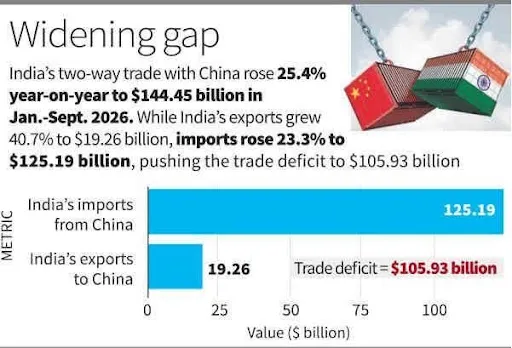
  • Bilateral trade: Trade between the two countries reached $144.45 billion during January-September 2026, registering 25.4% growth.
  • India's exports: Indian exports to China rose by 40.7% to $19.26 billion during the first nine months of 2026.
  • India's imports: Imports from China increased by 23.3% to $125.19 billion over the same period.
  • Trade deficit: The deficit reached $105.93 billion and was on track to surpass the previous year's record of $116.12 billion.
  • Although exports have grown significantly, they remain much smaller than imports. 
  • The resulting imbalance reflects differences in the scale and composition of trade, as well as concerns about market access and dependence on Chinese supplies.

Structural Causes of the Trade Imbalance

  • Dependence on Chinese intermediate goods
    • Indian manufacturers import substantial quantities of intermediate goods from China for domestic production. These inputs support industrial activity but also expose Indian supply chains to external disruptions.
    • The continued import of finished products, particularly electronics and machinery, is another concern because it can limit opportunities for domestic manufacturing to capture greater value addition.
  • Non-tariff barriers and restricted market access
    • Finance Minister Nirmala Sitharaman has identified non-tariff barriers as a major obstacle to expanding Indian exports to China.
    • These barriers include regulatory requirements, such as phytosanitary measures, that govern the import of agricultural and other products. 
    • While such measures can serve legitimate health and safety objectives, concerns arise when procedures are applied in ways that restrict market access without adequate transparency or timely resolution.
    • India has highlighted export opportunities in generic medicines, bovine meat, vegetables and perishable products, but has raised concerns about limited access to the Chinese market.
  • Unequal trade composition
    • India imports large quantities of industrial inputs, electronics and machinery, while its exports to China are concentrated in a narrower range of products, including seafood, naphtha and printed circuit boards.
    • This difference in trade composition contributes to the persistent imbalance and highlights the need to diversify India's export basket.

Strategic and Supply Chain Concerns

  • The trade deficit is not merely a question of the value of imports and exports. It also has implications for India's industrial resilience and economic security.
    • Export controls: Chinese restrictions on exports in sectors such as fertilisers and rare earths create uncertainty for Indian industries that depend on these supplies.
    • Manufacturing vulnerability: Dependence on imported components and machinery can expose production to external price shocks and supply interruptions.
    • Limited value addition: Continued reliance on finished goods can constrain the development of domestic manufacturing capabilities.
    • External trade pressures: High import expenditure, including on crude oil and fertilisers, can increase the pressure on India's overall import bill.
  • These concerns underline the importance of reducing excessive dependence without disrupting access to inputs required by Indian businesses.

India's Diplomatic and Trade Policy Approach

  • India has continued to pursue dialogue with China to address market access concerns and structural trade imbalances.
  • During their meeting on the side-lines of the BRICS summit in September 2026, Prime Minister Narendra Modi and Chinese President Xi Jinping acknowledged the need to address trade imbalances, supply chain issues and the facilitation of meaningful and predictable market access.
  • India has also emphasised that dialogue, rather than the imposition of tariffs or countervailing duties, remains its preferred approach to addressing trade barriers.
  • At the same time, India is accelerating negotiations for bilateral trade agreements with other countries. These agreements can expand export markets, strengthen commercial relationships and reduce overdependence on individual trading partners.

Way Forward

  • Addressing the India-China trade deficit requires a combination of market access negotiations, domestic industrial development and export diversification.
  • Improve market access: Pursue transparent and time-bound resolution of regulatory barriers affecting Indian products in China.
  • Diversify exports: Expand opportunities in pharmaceuticals, agricultural products, processed foods, engineering goods and other competitive sectors.
  • Strengthen domestic manufacturing: Improve infrastructure, technology adoption, productivity and component manufacturing to reduce excessive dependence on imported finished goods.
  • Diversify supply chains: Develop alternative sources for critical inputs while maintaining reliable access to essential Chinese intermediates.
  • Accelerate trade agreements: Use bilateral and multilateral trade arrangements to expand India's export opportunities across global markets.
  • Promote value addition: Encourage domestic production of higher-value goods to improve export competitiveness and strengthen industrial capabilities.

Source: TOI | TH

India-China Trade Deficit FAQs

Q1: What is the India-China trade deficit?

Ans: It is the difference between India's imports from China and its exports to China when imports exceed exports.

Q2: What are non-tariff barriers?

Ans: Non-tariff barriers are regulatory or administrative measures other than customs tariffs that can restrict or complicate international trade.

Q3: Why is India concerned about imports from China?

Ans: India's concerns include the widening trade deficit, dependence on Chinese industrial inputs, imports of finished goods and restrictions affecting access to the Chinese market.

Q4: Which Indian products have export potential in China?

Ans: India has identified generic medicines, bovine meat, vegetables and perishable products as areas with significant export potential.

Q5: How can India reduce its trade imbalance with China?

Ans: India can improve market access, diversify exports, strengthen domestic manufacturing, develop alternative supply chains and expand trade relationships with other countries.

Enquire Now