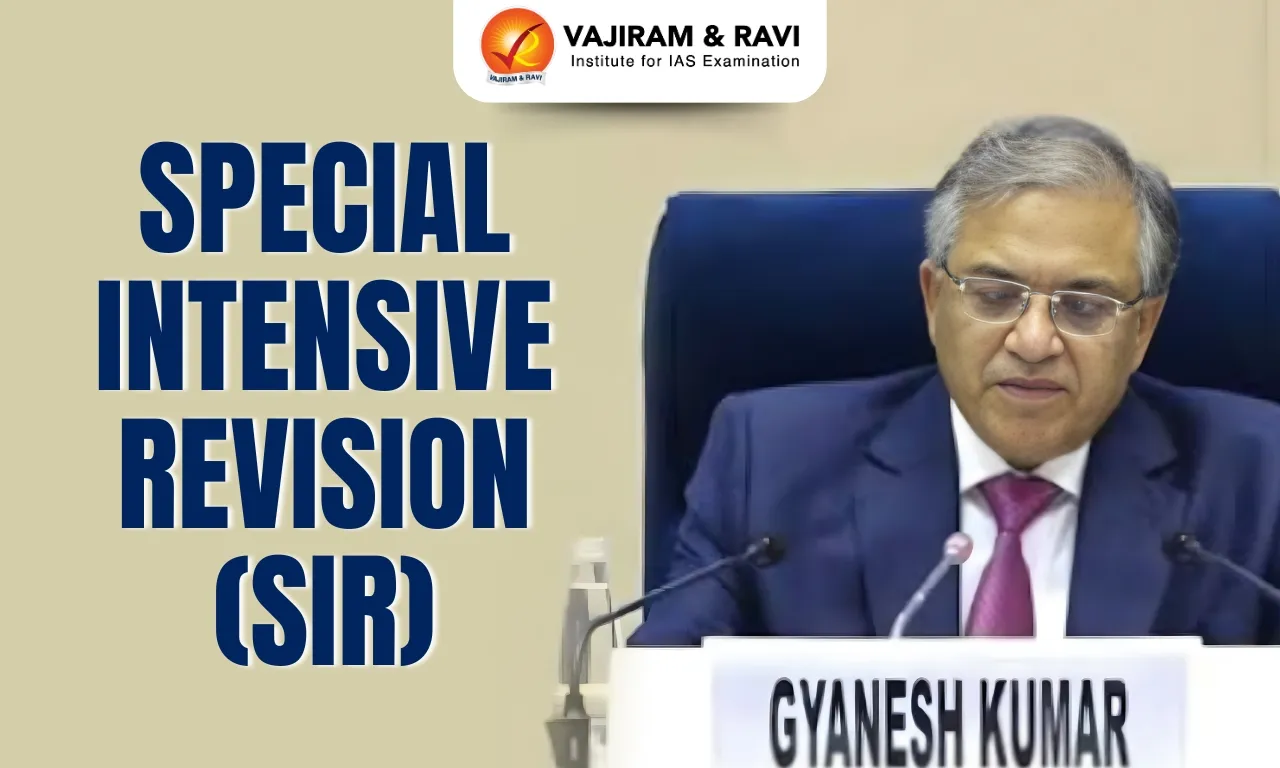
Special Intensive Revision (SIR) is a comprehensive, time bound exercise of the Election Commission of India (ECI) to verify and update electoral rolls through house to house enumeration. It aims to include every eligible citizen while removing deceased, shifted, duplicate and otherwise ineligible entries. The exercise is conducted under constitutional and statutory authority and includes draft publication, claims, objections and verification before finalisation.
Special Intensive Revision Latest News 2026
As of September 2026, Special Intensive Revision (SIR) is being implemented in phases across India. Phase III covers 16 States and 3 Union Territories. Odisha, Mizoram, Sikkim and Manipur were scheduled for final rolls on September 6, while other regions have later deadlines extending into October, November and December 2026.
What is Special Intensive Revision (SIR)?
Special Intensive Revision (SIR) is an intensive verification of electoral rolls conducted by the Election Commission of India. It differs from routine summary revision because it involves extensive field level enumeration and verification.
- Full form: SIR stands for Special Intensive Revision of electoral rolls. It involves systematic verification of voters at the household level.
- Primary objective: The central aim is to ensure that no eligible citizen is excluded and no ineligible person remains enrolled in the electoral roll.
- Field verification: Booth Level Officers conduct house to house visits, distribute SIR Enumeration Forms and verify existing electoral information.
- Electoral roll: An electoral roll is the official voter list of a constituency. Registration generally requires Indian citizenship, attainment of the prescribed voting age and ordinary residence in the concerned area.
- Entries examined: The process identifies deaths, permanent migration, duplicate registrations, incorrect particulars and voters who remain untraceable after prescribed verification.


Special Intensive Revision Background
SIR (Special Intensive Revision) has historical roots in earlier intensive electoral roll revisions. The current nationwide exercise gained importance from demographic changes, migration, urbanisation and the need to improve electoral roll accuracy.
- Earlier revisions: Intensive revisions were conducted in 1952-56, 1957, 1961, 1965, 1966, 1983-84, 1987-89, 1992, 1993, 1995, 2002, 2003 and 2004 in different parts of India.
- Nationwide expansion: The ECI subsequently expanded SIR through multiple phases, covering progressively larger groups of States and Union Territories.
- Participatory structure: Political parties participate through Booth Level Agents. During the first two phases, nearly 59 crore electors were covered with over 6.3 lakh BLOs and 9.2 lakh BLAs involved at different stages.
Special Intensive Revision Phases
The current Special Intensive Revision has been organised in stages to manage the large administrative scale and allow verification, claims and objections before final publication.
SIR Phase I
- Bihar was covered from June to September 2025.
- The starting electorate was 7.89 crore, while the final roll contained nearly 7.42 crore electors.
SIR Phase II
- Chhattisgarh, Goa, Gujarat, Kerala, Madhya Pradesh, Rajasthan, Tamil Nadu, Uttar Pradesh and West Bengal, along with Andaman and Nicobar Islands, Lakshadweep and Puducherry, were covered during the second phase.
- The exercise covered about 50.99 crore electors.
- The final electorate was approximately 45.81 crore, representing a reduction of about 10.2%.
SIR Phase III
- Andhra Pradesh, Arunachal Pradesh, Haryana, Jharkhand, Karnataka, Maharashtra, Manipur, Meghalaya, Mizoram, Nagaland, Odisha, Punjab, Sikkim, Tripura, Telangana and Uttarakhand are covered along with Delhi, Chandigarh and Dadra and Nagar Haveli and Daman and Diu.
- Over 3.94 lakh BLOs were assigned to visit approximately 36.73 crore electors.
- Political parties appointed about 3.42 lakh BLAs to support participation and verification.
Remaining Areas
- Himachal Pradesh, Jammu and Kashmir and Ladakh were kept for a later schedule considering Census related requirements and difficult weather conditions in higher altitude areas.
What is the Need of Special Intensive Revision?
The principal purpose of Special Intensive Revision SIR is to maintain an accurate, inclusive and credible electoral roll amid continuous demographic and residential changes.
- Remove duplicate entries: SIR identifies multiple registrations of the same elector across constituencies or within electoral records.
- Update migration: Frequent movement of workers, students and families can leave voters registered at addresses where they no longer ordinarily reside.
- Record deaths: Verification helps remove names of deceased electors when such information has not been reflected in electoral records.
- Add eligible voters: Young citizens reaching voting age and eligible residents omitted earlier can seek inclusion through the prescribed process.
- Protect one person one vote: Accurate rolls strengthen electoral equality by reducing duplicate and invalid registrations.
- Improve public confidence: Transparent verification, publication of draft rolls and grievance mechanisms can improve trust in the electoral process.
Also Read: Universal Adult Franchise
Special Intensive Revision SIR Process
Special Intensive Revision combines physical enumeration, administrative scrutiny, public participation and final verification before an electoral roll is formally published.
- Notification: The ECI announces the revision, qualifying date, schedule, areas covered and applicable procedures for the concerned States and Union Territories.
- House visits: BLOs visit households in their assigned polling areas and distribute or collect enumeration forms from electors.
- Data verification: Existing electoral information is checked against field findings and available official records to identify discrepancies.
- Identification of entries: Deaths, permanent shifts, duplicate registrations and untraceable electors are examined before any deletion is finalised.
- Draft roll: A draft electoral roll is published after enumeration and preliminary scrutiny, allowing citizens and political parties to examine entries.
- Claims and objections: Form 6 is used for inclusion, Form 7 for objections or deletion and Form 8 for correction or shifting of residence.
- Notice and verification: Deletion follows prescribed procedures. The ECI has stated that BLOs make two to three attempts before an elector is treated as untraceable.
- Appeal mechanism: Aggrieved persons can use the prescribed appellate channels, including the designated appellate authority and further recourse to the Chief Electoral Officer.
- Final publication: After disposal of claims and objections, corrections and verification, the final electoral roll is published.
Special Intensive Revision Legal Framework
SIR (Special Intensive Revision) rests on constitutional authority and statutory provisions governing electoral roll preparation, revision and correction.
- Constitutional Articles:
- Article 324: It gives the Election Commission superintendence, direction and control over elections and electoral roll preparation within its constitutional functions.
- Article 326: It establishes elections to the Lok Sabha and State Legislative Assemblies on the basis of adult suffrage, subject to legal qualifications and disqualifications.
- Representation of the People Act 1950:
- Section 16: The Act 1950 specifies disqualifications for registration, including non citizenship.
- Section 19: Registration is linked to eligibility conditions including the prescribed age and ordinary residence in the concerned constituency.
- Section 21: Section 21(3) specifically permits the ECI to direct a special revision of an electoral roll at any time for reasons recorded by it.
- Section 22: Electoral Registration Officers can correct, transpose or delete entries after proper verification when entries are erroneous, the elector has shifted or other statutory grounds apply.
- Registration of Electors Rules 1960: The rules provide the procedural framework for electoral roll revision, claims, objections and related actions.
- Supreme Court judgment: On May 27, 2026, the Supreme Court in Association for Democratic Reforms & Ors. vs. Election Commission of India & Ors. held that SIR falls within the ECI’s statutory mandate and is consistent with its constitutional responsibility to ensure free and fair elections.
Special Intensive Revision (SIR) Significance
Special Intensive Revision has significance for electoral integrity because the quality of the voter list directly affects participation, representation and confidence in elections.
- Electoral accuracy: Regular field verification helps bring electoral records closer to actual demographic conditions.
- Democratic legitimacy: Accurate rolls strengthen the principle that eligible citizens should have an equal opportunity to participate in elections.
- Better inclusion: Enumeration can identify eligible citizens who were previously missed, particularly first time voters and people affected by residential changes.
- Administrative efficiency: Updated rolls support better polling station planning, voter communication and election management.
- Political transparency: BLAs allow recognised political parties to participate in verification and flag discrepancies during the process.
Special Intensive Revision Challenges
The effectiveness of SIR (Special Intensive Revision) depends on balancing electoral roll accuracy with the constitutional importance of universal adult participation.
- Risk of exclusion: Strict verification requirements can create difficulties for genuine voters who lack easily available historical or residential documents.
- Migrant vulnerability: Migrant workers, students and seasonal labourers frequently change residences, making ordinary residence verification more difficult.
- Documentation burden: Poor, elderly, homeless and socially marginalised citizens may face greater difficulty completing forms or producing supporting records.
- Timing concerns: Large scale revision close to elections can create administrative pressure and political controversy over possible voter exclusions.
- Digital divide: Online systems can improve efficiency but may disadvantage citizens with limited internet access, digital literacy or connectivity.
- Public trust: Large deletions can generate anxiety unless reasons, procedures and opportunities for restoration are communicated clearly.
Way Forward
The future implementation of Special Intensive Revision should combine rigorous verification with simple procedures, transparency and strong safeguards against wrongful exclusion.
- Simple documentation: Documentation requirements should remain proportionate and should not create unnecessary barriers for genuinely eligible electors.
- Strong field verification: Door to door verification should remain central, particularly for vulnerable communities and areas with high migration.
- Transparent deletion: Reasons for deletions should be properly recorded and made accessible through lawful and privacy conscious disclosure mechanisms.
- Effective appeals: Claims, objections and appeals should receive adequate time and prompt disposal before final electoral rolls are published.
- Political participation: Political parties should actively appoint BLAs so that discrepancies can be identified through wider stakeholder participation.
- Technology safeguards: Digital systems can support duplicate detection, tracking and monitoring, but automated flags should not independently determine voter deletion.
- Special outreach: Dedicated camps and multilingual awareness drives should assist migrants, persons with disabilities, first time voters and other vulnerable groups.
- Post revision audits: Independent sample checks after finalisation can identify wrongful exclusions and help improve the accuracy of subsequent electoral roll revisions.
SIR Election Commission
The Election Commission of India (ECI) plays a central role in planning and executing the Special Intensive Revision (SIR). It issues formal notifications specifying the schedule, qualifying date, and procedures for enumeration. The ECI also supervises the house-to-house verification, document scrutiny, and final roll publication. Through its constitutional authority under Article 324, the Commission ensures that every eligible citizen is included and every error or duplicate is eliminated from the voter roll.
Chief Electoral Officer
The Chief Electoral Officer (CEO) of each state or union territory is responsible for implementing SIR on the ground. Acting under the guidance of the Election Commission, the CEO coordinates with District Election Officers, Electoral Registration Officers, and Booth Level Officers. The CEO ensures timely data collection, field verification, training of staff, public awareness drives, and transparent grievance redressal during the revision. Their reports form the basis for ECI’s final electoral roll approval.

 Last updated on Oct, 2026
→ UPSC 2027 Notification will be released on 13 January 2027 at upsconline.nic.in.
→ Check Nobel Prize 2026 Winners List here.
→ Download PIB PRiSM Monthly Magazine 2026 here.
→ Check UPSC Monthly Current Affairs Magazine The Recitals here.
→ Check out the latest UPSC Syllabus here.
→ Download UPSC Model Answers for Mains 2026
→ UPSC Mains Question Paper 2026 is out now for Essay & GS Paper 1, 2, 3 & 4.
→ UPSC Calendar 2027 has been released.
→ Enroll in Vajiram & Ravi’s UPSC Mains Test Series 2027 for structured answer writing practice, expert evaluation, and exam-oriented feedback.
→ Join Vajiram & Ravi’s UPSC Mentorship Program 2027 for personalized guidance, strategy planning, and one-to-one support from experienced mentors.
→ Go through the UPSC Mains Previous Year Papers to enhance your preparation.
→ UPSC has released UPSC Toppers List 2025 with the Civil Services final result on its official website.
→ Also check Best UPSC Coaching in India
Special Intensive Revision (SIR) FAQs
Q1. What is Special Intensive Revision (SIR)? +
Q2. Why is Special Intensive Revision important before elections? +
Q3. Who conducts Special Intensive Revision in each state? +
Q4. What documents are required for SIR verification? +
Q5. What are the major challenges in Special Intensive Revision? +
Tags: sir election commission Special Intensive Revision