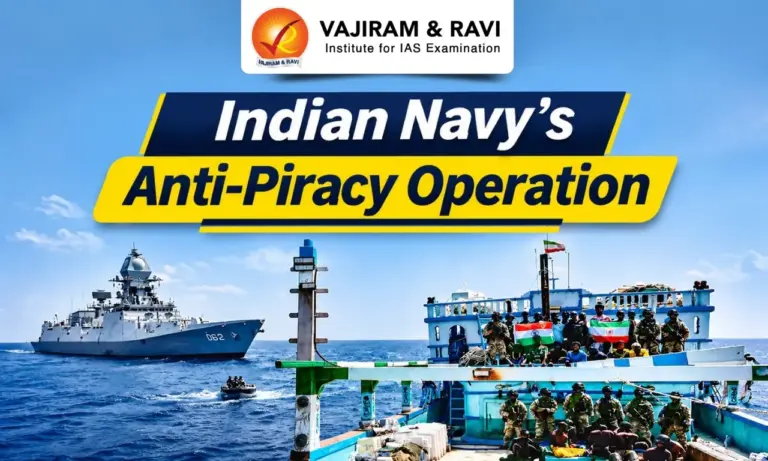
Indian Navy’s Anti-Piracy Operations play an important role in protecting merchant vessels, rescuing seafarers and maintaining maritime security in the Indian Ocean Region (IOR). The Navy’s rescue of the Iranian fishing vessel Azini off Somalia in November 2026 highlights India’s ability to conduct coordinated maritime operations far beyond its coastline.
Indian Navy’s Rescue Operation: Azini (November 2026)
On 29 October 2026, the Iranian fishing vessel Azini was hijacked by armed pirates off the north-eastern coast of Somalia, between Bandar Bayla and Hafun. The Indian Navy completed a coordinated rescue operation on 2 November 2026, securing the release of all 20 crew members.
- A mission-deployed naval warship and a maritime reconnaissance aircraft located and tracked the hijacked vessel through sustained surveillance.
- The Navy used calibrated non-kinetic measures to restrict the vessel’s movement and prevent its escape.
- Marine Commandos (MARCOS) were deployed through a precision airdrop with support from an Indian Air Force (IAF) C-17 aircraft.
- The operation lasted over 48 hours and concluded with the safe rescue of all 20 crew members, without casualties or injuries.
The hijacked vessel was considered a potential mother ship, which pirates could use as a mobile base to launch attacks on commercial shipping farther from the coast. The operation demonstrated the Indian Navy’s long-range operational capability and coordination with the Indian Air Force.
Major Anti-Piracy Operations by the Indian Navy
The Indian Navy has maintained an anti-piracy presence in the Gulf of Aden and off the eastern coast of Africa to protect international shipping and respond to piracy incidents.
Anti-Piracy Patrols in the Gulf of Aden since 2008
The Indian Navy commenced anti-piracy patrols in the Gulf of Aden in October 2008 to protect merchant vessels from Somali pirate attacks. According to information provided by the Ministry of Defence in February 2024, Indian naval deployments since 2008 had safely escorted 3,440 ships and more than 25,000 seafarers. The Navy has also undertaken anti-piracy deployments in the Gulf of Guinea off the west coast of Africa since 2022.
Rescue of FV Iman and FV Al Naeemi by INS Sumitra (January 2024)
In January 2024, INS Sumitra rescued 17 Iranian crew members from the hijacked fishing vessel Iman off Somalia. Within 36 hours, it carried out another operation to rescue 19 Pakistani crew members aboard Al Naeemi. These operations also prevented the hijacked vessels from being used as mother ships for further pirate attacks.
Rescue of FV Omari by INS Sharda (February 2024)
In February 2024, INS Sharda intercepted the Iranian-flagged fishing vessel Omari, which had been hijacked by Somali pirates. The Navy secured the release of all 19 crew members, comprising 11 Iranians and 8 Pakistanis, through coordinated action involving its helicopter and boats.
Interception of MV Ruen by INS Kolkata (March 2024)
In March 2024, INS Kolkata intercepted the Maltese-flagged merchant vessel MV Ruen, which had been hijacked by Somali pirates in December 2023. After more than 40 hours of sustained operations involving naval warships, drones, maritime surveillance aircraft and MARCOS deployed with support from an IAF C-17 aircraft, all 35 pirates surrendered and the vessel’s original 17 crew members were rescued. The captured pirates were brought to India for prosecution under the Maritime Anti-Piracy Act, 2022.


Maritime Piracy under UNCLOS, 1982
Maritime piracy involves illegal acts of violence, detention or robbery committed for private ends against another vessel on the high seas or in areas outside the jurisdiction of any State. The United Nations Convention on the Law of the Sea (UNCLOS), 1982 provides the international legal framework for combating piracy. Key provisions include:
- Article 100 requires all States to cooperate in suppressing piracy on the high seas.
- Article 101 defines piracy and specifies the acts that constitute piracy.
- Article 105 empowers States to seize pirate ships, arrest persons involved and seize property on board on the high seas or in places outside the jurisdiction of any State.
- Article 107 specifies the government vessels and aircraft authorised to carry out seizures for piracy.
Piracy on the high seas is distinct from armed robbery against ships, which occurs within a country’s internal waters, archipelagic waters or territorial sea.
Maritime Anti-Piracy Act, 2022
India enacted the Maritime Anti-Piracy Act, 2022, to give effect to its obligations under UNCLOS and establish a domestic legal framework for the prosecution of piracy-related offences. The Act came into force on 22 February 2023.
- Jurisdiction: The Act applies to the high seas, including the Exclusive Economic Zones (EEZs) of India and other countries.
- Punishment: Piracy is punishable with imprisonment for life, a fine or both. If an act of piracy causes death or an attempt to cause death, the punishment may extend to death or life imprisonment.
- Other offences: Attempting, aiding or abetting piracy is punishable with imprisonment of up to 10 years. Organising or directing others to participate in piracy is punishable with imprisonment of up to 14 years.
- Enforcement: The Act empowers authorised personnel to take action against piracy-related offences, including the arrest of persons and seizure of pirate ships.
- Trial: It provides for the designation of courts to conduct trials of piracy-related offences.
Significance of Indian Navy’s Anti-Piracy Operations
Indian Navy’s Anti-Piracy Operations strengthen maritime security in the Indian Ocean Region and help protect international shipping, seafarers and India’s maritime interests.
- Maritime Trade Security: Protect important Sea Lines of Communication (SLOCs) connecting Asia, Africa, Europe and the Middle East, ensuring the safe movement of commercial vessels.
- Protection of Seafarers: Safeguard the lives of Indian and foreign crew members through timely rescue operations, irrespective of their nationality.
- Energy Security: Help secure maritime routes used for transporting crude oil, natural gas and other essential commodities.
- Regional Maritime Cooperation: Strengthen coordination with regional navies and international maritime agencies through joint patrols and information-sharing.
- India’s Role in the Indian Ocean: Reinforce India’s position as a first responder and preferred security partner in the Indian Ocean Region through sustained naval deployments.

 Last updated on Nov, 2026
→ UPSC 2027 Notification will be released on 13 January 2027 at upsconline.nic.in.
→ Check Nobel Prize 2026 Winners List here.
→ Download PIB PRiSM Monthly Magazine 2026 here.
→ Check UPSC Monthly Current Affairs Magazine The Recitals here.
→ Check out the latest UPSC Syllabus here.
→ Download UPSC Model Answers for Mains 2026
→ UPSC Mains Question Paper 2026 is out now for Essay & GS Paper 1, 2, 3 & 4.
→ UPSC Calendar 2027 has been released.
→ Enroll in Vajiram & Ravi’s UPSC Mains Test Series 2027 for structured answer writing practice, expert evaluation, and exam-oriented feedback.
→ Join Vajiram & Ravi’s UPSC Mentorship Program 2027 for personalized guidance, strategy planning, and one-to-one support from experienced mentors.
→ Go through the UPSC Mains Previous Year Papers to enhance your preparation.
→ UPSC has released UPSC Toppers List 2025 with the Civil Services final result on its official website.
→ Also check Best UPSC Coaching in India
Indian Navy's Anti-Piracy Operations FAQs
Q1. What was the Indian Navy's Azini rescue operation?+
Q2. What is a mother ship in maritime piracy?+
Q3. Which UNCLOS article defines piracy?+
Q4. When did the Maritime Anti-Piracy Act, 2022 come into force?+
Q5. What is the role of the Indian Navy's MARCOS in anti-piracy operations?+
Tags: anti-piracy operation indian navy's indian navy's anti-piracy operation