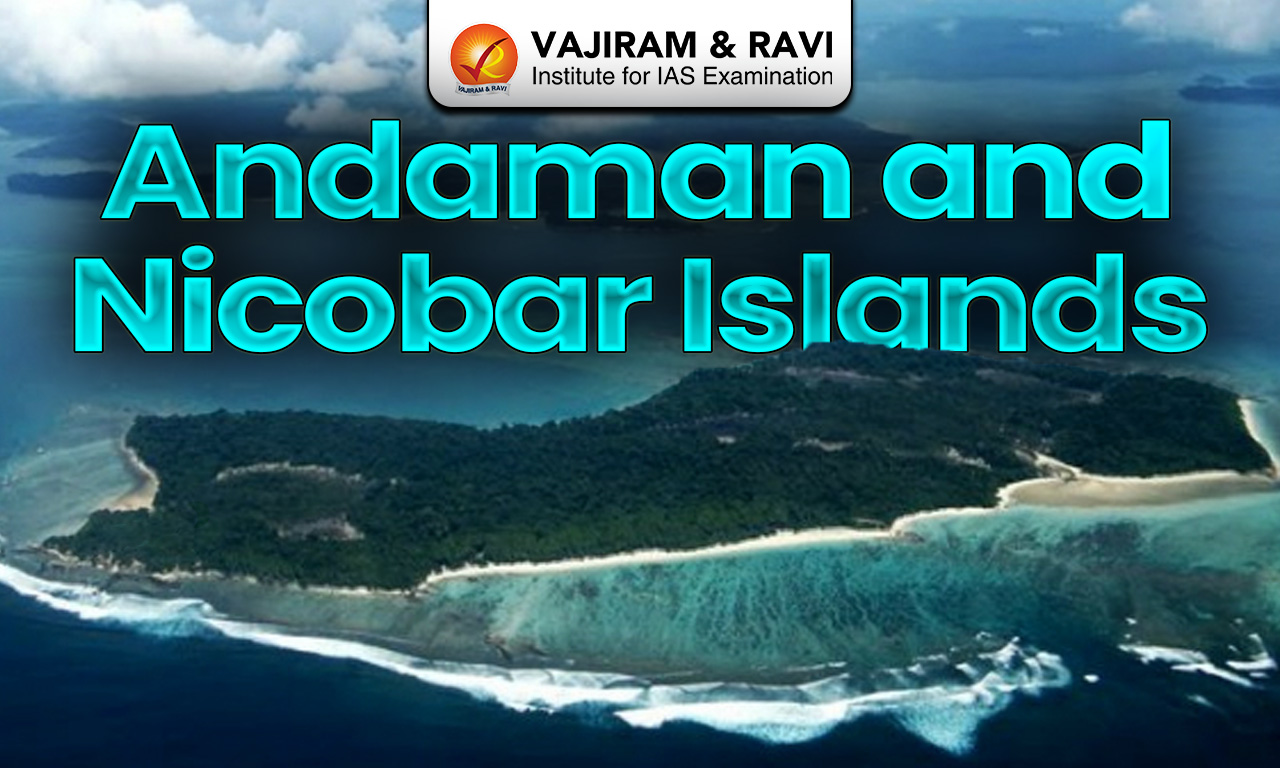
The Andaman and Nicobar Islands are a group of beautiful islands located in the Bay of Bengal, southeast of mainland India. This island is known for its rich biodiversity, strategic location, and unique tribal culture. These islands are one of India’s most ecologically and culturally important regions.
Topography and Geological Features
The Andaman and Nicobar Islands have a rugged and mountainous topography, formed as part of a submerged extension of the Arakan Yoma mountain range.
- Submerged Mountain Chain
-
- The islands are an extension of the Arakan Yoma fold mountains, stretching from Myanmar to Indonesia.
- Mountainous Terrain
- Most islands are hilly with steep slopes and narrow valleys, while flat land is limited to coastal areas.
- Highest Peak
- Saddle Peak (737 m) in North Andaman is the highest point.
- Volcanic Origin
- Many islands have a volcanic base, composed of tertiary sandstone, limestone, and shale.
- Active and Dormant Volcanoes
- Barren Island is India’s only active volcano.
- Narcondam Island is a dormant volcanic island.
- Coastal Features
- The islands have narrow coastal plains, sandy beaches, and are fringed with coral reefs.
- Tectonic Activity
- Located in a seismically active zone due to the interaction of the Indian and Burmese plates.
- Island Separation
- The Ten Degree Channel divides the Andaman group from the Nicobar group.
Andaman and Nicobar Islands Climate
The Andaman and Nicobar Islands experience a tropical maritime climate, influenced by the surrounding Bay of Bengal. The weather remains warm, humid, and equable throughout the year, with no extreme winters or summers.
- Temperature
- The temperature generally ranges between 23°C to 30°C.
- Seasonal variation is minimal due to the moderating effect of the sea.
- Rainfall
- The islands receive heavy rainfall (around 3000 mm annually).
- Rainfall is well distributed but peaks during the monsoon months.
- Monsoon Influence
- Affected by both Southwest Monsoon (May-September) and Northeast Monsoon (October–December).
- Prolonged rainy season compared to mainland India.
- Humidity
- High humidity levels, usually between 70% to 90%, prevail throughout the year.
- Cyclonic Activity
- Occasionally affected by cyclones and depressions originating in the Bay of Bengal.
- No Distinct Winter Season
- Winters are mild and pleasant, without significant temperature drops.
- Favorable for Dense Vegetation
- The warm and wet climate supports tropical evergreen forests and rich biodiversity.


Area, Sub-Groups, and Distribution of Nicobar Islands
The Nicobar Islands form the southern part of the Andaman and Nicobar archipelago, spread over a length of about 262 km with a maximum width of 58 km and covering an area of nearly 1,653 sq km. These islands are strategically located close to Southeast Asia and are divided into distinct sub-groups based on their geographical distribution.
- Total Area and Extent
-
- Spread over 262 km length and 58 km maximum width with a total area of 1,653 sq km.
- Three Major Sub-Groups
- Divided into Northern, Central, and Southern groups based on location and island clustering.
- Northern Group
- Includes islands like Car Nicobar and Battimalv, which are relatively more populated.
- Central Group
- Consists of islands such as Chowra, Teressa, Katchal, Camorta, Nancowry, Trinket, and Tillangchong.
- Southern Group
- Dominated by Great Nicobar Island, along with Little Nicobar, Kondul, and other smaller islands.
- Southernmost Point of India
- Indira Point is located at the southern tip of Great Nicobar.
- Proximity to Indonesia
- Great Nicobar lies just about 147 km from Sumatra (Indonesia), highlighting its strategic importance.
- Habitation
- Only about 12 islands are inhabited, mainly by indigenous tribes like Nicobarese and Shompen.
Biodiversity of Andaman and Nicobar Islands
The Andaman and Nicobar Islands, a group of 572 islands in the Bay of Bengal, are recognized as a major biodiversity hotspot of India. More than 90% of the land area is covered with dense tropical rainforests, mangroves, and coastal ecosystems.
Flora (Plant Diversity)
The vegetation of these islands is dominated by dense tropical forests with multiple layers, ranging from coastal vegetation to inland evergreen forests.
- Forest Types
- North Andaman is covered with wet evergreen forests, while Middle Andaman has moist deciduous forests.
- The Nicobar Islands mainly have evergreen forests and grasslands, showing variation in vegetation across regions.
- Dominant Tree Species
- Forests include tall canopy trees like Dipterocarpaceae species forming dense layers.
- Andaman Padauk is a valuable timber tree known for its strong reddish wood.
- Dhoop tree produces aromatic resin, and Andaman Red Cedar is another important species.
- Epiphytic Vegetation
- Southern islands show abundant growth of epiphytes such as orchids and ferns.
- These plants grow on other trees and thrive in humid conditions.
- Mangrove Ecosystems
- Mangroves cover large coastal areas and protect the shoreline from erosion.
- They act as breeding and nursery grounds for marine organisms.
- High Endemism in Plants
- A large number of plant species are unique to the islands due to their isolation.
- These species show special adaptations to island conditions.
Fauna (Animal Life)
The islands support a wide variety of terrestrial and marine fauna with high levels of endemism.
- Mammals
- Endemic mammals include the Andaman Wild Pig, Nicobar Tree Shrew, and Narcondam Shrew.
- Mammalian diversity is limited but unique compared to mainland India.
- Bird Species
- The islands are home to rare birds like the Nicobar megapode, known for building nesting mounds.
- Narcondam hornbill is another important endemic species.
- The region also supports many migratory birds.
- Marine Biodiversity
- Rich marine life includes the dugong (sea cow and state animal) and Indo-Pacific humpback dolphin.
- Coral reefs are highly diverse, with about 179 coral species, 1200+ fish species, and 1000+ molluscs.
- Reptiles
- The islands are known for the saltwater crocodile, especially in mangrove regions.
- Various rare snakes, lizards, and geckos are also found.
- High Endemism in Animals
- Many animal species are found only in these islands and nowhere else in the world.
- This makes conservation extremely important.
Tribes of Andaman and Nicobar Islands
The Andaman and Nicobar Islands are home to some of the oldest indigenous communities in the world, known for their distinct cultures, languages, and isolated lifestyles. These tribes are broadly divided into Andamanese and Nicobarese groups, with several classified as Particularly Vulnerable Tribal Groups (PVTGs).
- Great Andamanese Tribe (PVTG) – One of the earliest inhabitants, now reduced in population and settled mainly in Strait Island.
- Jarwa Tribe (PVTG) – A nomadic hunting-gathering tribe living in parts of South and Middle Andaman, maintaining limited outside contact.
- Onge Tribe (PVTG) – A semi-nomadic tribe primarily residing in Little Andaman, dependent on forest and marine resources.
- Sentinelese Tribe (PVTG)– A highly isolated tribe that resists all external contact and lives on North Sentinel Island.
- Nicobarese Tribe – The most populous tribe, practicing agriculture and living in relatively developed settlements.
- Shompen Tribe (PVTG) – A reclusive tribe inhabiting the forests of Great Nicobar, with minimal interaction with outsiders.
National Parks of Andaman and Nicobar Islands
The Andaman and Nicobar Islands have a rich network of protected areas, including 9 National Parks, which play a crucial role in conserving tropical forests, coral reefs, and rare wildlife species.
- Mahatma Gandhi Marine National Park
-
- Famous for coral reefs, mangroves, and marine life like sea turtles and fishes.
- Mount Harriet National Park
- Known for evergreen forests, butterflies, and scenic viewpoints near Port Blair.
- Saddle Peak National Park
- Covers the highest peak and rich tropical forest biodiversity.
- Rani Jhansi Marine National Park
- Protects coral reefs, seagrass beds, and diverse marine species.
- Campbell Bay National Park
- Part of the Great Nicobar Biosphere Reserve with dense forests and endemic fauna.
- Galathea National Park
- Known for nesting grounds of leatherback turtles and tropical rainforests.
- North Button Island National Park
- A small marine park rich in coral reefs and underwater biodiversity.
- Middle Button Island National Park
- Famous for clear waters, coral reefs, and marine fauna.
- South Button Island National Park
- Known for vibrant coral ecosystems and diving spots.
Wildlife Sanctuaries of Andaman and Nicobar Islands
The Andaman and Nicobar Islands have an extensive network of 100+ wildlife sanctuaries, making them one of the most ecologically protected regions in India. These sanctuaries conserve fragile island ecosystems, including tropical forests, mangroves, coral reefs, and rich marine biodiversity.
- Interview Island Wildlife Sanctuary: Known for its forest ecosystem and population of feral elephants along with diverse birdlife.
- North Reef Island Wildlife Sanctuary: Protects coral reefs, sea turtles, and rich marine biodiversity.
- South Sentinel Island Wildlife Sanctuary: A remote sanctuary important for nesting sea turtles and undisturbed ecosystems.
- Ross and Smith Islands Wildlife Sanctuary: Famous for twin islands connected by a sandbar and coastal biodiversity.
- Narcondam Island Wildlife Sanctuary: Habitat of the endemic Narcondam hornbill and unique volcanic ecosystem.
Farming and Agricultural Practices in Andaman and Nicobar Islands
The Andaman and Nicobar Islands have a unique agricultural system shaped by tropical climate, island geography, and ecological sensitivity. Agriculture is largely small-scale, sustainable, and subsistence-oriented, focusing on local food security rather than large-scale commercialization.
- Agriculture is mainly subsistence farming, where production is done for self-consumption, with limited market surplus due to isolation and transport constraints.
- The islands follow mixed cropping and multi-cropping systems, ensuring efficient land use, risk reduction, and food diversity.
- Rice (paddy) is the staple food crop, cultivated in low-lying monsoon-fed fields, while pulses and vegetables are grown on a smaller scale.
- Plantation agriculture dominates, with coconut as the most important cash crop, supported by arecanut plantations in coastal regions.
- Cultivation of spices such as black pepper, clove, nutmeg, and cinnamon adds commercial value and supports small-scale agro-economy.
- Shifting cultivation (Jhum farming) is practiced in tribal areas of Nicobar, involving temporary land clearing and natural regeneration cycles.
- Organic farming practices are encouraged due to the fragile ecosystem, with minimal use of chemical fertilizers and pesticides.
- Integrated farming systems combine crop cultivation, livestock rearing, and fisheries, ensuring income diversification and resource efficiency.
- Horticulture is significant, with fruits like banana, pineapple, papaya, and mango grown due to favorable humid climate.
- Agriculture faces challenges like limited cultivable land, soil erosion, and coastal salinity, which restrict productivity.
- Frequent cyclones, heavy rainfall, and high humidity create climatic risks, affecting crop stability and yields.
About Great Nicobar Project
The ₹81,000-crore Great Nicobar Project is a major strategic infrastructure initiative on Great Nicobar Island, led by NITI Aayog and Andaman and Nicobar Islands Integrated Development Corporation (ANIIDCO), aimed at transforming the island into a global transshipment and connectivity hub.
- Focuses on developing an International Container Transshipment Terminal (ICTT) to position India as a key player in global maritime trade.
- Includes a Greenfield International Airport at Galathea Bay to improve civilian and strategic connectivity.
- Plans for a modern township and supporting infrastructure for economic growth.
- Enhances strategic importance due to proximity to major sea routes like the Malacca Strait.
- Located within the Great Nicobar Biosphere Reserve, raising ecological concerns.
- May impact biodiversity and indigenous communities such as the Shompen Tribe.
- Emphasizes balanced development with environmental safeguards and sustainability measures.

 Last updated on Oct, 2026
→ UPSC 2027 Notification will be released on 13 January 2027 at upsconline.nic.in.
→ Check Nobel Prize 2026 Winners List here.
→ Download PIB PRiSM Monthly Magazine 2026 here.
→ Check UPSC Monthly Current Affairs Magazine The Recitals here.
→ Check out the latest UPSC Syllabus here.
→ Download UPSC Model Answers for Mains 2026
→ UPSC Mains Question Paper 2026 is out now for Essay & GS Paper 1, 2, 3 & 4.
→ UPSC Calendar 2027 has been released.
→ Enroll in Vajiram & Ravi’s UPSC Mains Test Series 2027 for structured answer writing practice, expert evaluation, and exam-oriented feedback.
→ Join Vajiram & Ravi’s UPSC Mentorship Program 2027 for personalized guidance, strategy planning, and one-to-one support from experienced mentors.
→ Go through the UPSC Mains Previous Year Papers to enhance your preparation.
→ UPSC has released UPSC Toppers List 2025 with the Civil Services final result on its official website.
→ Also check Best UPSC Coaching in India
Andaman and Nicobar Islands FAQs
Q1. Where are the Andaman and Nicobar Islands located?+
Q2. What is the capital of the Andaman and Nicobar Islands?+
Q3. How many islands are there in the Andaman and Nicobar group?+
Q4. What separates the Andaman Islands from the Nicobar Islands?+
Q5. What is the climate of the islands?+
Q6. What is the highest peak in the islands?+
Q7. Which is the only active volcano in India?+
Tags: andaman and nicobar islands geography geography notes