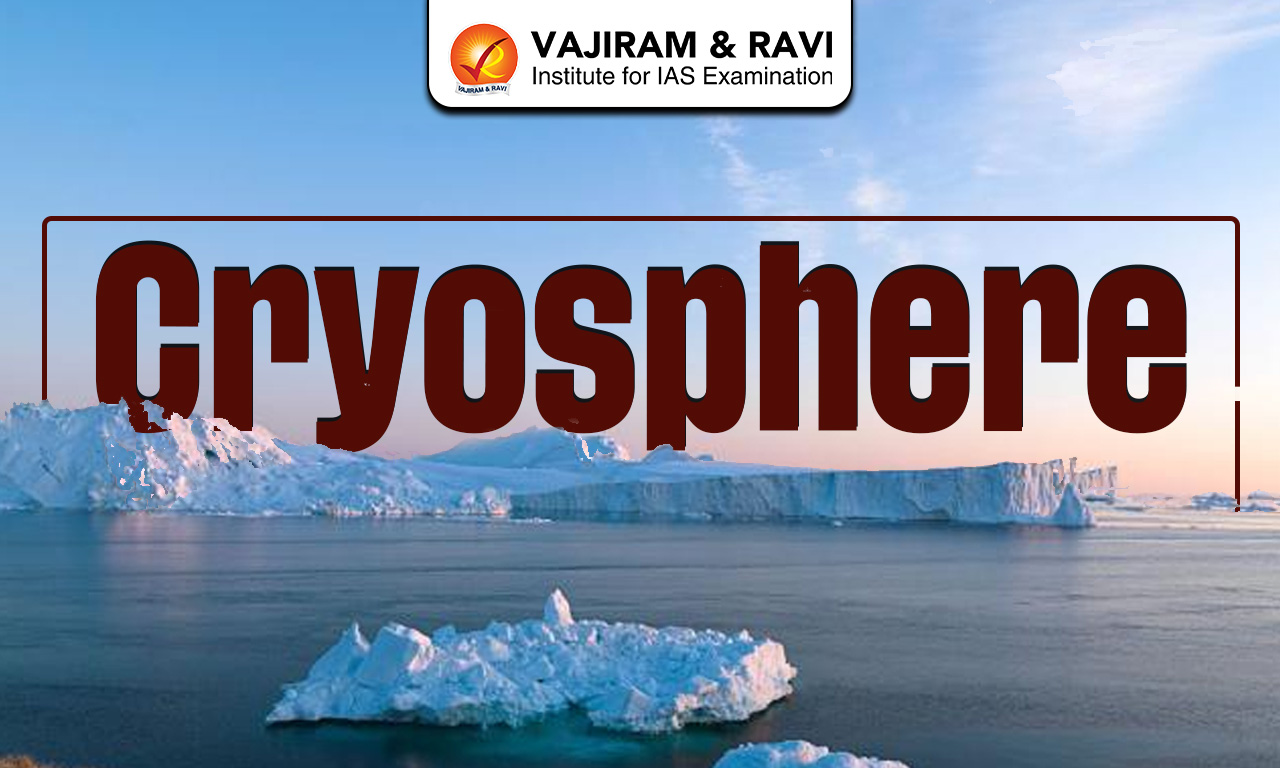
The cryosphere refers to all parts of the Earth where water exists in frozen form. This includes glaciers, ice sheets, snow cover, sea ice, and permafrost.
Cryosphere Meaning
The cryosphere is the frozen water component of the Earth system. It includes both permanent features such as ice sheets and glaciers, and seasonal features such as snow cover and sea ice. Although largely confined to polar and high mountain regions, its influence extends far beyond these areas. It regulates global climate, controls sea levels, and sustains freshwater systems.
Components of the Cryosphere
The cryosphere is composed of various forms of frozen water, each differing in location, scale, and role within the Earth’s climate system.
- Ice Sheets: Ice sheets are massive bodies of ice covering large land areas, mainly found in Antarctica and Greenland. They store a major portion of the world’s freshwater and play a significant role in sea-level changes.
- Glaciers: Glaciers are smaller ice masses formed by the accumulation of snow over long periods. In India, Himalayan glaciers are especially important as they feed major rivers such as the Ganga, Brahmaputra, and Indus.
- Sea Ice: Sea ice forms when ocean water freezes in polar regions. It floats on the ocean surface and plays a crucial role in regulating temperature and influencing ocean circulation.
- Snow Cover: Snow cover is usually seasonal and reflects a large portion of solar radiation, helping to maintain lower surface temperatures.
- Permafrost: Permafrost refers to ground that remains frozen for at least two consecutive years. It contains organic matter which, when thawed, can release greenhouse gases and contribute to global warming.


Impact of the Cryosphere on Global Climate
The cryosphere has a significant influence on the global climate system by interacting with the atmosphere, oceans, and land, thereby affecting temperature, sea levels, and weather patterns.
- Regulation of Earth’s Temperature: The cryosphere helps in keeping the Earth cool. Ice and snow reflect a large part of the Sun’s heat back into space. This is known as the albedo effect. When ice melts, dark land or ocean surfaces are exposed, which absorb more heat. This increases temperature and leads to further melting.
- Sea-Level Rise: Glaciers and ice sheets are found on land. When they melt, the water flows into the oceans, causing sea levels to rise. This can lead to flooding of coastal areas and loss of land.
- Influence on Ocean Circulation: Melting ice adds fresh water to the oceans. This reduces the salinity of seawater and affects its density. As a result, ocean currents that distribute heat across the world may slow down or change, affecting the global climate.
- Role in Climate Feedback Mechanism: When ice melts, it reduces reflectivity and increases heat absorption. In addition, thawing permafrost releases gases like methane and carbon dioxide, which further increase global warming.
- Impact on Atmospheric Circulation: Rapid warming in polar regions reduces the temperature difference between the equator and the poles. This weakens wind systems such as jet streams, leading to extreme weather conditions like heatwaves, cold spells, and irregular rainfall.
- Effect on Water Availability: Glaciers store fresh water and release it slowly over time. This helps maintain river flow. When glaciers shrink, water supply may increase in the short term but decrease in the long term, affecting agriculture and human use.
- Impact on Climate and Ecosystems: Changes in the cryosphere affect polar and mountain ecosystems. Loss of ice alters habitats and can disturb the balance of the climate system.
Cryosphere Loss: Causes and Trends
Cryosphere loss refers to the reduction in the extent, thickness, and stability of frozen components such as glaciers, ice sheets, sea ice, and permafrost. It is one of the most visible indicators of climate change.
Recent Trends
- Glaciers are retreating across almost all mountain regions, including the Himalayas.
- Arctic sea ice is declining in both area and thickness, especially during summer.
- Permafrost is thawing in high-latitude regions.
- The rate of ice loss has increased significantly in recent decades, as observed through satellite data.
- Overall, the cryosphere is shrinking rapidly, reflecting rising global temperatures.
Causes of Cryosphere Loss
- Increase in global temperature due to greenhouse gas emissions is the primary cause.
- Black carbon deposition on ice reduces reflectivity and speeds up melting, especially in the Himalayas.
- Warming of oceans contributes to melting of sea ice and ice sheets from below.
- Local factors such as land-use change and pollution further accelerate melting in some regions.
Consequences of Cryosphere Loss
The loss of the cryosphere has wide-ranging impacts on both natural systems and human life.
- Rising sea levels increase the risk of coastal flooding, salinization of groundwater, and displacement of populations.
- Reduction in glacier volume threatens long-term water availability in river basins dependent on glacial melt.
- Climate feedback processes intensify warming, making climate change more difficult to control.
- Disturbance in ocean circulation can alter rainfall patterns, including monsoon systems.
- Increased occurrence of disasters such as glacial lake outburst floods and landslides in mountain regions.
- Loss of biodiversity in fragile polar and alpine ecosystems due to habitat changes.
Cryosphere and India
Although India is a tropical country, the cryosphere plays a crucial role due to the Himalayan region, often referred to as the “Third Pole.”
- Cryosphere Extent in India: India’s cryosphere is mainly found in the Himalayan and trans-Himalayan regions, including Ladakh, Himachal Pradesh, Uttarakhand, Sikkim, and Arunachal Pradesh. It includes glaciers, snow cover, permafrost, and glacial lakes.
- Cryosphere Importance for India: Himalayan glaciers feed major river systems such as the Ganga, Brahmaputra, and Indus, making them essential for water supply, irrigation, and hydropower generation. They also influence regional climate patterns and play a role in the behaviour of the Indian monsoon.
Cryosphere-Induced Hazards in the Himalayan Region
Cryosphere changes are no longer limited to environmental concerns; they are increasingly manifesting as disasters in the Himalayan region, directly affecting lives, infrastructure, and livelihoods. The rapid melting of glaciers and associated geomorphic instability has made mountain regions more vulnerable to sudden and high-intensity hazards.
- Glacial Lake Outburst Floods (GLOFs): The accelerated melting of glaciers has led to the formation and expansion of glacial lakes. These lakes are often unstable and can burst suddenly due to triggers such as ice avalanches or moraine failure. Incidents like the Chamoli disaster (2021) and the South Lhonak Lake flood in Sikkim (2023) highlight the increasing frequency and intensity of such events.
- Landslides and Flash Floods: Melting ice weakens mountain slopes and alters natural drainage systems. Combined with intense rainfall events, this leads to more frequent landslides and flash floods in Himalayan regions.
- Cryoseisms (Ice Quakes): In cold regions, repeated freezing and thawing of water in the ground creates stress within rocks and soil. Sudden release of this stress can cause minor seismic shocks, known as cryoseisms, indicating growing instability in permafrost areas.
This emerging disaster dimension highlights the need to view the cryosphere not only as a climate regulator but also as a critical factor in disaster risk management, particularly in fragile mountain ecosystems like the Himalayas.
Indian Initiatives for Cryosphere Study and Protection
India has taken several scientific and policy initiatives to understand and manage cryosphere-related changes.
- Establishment of Himansh, a high-altitude research station in Himachal Pradesh for glacier studies.
- Role of the National Centre for Polar and Ocean Research, which coordinates research in polar regions and the Himalayas.
- Maintenance of Antarctic research stations such as Bharati and Maitri for long-term scientific observation.
- Deployment of IndARC, an underwater observatory in the Arctic region, to study ocean and climate interactions.
- Implementation of the National Mission for Sustaining the Himalayan Ecosystem under the National Action Plan on Climate Change, focusing on conservation and sustainable development.

 Last updated on Oct, 2026
→ UPSC 2027 Notification will be released on 13 January 2027 at upsconline.nic.in.
→ Check Nobel Prize 2026 Winners List here.
→ Download PIB PRiSM Monthly Magazine 2026 here.
→ Check UPSC Monthly Current Affairs Magazine The Recitals here.
→ Check out the latest UPSC Syllabus here.
→ Download UPSC Model Answers for Mains 2026
→ UPSC Mains Question Paper 2026 is out now for Essay & GS Paper 1, 2, 3 & 4.
→ UPSC Calendar 2027 has been released.
→ Enroll in Vajiram & Ravi’s UPSC Mains Test Series 2027 for structured answer writing practice, expert evaluation, and exam-oriented feedback.
→ Join Vajiram & Ravi’s UPSC Mentorship Program 2027 for personalized guidance, strategy planning, and one-to-one support from experienced mentors.
→ Go through the UPSC Mains Previous Year Papers to enhance your preparation.
→ UPSC has released UPSC Toppers List 2025 with the Civil Services final result on its official website.
→ Also check Best UPSC Coaching in India
Cryosphere FAQs
Q1. What is the cryosphere?+
Q2. Why is the cryosphere important for global climate?+
Q3. What is the albedo effect?+
Q4. What are Glacial Lake Outburst Floods?+
Q5. What are the major consequences of cryosphere loss?+
Tags: cryosphere