


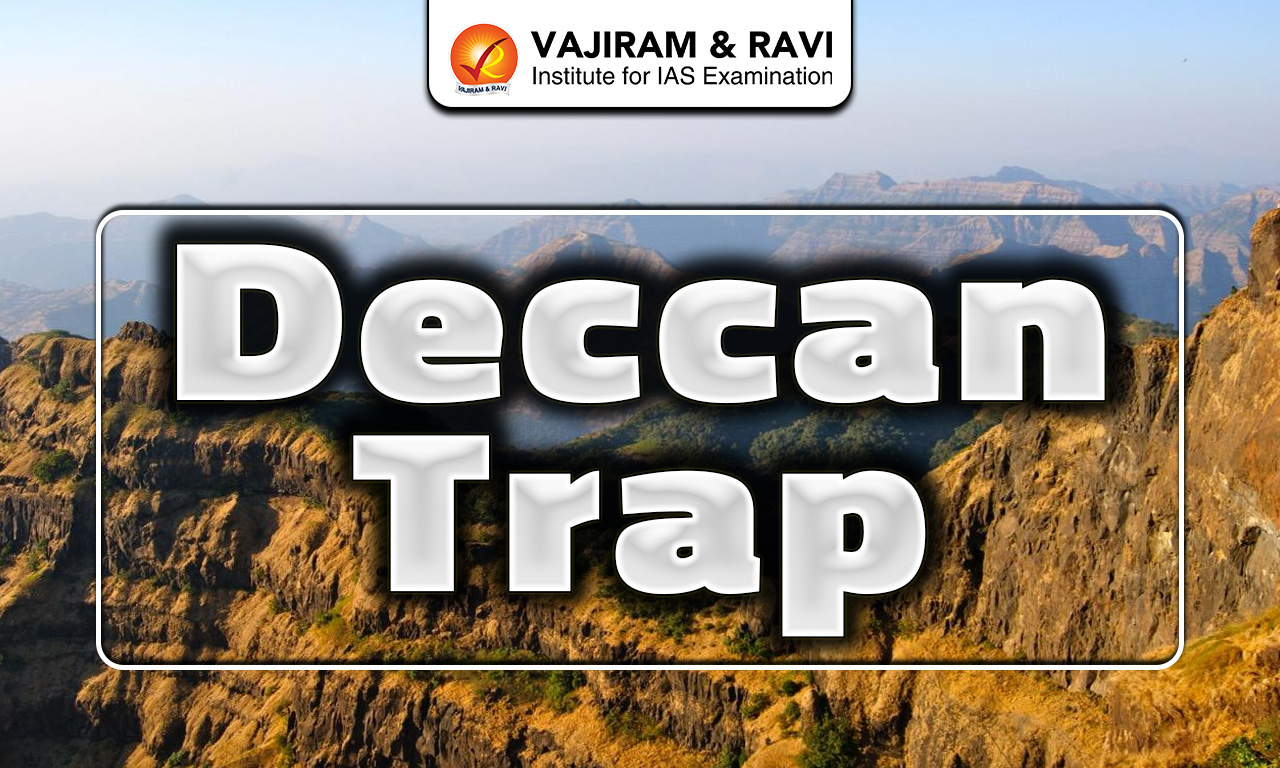
The Deccan Traps form one of the most extensive volcanic landscapes in the world, dominating the west-central Indian Peninsula. These are classic examples of flood basalt formations, where highly fluid lava spread over vast areas, creating a layered, step-like terrain.
What are Deccan Traps?
The Deccan Traps are a massive accumulation of basaltic lava flows formed during intense volcanic activity in the Late Cretaceous period (~66 million years ago). These lava flows now cover about 500,000 sq. km of India.
The term “Trap” comes from the Swedish word Trappa, meaning stairs, referring to the terraced topography formed due to successive lava layers.
How are Deccan Traps Formed?
The Deccan Traps were formed due to massive fissure volcanic eruptions during the Late Cretaceous period (~66 million years ago), when large volumes of highly fluid basaltic lava flowed out onto the Earth’s surface and spread over vast areas of peninsular India.
- The formation began when the Indian Plate passed over the Reunion hotspot, causing intense volcanic activity.
- Instead of erupting from a single volcanic cone, lava emerged through long linear cracks (fissures) in the Earth’s crust.
- These eruptions were non-explosive (quiet eruptions), allowing lava to flow smoothly over long distances.
- The lava was highly fluid (low viscosity), which enabled it to spread across hundreds of kilometers, forming a vast lava plateau.
- Multiple eruptions occurred over time, creating layer upon layer of basalt flows, leading to great thickness (up to 3000+ meters).
- The eruptions took place in a sub-aerial environment, meaning lava spread over land rather than underwater.
- Vertical intrusions called dykes acted as feeder channels through which magma reached the surface.
- The volcanic activity was not continuous, there were intervals of inactivity during which:
- Rivers and lakes developed
- Sediments were deposited
- Plant and animal life existed
- These breaks resulted in the formation of inter-trappean beds, which contain fossil evidence.
- Over millions of years, cooling, weathering, and erosion shaped the lava flows into a step-like (trap) topography seen today.


Deccan Trap Distribution
The Deccan Trap spread reflects the vast outpouring of basaltic lava that once covered a much larger area, later reduced due to erosion.
- The largest coverage of Deccan Traps is found in Maharashtra, forming the core of the Deccan Plateau.
- Significant extensions occur in Madhya Pradesh, Gujarat (Kutch and Kathiawar), Karnataka, Telangana, and Andhra Pradesh.
- In Gujarat, the traps are well-developed in the Saurashtra peninsula and Kutch region.
- The lava flows extend eastward into the Godavari and Krishna river valleys.
- Thickness varies from over 3,000 m in the Western Ghats to thinner layers toward the eastern margins.
- The Deccan Traps originally covered a much larger area, possibly extending into parts of central India and beyond, but have been reduced due to erosion and denudation.
- Isolated remnants of basalt flows are also found in Jharkhand, Bihar, and northern Andhra, indicating their former wider spread.
- The traps form a step-like topography, especially visible in the Western Ghats region.
- After the Archaean rock system, the Deccan Traps are the second most widespread geological formation in India.
Deccan Trap Characteristics
The Deccan Traps exhibit distinctive geological, structural, and soil-related features that reflect their origin from extensive flood basalt eruptions.
- The Deccan Traps consist of thick, horizontal layers of basaltic lava flows, giving rise to a step-like or terraced topography (trap structure).
- The lava flows are remarkably uniform in composition, indicating repeated eruptions of similar magma over a long period.
- The average dip of layers is low (about 5°–10°), showing that lava spread widely over flat surfaces.
- Individual lava flows vary in thickness from 3 to 30 meters, while the total thickness may exceed 3,000 meters in some regions.
- These flows extend over very large areas (sometimes up to 100 km or more), highlighting the fluid nature of basaltic lava.
- The rocks are primarily basalt (igneous), often showing vesicular texture (gas bubbles) and amygdaloidal structure (mineral-filled cavities).
- The presence of numerous dykes and sills indicates the pathways through which magma rose to the surface.
- Inter-trappean beds (sedimentary layers) occur between lava flows, formed during pauses in volcanic activity; these contain fossils of plants and freshwater organisms.
- The Deccan Trap region has given rise to black cotton soil (regur) due to weathering of basalt rocks.
- The soils are clay-rich, moisture-retentive, and fertile, but low in humus and nitrogen.
- The terrain often shows flat-topped hills, plateaus, and steep escarpments, especially along the Western Ghats.
Black Cotton Soil (Regur Soil)
Black Cotton Soil, also known as Regur Soil, is a distinctive soil type formed by the weathering of basaltic rocks of the Deccan Traps. It is widely recognized for its dark color, high clay content, and excellent moisture retention, making it especially suitable for cotton cultivation.
- Black soil derives its origin from the basalt lava flows of the Deccan Trap region, making it a residual soil formed in situ.
- It is most commonly found in semi-arid and sub-humid regions, where climatic conditions favor its development.
- The soil appears deep black to grey in color due to the presence of iron, magnesium, and certain mineral salts.
- It has a fine-grained, clayey texture, dominated by montmorillonite clay minerals, which are responsible for its swelling and shrinking nature.
Key Characteristics:
- High moisture retention capacity, allowing crops to survive even during dry periods.
- Becomes sticky and plastic when wet, making ploughing difficult.
- Develops wide cracks during dry seasons, aiding aeration, this is known as the self-ploughing property.
- Poor in humus content, but rich in certain minerals.
- Slow permeability, which helps retain water but can lead to waterlogging if poorly managed.
Chemical Composition:
- Rich in Calcium Carbonate (Lime): Enhances soil structure and supports plant growth.
- High Magnesium Content: Important for chlorophyll formation and crop productivity.
- Contains Potash (Potassium): Essential for plant metabolism and disease resistance.
- Deficient in Nitrogen and Phosphorus: Limits fertility unless supplemented with fertilizers.
Agricultural Importance
- Black cotton soil (regur) is highly fertile and ideal for farming
- Excellent moisture retention supports crops even in low rainfall
- Suitable for major crops like cotton, sugarcane, and millets
- Supports rain-fed agriculture, reducing dependence on irrigation
Environmental Issues in Deccan Trap Region
The Deccan Trap region faces multiple environmental challenges due to its basaltic geology, clay-rich black soils, and semi-arid climate, which affect land, water, and agriculture.
- Soil erosion and land degradation: Removal of vegetation and improper farming on slopes leads to loss of fertile topsoil and reduced productivity.
- Water scarcity and groundwater limitations: Hard basalt rocks have low permeability, restricting groundwater recharge and causing frequent drought-like conditions.
- Waterlogging in black soil areas: The clayey nature of regur soil leads to poor drainage, resulting in temporary waterlogging during heavy rainfall.
- Soil salinity and alkalinity: Improper irrigation practices and poor drainage contribute to salt accumulation, reducing soil fertility.
- Cracking and structural damage in soil: Deep cracks in dry seasons can damage plant roots and infrastructure like roads and buildings.
- Deforestation and biodiversity loss: Expansion of agriculture and urbanization leads to loss of natural vegetation and wildlife habitats.
- Overgrazing pressure: Excessive grazing depletes vegetation cover, accelerating soil erosion and desertification tendencies.
- Climate variability impacts: Erratic rainfall and prolonged dry spells affect crop yields and water availability.
- Mining and quarrying impacts: Extraction of basalt for construction causes landscape degradation and dust pollution.

 Last updated on Oct, 2026
→ UPSC 2027 Notification will be released on 13 January 2027 at upsconline.nic.in.
→ Check Nobel Prize 2026 Winners List here.
→ Download PIB PRiSM Monthly Magazine 2026 here.
→ Check UPSC Monthly Current Affairs Magazine The Recitals here.
→ Check out the latest UPSC Syllabus here.
→ Download UPSC Model Answers for Mains 2026
→ UPSC Mains Question Paper 2026 is out now for Essay & GS Paper 1, 2, 3 & 4.
→ UPSC Calendar 2027 has been released.
→ Enroll in Vajiram & Ravi’s UPSC Mains Test Series 2027 for structured answer writing practice, expert evaluation, and exam-oriented feedback.
→ Join Vajiram & Ravi’s UPSC Mentorship Program 2027 for personalized guidance, strategy planning, and one-to-one support from experienced mentors.
→ Go through the UPSC Mains Previous Year Papers to enhance your preparation.
→ UPSC has released UPSC Toppers List 2025 with the Civil Services final result on its official website.
→ Also check Best UPSC Coaching in India
Deccan Trap FAQs
Q1. What are the Deccan Traps?+
Q2. Why are they called “Traps”?+
Q3. When were the Deccan Traps formed?+
Q4. How were the Deccan Traps formed?+
Q5. What type of rock is found in the Deccan Traps?+
Tags: geography geography notes








