Planetary winds, also called permanent winds, are large-scale air currents that blow over the Earth in fairly fixed directions throughout the year. These winds are important because they help control climate, influence ocean currents, determine rainfall patterns, and affect agriculture across the world.
What are Planetary Winds?
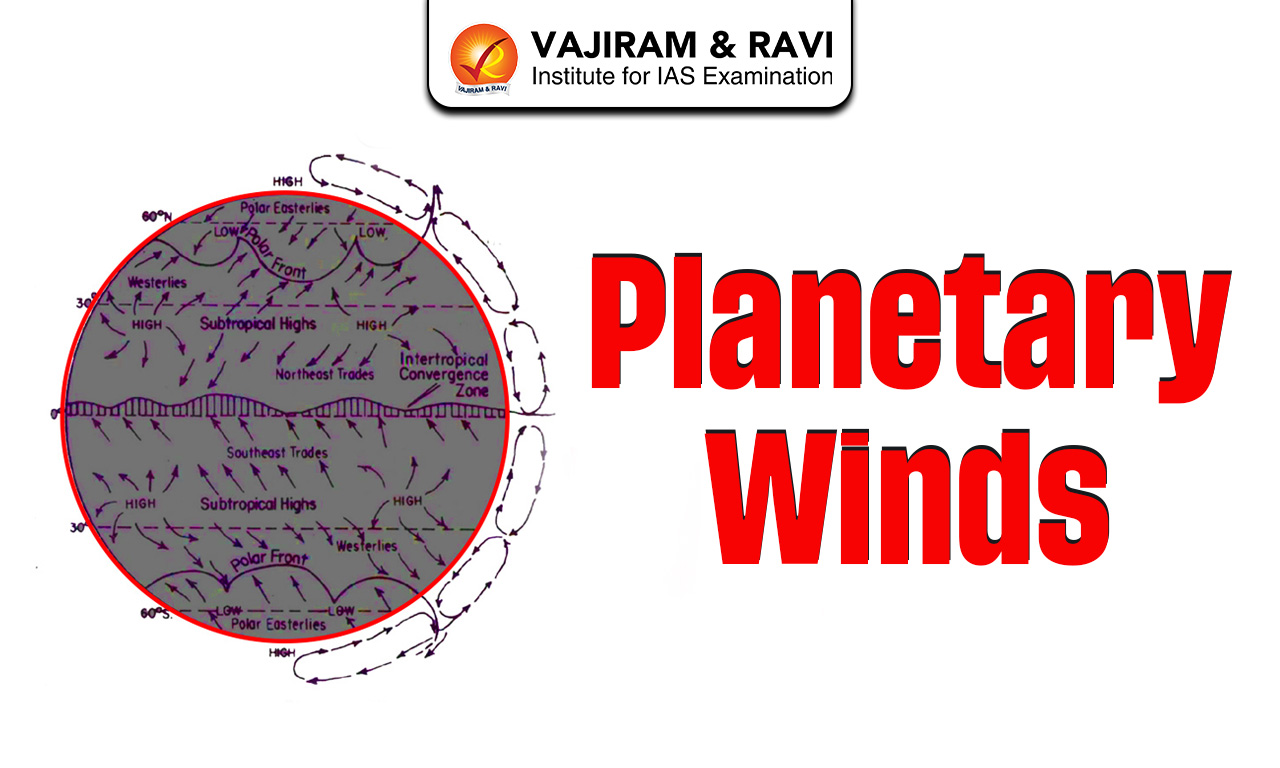
Planetary winds are large-scale wind patterns that blow across the Earth’s surface, from one permanent pressure belt to another in a consistent direction throughout the year. They are also called primary winds or permanent winds because they remain the same throughout the year and are distributed all across the globe.
Pressure Belts and Their Role in Planetary Winds Movement
The origin and direction of planetary winds can only be fully understood in the context of the global distribution of pressure belts.
- These pressure belts are formed due to differential heating of the Earth’s surface and the dynamic movement of air masses.
- The Earth is characterized by seven major pressure belts, which include one equatorial low-pressure belt, two subtropical high-pressure belts, two subpolar low-pressure belts, and two polar high-pressure belts.
- The equatorial region experiences intense heating, causing air to expand, become lighter, and rise, thereby creating a low-pressure zone.
- The polar regions remain cold, resulting in dense, descending air that forms high-pressure areas.
- Between these extremes, subtropical and subpolar belts are formed due to complex atmospheric circulation processes.
Air continuously moves from high-pressure regions to low-pressure regions, and it is this pressure gradient that drives planetary winds. However, due to the influence of the Coriolis effect, these winds follow curved paths, giving rise to distinct wind belts across latitudes.


Forces Affecting Planetary Wind
Planetary winds are controlled by four main forces that act together to decide their speed and direction.
- Pressure Gradient Force: This is the main driving force of wind. Air moves from areas of high pressure to areas of low pressure. The greater the pressure difference, the stronger the wind. It gives the initial direction of wind flow.
- Coriolis Force: This force is caused by the rotation of the Earth. It deflects winds to the right in the Northern Hemisphere and to the left in the Southern Hemisphere, as explained by Ferrel’s Law. It increases with latitude and is zero at the equator. It changes only the direction of wind, not its speed.
- Frictional Force: This force acts near the Earth’s surface. It slows down the wind and reduces the effect of the Coriolis force, causing winds to move more directly towards low-pressure areas. It is absent in the upper atmosphere.
- Gravitational Force: Gravity keeps the atmosphere attached to the Earth. It helps maintain pressure differences and the vertical structure of the atmosphere, which are necessary for wind movement.
In the upper atmosphere, where friction is negligible, the pressure gradient force and Coriolis force balance each other. As a result, winds flow parallel to isobars. This is called geostrophic wind, and jet streams are a good example of this behaviour.
Types of Planetary Winds
The major types of planetary winds are: Trade Winds (Tropical Easterlies), Westerlies and Polar Easterlies.
Trade Winds
- Trade winds blow from the subtropical high-pressure belts towards the equatorial low-pressure belt, covering the region between zero degrees and thirty degrees latitude.
- In the Northern Hemisphere, they blow from the northeast towards the southwest, while in the Southern Hemisphere, they blow from the southeast towards the northwest.
- Trade winds are characterized by their remarkable consistency in both speed and direction.
- As they travel over oceans, they pick up moisture and become moisture-laden. When they meet near the equator in the Intertropical Convergence Zone, the air rises and produces heavy rainfall.
- Trade winds are important because they bring rainfall to equatorial regions and help form tropical forests.
- They are also linked to the monsoon system and help drive ocean currents near the equator.
Westerlies
- Westerlies blow from the subtropical high-pressure belts towards the subpolar low-pressure belts, covering the region between thirty degrees and sixty degrees latitude.
- In the Northern Hemisphere, they blow from the southwest towards the northeast, while in the Southern Hemisphere, they blow from the northwest towards the southeast.
- These winds are less steady than trade winds and often change in speed and direction. They are stronger in the Southern Hemisphere because there is more ocean and less land to block their movement.
- Westerlies are important because they control the weather of temperate regions. They carry cyclones and bring rainfall to the western parts of continents. In the Southern Hemisphere, very strong westerlies are found in regions called the Roaring Forties, Furious Fifties, and Screaming Sixties.
Polar Easterlies
- Polar easterlies blow from the polar high-pressure belts towards the subpolar low-pressure belts, covering the region between sixty degrees and ninety degrees latitude.
- These winds move from east to west and are cold and dry because they originate in polar regions. They are weaker and less regular compared to trade winds and westerlies.
- When polar easterlies meet the warmer westerlies, they form a boundary called the polar front. This region is important because it leads to the formation of cyclones.
Seasonal Shift of Wind Belts
Planetary wind belts do not remain fixed throughout the year. They shift slightly due to the apparent movement of the Sun between the northern and southern hemispheres.
- During summer, the Sun moves towards the Northern Hemisphere, and the wind belts shift northward.
- During winter, they move southward. This shift is usually around five to ten degrees in latitude.
This seasonal movement is very important for India because it controls the onset and withdrawal of the monsoon. When the Intertropical Convergence Zone moves northward, it helps bring monsoon rains. When it moves southward, the monsoon withdraws.
Influence of Planetary Wind on Indian Climate
Planetary winds play a very important role in shaping the climate of India. The most important example is the monsoon.
- During the summer months, the southeast trade winds cross the equator and are deflected due to the Coriolis effect, eventually becoming the southwest monsoon winds that bring widespread rainfall to the Indian subcontinent.
- Westerlies also affect India during winter. They bring western disturbances, which cause rainfall and snowfall in northwestern India. This precipitation is vital for the cultivation of rabi crops such as wheat.
- Additionally, high-altitude jet streams associated with westerlies influence the onset and withdrawal of the monsoon.
Any shift or weakening of these wind systems can have significant implications for agricultural productivity, water resources, and overall economic stability in India.
Influence of Planetary Winds on Ocean Currents
Planetary winds exert a significant influence on the movement of ocean waters, thereby generating surface ocean currents.
- Trade winds drive equatorial currents that flow from east to west, while westerlies influence mid-latitude currents that move in the opposite direction.
- These wind-driven currents play a vital role in redistributing heat across the oceans, which in turn affects global climate patterns.
- In certain regions, winds cause upwelling, a process in which cold, nutrient-rich water rises from the deep ocean to the surface. This enhances marine productivity and supports rich fishing grounds.
- Variations in planetary winds are also linked with large-scale ocean-atmosphere phenomena such as El Nino and La Nina, which have far-reaching impacts on weather patterns, including the Indian monsoon.
Climate Zones Shaped by Planetary Winds
Planetary winds help create different climate zones across the world.
- Near the equator, the meeting of trade winds causes heavy rainfall and leads to equatorial climate.
- In regions around thirty degrees latitude, descending air creates dry conditions, leading to the formation of deserts.
- Similarly, the seasonal influence of westerlies gives rise to Mediterranean climates, which experience dry summers and wet winters.
Thus, the global pattern of climate zones is closely aligned with the distribution and movement of planetary winds.
Significance of Planetary Winds
Planetary winds play a fundamental role in shaping the Earth’s climate system and influencing both natural processes and human activities.
- Climate regulation: They help maintain the Earth’s heat balance by transferring warm air from equatorial regions towards higher latitudes and bringing cold air towards lower latitudes. This prevents extreme temperature differences across the planet.
- Rainfall distribution: Planetary winds control global rainfall patterns. For example, convergence of trade winds near the equator leads to heavy rainfall, while descending air in subtropical regions creates dry conditions and deserts.
- Ocean currents: They drive major surface ocean currents, which in turn influence coastal climates, marine ecosystems, and global heat distribution.
- Weather systems: Westerlies, in particular, carry cyclones and fronts in temperate regions, shaping day-to-day weather changes.
- Indian monsoon system: Trade winds are closely linked to the origin of the monsoon, while westerlies bring western disturbances in winter, affecting rainfall and agriculture in India.
- Agriculture and human life: By influencing rainfall and temperature patterns, planetary winds directly affect crop production, water availability, and settlement patterns.
- Navigation and trade: Historically, steady winds like the trade winds enabled sea navigation and global trade routes.
- Climate zones formation: They help determine major climatic regions such as equatorial rainforests, tropical deserts, and Mediterranean climates.

 Last updated on Oct, 2026
→ UPSC 2027 Notification will be released on 13 January 2027 at upsconline.nic.in.
→ Check Nobel Prize 2026 Winners List here.
→ Download PIB PRiSM Monthly Magazine 2026 here.
→ Check UPSC Monthly Current Affairs Magazine The Recitals here.
→ Check out the latest UPSC Syllabus here.
→ Download UPSC Model Answers for Mains 2026
→ UPSC Mains Question Paper 2026 is out now for Essay & GS Paper 1, 2, 3 & 4.
→ UPSC Calendar 2027 has been released.
→ Enroll in Vajiram & Ravi’s UPSC Mains Test Series 2027 for structured answer writing practice, expert evaluation, and exam-oriented feedback.
→ Join Vajiram & Ravi’s UPSC Mentorship Program 2027 for personalized guidance, strategy planning, and one-to-one support from experienced mentors.
→ Go through the UPSC Mains Previous Year Papers to enhance your preparation.
→ UPSC has released UPSC Toppers List 2025 with the Civil Services final result on its official website.
→ Also check Best UPSC Coaching in India
Planetary Winds FAQs
Q1. What are planetary winds?+
Q2. Why are planetary winds termed permanent winds?+
Q3. What are the major types of planetary winds?+
Q4. What are the main factors controlling planetary winds?+
Q5. How do trade winds influence the Indian monsoon?+
Tags: planetary winds