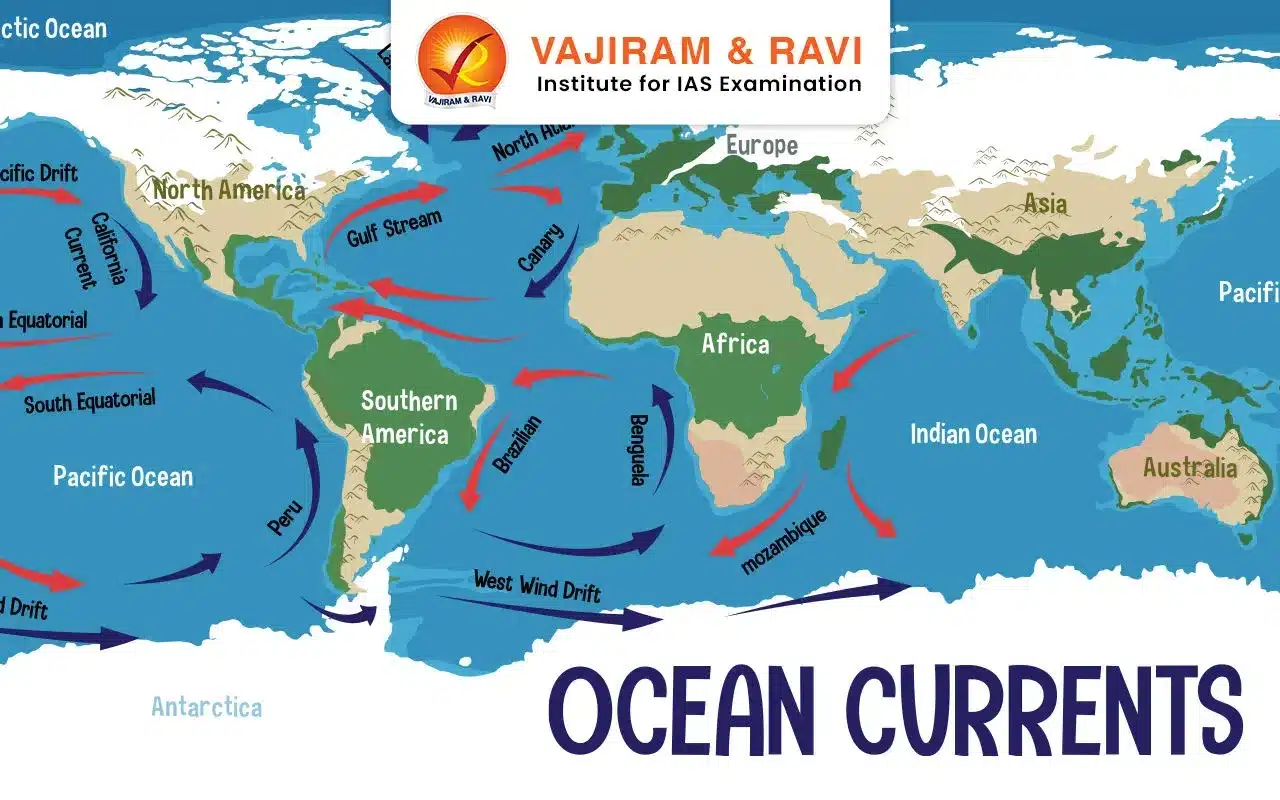
Ocean currents are large-scale, continuous movements of seawater driven by factors like wind, density gradients, Earth’s rotation, and landmasses that cause and influence their speed, direction, and behaviour. They redistribute heat, regulate climate, influence rainfall and weather, support fisheries through upwelling, and aid navigation.
However, climate change is altering ocean temperatures and circulation patterns, affecting marine ecosystems, fisheries and sea levels. Changes in currents can also influence marine heatwaves, extreme weather and monsoon variability, making their long-term impacts challenging to predict.
Ocean Currents Meaning
Ocean currents are persistent and predictable flows of ocean water mass. These horizontal and vertical movements of ocean water are part of a large complex system that regulates heat transfer, shapes biodiversity patterns, and plays a vital role in Earth's climate dynamics.
- Primarily, there are two types of ocean currents: warm and cold currents. These currents arrange themselves in such a way that they form the world’s major and minor oceanic gyres.
Factors Influencing Ocean Currents
Ocean currents are large-scale movements of seawater that flow in a specific direction. Several factors contribute to the formation and modification of these ocean currents.
Primary Forces Influencing Ocean Currents
Primary forces initiate the movement of ocean water and determine the broad direction of currents. The interaction of these forces results in large rotating systems of ocean water known as gyres. These gyres generate broad, circular patterns of surface circulation across the major ocean basins.
- Solar Heating: Unequal heating of the Earth's surface causes seawater to expand. As a result, sea level near the equator is slightly higher than in many middle-latitude regions. This creates a small pressure or slope gradient, causing water to move from areas of higher level towards lower levels.
- Wind: Winds blowing over the ocean surface transfer energy to the water through friction. Persistent winds can therefore push large masses of surface water and contribute significantly to the formation and movement of ocean currents.
- Gravity: Gravity causes accumulated water to move from relatively elevated areas towards lower levels. It therefore helps maintain the pressure gradients that drive water movement.
- Coriolis Force: Earth's rotation deflects moving ocean water. Currents are generally deflected to the right in the Northern Hemisphere and to the left in the Southern Hemisphere.
Secondary Forces Influencing Ocean Currents
Secondary forces influence the movement and distribution of water after ocean circulation has been initiated.
- Differences in Water Density: Variations in seawater density are important for the vertical movement of ocean water. Density is affected mainly by salinity and temperature.
- Water with higher salinity is generally denser than less saline water.
- Cold water is denser than warm water.
- Dense water tends to sink, whereas less-dense water tends to rise.
- Temperature Differences: Differences in temperature contribute to the development of warm and cold ocean currents. Cold, dense water from polar and high-latitude regions can sink and move through the deeper ocean towards lower latitudes. Meanwhile, warmer surface water from tropical regions flows towards higher latitudes, helping replace the water that sinks.


Ocean Currents Types
Ocean currents are classified on various dimensions, such as speed, depth, temperature, etc.
Based on Velocity
Ocean currents can be classified as drifts, currents, and streams in the order of velocity.
- Drifts are the movement of surface water of low velocity. Example: North Atlantic Drift.
- Currents are faster than drifts. Example: Labrador Current.
- Streams are larger masses of water moving in a definite direction and at a much greater velocity than drifts and currents. Example: Gulf Stream.
Based on Depth
The ocean currents may be classified based on their depth as surface currents and deep water currents.
- Surface currents: These comprise about 10% of the ocean water, occupying the upper 400 meters. Surface currents are mainly powered by wind patterns and are easily observable.
- Deep-water currents: Constituting the remaining 90%, these currents move around ocean basins due to density and gravity variations.
- Deep waters sink into ocean basins at high latitudes, where colder temperatures increase density.
- Deep currents are powered by the density gradient and are part of a more complex system.
Based on Temperature
Ocean currents are classified into two main types based on temperature: warm currents and cold currents.
- Cold Currents: Cold currents carry cold water from higher latitudes towards lower latitudes, thereby cooling coastal areas and influencing local climates.
- They are generally found along the western coasts of continents in low and mid-latitudes and the eastern coasts in higher latitudes.
- Examples include the California Current and Benguela Current.
- Warm Currents: Warm currents transport warm water from lower latitudes towards higher latitudes, raising coastal temperatures and influencing regional weather patterns.
- They are generally found along the eastern coasts of continents in low and mid-latitudes and the western coasts in higher latitudes.
- Examples include the Gulf Stream, Kuroshio Current and Agulhas Current.
Ocean Currents Characteristics
Ocean currents exhibit distinct patterns based on wind, Earth’s rotation, temperature and salinity. Their movement influences heat distribution, climate patterns, marine ecosystems and regional weather conditions.
- Wind and Coriolis Influence: Major ocean currents are primarily shaped by prevailing winds and the Coriolis force. As a result, surface circulation broadly reflects global atmospheric circulation patterns.
- Mid-Latitude Circulation: In the middle latitudes, atmospheric circulation is largely anticyclonic, particularly in the Southern Hemisphere. Ocean currents tend to develop a corresponding circulation pattern.
- High-Latitude Circulation: At higher latitudes, where cyclonic wind systems are more common, oceanic circulation is also influenced by this general pattern.
- Monsoonal Influence: In regions affected by seasonal monsoon winds, changes in wind direction significantly alter the movement and direction of ocean currents.
- Hemisphere-Based Deflection: The Coriolis force deflects currents to the right in the Northern Hemisphere and to the left in the Southern Hemisphere.
- Heat Redistribution: Ocean currents transport heat between different latitudes, helping regulate global temperatures.
- Pole-to-Equator Exchange: Cold polar waters move towards warmer regions, while warm tropical waters flow towards higher latitudes, creating a continuous heat-balancing system.
Ocean Currents and Global Circulation
The world's oceans are in constant motion, driven by two main types of currents - surface currents and deep underwater currents. The features of the global ocean current are described here. Ocean currents involve the movement of the top 200 meters of the ocean, as both horizontal and vertical circulation.
- Horizontal circulation: The horizontal circulation, also called surface currents, involves the movement of warm water from the equator towards the poles as well as the movement of cold water from the poles towards the equator.
- Vertical circulation: Also called Thermohaline circulation, it is the vertical flow of seawater and is driven by temperature and salinity gradients. It causes upwelling and downwelling.
- Upwelling refers to the dense, cooler, and nutrient-rich water rising to the surface, replacing warmer, nutrient-depleted water.
- On the other hand, downwelling occurs when surface water sinks deep.
- Downwelling regions have low productivity, whereas upwelling enriches surface water with nutrients.
Global Ocean Conveyor Belt
Thermohaline circulation, also called the global ocean conveyor belt, is a global system that moves water around the Earth. It involves a continuous exchange between warm surface waters and cold, nutrient-rich deep waters. The conveyor belt moves water around the planet in a continuous cycle.
- North Atlantic deep-water formation: Near Greenland and Norway, cold, salty water becomes dense and sinks, initiating the conveyor belt.
- Southward flow: This dense water moves south towards Antarctica as a deep, slow-moving current.
- Antarctic Circumpolar Current: Upon reaching Antarctica, the water joins the powerful Antarctic Circumpolar Current, which circles the continent.
- Upwelling in the Indian and Pacific: As the deep water moves into these oceans, it gradually warms and rises, bringing nutrients to the surface.
- Return flow: Surface waters then flow back through the Indonesian archipelago, around southern Africa, and into the Atlantic, completing the loop.
Ekman Transport
It is the impact of the Earth's rotation on the ocean current. When the wind blows across the ocean, the water moves due to friction between the ocean surface and the wind.
- As the Earth rotates, the surface water moves to the right of the wind in the Northern Hemisphere and the left of the wind in the Southern Hemisphere, due to the Coriolis effect.
- The velocity (speed and direction) of the water changes with depth. At the surface, it moves at an angle of about 45 degrees to the wind, and under the surface water, it turns a bit more, and the water below that turns even more. Thus, it makes a spiral of moving water 100 to 150 meters deep, called an Ekman spiral.
- The average direction of all the turning water is about a right angle from the wind. This average is called Ekman transport.
Oceanic Gyres
These are large systems of rotating ocean surface currents, driven by wind movements, Coriolis force, and Earth’s landmasses. These gyres are found in all the major oceans and play a crucial role in shaping the Earth's climate and ocean circulation patterns.
- Formation: Wind drags on the ocean surface and causes water to move in the direction of the wind. Beneath the surface currents, the Ekman spiral, due to the Coriolis effect, causes the formation of oceanic gyres.
- Earth’s continents and other landmasses also influence the creation of ocean gyres.
- Types: There are five major gyres - North and South Pacific Subtropical Gyres, North and South Atlantic Subtropical Gyres, and Indian Ocean Subtropical Gyres.
Major Ocean Currents Examples
Hеrе аrе sоmе of thе most significant ocean currents, including both cold and warm currents.
|
Major Ocean Currents |
||
|
Current |
Ocean Location |
Flow Direction |
|
Cold Currents |
||
|
Labrador Current |
North Atlantic Ocean |
-It flows southward along the eastern coast of North America. |
|
Benguela Current |
South Atlantic Ocean |
- It flows northward along the southwestern coast of Africa. |
|
California Current |
North Pacific Ocean |
- It flows southward along the western coast of North America. |
|
Peru Current/Humboldt Current |
South Pacific Ocean |
- It flows northward along the western coast of South America. - It is closely linked to phenomena like El Niño and La Niña. |
|
Oyashio Current |
North Pacific Ocean |
- It flows southward from the Arctic Ocean into the North Pacific. - Its collision with the Kuroshio Current enriches fishing grounds off Japan’s east coast. |
|
Canary Current |
North Atlantic Ocean |
- It is part of the North Atlantic Gyre. |
|
Falkland Current |
South Atlantic Ocean |
- Originating from the Antarctic Circumpolar Current, it mixes with the Brazil Current. |
|
Western Australian Current |
Indian Ocean |
- It flows northward along the West Australian Coast. |
|
Antarctic Circumpolar Current |
Antarctica |
- It is also known as the West Wind Drift, which flows eastward across the Earth. |
|
Antarctic Coastal Current (East Wind Drift) |
Antarctica |
- It is the southernmost current in the world. - It flows westward, parallel to the Antarctic coastline. |
|
Warm Currents |
||
|
Gulf Stream |
North Atlantic Ocean |
- It flows northward along the eastern coast of North America. |
|
Kuroshio Current |
North Pacific Ocean |
- It flows northward along the eastern coast of Asia. |
|
Agulhas Current |
Indian Ocean |
- It flows southward along the southeastern coast of Africa. |
|
Brazil Current |
South Atlantic Ocean |
-It flows southward along the eastern coast of South America. |
|
North Equatorial Current, South Equatorial Current and Equatorial Countercurrent |
Equatorial region in all three major oceans |
- North and South Equatorial Currents flow westward. - Equatorial Countercurrent flows westward. |
Ocean Currents Significance
Ocean currents significantly impact Earth's climate system and human activities through their roles in distributing heat, energy, and nutrients globally.
- Influence on Climate: Ocean currents significantly affect the climatic conditions of coastal areas through the transfer of warm and cold water. Warm currents raise temperatures, whereas cold currents generally reduce them.
- For instance, the North Atlantic Drift keeps the British Isles considerably warmer than their latitude would otherwise suggest.
- Similarly, the cold Peru Current moderates temperatures along the Peruvian coast.
- Impact on Rainfall: Winds passing over warm currents absorb moisture and may bring rainfall to nearby coastal regions. The North Atlantic Drift, for example, contributes to moist conditions along parts of Western Europe.
- In contrast, cold currents generally reduce evaporation and contribute to cooler and drier conditions. The Benguela Current is one factor contributing to the aridity of southwestern Africa.
- Fog Formation: When warm and cold ocean currents meet, condensation can produce dense fog. Such fog reduces visibility and creates serious hazards for maritime navigation.
- Historically, poor visibility in these regions has increased the risk of ships colliding with icebergs and other obstacles.
- Fishing Grounds: Areas where warm and cold currents converge often become highly productive fishing zones. The mixing and upwelling of nutrient-rich waters supports abundant plankton, which provides food for large fish populations.
- Desert Formation: Cold ocean currents can contribute to the development of coastal deserts, particularly along the western margins of tropical and subtropical continents. They reduce evaporation and atmospheric moisture, encouraging dry and arid conditions.
- Trade and Navigation: Ocean currents can assist ships travelling in their direction and help keep some high-latitude ports relatively ice-free during winter.
- Formation of Storms: The interaction between contrasting warm and cold currents can create atmospheric instability and contribute to severe storms. Along the U.S. East Coast, the interaction between the Gulf Stream and Labrador Current influences weather conditions and storm development.
Ocean Currents UPSC PYQs
Q1: How do ocean currents and water masses differ in their impacts on marine life and the coastal environment? Give suitable examples. (UPSC Mains 2019)
Q2: Explain the factors responsible for the origin of ocean currents. How do they influence regional climates, fishing, and navigation? (UPSC Mains 2015)
Q3: What explains the eastward flow of the equatorial counter-current (UPSC Prelims 2015)
- The Earth’s rotation on its axis
- Convergence of the two equatorial currents
- Difference in salinity of water
- Occurrence of the belt of calm near the equator
Ans: (b)

 Last updated on Oct, 2026
→ UPSC 2027 Notification will be released on 13 January 2027 at upsconline.nic.in.
→ Check Nobel Prize 2026 Winners List here.
→ Download PIB PRiSM Monthly Magazine 2026 here.
→ Check UPSC Monthly Current Affairs Magazine The Recitals here.
→ Check out the latest UPSC Syllabus here.
→ Download UPSC Model Answers for Mains 2026
→ UPSC Mains Question Paper 2026 is out now for Essay & GS Paper 1, 2, 3 & 4.
→ UPSC Calendar 2027 has been released.
→ Enroll in Vajiram & Ravi’s UPSC Mains Test Series 2027 for structured answer writing practice, expert evaluation, and exam-oriented feedback.
→ Join Vajiram & Ravi’s UPSC Mentorship Program 2027 for personalized guidance, strategy planning, and one-to-one support from experienced mentors.
→ Go through the UPSC Mains Previous Year Papers to enhance your preparation.
→ UPSC has released UPSC Toppers List 2025 with the Civil Services final result on its official website.
→ Also check Best UPSC Coaching in India
Ocean Currents FAQs
Q1. What are ocean currents?+
Q2. What are the five ocean currents?+
Q3. What are two types of currents?+
Q4. What is the main role of ocean currents?+
Q5. What are the major ocean currents in the world?+
Tags: ocean currents quest UPSC Geography Notes