India’s Mineral Exchanges: Benefits, Rules and Key Challenges

India’s Mineral Exchanges

India’s Mineral Exchanges Latest News

  • In under 14 months, India has moved from legislative intent to a formal regulatory framework, setting the stage for establishing Mineral Exchanges — an electronic platform designed to bring India’s fragmented mineral market onto a single, transparent marketplace. 
  • The goal: let representative prices reflect actual demand and supply, rather than relying on fragmented negotiations and auctions, addressing long-standing issues of price opacity, market fragmentation, and information asymmetry in India’s mining sector.

Why India Needs This Reform

  • Small and medium miners often have limited bargaining power compared to large buyers.
  • Key Benefits Expected
    • Market-driven mineral prices, improving cost planning for industries like steel, aluminium, cement, and renewable energy equipment manufacturing.
    • Greater visibility on transaction volumes, quality specifications, and prevailing prices — reducing information disadvantages for smaller miners.
    • Encouraging exploration investment by improving visibility of future demand and pricing.
    • This is an area where, as per NITI Aayog, India has struggled despite its significant mineral resources, due to gaps in exploration, geological data, logistics, and investment conditions.
  • This reform arrives as minerals become increasingly critical to India’s economic security, amid growing focus on infrastructure, renewable energy, EVs, defence equipment, advanced manufacturing, and clean energy.

The Legal and Regulatory Architecture

  • Legal bedrock: Amendments to the Mines and Minerals (Development and Regulation) Act paved the way, marking a shift from the traditional one-to-many sales model to a competitive many-to-many trading platform.
    • Section 18B, MMDR Act provides for promoting mineral markets, including trading via mineral exchanges.
    • The Ministry of Mines subsequently framed the Mineral Exchange Rules, 2026.
  • Regulatory Authority: The Indian Bureau of Mines (IBM), under the Ministry of Mines, has been designated to register and regulate mineral exchanges for minerals other than coal, lignite, and atomic minerals.
  • Industry Moves
    • PTC India’s board approved a ₹65 crore investment to set up a wholly-owned subsidiary for a mineral exchange.
    • MCX (Multi Commodity Exchange of India) has established MCX Mineral Exchange of India Limited as its subsidiary.

What Will Actually Be Traded

  • Exchanges will initially focus on physical mineral ores (spot, delivery-based contracts), starting with bulk minerals: iron ore, bauxite, limestone, and manganese ore.
  • Importantly, trading will begin with ores (raw mine output), not processed metals — distinguishing this from existing commodity bourses, which mostly trade processed products.
  • Iron ore is the strongest contender for the first major contract, combining scale, liquidity, and industrial importance. 
  • India’s iron ore production jumped from 152 million tonnes (2013-14) to over 300 million tonnes recently, driven by robust steel demand.
  • Currently, steel producers rely on negotiated contracts, captive mines, auctions, and benchmark prices — an exchange could create a more visible domestic reference price.
  • Future phases may include critical minerals: lithium, nickel, cobalt, graphite, and rare earth elements, supporting India’s push to reduce import dependence via critical mineral block auctions, for EVs, batteries, renewables, and defence technologies.

Challenges Ahead

  • Exchanges will operate as an electronic, delivery-based physical marketplace — trading actual mineral quantities, not just financial contracts.
  • Success hinges on liquidity, requiring sufficient participation from buyers and sellers.
  • Unlike financial assets, physical minerals involve supply-chain complexities — quality variation, transportation, storage, and delivery — making standardisation of mineral grades essential.
  • Risk of Market Concentration: Given existing logistical and regional disparities, a small number of large producers or buyers could dominate trading, weakening competition.
  • The new system should complement existing mining regulations, not add fresh compliance burdens.

Key Priorities for Success

  • Standardise Mineral Grades and Testing — consistent specifications and independent assaying are essential for comparing offers.
  • Ensure Price Transparency — publish sufficient data on traded prices, quantities, and grades to build meaningful benchmarks.
  • Monitor Dominant Participants — watch for unusual trading and coordinated bidding to prevent market concentration and manipulation.
  • Make Participation Commercially Viable — ease access for smaller miners and regional buyers, while maintaining robust delivery and settlement safeguards.

Global and Strategic Significance

  • Asia is already the world’s largest regional market for critical-mineral trade — in 2024, it accounted for ~$757 billion in critical-mineral exports and nearly $1.37 trillion in imports (as per UN Trade and Development).
  • If successful, India’s Mineral Exchanges could become more than a domestic trading platform — potentially serving as a common reference point for mineral prices across Asia, amid intensifying global competition for mineral security.

Conclusion

  • India’s Mineral Exchanges represent a structurally sound attempt to replace fragmented, opaque price discovery with a transparent, market-driven system — potentially benefiting smaller miners, improving industrial cost planning, and attracting much-needed exploration investment. 
  • With the regulatory and legal architecture now in place, the real test lies ahead: whether the exchanges can attract sufficient liquidity, enforce credible grade standardisation, and prevent dominance by a few large players. 
  • If these conditions are met, India’s Mineral Exchanges could evolve from a domestic reform into a genuine regional benchmark, reinforcing the country’s position in the intensifying global contest for mineral security.

Source: TH | MC

India’s Mineral Exchanges FAQs

Q1: What are India’s Mineral Exchanges?

Ans: India’s Mineral Exchanges are electronic marketplaces designed to facilitate transparent, competitive trading of physical mineral ores and improve price discovery across the domestic mining sector.

Q2: Why does India need Mineral Exchanges?

Ans: India’s Mineral Exchanges aim to reduce price opacity, improve smaller miners’ bargaining power, provide reliable market information and encourage investment in mineral exploration.

Q3: Which minerals will initially be traded on India’s Mineral Exchanges?

Ans: India’s Mineral Exchanges will initially focus on physical ores, including iron ore, bauxite, limestone and manganese ore, with iron ore a leading contender.

Q4: Which institution will regulate India’s Mineral Exchanges?

Ans: The Indian Bureau of Mines, under the Ministry of Mines, will register and regulate India’s Mineral Exchanges for minerals excluding coal, lignite and atomic minerals.

Q5: What challenges could affect India’s Mineral Exchanges?

Ans: India’s Mineral Exchanges must attract enough buyers and sellers, standardise mineral grades, ensure reliable delivery and prevent market concentration or manipulation by dominant participants.

Cyclone Arnab and El Niño: Why the Storm Intensified Rapidly

Cyclone Arnab and El Niño

Cyclone Arnab and El Niño Latest News

  • Cyclone Arnab, the first cyclone of 2026 in the North Indian Ocean basin, made landfall on India’s east coast, crossing the Andhra Pradesh and Yanam (Puducherry) coasts. 
  • The “very severe” cyclonic storm has since weakened into a “severe” cyclonic storm. It uprooted trees and power poles, triggered widespread power outages, and forced the evacuation of over 1,80,000 people across Andhra Pradesh and Odisha. 
  • This raises a key question: what role did El Niño — the abnormal warming of Pacific Ocean surface waters — play in intensifying Arnab?

How Cyclone Arnab Formed and Intensified

  • Began as a low-pressure system in the southeast Bay of Bengal on October 23.
  • Intensified into Cyclone Arnab by October 26.
  • Rapidly escalated into a “severe” and then a “very severe” cyclone — with wind speeds of 125-135 kmph.
  • Faster-than-forecast movement: The IMD advanced its landfall prediction from forenoon to early hours of Oct 28.
  • Landfall began around 1 am Oct 28, crossing between Bapatla and Visakhapatnam with wind speeds of 125-135 kmph, gusting to 140 kmph — cyclones cause maximum damage at the point of landfall, when the storm’s “eye” crosses from sea to land.

An Unusual Pattern: Sustained Intensity After Landfall

  • Normally, cyclones lose strength upon hitting land due to friction and obstacles.
  • Arnab defied this pattern — it maintained intensity for at least six hours after landfall before weakening to a “severe” storm.
  • As per IMD, Arnab remained stationary near Narsapur (Andhra Pradesh) and Yanam (Puducherry) since 4 am, slowing the landfall process (normally completed within ~6 hours, depending on cyclone speed/size).
  • Heavy rainfall recorded: Visakhapatnam (217mm), Kalingapatam (147mm), Tuni (123mm), Kakinada (118mm), Machilipatnam (115mm), Gopalpur (94mm).

The El Niño Connection

  • 2026’s El Niño is forecast to be among the strongest since records began; the World Meteorological Organization (WMO) has warned of its potential impact on Asian cyclones.
  • Normal Pattern: Odisha and West Bengal coasts are most prone to Bay of Bengal cyclones.
  • During El Niño Years: Cyclones instead tend to affect Andhra Pradesh and Tamil Nadu — linked to where cyclones form and the paths they take.
  • Mechanism: El Niño causes abnormal warming in the equatorial and central Pacific, altering rainfall patterns, temperatures, and global wind patterns — including unusual warming in the North Indian Ocean.
  • As the southwest monsoon weakens, the monsoon trough (a shifting low-pressure band) moves southwards; El Niño further alters wind patterns and air pressure near the equator.
  • Key Effect: During El Niño years, tropical cyclones form closer to the equator, making them more likely to move toward Andhra Pradesh and Tamil Nadu rather than Odisha/West Bengal.
  • Historical Precedent: 2014 — another El Niño year — saw Cyclone Hudhud strike the Andhra Pradesh coast.
  • Net Effect: Cyclones forming under these conditions tend to intensify rapidly and move faster, as seen with Arnab.

The Science of Cyclone Fuel

  • From July to September 2026, sea surface temperatures in the Niño 3.4 region (used to measure El Niño intensity) were 2 to 2.8°C above normal — indicating significantly warmer oceans.
  • Cyclone-Favourable Conditions: Ocean temperatures of 26°C or above, at depths of 50-100 metres.
  • Tropical cyclones are fuelled by ocean heat — warmer oceans directly contribute to rapid intensification.
  • Arnab reached peak “very severe” intensity within a single day — though cyclone intensification is a highly complex process, influenced by multiple factors: boundary layers, wind shear, convection, upper ocean circulation, and air-sea interaction.

Arnab’s Continuing Path and Impact

  • Heavy rainfall (64-115mm/24hrs) will continue to batter northern Andhra Pradesh and south Odisha coastal districts through Oct 29.
  • Alert status: Odisha and Andhra Pradesh on ‘red’ alert; Chhattisgarh on ‘orange’ alert.
  • As Arnab recurves northward, its weakening remnants are expected to bring very heavy rainfall (115-204mm/24hrs) over Telangana, Chhattisgarh, Jharkhand, Bihar, Gangetic West Bengal, eastern Madhya Pradesh, and eastern Uttar Pradesh over the next two days.

Conclusion

  • Cyclone Arnab exemplifies how large-scale climate phenomena like El Niño can reshape not just where cyclones strike, but how intensely and how quickly they do so. 
  • By warming the North Indian Ocean and shifting cyclone formation closer to the equator, this year’s unusually strong El Niño redirected Arnab toward Andhra Pradesh rather than the traditionally more vulnerable Odisha-West Bengal coast, while also fuelling its rapid intensification and unusually sustained strength post-landfall. 
  • As El Niño events are projected to grow more frequent and intense amid climate change, India’s disaster preparedness strategy will need to account for this shifting cyclone geography — treating states like Andhra Pradesh and Tamil Nadu as increasingly high-risk zones during El Niño years, rather than relying solely on historical vulnerability patterns.

Source: IE | BT

Cyclone Arnab and El Niño FAQs

Q1: How did El Niño influence Cyclone Arnab?

Ans: Cyclone Arnab and El Niño were linked through warmer ocean conditions and changing wind patterns that favoured rapid intensification and influenced the storm’s trajectory.

Q2: Why did Cyclone Arnab intensify so quickly?

Ans: Cyclone Arnab and El Niño highlight how warmer sea surfaces can supply energy to tropical cyclones, although wind shear, convection and ocean circulation also influence intensification.

Q3: Why did Cyclone Arnab maintain its strength after landfall?

Ans: Cyclone Arnab and El Niño drew attention because Arnab maintained its intensity for at least six hours after landfall before weakening, an unusual pattern.

Q4: Which Indian states are more vulnerable to cyclones during El Niño years?

Ans: Cyclone Arnab and El Niño illustrate how Andhra Pradesh and Tamil Nadu may face greater cyclone exposure during El Niño years as storm formation and tracks shift.

Q5: How can El Niño affect India’s cyclone preparedness?

Ans: Cyclone Arnab and El Niño underline the need to account for shifting cyclone paths, improve regional forecasting and strengthen preparedness in states facing changing storm risks.

Graded Response Action Plan in Delhi-NCR – Explained

Graded Response Action Plan

Graded Response Action Plan Latest News

  • The Commission for Air Quality Management (CAQM) invoked Stage I of the Graded Response Action Plan (GRAP) as Delhi’s Air Quality Index (AQI) entered the ‘Poor’ category, renewing debate over the effectiveness of emergency pollution-control measures.

Understanding the Graded Response Action Plan

  • The Graded Response Action Plan is a set of short-term emergency measures designed to reduce air pollution when air quality deteriorates. 
  • First notified by the Ministry of Environment, Forest and Climate Change in January 2017, it was introduced following Supreme Court directions.
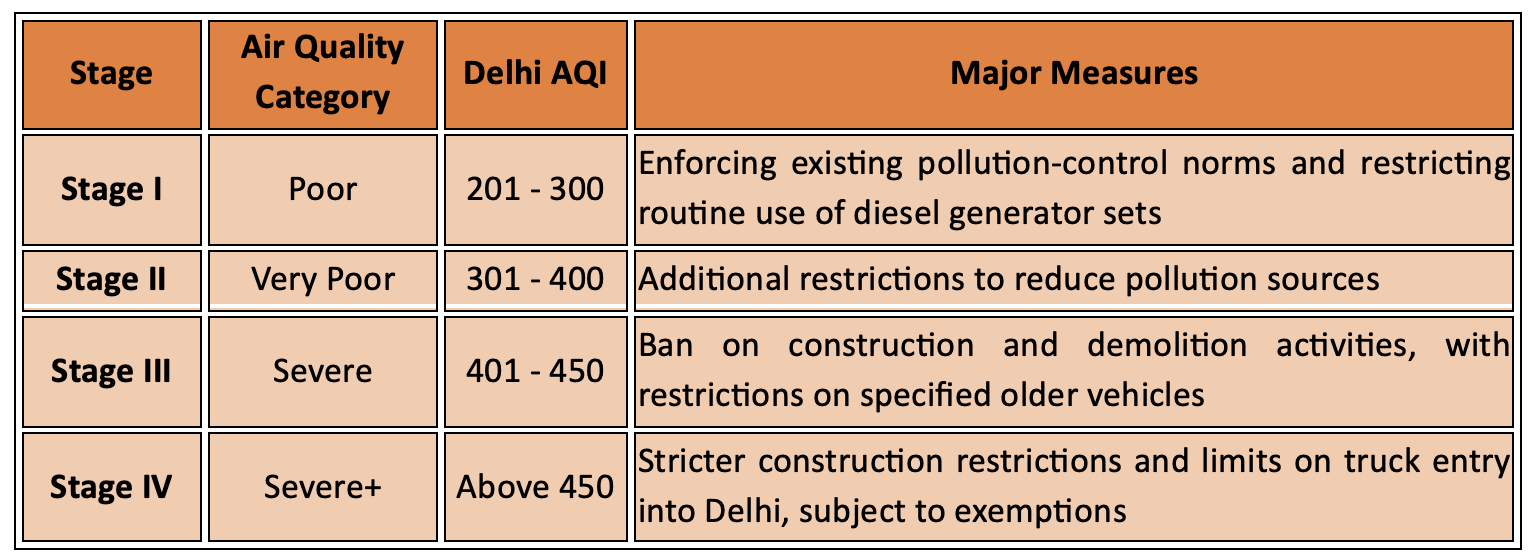
  • GRAP operates through four stages, with increasingly stringent restrictions corresponding to worsening air quality. The CAQM announces the applicable stages based on recorded pollution levels or forecasts.
  • Its directions cover Delhi and the National Capital Region (NCR) districts of Haryana, Uttar Pradesh and Rajasthan. State governments implement the measures through their respective orders and are legally bound to comply with CAQM directions.

Institutional Evolution

  • Initially, GRAP was implemented by the Environment Pollution (Prevention and Control) Authority (EPCA), established in 1998. However, concerns about its limited statutory powers weakened its ability to enforce compliance.
  • In 2021, the Commission for Air Quality Management replaced the EPCA and assumed responsibility for implementing GRAP. The plan has since undergone multiple revisions to strengthen pollution-control measures.

Four Stages of GRAP

  • The restrictions become progressively more stringent as Delhi’s AQI rises.

Four Stages of GRAP

  • Under Stage III, restrictions apply to BS-III petrol and BS-IV or older diesel light motor vehicles in Delhi and specified high-vehicle-density districts. 
  • Stage IV further restricts construction activities and truck entry, with exemptions for specified cleaner-fuel and BS-VI vehicles.
  • Although GRAP can be imposed throughout the year, its higher stages are predominantly activated during winter, when meteorological conditions worsen pollution.

Factors Behind Delhi-NCR’s Winter Pollution

  • Winter air pollution results from a combination of emissions and atmospheric conditions.
    • Meteorological conditions: Lower wind speeds and falling temperatures hinder the dispersion of pollutants.
    • Vehicular emissions: Road transport contributes to the concentration of pollutants in the region.
    • Construction and road dust: Dust-generating activities add particulate matter to the atmosphere.
    • Stubble burning: Agricultural residue burning during October and November contributes to seasonal pollution.
    • Firecrackers: Festive-season emissions can further worsen air quality.
  • These interacting factors demonstrate why temporary restrictions may reduce pollution without eliminating its underlying causes.

Effectiveness of GRAP

  • GRAP aims to reduce pollution sources during episodes of extremely poor air quality. However, its short-term and emergency-oriented nature limits its ability to deliver sustained improvements without complementary long-term policies.
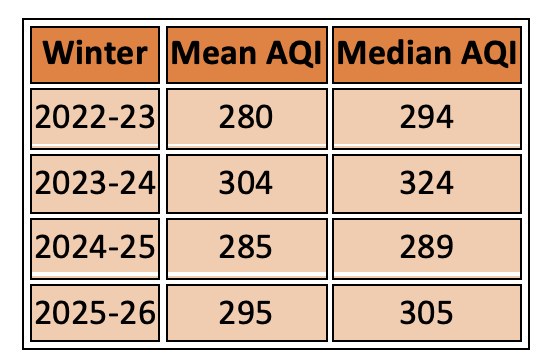
  • An analysis by the Centre for Research on Energy and Clean Air (CREA), cited in October 2026, found no consistent improvement in Delhi’s winter air quality over the preceding four years.

Mean_Median AQI in Delhi

  • The figures show fluctuations rather than a consistent downward trend. Both the mean and median AQI in 2025-26 were higher than in 2022-23.
  • These findings indicate that the existence of emergency restrictions alone does not guarantee sustained improvement in winter air quality. They do not, by themselves, establish that GRAP has no effect during individual pollution episodes.

Additional Restrictions Introduced by Delhi

  • The Delhi government introduced additional restrictions through a notification dated June 23, 2026. Unlike GRAP, these measures apply during specified periods regardless of the prevailing AQI.
    • Vehicle restrictions: From November 1 to January 31, non-Delhi-registered motor vehicles below BS-VI emission standards are prohibited from operating in Delhi, subject to exemptions for electric, CNG, emergency and sovereign-duty vehicles.
    • Higher parking charges: Parking charges at authorised sites are doubled from November 1 to February 28 to discourage private vehicle use. Parking spaces owned and managed by the Delhi Metro Rail Corporation are exempt.
    • Priority of GRAP: In case of conflict between these restrictions and GRAP directions, GRAP takes precedence.
  • These measures represent an attempt to reduce vehicle-related emissions through preventive action rather than relying exclusively on emergency responses after air quality deteriorates.

Way Forward

  • A more effective approach to air pollution requires emergency measures to operate alongside sustained emissions reduction.
  • Year-round pollution control: Strengthen enforcement against vehicular emissions, construction dust and industrial pollution rather than concentrating action primarily in winter.
  • Regional coordination: Improve cooperation among Delhi and neighbouring states to address pollution sources across administrative boundaries.
  • Cleaner transport: Encourage public transport and cleaner vehicles while reducing dependence on private motor vehicles.
  • Agricultural solutions: Strengthen practical alternatives to stubble burning and support farmers in adopting them.
  • Monitoring and accountability: Improve pollution-source monitoring and assess the effectiveness of individual interventions.
  • Long-term planning: Combine emergency restrictions with sustained measures addressing the sources and causes of pollution.

Source: TH

Graded Response Action Plan FAQs

Q1: What is GRAP?

Ans: GRAP is a set of short-term emergency measures activated by the CAQM to control air pollution in Delhi-NCR as air quality deteriorates.

Q2: What are the four stages of GRAP?

Ans: The four stages correspond to Poor (AQI 201–300), Very Poor (301–400), Severe (401–450) and Severe+ (above 450) air quality.

Q3: What is the role of CAQM?

Ans: The CAQM announces GRAP stages, issues directions to the relevant governments and oversees implementation of pollution-control measures.

Q4: Why does Delhi-NCR experience severe winter pollution?

Ans: Low wind speeds and falling temperatures limit pollutant dispersion, while vehicle emissions, dust, stubble burning and firecrackers add to pollution.

Q5: Has GRAP consistently improved Delhi’s winter air quality?

Ans: CREA’s analysis cited in October 2026 found no consistent improvement in Delhi’s winter AQI between 2022–23 and 2025–26.

Enquire Now