Graded Response Action Plan Latest News
- The Commission for Air Quality Management (CAQM) invoked Stage I of the Graded Response Action Plan (GRAP) as Delhi’s Air Quality Index (AQI) entered the ‘Poor’ category, renewing debate over the effectiveness of emergency pollution-control measures.
Understanding the Graded Response Action Plan
- The Graded Response Action Plan is a set of short-term emergency measures designed to reduce air pollution when air quality deteriorates.
- First notified by the Ministry of Environment, Forest and Climate Change in January 2017, it was introduced following Supreme Court directions.
- GRAP operates through four stages, with increasingly stringent restrictions corresponding to worsening air quality. The CAQM announces the applicable stages based on recorded pollution levels or forecasts.
- Its directions cover Delhi and the National Capital Region (NCR) districts of Haryana, Uttar Pradesh and Rajasthan. State governments implement the measures through their respective orders and are legally bound to comply with CAQM directions.


Institutional Evolution
- Initially, GRAP was implemented by the Environment Pollution (Prevention and Control) Authority (EPCA), established in 1998. However, concerns about its limited statutory powers weakened its ability to enforce compliance.
- In 2021, the Commission for Air Quality Management replaced the EPCA and assumed responsibility for implementing GRAP. The plan has since undergone multiple revisions to strengthen pollution-control measures.
Four Stages of GRAP
- The restrictions become progressively more stringent as Delhi’s AQI rises.
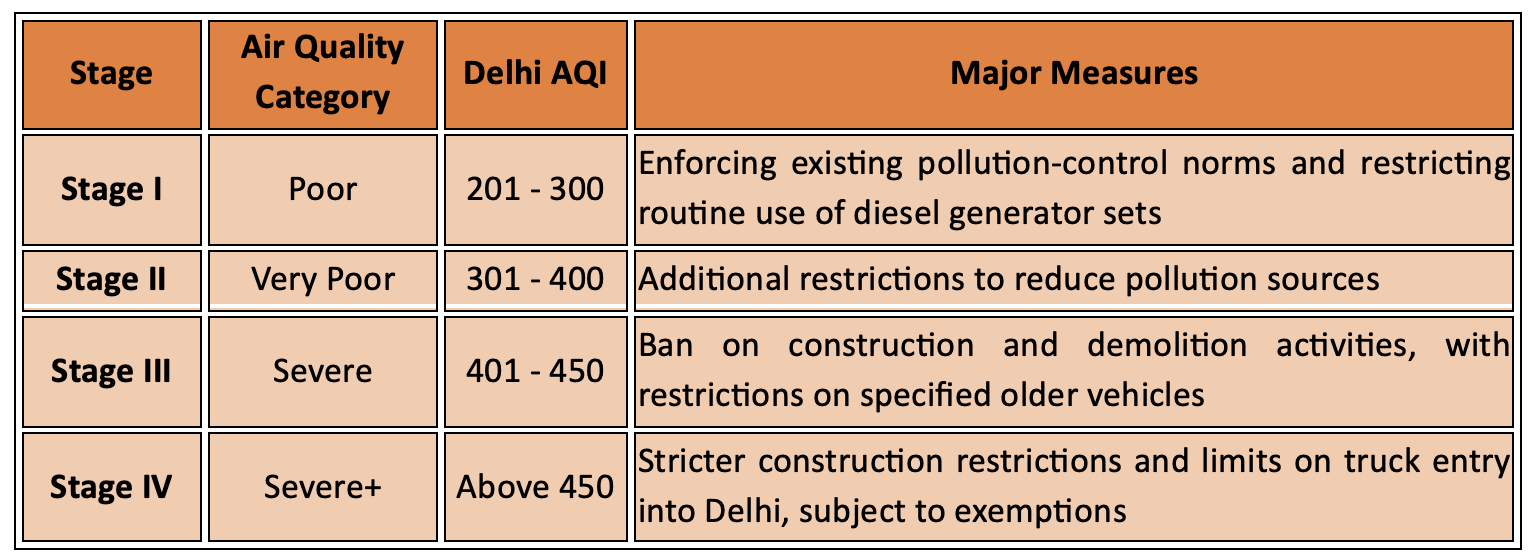
- Under Stage III, restrictions apply to BS-III petrol and BS-IV or older diesel light motor vehicles in Delhi and specified high-vehicle-density districts.
- Stage IV further restricts construction activities and truck entry, with exemptions for specified cleaner-fuel and BS-VI vehicles.
- Although GRAP can be imposed throughout the year, its higher stages are predominantly activated during winter, when meteorological conditions worsen pollution.
Factors Behind Delhi-NCR’s Winter Pollution
- Winter air pollution results from a combination of emissions and atmospheric conditions.
- Meteorological conditions: Lower wind speeds and falling temperatures hinder the dispersion of pollutants.
- Vehicular emissions: Road transport contributes to the concentration of pollutants in the region.
- Construction and road dust: Dust-generating activities add particulate matter to the atmosphere.
- Stubble burning: Agricultural residue burning during October and November contributes to seasonal pollution.
- Firecrackers: Festive-season emissions can further worsen air quality.
- These interacting factors demonstrate why temporary restrictions may reduce pollution without eliminating its underlying causes.
Effectiveness of GRAP
- GRAP aims to reduce pollution sources during episodes of extremely poor air quality. However, its short-term and emergency-oriented nature limits its ability to deliver sustained improvements without complementary long-term policies.
- An analysis by the Centre for Research on Energy and Clean Air (CREA), cited in October 2026, found no consistent improvement in Delhi’s winter air quality over the preceding four years.
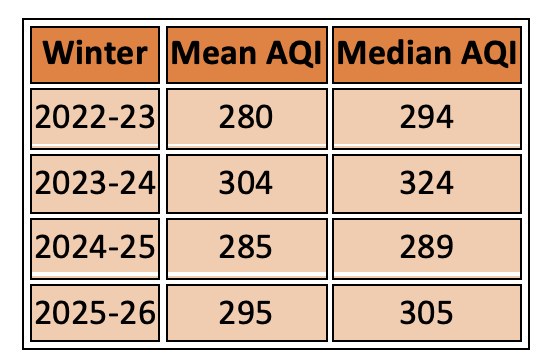
- The figures show fluctuations rather than a consistent downward trend. Both the mean and median AQI in 2025-26 were higher than in 2022-23.
- These findings indicate that the existence of emergency restrictions alone does not guarantee sustained improvement in winter air quality. They do not, by themselves, establish that GRAP has no effect during individual pollution episodes.
Additional Restrictions Introduced by Delhi
- The Delhi government introduced additional restrictions through a notification dated June 23, 2026. Unlike GRAP, these measures apply during specified periods regardless of the prevailing AQI.
- Vehicle restrictions: From November 1 to January 31, non-Delhi-registered motor vehicles below BS-VI emission standards are prohibited from operating in Delhi, subject to exemptions for electric, CNG, emergency and sovereign-duty vehicles.
- Higher parking charges: Parking charges at authorised sites are doubled from November 1 to February 28 to discourage private vehicle use. Parking spaces owned and managed by the Delhi Metro Rail Corporation are exempt.
- Priority of GRAP: In case of conflict between these restrictions and GRAP directions, GRAP takes precedence.
- These measures represent an attempt to reduce vehicle-related emissions through preventive action rather than relying exclusively on emergency responses after air quality deteriorates.
Way Forward
- A more effective approach to air pollution requires emergency measures to operate alongside sustained emissions reduction.
- Year-round pollution control: Strengthen enforcement against vehicular emissions, construction dust and industrial pollution rather than concentrating action primarily in winter.
- Regional coordination: Improve cooperation among Delhi and neighbouring states to address pollution sources across administrative boundaries.
- Cleaner transport: Encourage public transport and cleaner vehicles while reducing dependence on private motor vehicles.
- Agricultural solutions: Strengthen practical alternatives to stubble burning and support farmers in adopting them.
- Monitoring and accountability: Improve pollution-source monitoring and assess the effectiveness of individual interventions.
- Long-term planning: Combine emergency restrictions with sustained measures addressing the sources and causes of pollution.
Source: TH

 Last updated on Oct, 2026
→ UPSC 2027 Notification will be released on 13 January 2027 at upsconline.nic.in.
→ Check Nobel Prize 2026 Winners List here.
→ Download PIB PRiSM Monthly Magazine 2026 here.
→ Check UPSC Monthly Current Affairs Magazine The Recitals here.
→ Check out the latest UPSC Syllabus here.
→ Download UPSC Model Answers for Mains 2026
→ UPSC Mains Question Paper 2026 is out now for Essay & GS Paper 1, 2, 3 & 4.
→ UPSC Calendar 2027 has been released.
→ Enroll in Vajiram & Ravi’s UPSC Mains Test Series 2027 for structured answer writing practice, expert evaluation, and exam-oriented feedback.
→ Join Vajiram & Ravi’s UPSC Mentorship Program 2027 for personalized guidance, strategy planning, and one-to-one support from experienced mentors.
→ Go through the UPSC Mains Previous Year Papers to enhance your preparation.
→ UPSC has released UPSC Toppers List 2025 with the Civil Services final result on its official website.
→ Also check Best UPSC Coaching in India
Graded Response Action Plan FAQs
Q1. What is GRAP?+
Q2. What are the four stages of GRAP?+
Q3. What is the role of CAQM?+
Q4. Why does Delhi-NCR experience severe winter pollution?+
Q5. Has GRAP consistently improved Delhi’s winter air quality?+
Tags: graded response action plan mains articles upsc current affairs upsc mains current affairs