
Right to Internet Access for Children – Constitutional Framework and Online Safety

Right to Internet Access

Right to Internet Access Latest News

  • The Supreme Court, in Just Rights for Children Alliance v. S. Harish (2026), recognised the importance of internet access for children and emphasised the need to balance digital freedom with age-appropriate safeguards.

Internet Access as a Fundamental Right

  • Access to the internet has become essential for education, information, communication, creativity and participation in modern society. 
  • The Supreme Court's observations in Just Rights for Children Alliance v. S. Harish (2026) reinforce the importance of internet access, particularly for children, as a gateway to knowledge, creativity and self-expression.
  • The constitutional basis for this right can be understood through the following provisions:
    • Article 19(1)(a): Guarantees freedom of speech and expression, which includes the ability to access, receive and communicate information through the internet.
    • Article 19(1)(g): Protects the freedom to practise any profession or carry on any occupation, trade or business, including activities conducted through the internet.
    • Article 21: Protects life and personal liberty, encompassing the broader right to live with dignity and access essential opportunities in a digital society

Constitutional Framework: Authority-Liberty Coordination

  • A constitutional democracy must maintain a balance between the authority of the State and the liberty of citizens. This principle can be described as authority-liberty coordination.
  • Reasonable restrictions are necessary to reconcile individual freedoms with wider social interests. The Constitution places limits on both State authority and the exercise of individual liberty.
  • Excessive State interference can lead to authoritarian tendencies and undermine fundamental freedoms.
  • Unrestrained exercise of individual rights can disregard legitimate social interests and public safety.
  • The objective is to ensure that restrictions remain constitutionally justified, proportionate and consistent with democratic principles.
  • In the context of children's internet access, this means protecting children from harmful online experiences without unnecessarily restricting their fundamental freedoms.

Global Approaches to Children's Online Safety

  • Several countries have introduced restrictions or safeguards to regulate children's access to social media and digital platforms.
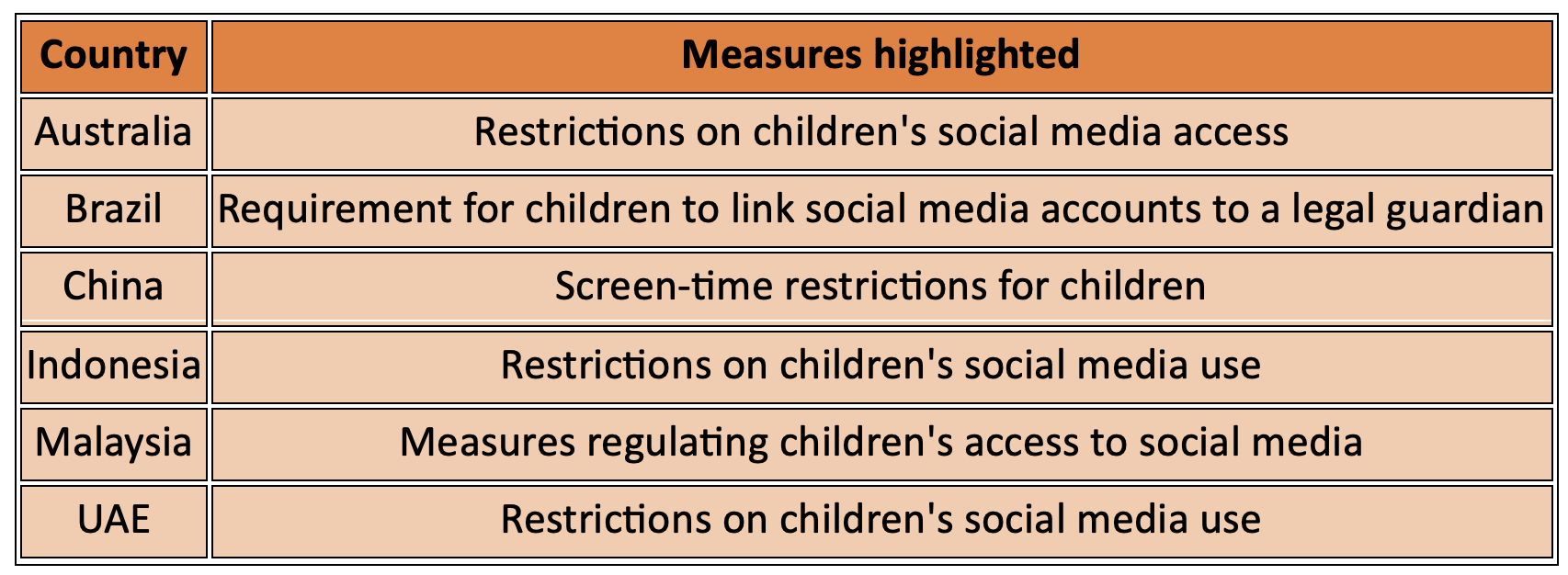
Global Approaches to Children's Online Safety

  • In India, States such as Andhra Pradesh and Karnataka have also considered measures to regulate children's screen time.
  • These approaches reflect growing concerns about excessive screen exposure, harmful online content and the vulnerability of children in digital spaces.
  • However, regulatory approaches adopted by other countries cannot automatically be replicated in India. Restrictions must be evaluated in light of India's constitutional framework, social conditions and the importance of digital inclusion.

Judicial Developments on Internet Access and Digital Rights

  • The Supreme Court has progressively recognised the relationship between digital access and fundamental rights through several important judgments.
  • Anuradha Bhasin v. Union of India (2020)
    • The Supreme Court held that freedom of speech and expression under Article 19(1)(a), and the freedom to carry on trade or business under Article 19(1)(g), are protected when exercised through the internet.
    • The judgment also emphasised that restrictions on internet services must satisfy constitutional requirements and be subject to judicial scrutiny.
  • Pragya Prasun v. Union of India (2025)
    • The Supreme Court held that excluding persons with disabilities from digital Know Your Customer (KYC) procedures violated Article 21.
    • It recognised digital access as an intrinsic component of the right to life, highlighting the State's responsibility to ensure that digital systems are accessible and inclusive.
  • Secretary, Ministry of Information and Broadcasting v. Cricket Association of Bengal (1995)
    • The Court recognised that Article 19(1)(a) includes the right to know, receive and impart information and ideas.
    • This principle provides an important foundation for understanding access to information as an essential component of freedom of expression.
  • Just Rights for Children Alliance v. S. Harish (2026)
    • The judgment highlighted the importance of internet access for children and challenged the assumption that safety and freedom are necessarily contradictory.
    • It emphasised that protecting children does not automatically require restricting their digital freedom. Instead, the focus should be on creating an environment in which children can explore the internet safely while exercising their fundamental rights.

Balancing Digital Freedom with Online Safety

  • The central challenge is to ensure that protective measures do not unnecessarily undermine children's access to information and opportunities.
  • A blanket prohibition on internet or social media access may prevent children from benefiting from educational resources, digital services and opportunities for self-expression.
  • Instead, a preventive and collaborative approach involving multiple stakeholders is necessary.
  • Role of Parents and Guardians
    • Parents should encourage responsible internet use, establish age-appropriate boundaries and help children recognise online risks. Digital awareness should focus on informed decision-making rather than excessive restrictions.
  • Role of Government
    • The government should establish appropriate regulatory frameworks to restrict harmful content, protect children's privacy and ensure accountability of digital platforms.
  • Role of Educational Institutions
    • Schools and educational institutions should integrate digital literacy and cyber safety awareness into education, enabling children to identify risks and use online resources responsibly.
  • Role of Digital Service Providers
    • Technology companies and online platforms should strengthen content moderation, privacy safeguards, age-appropriate settings and mechanisms for reporting harmful activities.
    • The emphasis should be on preventive safeguards and shared responsibility rather than restricting children's fundamental rights as a corrective measure after harm has occurred.

Source: TH

Right to Internet Access FAQs

Q1: Which constitutional provision protects freedom of expression through the internet?

Ans: Article 19(1)(a) protects freedom of speech and expression, including the ability to receive and communicate information through the internet.

Q2: What is authority-liberty coordination?

Ans: It refers to maintaining a constitutional balance between State authority and individual liberty through reasonable and constitutionally justified restrictions.

Q3: What did Anuradha Bhasin v. Union of India (2020) establish?

Ans: The Supreme Court held that freedom of speech and expression under Article 19(1)(a) and the freedom to carry on trade or business under Article 19(1)(g) are protected when exercised through the internet.

Q4: What was the significance of Pragya Prasun v. Union of India (2025)?

Ans: The judgment recognised digital access as an intrinsic component of Article 21 and held that excluding persons with disabilities from digital KYC procedures violated their rights.

Q5: Why are blanket restrictions on children's internet access problematic?

Ans: They can restrict access to educational resources, information, digital opportunities and freedom of expression, potentially undermining children's development and digital inclusion.

ECI’s Special Summary Revision (SSR) and Internal Administrative Reorganisation

Special Summary Revision

Special Summary Revision (SSR) Latest News

  • The Election Commission of India (ECI) has announced the Special Summary Revision (SSR) of electoral rolls in six States and Union Territories following the completion of the third phase of the Special Intensive Revision (SIR). 
  • Simultaneously, it has issued a revised work-allocation order to strengthen administrative oversight of its Information Technology (IT) division amid concerns over the centralisation of electoral roll management.

Special Summary Revision (SSR) of Electoral Rolls

  • Objective: To ensure accurate, inclusive and updated electoral rolls by enrolling eligible voters, particularly young and first-time electors.
  • Key features and timeline:
    • Coverage: Arunachal Pradesh, Mizoram, Odisha, Sikkim, Chandigarh and Dadra and Nagar Haveli and Daman and Diu.
    • Advance enrolment: Eligible citizens who will attain 18 years on April 1, July 1 and October 1, 2027, can submit advance applications.
    • Polling station Rationalisation: Rearrangement of polling stations must be completed by November 20.
    • Draft electoral rolls: Scheduled for publication on November 30.
    • Claims and objections: Accepted from November 30 to December 30.
    • Disposal of claims: To be completed by January 16.
    • Final electoral rolls: Scheduled for publication on January 21, 2027.
  • Chief Secretaries have been directed to ensure adequate manpower and administrative resources for the exercise.

Safeguards Against Arbitrary Deletions

  • To prevent wrongful exclusion of voters -
    • Applications for deletion involving repeated or multiple entries must undergo field verification.
    • Electoral Registration Officers (EROs) must personally cross-check deletions exceeding 2% of electors at a polling station.
    • Furnishing Aadhaar details in Forms 6 (new enrolment) and 8 (correction, shifting or replacement of EPIC) remains voluntary.
    • No application for voter enrolment can be rejected merely because the applicant has not provided Aadhaar details.
  • Significance: These safeguards seek to balance electoral roll accuracy with the constitutional principle of universal adult suffrage under Article 326.

Delay and Transparency Issues

  • Concerns:
    • The delay in conducting SSR in States where SIR had been completed became a point of disagreement within the ECI.
    • Election Commissioners Sukhbir Singh Sandhu and Vivek Joshi reportedly raised concerns, including difficulties faced by citizens attaining voting age in registering themselves.
  • Changes made:
    • A significant transparency-related change is the provision of readable PDF copies of draft and final electoral rolls, without elector photographs, free of cost to political parties, alongside physical copies.
    • Candidates will also be provided alphabetically arranged readable PDF electoral rolls in electronic storage devices on payment at the time of elections.
  • Significance: 
    • This partially addresses the Opposition's demand for machine-readable electoral rolls to facilitate comparison with previous lists and identify anomalies. 
    • Earlier, the ECI had expressed concerns that providing such data could compromise electoral roll integrity and enable manipulation.

ECI’s Revised Work Allocation and IT Oversight

  • Background: 
    • The ECI's internal functioning came under scrutiny following a work-allocation order that reassigned IT and Information and Communication Technology (ICT) responsibilities.
    • The order placed Director General (IT) Seema Khanna's work directly under the Election Commission, removing the earlier layer of oversight by a Deputy Election Commissioner (DEC).
    • Election Commissioners objected to the order, arguing that it had been issued without the Commission's approval.
    • They raised the matter with Cabinet Secretary T. V. Somanathan, citing concerns over administrative functioning and access to electoral management systems.
  • Concerns regarding centralisation:
    • The ECI's IT division manages two important digital platforms -
    • ECINet: Facilitates citizen engagement and participation in the electoral process.
    • ERONet: Supports election officials in managing electoral registration and related processes.
    • The two Election Commissioners reportedly expressed concerns that field-level officers were not receiving adequate access to ERONet, potentially resulting in the centralisation of electoral roll management.

Revised Work Allocation

  • The latest order seeks to reaffirm the existing oversight structure -
    • Senior DEC Pawan Kumar Sharma has been assigned responsibility for IT/ICT.
    • DG (IT) Seema Khanna will route files concerning these functional divisions through the Senior DEC.
    • The ECI maintains that the revised arrangement reflects a unanimous decision and that the DG (IT) has always reported to a DEC-level officer.
    • The earlier order was reportedly never implemented following the joint direction issued by the two Election Commissioners.
  • Additional administrative changes: The revised order also assigns responsibilities to the newly appointed DEC Prakash Rajpurohit -
    • Election planning, Model Code of Conduct (MCC) and delimitation have been assigned to him, among other subjects.
    • He will support Senior DEC Maneesh Garg on election planning.

Significance for Electoral Governance

  • Electoral inclusiveness: Timely revision and advance registration can reduce the exclusion of young and first-time voters.
  • Transparency and accountability: Readable electoral rolls facilitate scrutiny by political parties and improve public confidence in electoral processes.
  • Institutional accountability: Clear reporting structures and collective decision-making within the ECI are essential for maintaining institutional integrity and preventing excessive administrative centralisation.
  • Important legal - constitutional provisions underpinned:
    • Article 324: Vests the superintendence, direction and control of elections in the ECI.
    • Article 326: Provides for elections based on universal adult suffrage.
    • Section 21 of the Representation of the People Act (RPA), 1950: It provides the statutory basis for the preparation and revision of electoral rolls.
    • Democratic principle: Electoral integrity requires both the inclusion of every eligible voter and the exclusion of ineligible entries, without arbitrary disenfranchisement.

Source: ToI | DH | IE

Special Summary Revision (SSR) FAQs

Q1: How does the Special Summary Revision (SSR) strengthen electoral inclusiveness?

Ans: SSR facilitates enrolment of eligible and first-time voters, thereby strengthening universal adult suffrage under Article 326.

Q2: What safeguards are necessary to prevent arbitrary deletion of voters from electoral rolls?

Ans: Field verification of duplicate entries, ERO scrutiny and voluntary Aadhaar disclosure.

Q3: How can technology enhance transparency and efficiency in India's electoral process?

Ans: Platforms such as ECINet and ERONet improve citizen engagement and electoral administration.

Q4: Why is institutional accountability important for the independent functioning of the ECI?

Ans: It prevents excessive centralisation and strengthens the institutional credibility of the ECI under Article 324.

Q5: How can the ECI balance electoral roll accuracy with democratic inclusiveness?

Ans: By combining periodic revisions, transparent verification, accessible enrolment procedures, etc.

BPaL Patent Rejection in India: Boost for Affordable TB Treatment

BPaL Patent Rejection in India

BPaL Patent Rejection in India Latest News

  • The Indian Patent Office has rejected a patent application for BPaL — a combination of three tuberculosis drugs (bedaquiline, pretomanid, linezolid) — filed by the US-based TB Alliance. 
  • Experts have welcomed this as a major step toward making drug-resistant TB treatment more affordable in India, which bears nearly a quarter of the world’s TB burden, with an incidence rate of 187 cases per 100,000 people (2024).

What Is BPaL?

  • A six-month, all-oral treatment regimen recommended by the WHO for eligible drug-resistant TB patients.
  • Combines three drugs: Bedaquiline, Pretomanid and Linezolid.
  • A related regimen, BPaLM, adds a fourth drug, moxifloxacin, recording an 89% success rate — far higher than the 52–75% success of older regimens.
  • Over 15,000 patients have already started BPaLM treatment under India’s National TB Programme.
  • Unlike older regimens requiring many months of antibiotics and painful injections, BPaL offers a shorter, oral course — reducing physical, financial and emotional burden.

Why Was the Patent Rejected?

  • The rejection followed two pre-grant oppositions filed in 2020 — formal legal challenges allowing individuals/organisations to contest a patent before it’s granted. 
  • With this ruling, every bedaquiline-related patent application challenged in India has now been refused — including the salt form (2023), paediatric formulation (2024), long-acting injectable, and now BPaL.
  • Experts call this a win against “evergreening” — the practice of seeking additional patents on minor modifications of existing drugs to extend exclusivity and delay generic competition.

What Does This Mean for Patients?

  • No single company can now claim exclusive rights over the BPaL combination in India.
  • Any TB drug manufacturer can produce it for India’s national programme and for export.
  • This removes a legal barrier to competition — but doesn’t automatically lower prices or guarantee universal availability.
  • Actual impact depends on: number of quality-assured suppliers, government procurement, and uninterrupted supply chains.
  • Who Benefits Most - Patients with multidrug-resistant or rifampicin-resistant TB (MDR/RR-TB), especially those facing financial hardship, treatment delays, or poor access to treatment centres.

Will Treatment Become Cheaper?

  • Patients under India’s public health system already receive TB medicines free of cost — so the immediate financial benefit accrues to the government, which procures these drugs.
  • Precedent exists: after the 2023 rejection of the bedaquiline salt patent, a six-month BPaLM course cost dropped from $588 (2022) to $284.
  • Lower procurement costs mean the same budget could treat more patients, and greater competition could ensure more reliable supply.
  • However, patients still face out-of-pocket costs for travel, additional tests, nutrition, and lost income — lower drug prices alone won’t eliminate these burdens.

Important Distinctions to Note

  • Patent approval ≠ drug regulatory approval: A patent decides exclusivity rights; India’s CDSCO (Central Drugs Standard Control Organisation) separately decides if a drug can be marketed.
  • CDSCO has already approved bedaquiline and pretomanid for use under the National TB Elimination Programme (NTEP); linezolid and moxifloxacin are older, already-used antibiotics.
  • WHO prequalification (assessing quality/safety/efficacy) also does not substitute for Indian regulatory marketing permission.
  • Rejection of the patent is not automatic permission for unrestricted commercial sale.

Quality Concerns

  • Generic medicines must contain the same active pharmaceutical ingredients and meet regulatory standards.
  • Experts stress that quality checks must continue even as more manufacturers enter the market.

Conclusion

  • India’s rejection of the BPaL patent marks a significant victory against pharmaceutical “evergreening” and reinforces India’s role as the “pharmacy of the developing world.” 
  • While it opens the door to generic competition and potential cost savings for the government’s TB programme, real impact for patients will depend on scaling up access, ensuring reliable supply chains, and maintaining drug quality — essential steps if India is to meaningfully advance its fight against drug-resistant tuberculosis.

Source: IE

BPaL patent rejection in India FAQs

Q1: What is BPaL used for in tuberculosis treatment?

Ans: BPaL is a six-month, all-oral regimen combining bedaquiline, pretomanid and linezolid for eligible patients with drug-resistant tuberculosis.

Q2: Why was the BPaL patent rejected in India?

Ans: The BPaL patent rejection in India followed pre-grant oppositions and was welcomed as a step against evergreening and prolonged pharmaceutical exclusivity.

Q3: How will the BPaL patent rejection in India benefit patients?

Ans: The BPaL patent rejection in India removes an exclusivity barrier, allowing manufacturers to produce the combination and potentially improve access through competition.

Q4: Will the BPaL patent rejection in India automatically make treatment cheaper?

Ans: No. The BPaL patent rejection in India enables competition, but actual savings depend on quality-assured suppliers, government procurement and uninterrupted supply chains.

Q5: Does patent rejection mean BPaL can be sold freely in India?

Ans: No. The BPaL patent rejection in India does not replace CDSCO marketing approval; patent rights and drug regulatory permissions are separate processes.

Agnipath Scheme Revamp: 100% Absorption and Changes in Recruitment

Agnipath Scheme Revamp

Agnipath Scheme Revamp Latest News

  • Recently, the Centre approved a major overhaul of the Agnipath scheme, allowing all Agniveers undergoing training to eventually join the armed forces as regular soldiers. 
  • The change comes as the first batch of Agniveers nears completion of their four-year tenure this month. However, officials clarify this is not a return to pre-Covid regular recruitment — it retains the scheme’s core structure with modifications.

Agnipath Scheme

  • Introduced in 2022, Agnipath recruits candidates aged 17.5 to 21 years into the Army, Navy, and Air Force for a four-year tenure.
  • Recruits are called Agniveers.

What Has Changed?

  • 25% of Agniveers continue to be selected on merit for absorption as regular soldiers after four years — unchanged from the original scheme.
  • The remaining 75%, who earlier exited with the Seva Nidhi package, will now get an additional two-year engagement (total six years), after which they too can join as regular soldiers — subject to willingness and meeting selection criteria.
  • Net effect: 100% of Agniveers now get a pathway to permanent service, though not simultaneously or automatically.

The Seva Nidhi Package

  • A compulsory retirement-cum-transition fund: 30% of an Agniveer’s salary is deducted monthly and deposited into the Agniveer Corpus Fund, matched by the government.
  • On completing four years, Agniveers receive a tax-exempt lump sum of ~₹11.71 lakh (with interest).
  • Those opting for the two-year extension get enhanced pay and an enhanced Seva Nidhi package if they later choose not to join the forces.
  • Trade-off: Agniveers serving the extended term lose eligibility for reserved quotas in paramilitary forces, PSUs, and state government jobs.
  • No Agniveer receives monthly pension or gratuity.

Scale of Impact

  • Over 3 lakh Agniveers are currently training across the three services.
  • Army: ~2.8 lakh Agniveers, with ~19,000 completing their four-year tenure this round.
  • Navy: ~2,500 completing tenure this month.
  • Air Force: ~2,900 completing training as the first IAF batch, next month.

Why This Isn’t “Regular Recruitment”

  • Chief of Defence Staff General N.S. Raja Subramani clarified that Agnipath continues, only with modifications:
    • Only 25% are selected as regular soldiers immediately after four years, on merit.
    • The rest must complete a total of six years before becoming eligible.
    • Seniority-wise, those joining after the two-year extension rank below batchmates absorbed after four years.

How It Differs from Pre-Covid Recruitment

  • Agniveers thus retain the choice to leave or continue at two stages — a flexibility absent in the old system — backed by the Seva Nidhi cushion if they exit.
  • [my_image src="https://vajiramias.sgp1.cdn.digitaloceanspaces.com/wp/current-affairs/2026/11/06083456/Agniveer-Vs-Pre-Covid.jpg?v=1793934295" size="full" align="none" width="auto" height="187px" alt="" title="Agniveer Vs Pre Covid"]

Benefits for the Military

  • No major pension savings, even with 100% absorption, since benefits still apply.
  • Helps address the personnel shortage caused by halted recruitment during Covid-19 — critical given post-Galwan and post-Operation Sindoor security demands.
  • Fosters competitive spirit, as Agniveers strive to be among the top 25% selected early.
  • Creates a blended force: experienced soldiers alongside a youthful Agniveer cohort.
  • Those who leave after service gain transferable skills and training for civilian careers.

Conclusion

  • The revamped Agnipath scheme expands opportunity without abandoning its core philosophy of selective, merit-based, staggered absorption. 
  • By offering all Agniveers a pathway to permanence — rather than guaranteeing it — the government balances the armed forces’ need for a youthful, cost-effective force with addressing personnel shortages and improving retention incentives, while preserving the competitive, choice-driven structure that distinguishes Agnipath from the pre-Covid system.

Source: IE

Agnipath scheme revamp FAQs

Q1: What is the Agnipath scheme?

Ans: The Agnipath scheme revamp retains the 2022 recruitment model, which inducts candidates aged 17.5 to 21 into the Army, Navy and Air Force.

Q2: What has changed under the Agnipath scheme revamp?

Ans: The Agnipath scheme revamp allows the 75% not initially selected to undertake a two-year extension, after which they may qualify for regular service.

Q3: Does the Agnipath scheme revamp guarantee permanent absorption for every Agniveer?

Ans: No. The Agnipath scheme revamp provides every Agniveer a pathway to permanence, subject to willingness, selection criteria and completion of the required tenure.

Q4: What is the Seva Nidhi package under the Agnipath scheme?

Ans: Under the Agnipath scheme revamp, Agniveers completing four years receive a tax-exempt lump sum of approximately ₹11.71 lakh, including interest.

Q5: How does the Agnipath scheme revamp differ from pre-Covid recruitment?

Ans: The Agnipath scheme revamp retains conditional, staggered entry and allows Agniveers to leave or continue at two decision points, unlike pre-Covid recruitment.

Enquire Now

