Zombie Deer Disease

Zombie Deer Disease

Zombie Deer Disease Latest News

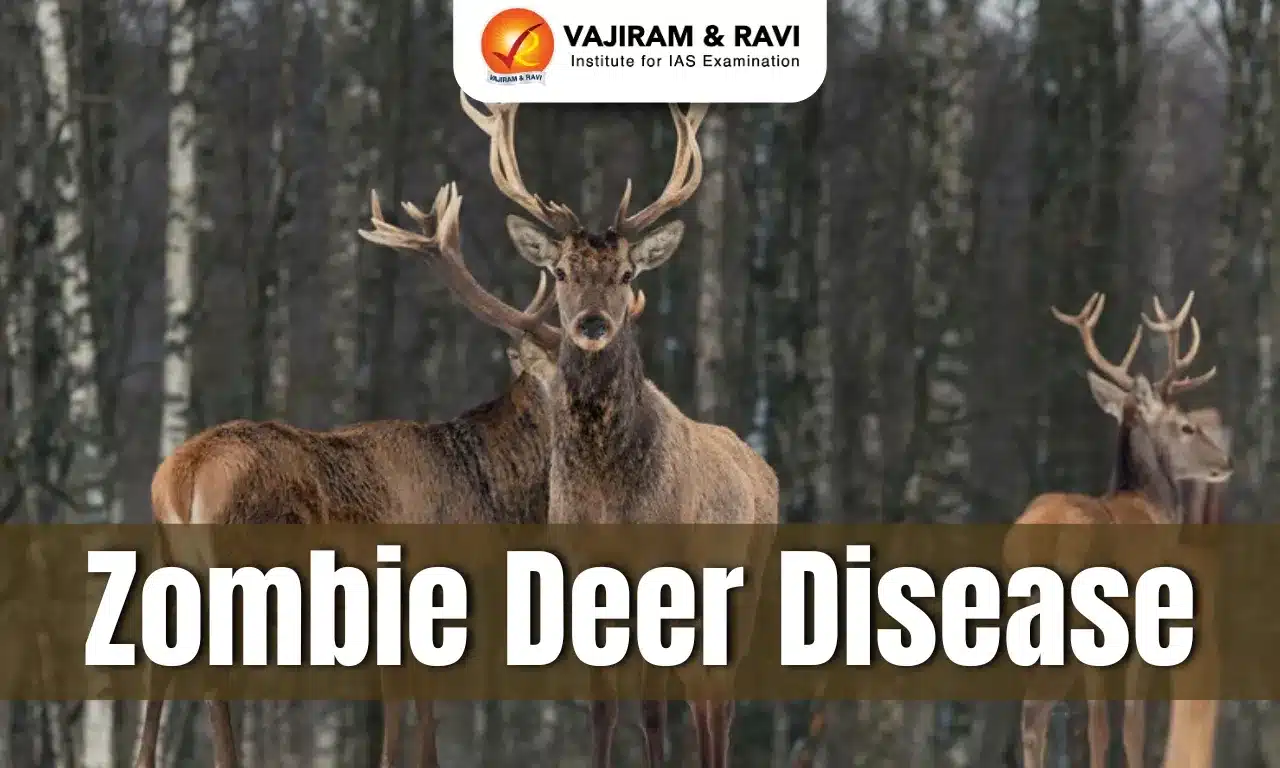
Health officials in Florida recently have confirmed cases of Chronic Wasting Disease, commonly known as “Zombie Deer Disease.”

About Zombie Deer Disease

  • Known scientifically as Chronic Wasting Disease (CWD), it is a progressive and fatal neurological disease which primarily affects deer, elk, moose, and reindeer.
  • It affects the central nervous system (the brain and the spinal cord).
  • What causes CWD?
    • CWD is caused by infectious proteins called prions.
    • Prions are unique in that they don’t contain DNA or RNA, unlike bacteria or viruses.
    • Instead, they are misfolded proteins that cause other proteins in the brain to likewise misfold, ultimately leading to brain damage.
    • Once these proteins accumulate in the brain, they create spongy holes in the tissue, resulting in severe neurological dysfunction.
  • Transmission:
    • CWD prions are highly contagious and spread through body fluids such as saliva, feces, blood, or urine, either by direct contact or environmental contamination.
    • Once present in an area, prions remain infectious in soil, water, and plants for years, posing long-term risks to animal populations.
  • Symptoms:
    • It has an extended incubation period averaging 18–24 months between infection and the onset of noticeable signs. During this time frame, animals look and act normal.
    • The most obvious sign of CWD is progressive weight loss.
    • Numerous behavioral changes have also been reported, including decreased social interaction, loss of awareness, and loss of fear of humans.
    • Diseased animals also may exhibit increased drinking, urination, and excessive salivation.
    • In the final stages of disease, animals become debilitated and ultimately die.
    • How fast CWD progresses depends on the species and the animal's genetics. 
  • Treatment: It is always fatal in infected animals. There is no vaccine or treatment.
  • Can Humans Get CWD?
    • So far, there has been no confirmed case of CWD transmission to humans. However, experts remain cautious.

Source: TN


Zombie Deer Disease FAQs

Q1: Which group of animals is primarily affected by Zombie Deer Disease?

Ans: It primarily affects deer, elk, moose, and reindeer.

Q2: Which part of the body does Zombie Deer Disease mainly affect?

Ans: Central nervous system.

Q3: What causes Chronic Wasting Disease (CWD)?

Ans: It is caused by infectious proteins called prions.

Nafithromycin

Nafithromycin

Nafithromycin Latest News

Recently, the union Science and Technology Minister informed that India has developed its first indigenously discovered antibiotic, Nafithromycin. 

About Nafithromycin

  • It is an antibiotic which has been developed with the support of “Biotechnology Industry Research Assistance Council” (BIRAC).
  • It has been brought to market under the trade name “Miqnaf”.
  • It is the first molecule entirely conceptualized, developed and clinically validated in India.
  • It is the country’s first indigenously developed antibiotic aimed at tackling Antimicrobial Resistance (AMR).
  • It is effective against resistant respiratory infections, particularly useful for cancer patients and poorly controlled diabetics.
  • This innovation is designed to treat Community-Acquired Bacterial Pneumonia (CABP).
  • Nafithromycin’s efficacy stands out as it targets both typical and atypical pathogens, offering a potent solution where no new antibiotic in this class has been developed worldwide for over three decades.

What is Antimicrobial Resistance (AMR)?

  • It occurs when bacteria, viruses, fungi and parasites no longer respond to antimicrobial medicines.
  • As a result of drug resistance, antibiotics and other antimicrobial medicines become ineffective and infections become difficult or impossible to treat.
  • It increases the risk of disease spread, severe illness, disability and death.
  • AMR is a natural process driven by genetic changes in pathogens over time, its spread is significantly accelerated by human activities.

Source: News On Air

Nafithromycin FAQs

Q1: What is Nafithromycin?

Ans: A type of antibiotic

Q2: Which class of antibiotics does Nafithromycin belong to?

Ans: Macrolides

Bathousim

Bathousim

Bathou Religion Latest News

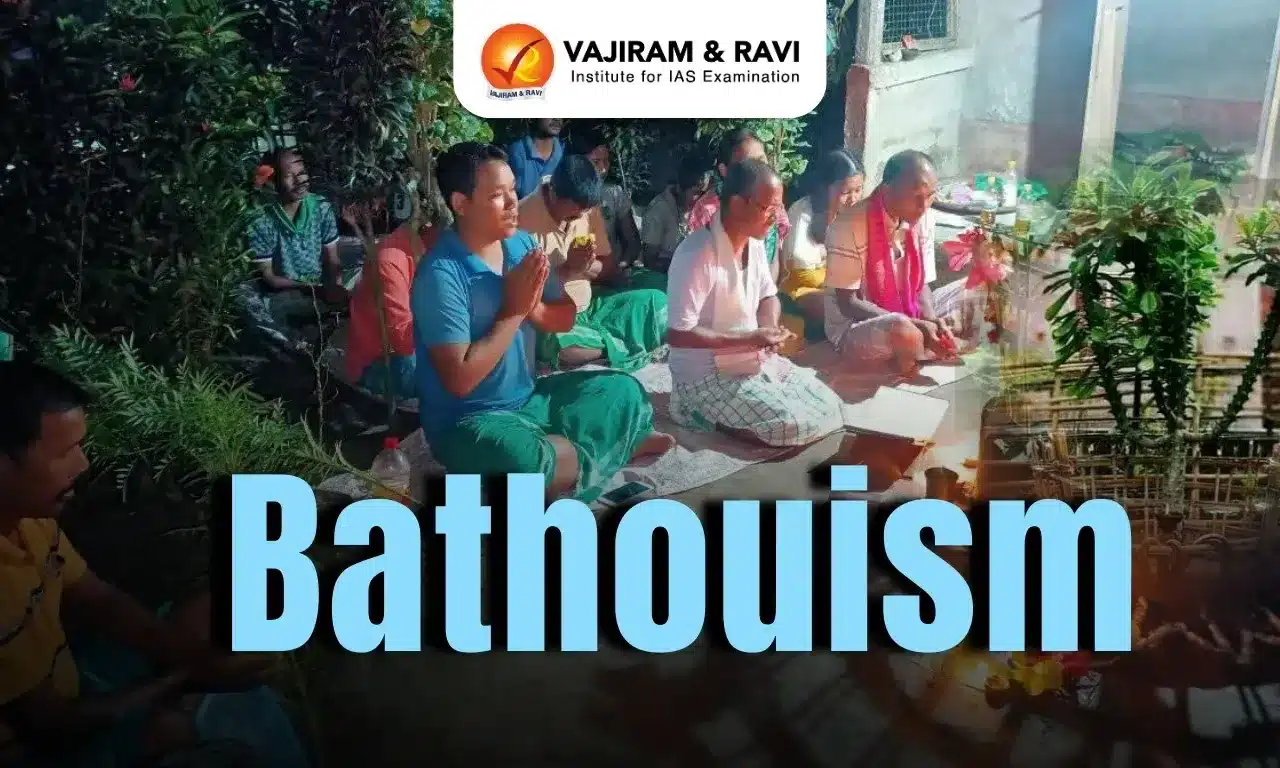
The Bathou religion of Bodo community in Assam gets a separate code in the upcoming census.

About Bathou Religion

  • It is the traditional faith of the Bodos, the largest plains tribe of Assam.
  • The word ‘Bathou’ is derived from the Bodo language, where ‘Ba’ means ‘five’ and ‘thou’ means ‘deep philosophical thought’.
  • The faith system is based on five elements: Bar (Air), San (Sun), Ha (Earth), Or (Fire), and Okhrang (Sky).

Beliefs of Bathousim

  • The community worships Bwrai Bathou as the supreme god. In the Bodo language, the word ‘Bwrai‘ refers to the ‘eldest’ man concerning power or knowledge.
  • The Bathou faith is centred on the Sijou plant (Euphorbia splendens).
  • It is planted in the Bathou altar at the centre as the symbol of Bathou religion of the Bodos.
  • It has an important place and has been widely accepted as the symbol of life or soul by the Bodo people since time immemorial.
    • This plant is the living symbol of Bathoubwrai, the supreme God of the Bodos.
    • Bodos plant the sijou tree on an elevated altar encircled with a bamboo fencing of eighteen pairs of posts weaved with five pieces of bamboo split.
    • The five bamboo strips signify the five bindings of Bathou, viz. (i) birth, (ii) marriage or procreation, (iii) sorrow, (iv) happiness and (v) death.

Source: ET

Bathou Religion FAQ's

Q1: Which community primarily practices the Bathou religion?

Ans: Bodo community

Q2: What is the significance of the Bathou symbol?

Ans: It is a representation of the supreme god Bathou.

We Rise Initiative

We Rise Initiative

We Rise Initiative Latest News

Recently, NITI Aayog’s Women Entrepreneurship Platform (WEP) and DP World announced a joint initiative ‘We Rise Initiative.

About We Rise Initiative

  • The Women Entrepreneurs Reimagining Inclusive and Sustainable Enterprises (We Rise) initiative was launched by NITI Aayog and DP World.
  • It was launched under the aegis of WEP’s Award to Reward (ATR) initiative.
  • Aim: It aims to help women entrepreneurs in India to scale their businesses globally through trade facilitation, mentorship, and strategic partnerships.
  • As part of this effort, WEP and DP World have joined hands to empower product centric women entrepreneurs.
  • It is a unique public-private collaboration focused on expanding trade access and unlock opportunities for women businesses to grow exponentially.

What is a Women Entrepreneurship Platform?

  • It was incubated in NITI Aayog in 2018 as an aggregator platform, transitioned into a public-private partnership in 2022.
  • It serves as a national aggregator to strengthen India’s women entrepreneurship ecosystem and make women-led development a reality.
  • Function: WEP functions as an enabler, addressing six key ecosystem needs — access to finance, market linkages, training and skilling, mentoring and networking, compliance and legal assistance, and business development services.

Source: PIB

We Rise Initiative FAQs

Q1: What is the primary objective of the We Rise Initiative?

Ans: To empower women entrepreneurs and boost India’s women-led MSME ecosystem.

Q2: Which organizations launched the We Rise Initiative?

Ans: NITI Aayog’s Women Entrepreneurship Platform (WEP) and DP World.

Food and Agriculture Organization

Food and Agriculture Organization

Food and Agriculture Organization Latest News

Recently, India and the Food and Agriculture Organization of the United Nations (FAO) celebrated 80 years of partnership on World Food Day 2025.

About Food and Agriculture Organization

  • It is a specialized agency of the United Nations (UN) that leads international efforts to defeat hunger.
  • It is the oldest permanent specialized agency of the UN, established in October 1945.
  • Mandate: To improve nutrition, increase agricultural productivity, raise the standard of living in rural populations, and contribute to global economic growth.
  • Functions
    • The FAO coordinates the efforts of governments and technical agencies in programs for developing agriculture, forestry, fisheries, and land and water resources.
    • It leads international efforts to fight hunger.
    • It is both a forum for negotiating agreements between developing and developed countries and a source of technical knowledge and information to aid development.
  • Members: It currently has 195 members - 194 countries and the European Union. (India is a founding member of FAO)
  • Funding: FAO receives its funding from its member countries.
  • Reports published by the FAO: The State of the World’s Forests (SOFO), The State of World Fisheries and Aquaculture (SOFIA), The State of Agricultural Commodity Markets (SOCO), The State of Food Security and Nutrition in the World (SOFI).
  • Headquarters: Rome, Italy.

Source: PIB

Food and Agriculture Organization FAQs

Q1: Where is the headquarters of the FAO located?

Ans: Rome, Italy

Q2: What is the primary objective of the Food and Agriculture Organization (FAO)?

Ans: To eradicate hunger, food insecurity, and malnutrition

Hygrocybe Pellucida

Hygrocybe Pellucida

Hygrocybe Pellucida Latest News

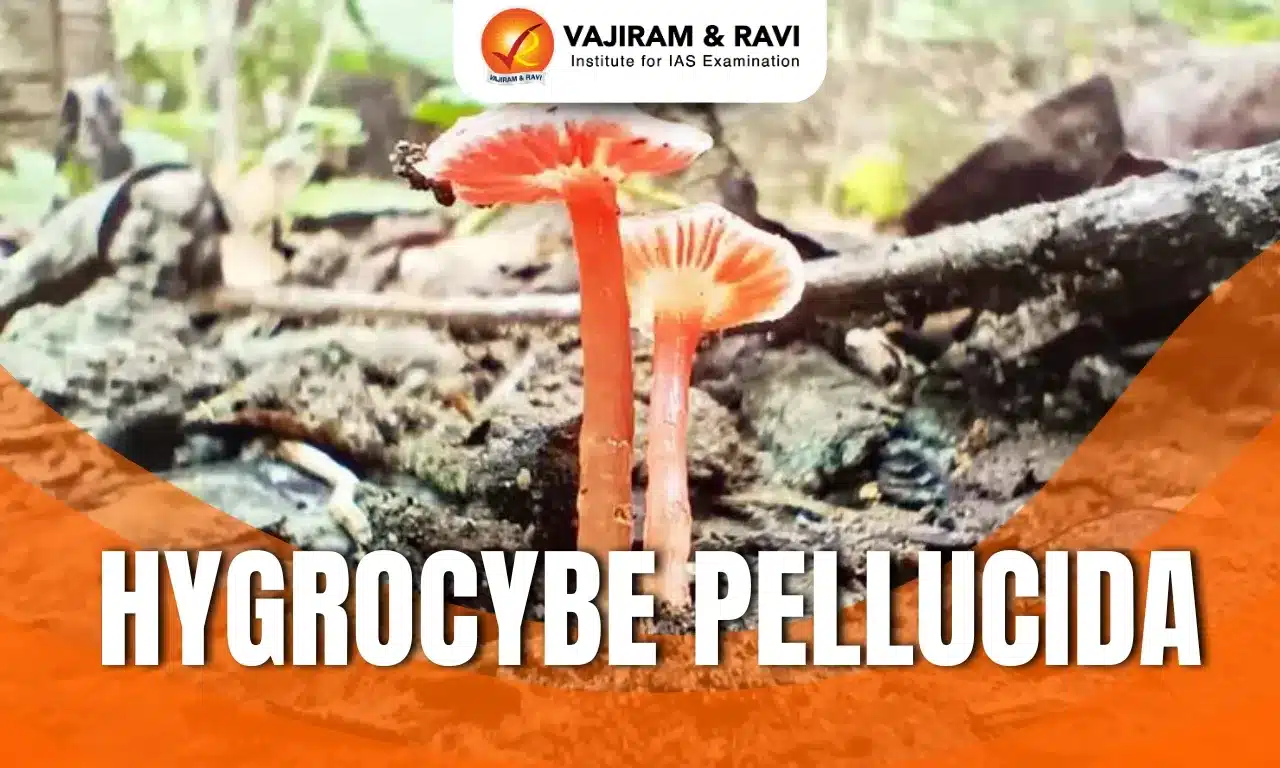
Recently, Hygrocybe pellucida, a rare fungi species, was sighted for the first time in Telangana’s Kawal Tiger Reserve.

About Hygrocybe Pellucida

  • It is a fungi species characterised by their bright, waxy, and often vividly coloured fruiting bodies.
  • Habitat: It is typically found in unimproved grasslands, mossy forest floors, and other nutrient-poor habitats and commonly known for wax cups.
  • It was described as a new species in the Hygrophoraceae family from Kerala during 2024.
  • The genus Hygrocybe is a well-known genera of agarics with 350 listed species and distributed worldwide.

Key Facts about Kawal Tiger Reserve

  • Location: It is located in the Telangana State along the banks of river Godavari, forming part of the Deccan peninsula-central highlands.
  • The reserve is nestled in the Sahyadri Mountain Ranges.
  • The government of India declared Kawal Wildlife Sanctuary a Tiger Reserve in 2012.
  • Rivers: The reserve is the catchment for the rivers Godavari and Kadam, which flow towards the south of the sanctuary.
  • Geographically, the reserve is situated at the southernmost tip of the Central Indian Tiger Landscape, having linkages with the Tadoba-Andhari (Maharashtra) and Indravati (Chhattisgarh) tiger reserves.
  • Vegetation: Southern Tropical Dry Deciduous Forest.
  • Flora: Teak along with Bamboo and other species like Anogeissus latifolia, Mitragyna parviflora, etc.
  • Fauna: nilgai, chousinga, chinkara, black buck, sambar, spotted deer etc.

 Source: NIE

Hygrocybe Pellucida FAQs

Q1: What is Hygrocybe pellucida?

Ans: A type of fungus.

Q2: In which state is Kawal Tiger Reserve located?

Ans: Telangana State.

Enquire Now