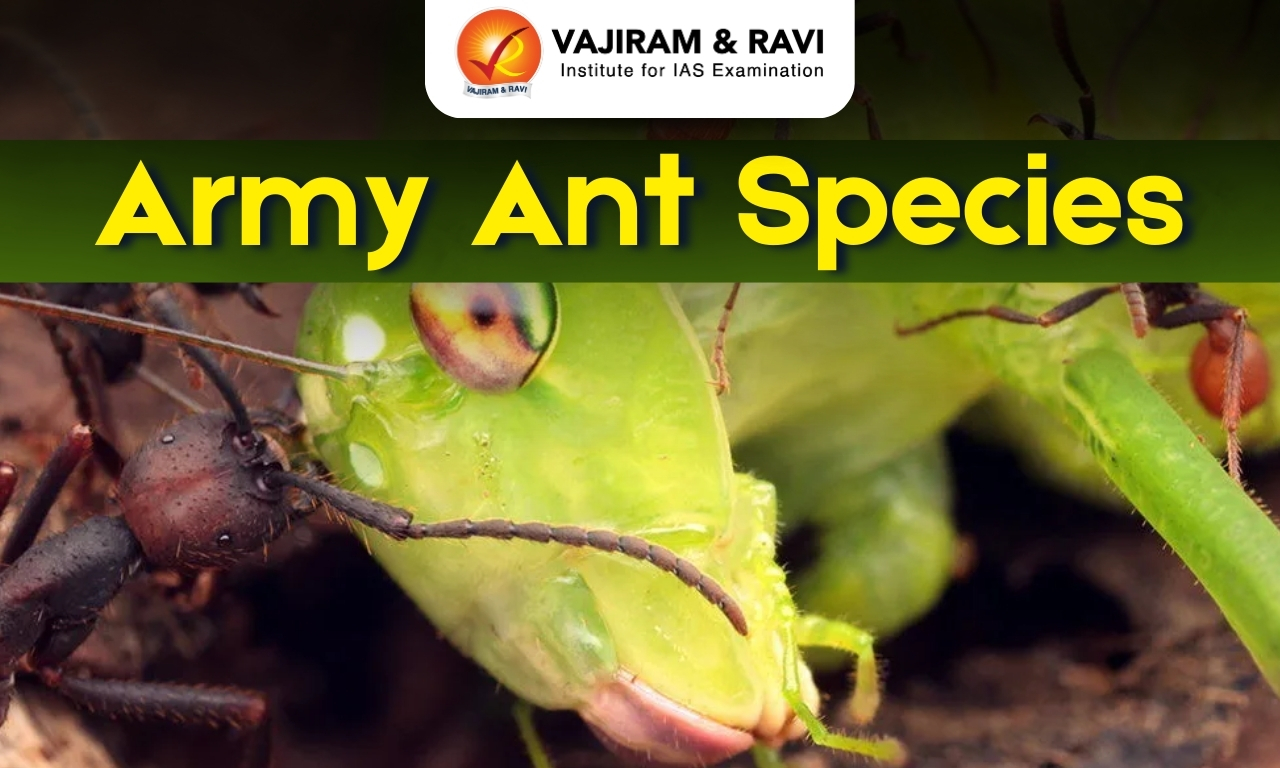
Army Ant Species Latest News
Researchers from Karnataka and Odisha have discovered two new species of army ants namely Aenictus chittoorensis and Aenictus lankamallensis in the Eastern Ghats of Andhra Pradesh.
About Army Ant Species
- Army ants are defined as a nomadic species of ants that lack a permanent nest.
- They belong to one of the subfamilies of ants called the Dorylinae.
- Habitat: Army ants are highly aggressive predators found mainly in tropical ecosystems.
Characteristics of Army Ant Species
- They do not build permanent nests.
- They form temporary living structures known as ‘bivouacs’, made entirely from the bodies of worker ants.
- They are social insects, form massive colonies that conduct coordinated raids, consuming insects and small animals in their path.
- They are distinguished by their large, sharp mandibles, stinging ability and heavy reliance on chemical pheromones to navigate and communicate.
- These ants are practically blind and rely on a pheromonal system with which they mark their paths and by which they follow paths taken by others.
- They have a single queen ant who lays all the eggs and female workers that tend the young and collect food for the colony.
- Ecological Role: As keystone predators they play a critical role in regulating arthropod populations and shaping forest biodiversity by consuming large quantities of invertebrates on a daily basis.
Source: DH
Army Ant Species FAQs
Q1: What is unique about Army Ant colonies?
Ans: They form massive colonies with coordinated raids
Q2: How do Army Ants primarily communicate?
Ans: Through pheromones