Ammonium Sulphate

Ammonium Sulphate

Ammonium Sulphate Latest News

Recently, the Indian Council for Agricultural Research (ICAR) suggested ammonium sulphate be used for paddy as an affordable option.

About Ammonium Sulphate

It is an inorganic sulfate salt obtained by reaction of sulfuric acid with two equivalents of ammonia.

Properties of Ammonium Sulphate

  • It is a white odorless solid and has a high-melting point.
  • It is very soluble in water.
  • It is widely used as a fertilizer for alkaline soils.
  • Ammonium Sulphate contains 21% nitrogen and 24% sulphur, making it an excellent source of essential nutrients for plants.
  • Ammonium sulfate is available as a byproduct from the steel industry (recovered from coke oven gas) and from some metallurgical and chemical processes.

Applications of Ammonium Sulphate

  • Agriculture and Fertilizers: It is used in the agricultural region as a nitrogen fertilizer.
  • Water Treatment: The water treatment industry is some other significant region where ammonium sulphate is appreciably used.
  • Food Industry Additive: It is used as a food additive and dough conditione.
  • Pharmaceutical Industry: Ammonium sulphate also unearths programs in the pharmaceutical enterprise
  • Textile and Leather Processing: The textile enterprise is any other vicinity wherein ammonium sulphate is hired, mainly in dyeing and printing tactics.

Source: NIE

Ammonium Sulphate FAQs

Q1: Which form of Ammonium Phosphate is most widely used in India as fertilizer?

Ans: Diammonium Phosphate

Q2: Which country is the largest producer of DAP globally?

Ans: China

RAINMUMBAI

RAINMUMBAI

RAINMUMBAI Latest News

The National Commodities and Derivatives Exchange (NCDEX) recently announced the launch of India’s first SEBI-approved exchange-traded weather derivatives contract, named “RAINMUMBAI”.

About RAINMUMBAI

  • It is India’s first exchange-traded weather derivatives contract.
  • It was launched by the National Commodity ​and Derivatives Exchange (NCDEX).  
  • The instrument will be used to hedge losses from unpredictable weather and monsoon variability.  
    • Unlike conventional insurance products, weather derivatives are settled directly against observed weather data rather than physical loss assessments, enabling faster payouts and reducing operational complexity. 
    • These products are widely used globally by sectors such as agriculture, power, construction, logistics, tourism, and energy, where revenues can be heavily impacted by weather variability.
  • RAINMUMBAI, which has received approval from the Securities and Exchange Board of India (SEBI), was developed in collaboration with the Indian Institute of Technology (IIT) Bombay, based on rainfall data in Mumbai.
  • India Meteorological Department (IMD) surface rainfall and automatic weather stations (AWS) observations at Santacruz and Colaba will be the source of rainfall data. 
  • The contract will be cash-settled and will track the deviation of actual rainfall from the city's long-period average (LPA) during the monsoon season. 
  • Only contracts for the months of June, July, August, and September will be available to trade, tracking Mumbai's monsoon patterns.
  • RAINMUMBAI will be traded in lots with a base cost of ₹50 per millimetre of rainfall, allowing participants to engage in contracts that suit their specific risk management needs. 
  • The trading hours for this contract will be from 10:00 a.m. to 11:30 p.m. on weekdays. 

What are Derivatives?

  • Derivatives are financial contracts that derive value from an underlying asset. 
  • Common underlying assets: Stocks, bonds, commodities, currencies, interest rates, and market indexes.
  • Derivatives allow traders to bid on the direction of the underlying asset’s price change without owning them. 
  • They allow investors to speculate on price movements, hedge against risks, or enhance portfolio returns.

Key Facts about National Commodity and Derivatives Exchange (NCDEX)

  • It is a commodities exchange dealing primarily in agricultural commodities in India. 
  • The NCDEX was established in 2003, and its headquarters are in Mumbai
  • The primary purpose of the exchange is to facilitate the electronic trading of agricultural derivative contracts like futures.  
  • The exchange mainly focuses on agricultural commodities like wheat, sugar, spices, and cotton. 
  •  At present, the NCDEX is managed by an independent board, with the SEBI maintaining supervision and oversight of the exchange.

Source: ET

RAINMUMBAI FAQ's

Q1: What is RAINMUMBAI?

Ans: It is India’s first exchange-traded weather derivatives contract.

Q2: Which organization launched RAINMUMBAI?

Ans: It was launched by the National Commodity and Derivatives Exchange.

Q3: What is the main purpose of RAINMUMBAI?

Ans: It is used to hedge losses arising from unpredictable weather and monsoon variability.

Q4: Which institution collaborated in developing RAINMUMBAI?

Ans: Indian Institute of Technology Bombay collaborated in developing it.

Q5: What does the RAINMUMBAI contract track?

Ans: It tracks the deviation of actual rainfall from Mumbai’s long-period average (LPA) during the monsoon season.

Velimalai Pumped Storage Hydro Electric Project

Velimalai Pumped Storage Hydro Electric Project

Velimalai Pumped Storage Hydro Electric Project Latest News

The 1,100 MW Velimalai Pumped Storage Hydroelectric Project in the Kanniyakumari district has been granted Terms of Reference (ToR) clearance by the Union Ministry of Environment, Forest, and Climate Change recently.

About Velimalai Pumped Storage Hydro Electric Project

  • It is an 1100 MW pumped hydropower storage plant to be developed at Vellimalai in the Kanyakumari district of Tamil Nadu.
  • This is the first project in Tamil Nadu to be developed under the public-private partnership model on a build-own-operate-transfer basis in accordance with Section 63 of the Electricity Act. 
  • The project, planned as a closed-loop off-river system, is aimed at strengthening peak power management in the State and enabling round-the-clock integration of renewable energy. 
  • The project will comprise an underground powerhouse comprising four units of 275 MW each.  
  • Two new off-river reservoirs will be built. 
    • The upper reservoir will have a gross storage capacity of 4.39 million cubic metres. 
    • The lower reservoir, upstream of the existing Mambazhathuraiyar dam, will have a gross storage capacity of 4.91 million cubic metres. 
  • The project is designed to pump about 3.94 million cubic metres of water to the upper reservoir over 6.94 hours during off-peak periods. 
  • Electricity generation is planned for six hours a day using stored water, with peak annual energy generation estimated at 2,080.55 million KWh. 
  • As a closed-loop off-river project, both reservoirs will be artificially created and will not be located on perennial rivers or streams.
    • Water will circulate between the two reservoirs in a controlled cycle with minimal reliance on natural inflows. 

Source: NIE

Velimalai Pumped Storage Hydro Electric Project FAQs

Q1: Where is the Velimalai Pumped Storage Hydro Electric Project located?

Ans: It is located at Vellimalai in the Kanyakumari district of Tamil Nadu.

Q2: What is the installed capacity of the Velimalai Pumped Storage Hydro Electric Project?

Ans: The project has an installed capacity of 1100 MW.

Q3: What type of system is planned for the Velimalai Pumped Storage Hydro Electric Project?

Ans: It is planned as a closed-loop off-river system.

Q4: Will the reservoirs of the Velimalai Project be located on perennial rivers?

Ans: No, the reservoirs will not be located on perennial rivers or streams

National Centre for Sustainable Coastal Management (NCSCM)

National Centre for Sustainable Coastal Management (NCSCM)

National Centre for Sustainable Coastal Management Latest News

The National Centre for Sustainable Coastal Management (NCSCM) recently completed the documentation and ground-truthing of all but 11 of Maharashtra’s 23,415 wetlands.

About National Centre for Sustainable Coastal Management

  • It was established by the Ministry of Environment, Forest, and Climate Change (MoEF&CC) in 2011 as an autonomous institution to support the protection, conservation, rehabilitation, management, and policy advice of the coast. 
  • Headquarters: Chennai, Tamil Nadu
  • Aims and Objectives:
    • Strive for being a world-class knowledge institution related to coastal zones, environment, resources, and processes.
    • To promote integrated and sustainable management of the coastal and marine areas in India for the benefit and well-being of the traditional coastal and island communities.
    • Advise the Union and State Governments and other associated stakeholder(s) on policy and scientific matters related to Integrated Coastal Zone Management (ICZM).
  • It undertakes studies and research in the area of Coastal Zone Management including coastal resources and environment. 
  • The Six Research Divisions of the NCSCM are: 
    • Geospatial Sciences, Remote Sensing and Geographic Information Systems (GIS), 
    • Integrated Social Sciences & Economics, 
    • Coastal environmental impact assessment, 
    • Conservation of Coastal & Marine Resources, 
    • Knowledge, Governance and Policy, 
    • Futuristic Research and Integrated Island Management Unit. 
  • NCSCM is partnering with leading national and international research institutions and agencies through advanced research, networking, and scientific committees. and peer-reviewed publications in international journals. 

Source: DH

National Centre for Sustainable Coastal Management FAQs

Q1: Which ministry established the National Centre for Sustainable Coastal Management?

Ans: It was established by the Ministry of Environment, Forest and Climate Change.

Q2: Where is the headquarters of National Centre for Sustainable Coastal Management located?

Ans: Its headquarters is located in Chennai, Tamil Nadu.

Q3: What is the primary purpose of establishing National Centre for Sustainable Coastal Management?

Ans: It was established to support the protection, conservation, rehabilitation, management, and policy advice of the coast.

Agricola Medal

Agricola Medal

Agricola Medal Latest News

The Prime Minister was recently conferred with the prestigious FAO Agricola Medal by the Food and Agriculture Organisation of the United Nations.

About Agricola Medal

  • It is the highest honour conferred by the Food and Agriculture Organization (FAO) of the United Nations. 
  • It is awarded to distinguished individuals who have played an exceptional role in advancing efforts toward global food security, improved nutrition and agricultural development. 
  • It is considered one of the highest honours granted by the Organization in recognition of outstanding leadership and tangible contributions in these fields. 

Key Facts about Food and Agriculture Organization 

  • It is a specialized agency of the United Nations (UN) that leads international efforts to defeat hunger.
  • It is the oldest permanent specialized agency of the UN. FAO was founded on October 16, 1945, when its constitution was signed in Canada’s Quebec City by 34 countries.  
  • Headquarters: Rome, Italy.
  • Mandate: To improve nutrition, increase agricultural productivity, raise the standard of living in rural populations, and contribute to global economic growth.
  • FAO’s goal is to achieve food and security for all and make sure that people have regular access to enough high-quality food and lead active, healthy lives. 
  • Functions:
    • The FAO coordinates the efforts of governments and technical agencies in programs for developing agriculture, forestry, fisheries, and land and water resources.
    • It is both a forum for negotiating agreements between developing and developed countries and a source of technical knowledge and information to aid development.
  • The FAO also collaborated with the United Nations to establish the World Food Programme (WFP) to distribute surplus food to those in need.  
  • Members: It currently has 195 members194 countries and the European Union. (India is a founding member of FAO).
  • It is governed by the biennial FAO conference, in which each member country, as well as the EU, is represented. 
  • The conference elects a 49-member Council, which serves as its executive organ. 
  • Funding: FAO receives its funding from its member countries.
  • Reports published by the FAO: The State of the World’s Forests (SOFO), The State of World Fisheries and Aquaculture (SOFIA), The State of Agricultural Commodity Markets (SOCO), The State of Food Security and Nutrition in the World (SOFI).
  • World Food Day is observed annually on October 16 to commemorate the founding of FAO in 1945.

Source: NDTV

Agricola Medal FAQs

Q1: What is the Agricola Medal?

Ans: It is the highest honour conferred by the Food and Agriculture Organization of the United Nations.

Q2: To whom is the Agricola Medal awarded?

Ans: It is awarded to distinguished individuals for exceptional contributions to global food security, nutrition, and agricultural development.

Q3: What type of organization is the Food and Agriculture Organization (FAO)?

Ans: It is a specialized agency of the United Nations.

Q4: What is the primary goal of the Food and Agriculture Organization (FAO)?

Ans: Its goal is to achieve food security for all and ensure access to sufficient high-quality food.

Q5: Where is the headquarters of the Food and Agriculture Organization (FAO) located?

Ans: Its headquarters is located in Rome, Italy.

South Korea

Key Facts about South Korea

South Korea Latest News

Recently, the Indian  Defence minister and Minister of National Defence, South Korea held comprehensive bilateral discussions in Seoul. 

About South Korea

  • Location: It occupies the southern half of the Korean Peninsula.
  • Bordering Country: North Korea
  • Maritime Borders: To the east by the East Sea (Sea of Japan), to the south by the East China Sea, and to the west by the Yellow Sea.
  • To the southeast it is separated from the Japanese island of Tsushima by the Korea Strait.
  • Capital City: Seoul.

Geographical Features of South Korea

  • Climate: South Korea has a continental climate, with hot, rainy summers and cold winters. 
  • Major Rivers: Han River, Nakdong River.
  • Major Islands: Jeju Island in the Korea Strait is the largest island.
  • Mountains: The country is dominated by the Taebaek Mountain range along the eastern coast.
  • Highest Peak: Mount Halla on Jeju Island (1,950 meters), an extinct volcano.
  • Natural Resources: The most important reserves are anthracite coal, iron ore, graphite, gold, silver, tungsten, lead, and zinc.

Source: PIB

South Korea FAQs

Q1: Which water body separates South Korea from Japan?

Ans: Sea of Japan

Q2: Capital and largest city of South Korea is?

Ans: Seoul

Suryastra Rocket System

Suryastra Rocket System

Suryastra Rocket System Latest News

India recently achieved a major milestone in indigenous defence technology after private defence firm Nibe Limited successfully tested the long-range Suryastra rocket system at Chandipur.

About Suryastra Rocket System

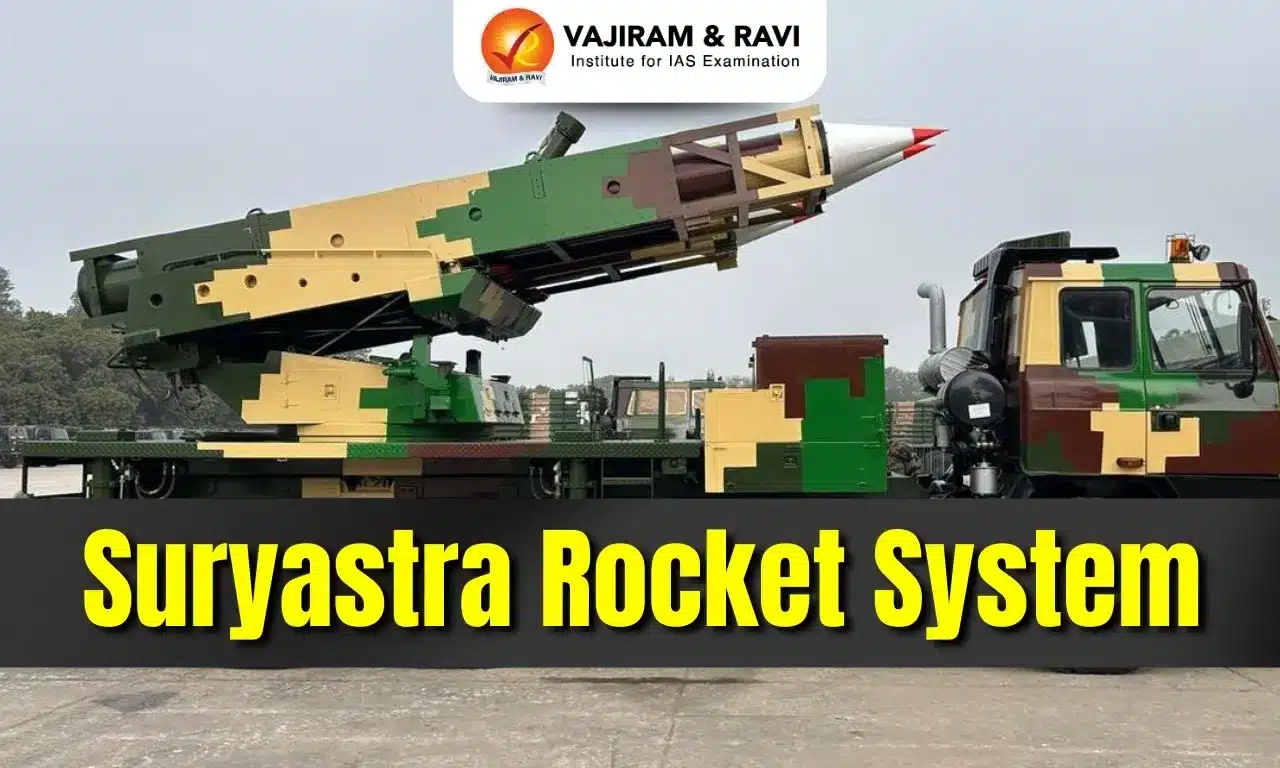
  • It is India’s first indigenous universal multi-calibre rocket launcher system.
  • It is developed by Pune-based NIBE Limited in collaboration with Israel’s Elbit Systems.
  • It is designed to deliver precision strikes against enemy positions, command centres, radar installations and logistics hubs deep inside hostile territory. 

Suryastra Rocket System Features

  • It is an advanced long-range rocket launcher system.
  • It is mounted on a highly mobile 6x6 Tatra truck. 
  • Multi-target Capability: It is designed to engage multiple targets simultaneously at varying ranges.
  • Precision: It achieves a high degree of accuracy with a circular error probable (CEP) of less than five metres during trials.
  • Instead of being limited to a single type of ammunition, it uses interchangeable modular pods that can fire a variety of munitions. 
  • This includes 122 mm rockets for closer engagements, 306 mm EXTRA missiles capable of hitting targets at 150 kilometres, and 370 mm Predator Hawk missiles that can reach up to 300 kilometres. 
  • The system can also launch SkyStriker loitering munitions—often referred to as suicide drones, capable of traveling up to 100 kilometres . 
  • Technology used: The system is based on Elbit Systems’ PULS (Precise & Universal Launching System) launcher technology.
  • It is equipped with a modern fire control system that integrates GPS, inertial navigation, and digital ballistic computation.
  • Its semi-automated reload and shoot-and-scoot capabilities reduce exposure to counter-battery fire.

Source: ITV

Suryastra Rocket System FAQs

Q1: What is the Suryastra Rocket System?

Ans: It is India’s first indigenous universal multi-calibre rocket launcher system.

Q2: Which company developed the Suryastra Rocket System?

Ans: It was developed by NIBE Limited in collaboration with Elbit Systems.

Q3: On what type of vehicle is the Suryastra system mounted?

Ans: It is mounted on a highly mobile 6x6 Tatra truck.

Q4: What is the strike range of the 306 mm EXTRA missiles used in Suryastra?

Ans: They can strike targets up to 150 kilometres away.

Q5: Which missile in the Suryastra system can hit targets up to 300 kilometres away?

Ans: The 370 mm Predator Hawk missile can hit targets up to 300 kilometres away.

Pulicat Lake

Pulicat Lake

Pulicat Lake Latest News

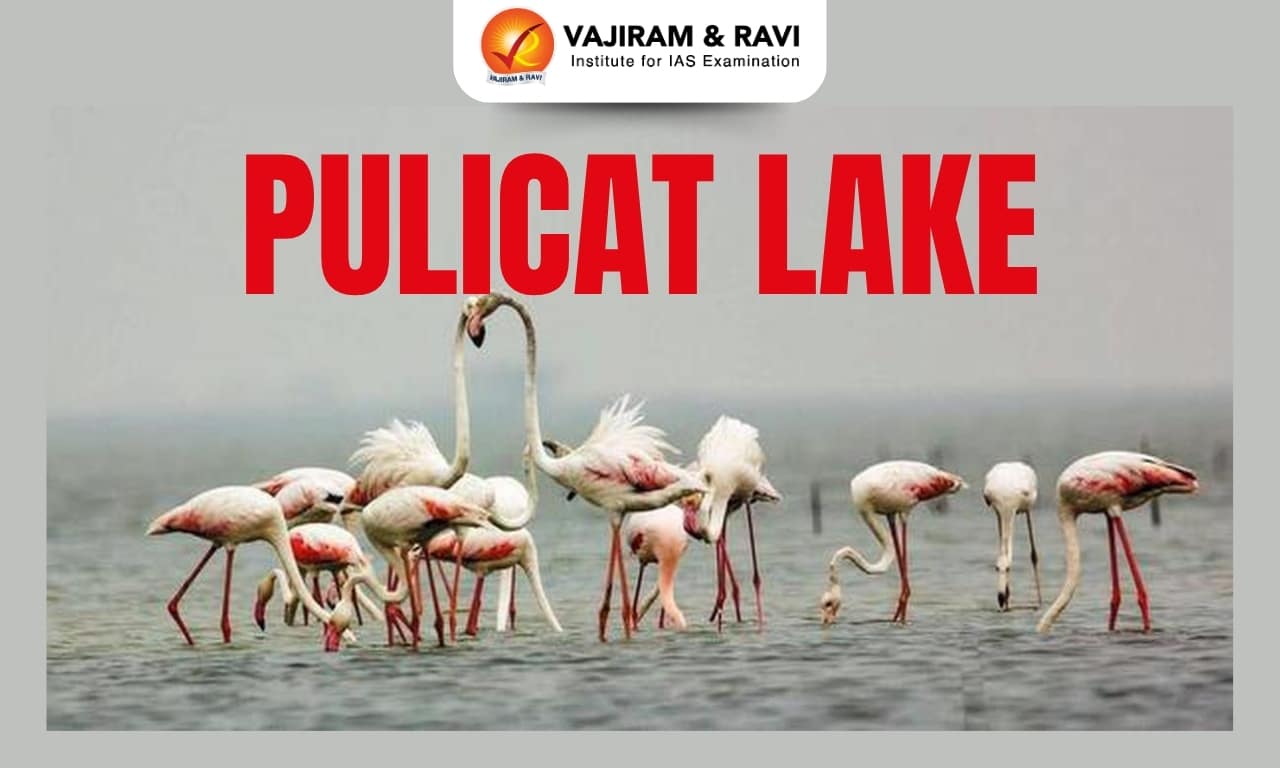
A historic Pulicat Lake draws birders and photographers from across South India who visit the lake to see the graceful flamingo in still waters.

About Pulicat Lake

  • It is a vast coastal shallow, brackish water lagoon along the coast of Bay of Bengal into which streams drain.
  • It is the second largest brackish water lagoon in India after Chilika, sprawling across Andhra Pradesh and Tamil Nadu.
  • This lagoon is separated from the Bay of Bengal by the Sriharikota island.
  • It is fed by the Aarani River at the southern tip and the Kalangi River from the northwest. The Buckingham Canal, a navigation channel, passes through the lagoon.
  • It was designated as a Ramsar site in 2002.
  • Biodiversity: It is a unique ecotone that supports rich biodiversity — from aquatic life such as mudskippers, seagrass beds, and oyster reefs to more than 200 avian species,
  • Flora: The green kingdom is represented with about 132 plant species like Walsura piscida; Manilkara elengi, Excoecaria agallocaha, Spinifex littoreus, Calamus viminalis, etc.
  • Fauna: It includes migratory birds such as Flamingo, Eurasian curlews, oystercatchers, bar-tailed godwits, sand plovers, and greater flamingos.

Source: TH

Pulicat Lake FAQs

Q1: Which island separates Pulicat Lake from Bay of Bengal?

Ans: Sriharikota Island

Q2: Pulicat Lake is located between which two states?

Ans: Andhra Pradesh & Tamil Nadu

Asian Productivity Organization

Asian Productivity Organisation (APO)

Asian Productivity Organization Latest News

The 68th Session of the Asian Productivity Organization (APO) Governing Body is being hosted by the Government of India in New Delhi. 

About Asian Productivity Organization

  • It is an intergovernmental organization which was established in 1961.
  • The APO is committed to enhancing productivity for sustainable socioeconomic development through mutual cooperation and knowledge sharing.
  • APO membership is open to countries in Asia and the Pacific that are members of the United Nations Economic and Social Commission for Asia and the Pacific (UN ESCAP). 
  • Members: It comprises 21 member economies from the Asia-Pacific region.
    • Bangladesh, Cambodia, Republic of China, Fiji, Hong Kong, India, Indonesia, Islamic Republic of Iran, Japan, Republic of Korea, Lao PDR, Malaysia, Mongolia, Nepal, Pakistan, Philippines, Singapore, Sri Lanka, Thailand, Türkiye, and Vietnam.
  • India is a founding member of APO.
  • These countries/economies support each other in their productivity drives in a spirit of mutual cooperation and coordinate with the APO through the designated national productivity organizations (NPOs).
    • National Productivity Council (NPC) under the Ministry of Commerce and Industry, is the designated NPO for India. 
  • Headquarters: Tokyo, Japan
  • Organisational Structure
    • APO is composed of the governing body, the NPOs, and the secretariat, which is headed by a secretary-general. 
    • The Governing Body is the APO’s highest decision-making authority and meets annually to set the organisation’s strategic direction, approve major proposals, and review Secretariat performance.

Source: PIB

Asian Productivity Organization FAQs

Q1: What is the highest decision-making body of APO?

Ans: Governing Body

Q2: Which Indian body is designated as the National Productivity Organization (NPO) for APO?

Ans: National Productivity Council (NPC)

Rupa Tarakasi

Rupa Tarakasi

Rupa Tarakasi Latest News

Cuttack’s centuries-old Rupa Tarakasi,silver filigree industry is getting impacted by the soaring prices and fresh import curbs push on silver.

About Rupa Tarakasi

  • It is one of the most exquisite silver crafts.
  • This centuries-old, sophisticated craft is practiced in the silver city of Cuttack, Odisha.
  • In Odia, “tara” means wire and “kasi” means to design.
  • Origin: While the exact origin of the filigree art in Cuttack is not clear, it is known to have existed as far back as the 12th century.
  • Patronage: The art form received considerable patronage under the Mughals.
  • Over the years, as Cuttack transitioned through the hands of different rulers, the silver filigree took on a new form with each.
  • Process
    • As part of Rupa tarakasi, silver bricks are transformed into thin fine wires or foils and used to create jewellery, artefacts or showpieces.
    • While different grades of silver are used in the main metal alloy, the craftsmen also use other metals like copper, zinc, cadmium, and tin.
  • The artists involved with this filigree work are called “Rupa Banias” or “Roupyakaras” (in Odia). 
  • This craftsmanship extends to creating various items, including jewellery worn by Odissi dancers, decorative artifacts, accessories, and religious and cultural pieces.
  • The famed handicraft work received a geographical indication (GI) tag in 2024.

Source: IE

Rupa Tarakasi FAQs

Q1: Rupa Tarakasi is a traditional craft of which Indian city?

Ans: Cuttack, Odisha

Q2: The artisans practicing Rupa Tarakasi are traditionally called?

Ans: Rupa Banias or Roupyakaras

Enquire Now