SARTHAK Public Distribution System (PDS) Scheme

SARTHAK Public Distribution System (PDS) Scheme

SARTHAK Public Distribution System (PDS) Scheme Latest News

Recently, the Cabinet Committee on Economic Affairs chaired by the Prime Minister approved the SARTHAK Public Distribution System (PDS) scheme.

About SARTHAK Public Distribution System (PDS) Scheme

  • SARTHAK PDS (Scheme for Assistance in Ration Transport and Handling-Income with Automation in PDS) is conceived as an umbrella scheme that integrates two ongoing initiatives
    • Assistance to State Agencies for intra-State movement of foodgrains and FPS dealers’ margin under NFSA
    • Scheme for Modernization and Reforms through Technology in Public Distribution System (SMART PDS)”
  • Aim: The government aims to create a single administrative structure for improving foodgrain distribution and strengthening implementation of the National Food Security Act, 2013.
  • It will run until March 2031.​​​​​​​​​​​​​​​​​​​​​​​​​​

Components of SARTHAK Public Distribution System (PDS) Scheme

  • Advanced Technology Use: It involves the use of advanced technologies such as Artificial Intelligence (AI), Machine Learning (ML), Natural Language Processing (NLP) and Blockchain to streamline operations in the public distribution system.
  • Unified Data& Architecture: Under the approved plan, the government intends to create unified databases and standardised digital architecture for real-time monitoring of the PDS network.
    • The scheme also proposes AI-enabled analytics and grievance redressal systems along with State Command Control Centres for monitoring operations through data-based oversight.
  • Certification: Government will introduce ISO-certified process frameworks to strengthen transparency, security standards and operational sustainability within the system.

Source: TH

SARTHAK Public Distribution System (PDS) Scheme FAQs

Q1: The SARTHAK PDS scheme aims to strengthen implementation of which Act?

Ans: National Food Security Act, 2013

Q2: SARTHAK PDS will run till which year?

Ans: 2031

CLEAR Technology

CLEAR Technology

CLEAR Technology Latest News

Researchers at the Jawaharlal Nehru Centre for Advanced Scientific Research (JNCASR) recently developed a novel imaging platform called Cleavable Light-Erased Antibody Reporter (CLEAR).

About CLEAR Technology

  • Cleavable Light-Erased Antibody Reporter (CLEAR) is a novel imaging platform that could significantly improve the visualization and mapping of proteins within biological samples. 
  • It was developed by researchers at the Jawaharlal Nehru Centre for Advanced Scientific Research (JNCASR).
  • Researchers from the Indian Institute of Science also collaborated in demonstrating the technology in complex biological settings, particularly immune cell systems. 
  • CLEAR technology enables scientists to visualize a large number of proteins within the same biological sample using a single fluorescent marker, overcoming a major challenge in spatial protein mapping.  
  • The scientists introduced a light-cleavable probe system that allows repeated cycles of protein labelling and imaging within the same spectral window. 
  • After imaging a set of proteins, the fluorescent signal can be erased using a gentle pulse of 365 nm LED light, enabling researchers to label and image a new set of proteins in the same cell. 
  • It allows increasingly detailed protein maps to be generated across specimens ranging from single cells to complex tissue sections. 
  • Unlike existing multiplex imaging methods, CLEAR combines high multiplexing capability with speed, spatial resolution, and compatibility with delicate biological samples, including live cells. 
  • The technology has the potential to improve early disease detection, particularly in cancers and neurological disorders, while also helping researchers better understand immune responses and cellular behaviour. 
  • In the long term, the platform could contribute to precision medicine by enabling detailed molecular analysis that can support targeted therapies and personalized treatment approaches.

Source: DDN

CLEAR Technology FAQs

Q1: What is CLEAR Technology used for?

Ans: It is used for visualization and mapping of proteins within biological samples.

Q2: What does CLEAR stand for in CLEAR Technology?

Ans: Cleavable Light-Erased Antibody Reporter.

Q3: Which institution developed CLEAR Technology?

Ans: Jawaharlal Nehru Centre for Advanced Scientific Research.

Q4: How does CLEAR Technology enable visualization of many proteins?

Ans: By using a single fluorescent marker for repeated imaging cycles.

National Health Accounts (NHA) Estimates for India 2022-23

National Health Accounts (NHA) estimates for India 2022-23

National Health Accounts (NHA) Estimates for India 2022-23 Latest News

The Health Ministry recently released the National Health Accounts NHA estimates for India 2022-23.

About National Health Accounts (NHA) Estimates for India 2022-23

  • The NHA estimates, released annually, provide a time-series analysis of actual health expenditure incurred by the government, private sector, and other sources. 
  • The current estimates for 2022-23 mark the 10th edition in the series that began in 2013-14.
  • It is prepared by the National Health Accounts Technical Secretariat (NHATS) under the National Health Systems Resource Centre, Ministry of Health and Family Welfare, using the internationally accepted System of Health Accounts (2011) framework.
  • Highlights:
    • The report indicates an increase in government expenditure on healthcare since 2013-14.
    • The report showed that government health expenditure increased from Rs 1.30 lakh crore in 2013-14 to Rs 3.85 lakh crore in 2022-23.
    • The share of government health expenditure in the country’s GDP has risen from 1.15 percent in 2013-14 to 1.43 percent in 2022-23. According to the new GDP series with base year 2022-23, the figure stands at 1.48 percent.   
    • Similarly, government health expenditure’s share in general government expenditure has increased from 3.78 percent to 4.89 percent over the same period.
    • In per capita terms, government health expenditure has increased nearly 2.7 times, from Rs. 1042 to Rs. 2786 between 2013-14 and 2022-23.  
    • The share of government health expenditure in total health expenditure has increased by almost 15 percentage points, from 28.6 percent in 2013-14 to 43.7 percent in 2022-23.  
    • The increase in public spending has contributed to a substantial decline in out-of-pocket expenditure incurred by households on healthcare. 
    • Out-of-pocket expenditure as a share of total health expenditure fell from 64.2 percent in 2013-14 to 43.4 percent in 2022-23. 
    • The share of Social Security Expenditure (SSE) in total health expenditure -- which includes government-funded health insurance such as the AB PM-JAY, medical reimbursements to government employees, and social health insurance programmes -- has increased substantially from 6 percent in 2013-14 to 9.9 percent in 2022-23. 
    • The share of private health insurance in total health expenditure has also increased, from 3.4 percent to 9.2 percent.
    • Expenditure on primary healthcare by the government more than doubled from Rs 0.5 lakh crore in 2013-14 to Rs 1.4 lakh crore in 2022-23.

Source: NOA

National Health Accounts (NHA) estimates for India 2022-23 FAQs

Q1: What do the National Health Accounts (NHA) estimates provide?

Ans: They provide a time-series analysis of actual health expenditure incurred by the government, private sector, and other sources.

Q2: In which year did the National Health Accounts series begin?

Ans: In 2013-14.

Q3: Which body prepares the National Health Accounts estimates in India?

Ans: The National Health Accounts Technical Secretariat (NHATS).

Q4: What was the share of government health expenditure in GDP in 2022-23?

Ans: 1.43 percent.

Q5: What was the share of government health expenditure in total health expenditure in 2013-14?

Ans: 28.6 percent.

Humboldtia nairiana

Humboldtia nairiana

Humboldtia nairiana Latest News

Researchers have discovered a new evergreen tree species from the southern Western Ghats of Kerala and have officially named it as Humboldtia nairiana.

About Humboldtia nairiana

  • It is a new evergreen tree species belonging to the genus Humboldtia.
  • The species identified in the riparian forests of the Shendurney Wildlife Sanctuary.

Features of Humboldtia nairiana

  • It is a medium-sized evergreen tree that grows between 5 to 8 metres in height. 
  • It possesses stable and distinguishing features including a unique warty, pale brown bark with a distinct creamy-white blaze; angled, glabrous branchlets.
  • It has distinctly shorter, sparsely hairy, isometric stipules and appendages;
  • It consists of larger flowers with comparatively long pedicels, and produces elliptic-oblong fruits with a shorter beak.
  • It is strictly endemic to Kerala and is presently known only from the biodiversity-rich Agasthyamala Biosphere Reserve at an elevation of about 300 meters.

Key Facts about Shendurney Wildlife Sanctuary

  • Location: It is located in the southern part of the Western Ghats in Kerala.
  • It forms part of the Agasthyamala Biosphere Reserve.
  • Terrain: Most of the Sanctuary area is hilly and interspersed with ravines.
  • Rivers: The major rivers are Shendurney, Kazhuthuruthy, and Kulathupuzha, which join together to form the Kallada River.
  • Vegetation: The vegetation primarily consists of tropical evergreen forests, semi-evergreen forests, and moist deciduous forests.

Source: TH

Humboldtia nairiana FAQs

Q1: Humboldtia nairiana is endemic to which state?

Ans: It is found only in Southern Western Ghats of Kerala.

Q2: Humboldtia nairiana belongs to which family?

Ans: Fabaceae, legume family

PM-WANI

What is Prime Minister Wi-Fi Access Network Interface (PM-WANI) Scheme?

PM-WANI Latest News

Recently, the Department of Telecommunications (DoT) has introduced a series of user-friendly reforms under the Prime Minister’s Wi-Fi Access Network Interface (PM-WANI) framework.

About PM-WANI

  • The PM-WANI (Prime Minister Wi-Fi Access Network Interface) was launched by the Department of Telecommunication in December 2020.
  • It aims to enhance the proliferation of public WiFi hotspots to create robust digital communications infrastructure in the country, especially in rural areas.
  • Objectives
    • To overcome the digital divide by increasing internet connectivity, especially in remote and rural regions.
    • To empower individuals and businesses to participate in the digital economy through affordable internet access.
    • To encourage local entrepreneurs by enabling shopkeepers and individuals to become Public Data Office (PDO) operators.

PM-WANI Ecosystem Components

  • Public Data Office (PDO): It will establish, maintain, and operate only WANI-compliant Wi-Fi access points and deliver broadband services to subscribers. No license is required from DoT.
    • The local shops and small establishments as PDOs may earn extra income from selling internet without any requirement of license, registration, and/or any fees to DoT.
  • Public Data Office Aggregator (PDOA): It will be an aggregator of PDOs and perform the functions relating to authorization and accounting.
  • App Provider: It will develop an App to register users and discover WANI-compliant Wi-Fi hotspots in the nearby area and display the same within the App for accessing the internet services.
  • Central Registry: It will maintain the details of App Providers, PDOAs, and PDOs. 
    • It is currently maintained by the Centre for Development of Telematics (C-DoT).

Source: News On Air

PM-WANI FAQs

Q1: Which entity maintains the central registry of PDOs in PM-WANI?

Ans: Centre for Development of Telematics

Q2: PM-WANI aims to increase broadband penetration through:

Ans: Public Wi-Fi Hotspots

Gynacantha khasiaca

Gynacantha khasiaca

Gynacantha khasiaca Latest News

A team of four citizen scientists recently recorded Gynacantha khasiaca, a rare dragonfly commonly known as the long-tailed duskhawker, from the Namdapha National Park and Tiger Reserve.

About Gynacantha khasiaca

  • It is a rare species of dragonfly, commonly known as the long-tailed duskhawker.
  • It has resurfaced in the dense rainforests of Namdapha National Park and Tiger Reserve, Arunachal Pradesh. 
  • It is the first confirmed record of the dragonfly from Arunachal Pradesh in 110 years. 
  • It was last officially recorded in Arunachal Pradesh in 1914 from the Abor Hills region. 
  • Outside India, the dragonfly has only been reported from scattered locations in Nepal, Myanmar, and Bangladesh. 
  • Within India, confirmed records remain sparse, with occasional sightings from Assam, Meghalaya, Uttarakhand, West Bengal, and Maharashtra. 
  • The male dragonfly was first spotted rapidly patrolling the forest edge on a cloudy morning before settling into a vertical hanging posture beneath dense vegetationbehaviour typical of elusive duskhawker species. 
  • The insect itself is visually striking, with pale blue-green eyes, a bright green thorax marked by dark stripes, transparent amber-tinted wings, and a long black-tipped abdomen stretching nearly five centimetres. 
  • Globally, the species is classified as “Data Deficient” by the IUCN Red List.

Source: TH

Gynacantha khasiaca FAQs

Q1: What is Gynacantha khasiaca?

Ans: It is a rare species of dragonfly.

Q2: What is the common name of Gynacantha khasiaca?

Ans: The long-tailed duskhawker.

Q3: Where has Gynacantha khasiaca recently resurfaced?

Ans: In Namdapha National Park and Tiger Reserve.

Q4: When was Gynacantha khasiaca last officially recorded in Arunachal Pradesh before the recent sighting?

Ans: In 1914.

Q5: What is the IUCN Red List status of Gynacantha khasiaca?

Ans: Data Deficient.

Fiji

Fiji

Fiji Latest News

A surprise announcement by the Quad to build a “model” port in Fiji recently sparked hopes that the US, Australia, India, and Japan will fund a $1.82 billion plan to relocate the nation’s main dock.

About Fiji

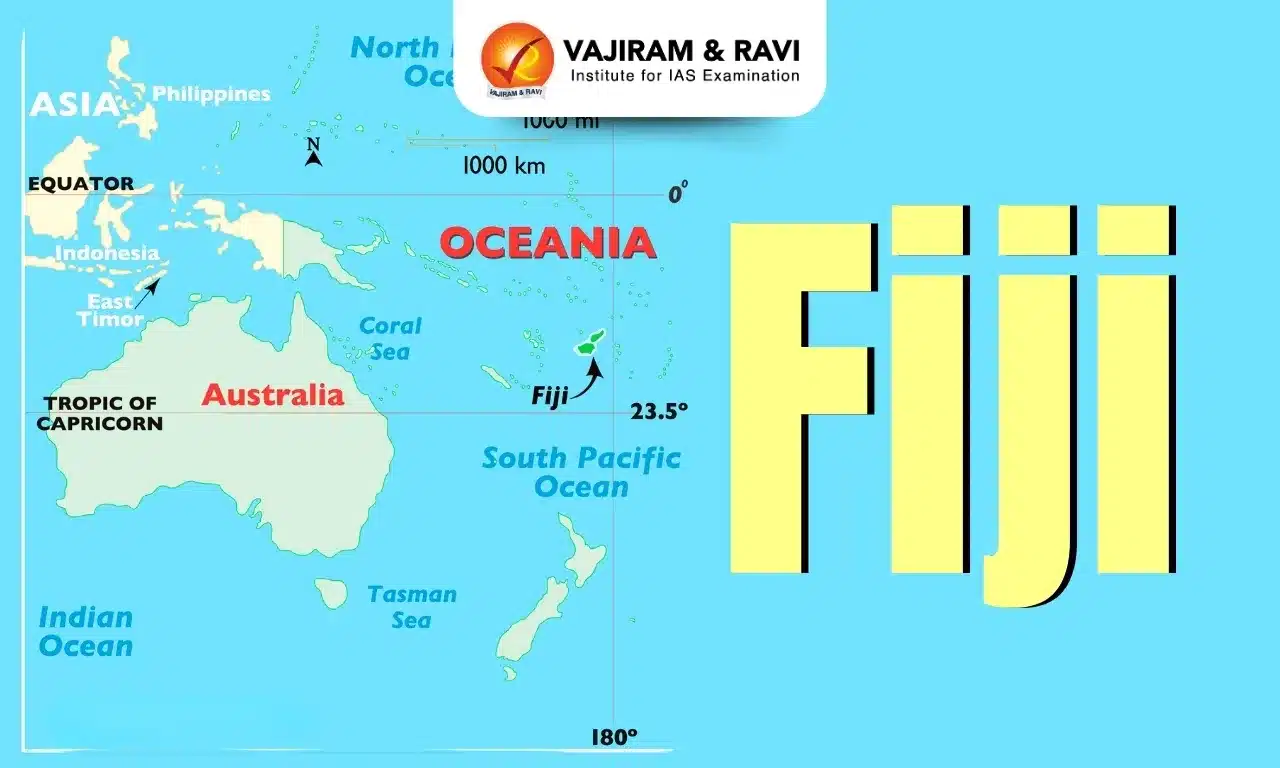
  • It is a country located in the South Pacific Ocean, surrounding the Koro Sea, to the northeast of New Zealand and southwest of Hawaii.
  • It does not share land borders with any other country. 
  • It is made up of about 300 islands, only about 100 of which are inhabited.  
  • The islands feature a central range of mountains, giving way to plateaus, lowlands, and coastal plains.  
  • Almost half of Fiji’s total area remains forested, while dry grasslands are found in western areas of the large islands.
  • The capital, Suva, is on the southeast coast of the largest island, Viti Levu (“Great Fiji”).
    • Viti Levu accounts for more than half of Fiji’s land area.
    • It includes the country’s highest peak, Mount Tomanivi, standing at 1,324 m (4,344 ft). 
  • Fiji Islands are largely the product of volcanic action, sedimentary deposit, and formations of coral. 
  • The majority of Fijians are of mixed Melanesian-Polynesian ancestry, with a large South Asian minority. 
  • Fiji's major languages are English, Fijian, and Hindi, and its major religions are Christianity, Hinduism, and Islam. 
  • Currency: Fiji dollar.
  • Fiji has one of the most developed economies in the Pacific, relying heavily on its tourism and sugar industries. 
  • Political History:
    • Fiji became independent in 1970 after nearly a century as a British colony. 
    • On independence, Fiji adopted a constitutional democratic form of government based on the Westminster system. 
    • A series of coups (1987, 2000, and 2006) slowed Fiji's progress to its current parliamentary democracy under the 2013 Constitution of Fiji. 
    • Fiji has a 55-seat unicameral parliament.

Source: FP

Fiji FAQs

Q1: Where is Fiji located?

Ans: In the South Pacific Ocean, northeast of New Zealand and southwest of Hawaii.

Q2: Does Fiji share land borders with any country?

Ans: No, Fiji does not share land borders with any country.

Q3: Approximately how many islands make up Fiji?

Ans: About 300 islands.

Q4: What is the capital of Fiji?

Ans: Suva.

Q5: What is the major ethnic composition of Fiji’s population?

Ans: Mixed Melanesian-Polynesian ancestry.

Algoza

Algoza

Algoza Latest News

Recently, Rajasthan’s celebrated folk artist Taga Ram Bheel received the Padma Shri in Art for preserving and promoting the traditional music of the Thar Desert through the rare folk instrument, the Algoza.

About Algoza

  • It is a traditional pair of woodwind instruments, widely associated with Rajasthan, Punjab, Sindh, and parts of western India and Pakistan.
  • It is one of India’s oldest surviving folk wind instruments.
  • How is it played?
    • Its name comes from the idea of “two flutes" — because it is played using two wooden pipes simultaneously.
    • One flute plays the melody, the other provides a continuous drone or rhythmic base. Together, they create a hypnotic, layered sound unique to desert folk music.
    • For playing the Algoza musicians must master circular breathing (a demanding technique that allows them to blow continuously without stopping for breath).
    • Sound is generated by breathing into it rapidly; the quick recapturing of breath on each beat creates a bouncing, swing rhythm.
    • This creates the instrument’s signature uninterrupted flow, making performances sound seamless and meditative.

Source: News18

Algoza FAQs

Q1: Algoza is mainly associated with which Indian region?

Ans: Punjab & Rajasthan

Q2: What is Algoza?

Ans: It is one of India’s oldest surviving folk wind instruments.

Bhimgad Wildlife Sanctuary

Bhimgad Wildlife Sanctuary

Bhimgad Wildlife Sanctuary Latest News

The Karnataka state government has issued rules to regulate development works around Bhimgad Wildlife Sanctuary in Belagavi district. 

About Bhimgad Wildlife Sanctuary

  • Location: It spans over the Western Ghats in the Belgaum district of Karnataka.
  • The sanctuary derives its name from Bhimgad Fort, built by the legendary Maratha king Shivaji in the 17th century. 
    • Bhimgad Fort acted as a strategic outpost to guard against Portuguese expansion from Goa. 
  • It shares its boundary with the north of Dandeli Wildlife Sanctuary, north-west of the Bhagwan Mahaveer Sanctuary and Mollem National Park, north of Netravali Wildlife Sanctuary, and east of Mhadei Wildlife Sanctuary.
  • Terrain:  It features rugged terrain with limestone formations and several caves, contributing to its unique biodiversity.
  • Rivers: The sanctuary is the origin of several rivers, including the Mhadei, Malaprabha, and Tillari and several perennial streams.
  • It is most famous for the Barapede Caves, the only known breeding ground of the Wroughton’s Free-tailed Bat, a threatened species on the verge of extinction.
  • Vegetation: The dominant vegetation of the forest comprises tropical and subtropical moist broadleaf forests. 
  • Flora: Forests are dominated by towering trees like Malabar teak, rosewood, and various species of dipterocarps
  • It also hosts a number of medicinal plants. 
  • Fauna
    • It provides habitat for several endangered species, such as the Indian sloth bear, Indian pangolin, and the elusive Black Panther. 
    • Other notable residents include the Malabar giant squirrel, gaur, sambar deer, and a plethora of bird species, including the Malabar trogon and the great Indian hornbill.
    • Reptiles: It serves as ideal breeding grounds for the King Cobra, the world’s longest venomous snake.

Source: TH

Bhimgad Wildlife Sanctuary FAQs

Q1: Where is Bhimgad Wildlife Sanctuary located?

Ans: Karnataka

Q2: Bhimgad WLS was notified in which year?

Ans: It was notified on 1st December 2011.

Enquire Now