Mongolia

Mongolia

Mongolia Latest News

In a significant milestone in India-Mongolia cultural and spiritual relations, the Holy Relics of Arhat Sariputra and Arhat Mahamoggallana were ceremonially enshrined at the Gandantegchenling Monastery in Ulaanbaatar, Mongolia

About Mongolia

  • It is a landlocked country in north-central Asia.
  • Bordering Countries: Mongolia is bordered by two nations: China in the south and Russia in the north.
  • Capital City: Ulaanbaatar

Geographical Features of Mongolia

  • Climate: Mongolia has a pronounced continental climate because of its high latitude and elevation and distance from oceans.
  • It has four main vegetation zones that run from north to south and from mountains to basins: forest-steppe, steppe, semidesert, and desert.
  • Major Mountains: Khentii Mountains, Khangai Mountains, and the Altay Mountains.
  • Highest Point: The highest point of Mongolia is Nayramadlin Orgil at 14,350 ft. (4,374 m)
  • Major River: Orkhon River (Orkhon River valley was inscribed by UNESCO in the World Heritage List).
  • Lake: Hovsgol Nuur, one of Asia's largest freshwater lakes, is located on its border with the Russian Federation.
  • Natural Resources: Mongolia possesses large deposits of coal and fluorite (fluorspar) and of copper, gold, silver, and other metallic ores.

Source: PIB

Mongolia FAQs

Q1: What is the capital of Mongolia?

Ans: Ulaanbaatar

Q2: What type of country is Mongolia in terms of sea access?

Ans: It is a landlocked country between Russia and China.

Mtkvari River

Mtkvari River

Mtkvari River Latest News

Authorities in Georgia recently found a body in the Mtkvari River, believed to be missing Indian medical student, pending DNA confirmation.

About Mtkvari River

  • The Mtkvari River, also known as the Kura River, is a significant watercourse in the South Caucasus mountains.
  • It is the longest river in the Caucasus region. 
  • It flows through the countries of Turkey, Georgia, and Azerbaijan. 
  • It is an east-flowing river that originates in eastern Turkey, enters Georgia, and flows through the valley between the Greater Caucasus and Lesser Caucasus mountains before reaching the Caspian Sea in Azerbaijan.  
  • The river has a total length of 1515 kilometers, with the longest portion in Azerbaijan (906 kilometers), followed by 270 kilometers in Georgia, and 174 kilometers in Turkey.  
  • The Araxes (Aras) River is the largest tributary of the Mtkvari. 
  • Tbilisi, the capital of Georgia, is the largest city located along the river. 
  • Historical Context:
    • The Mtkvari River has been a cradle of civilization for millennia. 
    • Ancient settlements along its banks date back to the Bronze Age. 
    • Historically, the river served as a vital trade route, connecting the Caucasus with the larger Eurasian trade networks. 

Source: IT

Mtkvari River FAQs

Q1: What is another name for the Mtkvari River?

Ans: The Kura River.

Q2: In which region is the Mtkvari River located?

Ans: The South Caucasus region.

Q3: Through which three countries does the Mtkvari River flow?

Ans: Turkey, Georgia, and Azerbaijan.

Q4: Into which sea does the Mtkvari River drain?

Ans: The Caspian Sea.

Q5: What is the total length of the Mtkvari River?

Ans: 1,515 kilometres.

Indopottia Himalayensis

Indopottia Himalayensis

Indopottia Himalayensis Latest News

Recently, scientists from the Botanical Survey of India have discovered a new species of moss and named it as Indopottia himalayensis. 

About Indopottia Himalayensis

  • It is a new moss species discovered from high-altitude forests of the Western Himalayas in Uttarakhand state.
  • It is only the third species of its kind ever identified globally.
  • Other two species reside far away in the Western Ghats of southern India and the mountains of  Thailand.
  • The research team chose the name Indopottia himalayensis as a tribute to the magnificent Himalayan mountain range.
  • Features
    • It is entirely terrestrial, thriving directly on soil-covered rocks.
    • It grows slightly taller reaching up to 13 millimetres in length, and features a perfectly rounded stem.
    • This moss produces a single, upright, cylindrical spore-capsule.
    • This capsule features a distinctive lid that bends sideways when dry.
    • Its leaves lack the specific patch of transparent, bulging cells found in its closest relatives.

Key Facts about Moss

  • It is a small nonvascular spore-bearing land plant belonging to the taxonomic division Bryophyta.
  • It is among the earliest land plants and has colonised some of the harshest environments on the planet, including Antarctica, volcanic fields, and deserts.
  • Types of Moss: There are three main types: peat moss, granite moss and true moss.
  • Distribution:  Mosses are distributed throughout the world except in salt water.
  • Habitat: It is the small plant commonly found in damp, shady spots is already known for its resilience on Earth.

Source: RM

Indopottia Himalayensis FAQs

Q1: What is Indopottia himalayensis?

Ans: Indopottia himalayensis is a moss species reported from Himalayan region.

Q2: What is the taxonomic classification of Indopottia himalayensis?

Ans: Belongs to Division Bryophyta

Beaufort Castle

Beaufort Castle

Beaufort Castle Latest News

Amid the West Asia conflict, Israel has pushed itself deeper into Lebanon recently, capturing the historic Beaufort Castle and the surrounding strategic ridge.

About Beaufort Castle

  • Beaufort Castle — known locally as Qalaat al-Shaqif or the “Castle of the High Rock", is a medieval fortress situated atop a commanding hill near the city of Nabatieh in southern Lebanon. 
  • It is located just 14.5 km from the Israeli border. 
  • Originally built by Crusaders in the 12th century, the castle has changed hands multiple times throughout history, passing through Crusader, Muslim, Mamluk, and Ottoman control. 
  • It is one of the best-preserved examples of medieval castles in the Near East.
  • Its impressive architecture, with a high castle and a low castle, demonstrates its defensive role in the Middle Ages.  
  • It overlooks vast stretches of southern Lebanon, the Litani River valley, and parts of northern Israel, making it a position of considerable strategic value. 
  • The castle has also been at the centre of fighting in the past. 
    • In 1982, amid the Lebanon War, Israel captured Beaufort Castle from the Palestine Liberation Organization (PLO) and held it until it withdrew from Lebanon in 2000.

Source: FP

Beaufort Castle FAQs

Q1: Where is Beaufort Castle located?

Ans: It is located near the city of Nabatieh in southern Lebanon.

Q2: How far is Beaufort Castle from the Israeli border?

Ans: It is located approximately 14.5 km from the Israeli border.

Q3: Who originally built Beaufort Castle?

Ans: It was originally built by the Crusaders.

Q4: In which century was Beaufort Castle constructed?

Ans: The 12th century.

Q5: Why is Beaufort Castle considered strategically important?

Ans: Because it overlooks southern Lebanon, the Litani River valley, and parts of northern Israel.

Giant Malabar Squirrel

Giant Malabar Squirrel

Giant Malabar Squirrel Latest News

Arare Giant Malabar Squirrel has been recently spotted in the Devpur forest area of Chhattisgarh’s Barnawapara forest.

About Giant Malabar Squirrel

  • The Malabar Giant Squirrel, also known as the Indian Giant Squirrel, is a large multicoloured tree squirrel species endemic to India.
  • It is one of the largest squirrels in the world.
  • Scientific Name: Ratufa indica.

Giant Malabar Squirrel Habitat and Distribution

  • It is found primarily in the Western Ghats, Eastern Ghats, and Satpura Range. 
  • It is found in areas with elevation ranging from 180 to 2,300 metres in tropical deciduous, semi-deciduous, and wet evergreen forests and woodlands.
  • It is arboreal and spends most of its time in the upper canopy, leaping from tree to tree with incredible agility, jumping up to 6 metre length.  
  • It makes its shelter within holes in trees. 
  • It is Maharashtra’s state animal and locally known as Shekru.

Giant Malabar Squirrel Features

  • Total body length varies from 254 to 457 mm. The tail is typically longer than the length of its body. 
  • It exhibits 2-3 types of color patterns with shades of black, brown, and deep red. 
  • The body varies from deep red to brown with white patches on the belly as well as dirty white or cream-colored under-parts and forelimbs. 
  • It has pink lips and a nose. The eyes are colored in bright dark or light brown.
  • The powerful and long tail is light brown with a creamy white tip. 
  • They have short, round ears, a broadened hand with an expanded inner paw for gripping, and large, powerful claws used for gripping tree bark and branches.
  • They are typically solitary animals, being seen only rarely in pairs during the breeding season.
  • Instead of running, it frequently freezes or flattens itself against the tree stem when threatened. 

Giant Malabar Squirrel Conservation Status

It is classified as 'Least Concern' under the  IUCN Red List.

Source: SM

Giant Malabar Squirrel FAQs

Q1: Is the Giant Malabar Squirrel endemic to India?

Ans: Yes, it is endemic to India.

Q2: What is the scientific name of the Giant Malabar Squirrel?

Ans: Ratufa indica.

Q3: In which mountain ranges is the Giant Malabar Squirrel primarily found?

Ans: The Western Ghats, Eastern Ghats, and Satpura Range.

Q4: What colours are commonly seen in the Giant Malabar Squirrel?

Ans: Shades of black, brown, and deep red.

Q5: What is the IUCN Red List status of the Giant Malabar Squirrel?

Ans: Least Concern.

Doctrine of Promissory Estoppel

Doctrine of Promissory Estoppel

Doctrine of Promissory Estoppel Latest News

The Supreme Court recently observed that the doctrine of promissory estoppel cannot be invoked to claim a benefit under a government policy which was never aimed to benefit a specific class of industrial unit. 

About Doctrine of Promissory Estoppel

  • It is a legal doctrine that states that if someone reasonably relies on a promise and acts (or fails to act) in a way that causes them some harm because of that promise, the promise can be enforced. 
  • Promissory estoppel prevents the promisor from arguing against the enforcement of a promise. 
  • When is the doctrine applied?
    • The doctrine applies when the promisor has made a promise to the promisee.
    • The promisee must have relied on the promise and suffered a detriment due to the non-performance of the promise. 
    • The doctrine prevents the promisor or enterprise from going back on its word or promise.
    • The doctrine enables the injured party or the promisee to recover on a promise.
    • The doctrine seeks to protect the rights of a promisee or aggrieved party against the promisor.
    • Thus, Promissory estoppel requirements include a clear promise (whether oral or in writing), reliance on that promise by the promisee, a detriment suffered, and a need to avoid injustice. 
  • Example:
    • A vendor makes an oral promise to the customer to replace the goods if they do not fit the customer’s size requirements. 
    • The customer purchases the clothes and takes them home.
    • However, the customer proposes to return the clothes to the vendor relying on the vendor’s oral promise. 
    • Here, the vendor is estopped from refusing the clothes returned.
  • The doctrine varies from country to country. Cases of promissory estoppel can result in either reliance or expectation damages, depending on the jurisdiction and circumstances.
  • In a 1981 decision in Chhaganlal Keshavalal Mehta v. Patel Narandas Haribhai, the SC lists a checklist for when the doctrine can be applied.
    • First, there must be a clear and unambiguous promise.
    • Second, the plaintiff must have acted relying reasonably on that promise.
    • Third, the plaintiff must have suffered a loss.

Source: LL

Doctrine of Promissory Estoppel FAQs

Q1: What is the Doctrine of Promissory Estoppel?

Ans: It is a legal doctrine that allows a promise to be enforced when a person has reasonably relied on it and suffered a detriment due to its non-performance.

Q2: What is the primary purpose of the Doctrine of Promissory Estoppel?

Ans: To prevent a promisor from going back on a promise that has been relied upon by another person.

Q3: When does the Doctrine of Promissory Estoppel apply?

Ans: When a promisor makes a promise, the promisee relies on it, and suffers a detriment due to its non-performance.

Q4: Is a written contract always necessary for Promissory Estoppel to apply?

Ans: No, even an oral promise may be enforceable.

Mettur Dam

Mettur Dam

Mettur Dam Latest News

The probability of the Mettur dam getting opened on the scheduled date appears to be remote, in view of the poor storage and the forecast of a poor southwest monsoon (June-September) this year.

About Mettur Dam

  • It is located at Mettur, Salem District, in Tamil Nadu.
  • At 65 meters high and 1,700 meters long, it is one of the largest dams in India and the largest in Tamilnadu. 
  • It is constructed in a gorge, where the Kaveri River enters the plains.
  • Built in 1934, it took 9 years to complete. The entire work was supervised by the then Governor of Madras, Sir George Stanley.   
  • It was constructed for the main purpose of capturing Kaveri waters for irrigation, drinking water supply, and power generation.  
  • Features:
    • It is a masonry gravity dam.
    • The reservoir formed by the dam is known as the Stanley Reservoir.  It has the contribution to produce 240 MW of hydroelectricity. 
    • There is a park adjoining the dam on the opposite side with lawns and fountains and also has the Muniappan/Aiyanar statue in the vicinity.
  • The dam receives inflows from its own catchment area, Kabini Dam, and Krishna Raja Sagara Dams located in Karnataka. 
  • It provides irrigation facilities to parts of Salem, the length of Erode, Namakkal, Karur, Tiruchirappali, and Thanjavur districts for 271,000 acres of farmland.

Source: TH

Mettur Dam FAQs

Q1: Where is Mettur Dam located?

Ans: Mettur in Salem District, Tamil Nadu.

Q2: Across which river is Mettur Dam constructed?

Ans: The Kaveri (Cauvery) River.

Q3: What type of dam is Mettur Dam?

Ans: A masonry gravity dam.

Q4: What is the name of the reservoir formed by Mettur Dam?

Ans: Stanley Reservoir.

Design Linked Incentive Scheme

Design Linked Incentive Scheme

Design Linked Incentive Scheme Latest News

Recently, the Union Minister said that India’s design-linked incentive (DLI) scheme is showing good results.

About Design Linked Incentive Scheme

  • It is a key instrument in advancing India’s ambition to develop a strong fabless capability.
  • It is implemented by the Ministry of Electronics and Information Technology (MeitY) under the Semicon India Programme.
  • Aim: The scheme aims to reduce import dependence, strengthen supply chain resilience, and enhance domestic value addition.
  • Eligibility:  Start-ups and MSMEs are eligible for financial incentives and design infrastructure support for semiconductor product design & deployment.
  • Other domestic companies are eligible for financial incentives for deploying semiconductor designs.
  • The DLI Scheme supports: Semiconductor design across the full lifecycle—from design and development to deployment—covering Integrated Circuits (ICs), chipsets, Systems-on-Chip (SoCs), systems and IP cores.
  • Nodal Agency: C-DAC (Centre for Development of Advanced Computing).

Financial Incentives and Design Infrastructure Support under DLI

  • Product Design Linked Incentive
    • Reimbursement of up to 50% of eligible expenditure.
    • The reimbursement is capped at ₹15 crore per application.
    • The support is available to entities involved in semiconductor design for: Integrated Circuits (ICs) Chipsets Systems on Chips (SoCs) Systems & IP Cores Semiconductor-linked designs.
  • Deployment Linked Incentive
    • Incentives of 6% to 4% of net sales turnover are provided for five years.
    • The incentive is capped at ₹30 crore per application.
    • The minimum cumulative net sales required over Years 1–5 is 1 crore for startups/ ₹ MSMEs and 5 crore for other domestic companies.

Source: DD News

Design Linked Incentive Scheme FAQ's

Q1: What is the Design Linked Incentive (DLI) Scheme?

Ans: Part of Semicon India Programme to boost semiconductor design

Q2: What is the nodal ministry for DLI Scheme?

Ans: Implemented by MeitY through C-DAC under India Semiconductor Mission

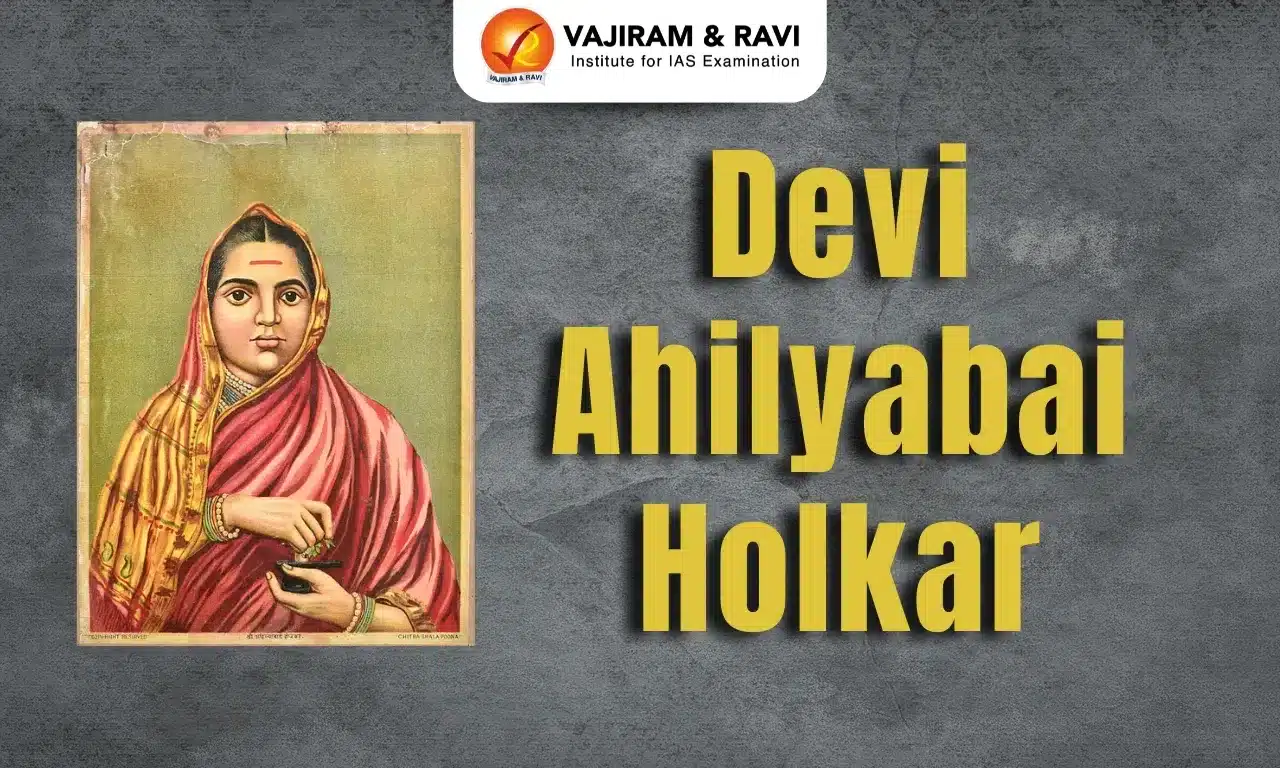
Ahilyabai Holkar

Who was Ahilya Bai Holkar?

Ahilyabai Holkar Latest News

Recently, the Prime Minister of India paid tributes to Lokmata Ahilyabai Holkar on her birth anniversary.

About Ahilyabai Holkar

  • Maharani Ahilyabai Holkar (31 May 1725 – 13 August 1795) was a ruler of the Malwa territory, a part of the Maratha Confederacy, from 1767 to 1795. 
  • She is known as Punyashlok (“One as Pure as the Sacred Chants”).
  • John Keay, the British historian, gave the queen the title of ‘The Philosopher Queen’.
  • Early Life and Marriage
    • Born on May 31, 1725, in the village of Chondi in Jamkhed, Ahmednagar (Maharashtra), and her father Mankoji Rao Shinde was the village head.
    • She got married to Khanderao Holkar (son of Malhar Rao Holkar) in 1733.
  • Rise to Power
    • Ahilyabai's husband Khanderao Holkar was killed in the battle of Kumbher in 1754. 
    • Her father-in-law, Malhar Rao passed away in 1766, and in the following year, she lost her son, Male Rao.
    • She ascended the throne and became the ruler of Indore on December 11, 1767.
    • She had appointed Tukoji Rao Holkar as the commander of her army.
    • She made Maheshwar in Madhya Pradesh as the capital of the Holkar dynasty.

Key Contributions of Ahilyabai Holkar

  • Temple Construction: She was instrumental in rebuilding major temples, notably the Kashi Vishwanath temple in 1780, and supported infrastructure such as rest houses and public ghats at various pilgrimage sites.
  • Cultural: She patronised stalwarts such as Marathi poet Moropant, Shahir Ananta Gandhi, and Sanskrit scholar Khushali Ram.
  • Promotion of craft: She established a textile industry in Maheshwar, which today is very famous for its Maheshwari sarees.
  • Understanding the importance of education, she established many gurukuls and schools.
  • In a revolutionary move for her time, she formed a women’s army and trained them in warfare, self-defense, and administrative security.

Source: News On Air

Ahilyabai Holkar FAQ's

Q1: What title was given to Ahilyabai Holkar by her people?

Ans: Punyashlok = “one revered for righteous deeds

Q2: What major temple did Ahilyabai Holkar rebuild?

Ans: Rebuilt Kashi Vishwanath in 1780;

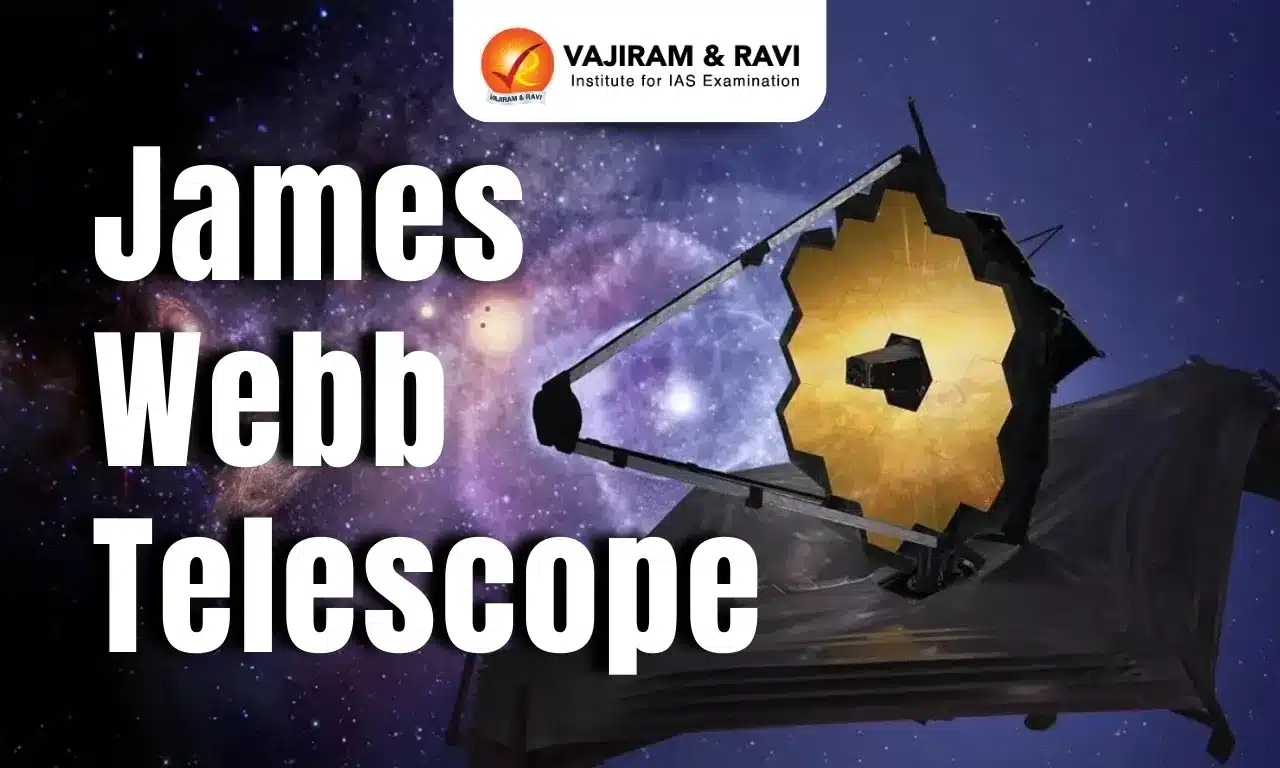
James Webb Space Telescope

James Webb Telescope

James Webb Space Telescope Latest News

Recently, the NASA James Webb Space Telescope (JWST) captured the weather of an exoplanet which is nearly 700 light-years away.

About James Webb Space Telescope

  • It was launched in December 2021.
  • It is the largest and most powerful space observatory built through collaboration between NASA, European Space Agency (ESA), and Canadian Space Agency (CSA).
  • JWST orbits the L2 Lagrange Point, about 1.5 million km beyond Earth, enabling a stable position for deep-space observation.
  • The telescope operates primarily in the infrared spectrum and is equipped with components such as:
    • Optical Telescope Element (OTE): It collects light from distant objects.
    • Integrated Science Instrument Module (ISIM): It houses all cameras and instruments.
    • Sunshield: It protects sensitive instruments from solar radiation.
    • Spacecraft Bus: It provides necessary operational support.

Objectives of James Webb Space Telescope

  • To look for galaxies that formed just after the Big Bang.
  • To determine the evolution of galaxies from their creation to the present.
  • To examine the stages of star creation till the formation of planetary systems.
  • To investigate the potential for life in planetary systems by measuring their physical and chemical features.

Source: TH

James Webb Space Telescope FAQs

Q1: What is the James Webb Space Telescope (JWST)?

Ans: JWST is an infrared space telescope; successor to Hubble

Q2: What is the orbit location of JWST?

Ans: Halo orbit around L2 for cold, stable observations

Enquire Now