Economic Advisory Council to the Prime Minister

Economic Advisory Council to the Prime Minister

Economic Advisory Council to the Prime Minister Latest News

Recently, the Prime Minister of India chaired a meeting of the Economic Advisory Council to the Prime Minister (EAC-PM). 

About Economic Advisory Council to the Prime Minister

  • It is an independent body constituted to give advice on economic and related issues to the Government of India, specifically to the Prime Minister.
  • The Terms of Reference of EAC-PM include:
    • Analysing any issue, economic or otherwise, referred to it by the Prime Minister and advising him thereon.
    • Addressing issues of macroeconomic importance and presenting views thereon to the Prime Minister.
    • These could be either suo-motu or on reference from the Prime Minister or anyone else.
    • Attending any other task as may be desired by the Prime Minister from time to time.
    • The role of EAC-PM is advisory in nature and not binding on the Government.
    • In addition to its advisory role, the EAC-PM also plays an important role in fostering greater economic understanding and awareness among the public.
  • Composition
    • EAC-PM is headed by a chairperson and consists of eminent economists as members.
    • It is supported in its functions by a team of officials and administrators.
    • There is no fixed definition of the exact number of members and staff of the EAC-PM.
    • For administrative, logistic, planning, and budgeting purposes, the NITI Aayog serves as the nodal agency for the EAC-PM.

Source: TH

Economic Advisory Council to the Prime Minister FAQs

Q1: What is the function of EAC-PM?

Ans: Advising the PM on macroeconomic issues

Q2: What is the rank of EAC-PM Chairman?

Ans: Cabinet Minister

Digital India BHASHINI Division

Digital India BHASHINI Division

Digital India BHASHINI Division Latest News

Recently, the Digital India BHASHINI Division (DIBD) has signed a Memorandum of Understanding (MoU) with Kathmandu University's Centre for Digital Public Infrastructure & Artificial Intelligence (DPI-AI), Nepal.

About Digital India BHASHINI Division

  • It is under Digital India Corporation (DIC), Ministry of Electronics and Information Technology (MeitY).
  • It is India’s national initiative for AI-driven multilingual digital inclusion and language technology.
  • Through the National Hub for Language Technology (NHLT), BHASHINI enables scalable speech and text-based AI services across Indian languages for governance, public platforms, and institutions.
  • DIBD also drives open-source innovation, multilingual AI research, dataset creation, startup enablement, and academic collaboration, strengthening India’s digital public infrastructure ecosystem.
  • A Bhashini Platform is making Artificial Intelligence (AI) and Natural Language Processing (NLP) resources available to MSMEs, Startups and Individual Innovators in the public domain. 
  • The platform powers over 800 government websites, processes more than 15 million inferences daily, and supports 36 Indian text languages, 23 Indian voice languages, and 35 international languages.

Source: PIB

Digital India BHASHINI Division FAQs

Q1: BHASHINI is under which ministry?

Ans: Digital India BHASHINI Division under MeitY

Q2: What does BHASHINI stands for?

Ans: BHASHa INterface for India

Slovenia

Slovenia

Slovenia Latest News

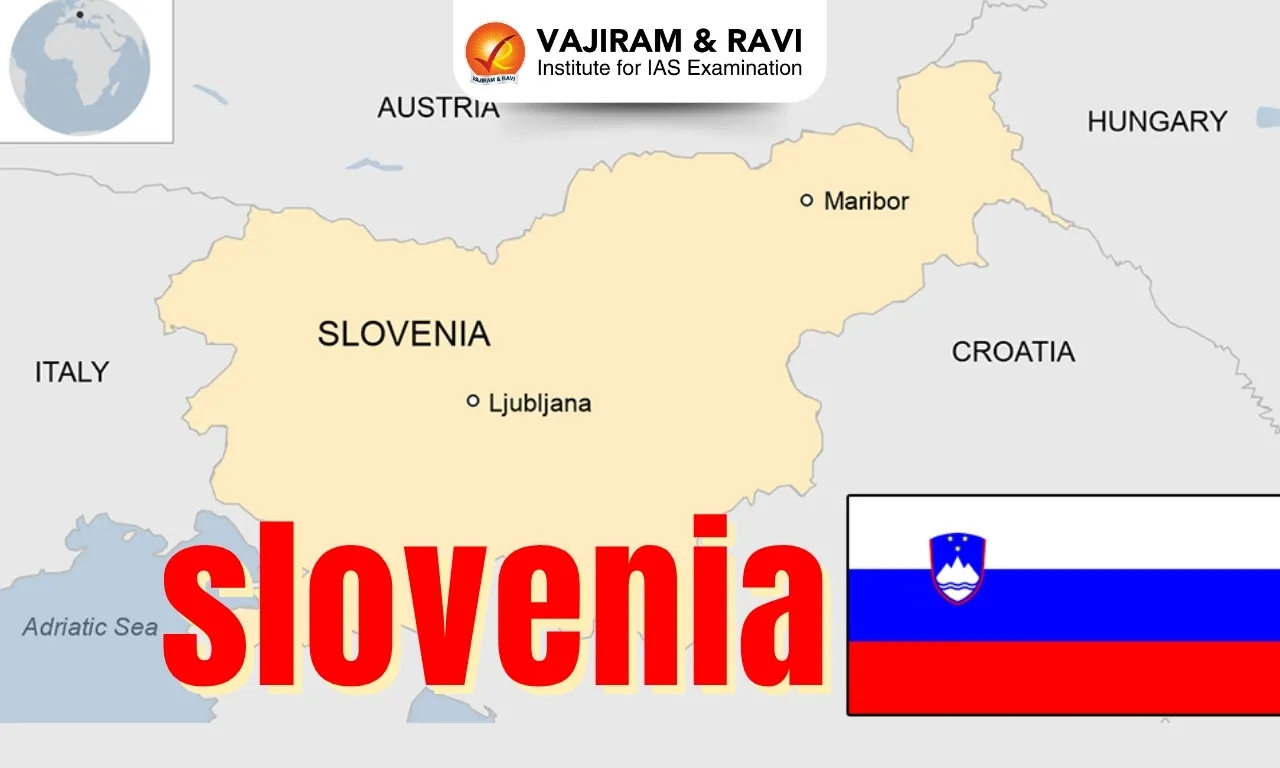
Recently, India’s External Affairs Minister congratulated the newly appointed Foreign Minister of Slovenia, Tone Kajzer, and expressed his desire to work together.

About Slovenia

  • Location: It is located in Central and South Eastern Europe.
  • Bordering Countries:  It is bordered by 4 countries: Austria in the north; Hungary in the northeast; Italy in the west; and Croatia in the southeast.
  • Maritime Border: It shares a small coastline along the Adriatic Sea in the South west.
  • Capital City: Ljubljana

Geographical Features of Slovenia

  • Terrain: Slovenia has a highly elevated terrain with over 40% of the country being mountainous.
  • It is made up of portions of four major European geographic landscapes—the European Alps, the karstic Dinaric Alps, the Pannonian and Danubian lowlands and hills, and the Mediterranean coast.
  • Climate:  Mediterranean climate on the coast, continental climate with mild to hot summers and cold winters in the plateaus and valleys to the east.
  • Highest point: Mount Triglav
  • Natural Resources: It consists of Lignite, lead, zinc, building stone, hydropower, forests
  • River: Major rivers include the Drava and Sava.

Source: News On Air

Slovenia FAQs

Q1: Which of these countries border Slovenia?

Ans: 4 neighbors: Italy, Austria, Hungary, Croatia

Q2: Slovenia shares a border with which sea?

Ans: Short coastline on Adriatic Sea

About Sea of Azov

Sea of Azov

About Sea of Azov Latest News

Recently, Ukraine said it has struck five ships carrying illegal cargo in the Sea of Azov.

About Sea of Azov

  • Location: It is bordered by Ukraine in the northwest and by Russia in the southeast.
  • It is connected to the Black Sea in the south via the Strait of Kerch.
  • The Kerch Strait is located between the Crimean Peninsula in the west and the Taman Peninsula in the east.
  • It is linked with the Atlantic Ocean via the Black Sea, the Sea of Marmara, the Aegean Sea, and the Mediterranean Sea.
  • Rivers: The Don and Kuban rivers contribute over 90% of freshwater inflow, reducing salinity and bringing nutrients.
  • Chief Ports: Taganrog in Russia, and Mariupol and Berdyans’k in Ukraine.
  • Coastal Features: The coastline is low and flat with extensive vegetation, lagoons like Syvash and long sand spits including Arabat, Fedotov and Berdyansk.
  • Climate Conditions: It has a continental climate with cold winters (-1 to -5°C, sometimes -30°C) and warm summers (23-25°C), with frequent storms and seasonal ice formation.

Source: BBC

Sea of Azov FAQs

Q1: Which major river flows into Sea of Azov?

Ans: Don River and KubanRiver

Q2: Sea of Azov is located between which two countries?

Ans: Between Russia and Ukraine

Kuno National Park

Kuno National Park

Kuno National Park Latest News

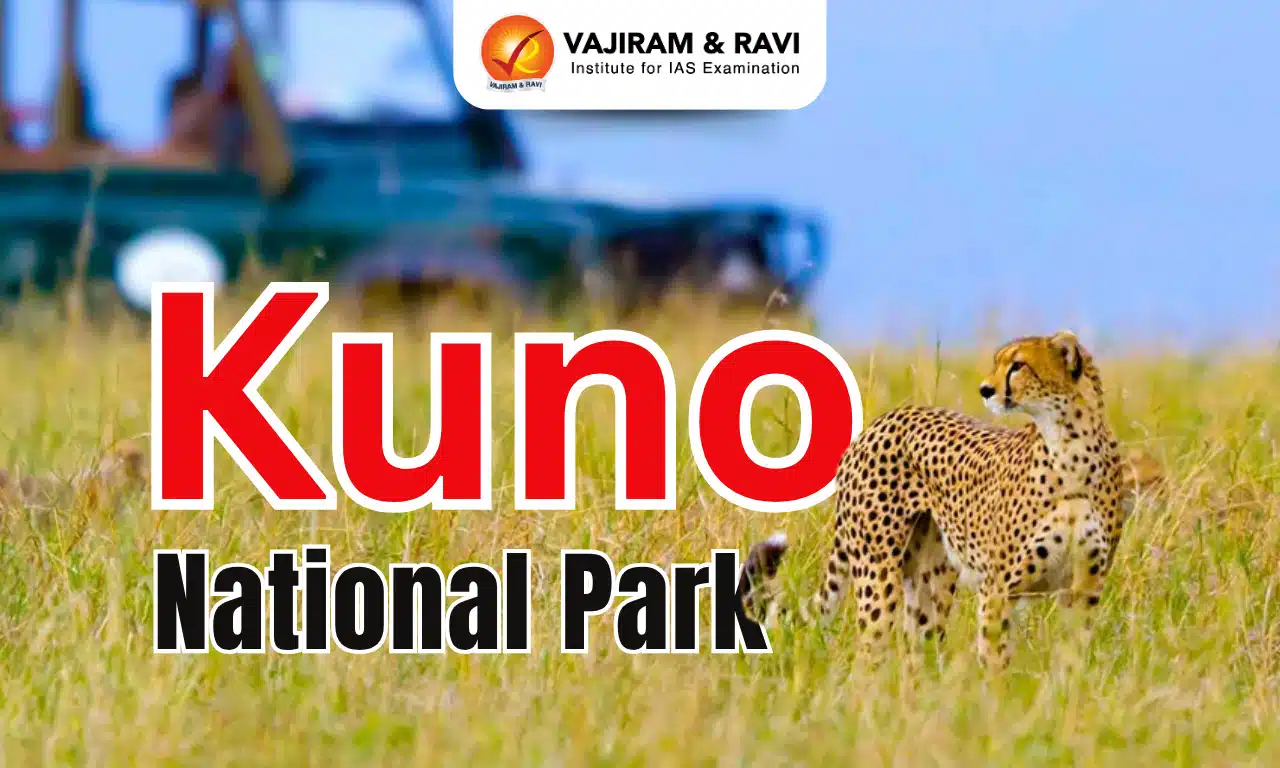
Recently, the elusive Caracal, often referred to as the “flying cat”, has been recorded at Madhya Pradesh’s Kuno National Park after decades.

About Kuno National Park

  • Location: It is located in the Sheopur district of Madhya Pradesh.
  • It derives its name from the meandering Kuno River (one of the main tributaries of the Chambal River), which flows from south to north and divides the park into two sections.
  • It is nestled near the Vindhyan Hills.
  • Originally established as Kuno Wildlife Sanctuary in 1981, it was upgraded to a national park in 2018.
  • Terrain: The park’s terrain is dotted with plateaus, valleys, and seasonal rivers, creating varied ecosystems.
  • Vegetation: The park boasts diverse vegetation, including tropical dry deciduous forests, savannah grasslands, and riverine forests.
  • Flora:  Dominant trees include Khair (Acacia catechu), Salai (Boswellia serrata), and Ber (Ziziphus mauritiana).
  • Fauna
    • The protected area of the forest is home to the jungle cat, Indian leopard, sloth bear, Indian wolf, striped hyena, golden jackal, Bengal fox, and dhole, along with more than 120 bird species.
    • It was selected under the ‘Action Plan for Introduction of Cheetah in India’.

Source: NIE

Kuno National Park FAQs

Q1: Kuno National Park is located in which state?

Ans: Madhya Pradesh

Q2: Kuno National Park is famous for which animal reintroduction project?

Ans: African Cheetah reintroduction, Project Cheetah 2022

Enquire Now