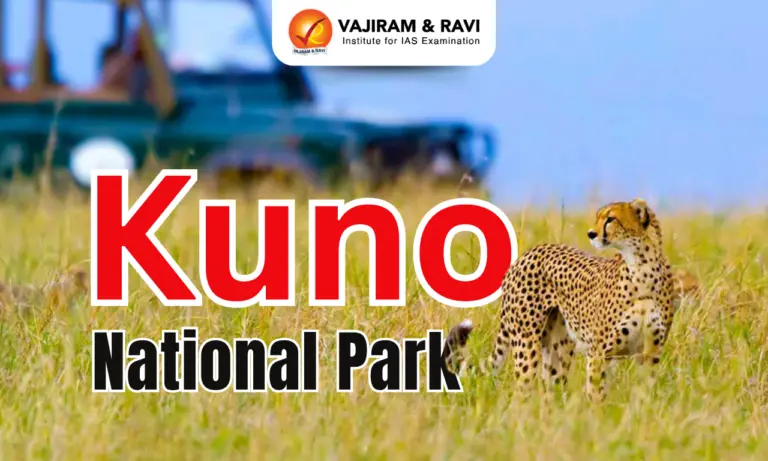
Kuno National Park, located in the Sheopur district of Madhya Pradesh, is one of India’s important wildlife conservation areas, known for its dry deciduous forests, grasslands and rich biodiversity. Spread across approximately 748.76 square kilometres, the park is home to leopards, sloth bears, deer, wolves and several bird species. It gained national and international attention in September 2022, when African cheetahs were reintroduced into India under Project Cheetah, more than 70 years after the species was declared extinct in the country.
Kuno National Park Latest News
- Cheetah KNG22 dies after being shot: The 19-month-old male cheetah, son of Nirva, was found injured on 25 October in Morena’s forests, just outside Kuno National Park. He was rescued the same day, operated on in Jabalpur, and five firearm pellets were removed, but he died on the morning of 27 October. It is the first reported cheetah shooting since Project Cheetah began in September 2022.
- Centre steps in with a high-level probe: The Environment Ministry has taken serious note of the death and sent a high-level team to investigate on the ground, examine the evidence and work with the Madhya Pradesh Forest Department so that strict and swift action follows.
- Madhya Pradesh forms a Special Task Force: The state has set up its own Special Task Force to find those responsible, a key step in protecting the cheetahs living in and around Kuno.
Kuno National Park Location
Kuno National Park is one of central India’s most important wildlife areas, and its location plays a big role in what makes it special.
- Location: Kuno National Park is situated in the Sheopur district of Madhya Pradesh, in central India. It lies in the Vindhyan hill region, close to Rajasthan, and forms part of a larger forest landscape known for its wildlife and natural vegetation.
- Area: The national park covers approximately 748.76 sq. km. Earlier, the Kuno Wildlife Sanctuary covered around 344 sq. km, but its area was expanded when it was upgraded to a national park in 2018.
- River system: The park is named after the Kuno River, a tributary of the Chambal River, which flows through the region. The river and its surrounding water sources support wildlife and vegetation throughout the park.


Kuno National Park History
Kuno National Park has a long and interesting past, from a protected sanctuary to the home of India’s cheetah comeback.
- Establishment in 1981: Kuno was originally established as the Kuno Wildlife Sanctuary in 1981 to protect the region’s forests, wildlife and natural habitats. It was earlier known as Kuno-Palpur Wildlife Sanctuary.
- Historical background: The Kuno region was once associated with the princely state of Gwalior. Its forests have a long history of wildlife conservation, particularly involving efforts to establish a population of Asiatic lions outside Gujarat.
- Asiatic Lion Reintroduction Project: Kuno was identified as a suitable location for introducing Asiatic lions from Gir National Park in Gujarat. The objective was to establish a second free-ranging population of Asiatic lions in India and reduce the risks associated with their concentration in a single region.
- National park status in 2018: On December 10, 2018, Kuno Wildlife Sanctuary was officially notified as Kuno National Park. Its protected area was expanded to approximately 748.76 sq. km to provide a larger and more secure habitat for wildlife.
- Selection for cheetah reintroduction: In 2009, Kuno was identified as a potential location for reintroducing cheetahs into India. After years of planning, Project Cheetah was launched on September 17, 2022, marking a major milestone in India’s wildlife conservation history.
Kuno National Park Geographical Features
Kuno National Park has a varied natural landscape that shapes its forests, wildlife and climate. Here is a quick look at the key features that define the park.
- Vindhyan landscape: Kuno National Park is located in the Vindhyan region of central India, characterised by hills, valleys, rocky terrain and forested areas. This varied landscape provides suitable habitats for different wildlife species.
- Dry deciduous forests: The park is mainly covered by tropical dry deciduous forests, where many trees shed their leaves during the dry season. These forests are adapted to the region’s seasonal rainfall and relatively dry climatic conditions.
- Grasslands and savannah habitat: Kuno also contains open grasslands, dry savannah forests and scrub vegetation. These habitats support herbivores such as deer and nilgai and provide important hunting grounds for large carnivores, particularly cheetahs.
- Kuno River: The Kuno River is an important geographical feature of the park. It flows through the landscape and provides water and riverine habitats for several animals, birds and reptiles.
- Climate: The region experiences hot summers, seasonal monsoon rainfall and relatively cool winters. The availability of vegetation and water changes with the seasons, influencing wildlife movement and habitat conditions.
Kuno National Park Flora & Fauna
Kuno National Park supports a rich variety of plant and animal species because of its combination of dry deciduous forests, grasslands, rivers and scrublands. Its diverse vegetation provides food, shelter and breeding habitats for several species.
Flora of Kuno National Park
- Vegetation: The park is dominated by dry deciduous forests, mixed woodlands, grasslands and scrub vegetation. These different habitats support a wide variety of plant species and maintain the park’s ecological balance.
- Major tree species: Important trees found in Kuno include Kardhai, Salai, Khair, Palash, Dhok and Tendu. Other species, such as Kachnar and Kadam, also contribute to the vegetation of the region.
- Plant diversity: According to Madhya Pradesh Tourism, the park supports approximately 123 tree species, 71 shrub species, 32 exotic and climbing plant species, and 34 bamboo and grass species, reflecting its rich floral diversity.
- Kardhai trees: The Kardhai tree is particularly associated with Kuno’s forests. It is known for becoming green with increasing atmospheric moisture, sometimes even before the arrival of monsoon rainfall.
- Grassland vegetation: The grasslands provide grazing areas for chital, nilgai and other herbivores. These open habitats are especially important for maintaining the prey population needed by cheetahs and other carnivores.
Fauna of Kuno National Park
- Major carnivores: Apart from reintroduced African cheetahs, Kuno is home to Indian leopards, sloth bears, striped hyenas, Indian wolves, golden jackals and jungle cats. These predators play an important role in maintaining ecological balance.
- Herbivorous animals: The park supports species such as chital (spotted deer), sambar, nilgai (blue bull), blackbuck, four-horned antelope and wild boar. These animals form an important prey base for large carnivores.
- Bird diversity: Kuno is home to several bird species, including the Indian peafowl, painted spurfowl, grey francolin, black-shouldered kite and ruddy shelduck. Its forests and water bodies provide feeding and nesting habitats for resident and migratory birds.
- Reptiles and other wildlife: The park’s wider ecosystem also supports reptiles such as mugger crocodiles, gharials, Bengal monitor lizards and turtles, along with smaller mammals and other wildlife species.
Kuno National Park and the Cheetah Reintroduction Project
Kuno National Park is the heart of Project Cheetah, India’s bold effort to bring back a lost big cat.
- Kuno National Park is now home to about 57 cheetahs: After the Indian-born female KJP21 gave birth to five cubs, India’s total cheetah population rose to 60, including 41 Indian-born cheetahs. Of these, three live in Gandhi Sagar Sanctuary, which leaves roughly 57 cheetahs in Kuno National Park.
- Project Cheetah: Kuno National Park became the main site for Project Cheetah, an ambitious wildlife conservation initiative launched by the Government of India to reintroduce cheetahs into the country after their local extinction.
- Extinction of cheetahs in India: The Asiatic cheetah was officially declared extinct in India in 1952, mainly due to hunting, habitat loss and declining prey populations. Its reintroduction after more than seven decades represents an important effort to restore a lost large carnivore.
- First cheetah release in 2022: On September 17, 2022, eight African cheetahs from Namibia, including five females and three males, were brought to Kuno National Park and released into quarantine enclosures as part of the first phase of the project.
- Second cheetah release in 2023: On February 18, 2023, another 12 cheetahs from South Africa, comprising seven males and five females, were introduced into Kuno. This increased the initial number of translocated cheetahs to 20.
- Objectives of the project: The initiative aims to establish a viable cheetah population in India, restore grassland ecosystems and strengthen biodiversity conservation. It also seeks to improve the management of prey species and their natural habitats.
- International conservation initiative: Project Cheetah is recognised as a major intercontinental large carnivore translocation initiative, involving cooperation between India, Namibia and South Africa.
- Conservation challenges: The project faces challenges such as ensuring cheetah survival and successful breeding, maintaining sufficient prey populations, managing habitats and reducing human-wildlife conflict in surrounding areas.
Kuno National Park Significance
Kuno National Park matters far beyond its borders, for its wildlife, its habitats and the future of conservation in India.
- Wildlife conservation: Kuno National Park plays an important role in protecting central India’s wildlife and biodiversity. Its forests, grasslands and river habitats support a wide range of animals and plants.
- Restoration of cheetahs: The park gained international importance through Project Cheetah, which marked the return of cheetahs to India after more than 70 years and opened new opportunities for wildlife restoration.
- Grassland ecosystem protection: Kuno highlights the importance of conserving grasslands and semi-arid ecosystems, which support numerous herbivores, carnivores and other species but have often received less conservation attention than forests.
- Asiatic lion conservation: Kuno has also been identified as a potential site for establishing a second population of Asiatic lions outside Gir, making it an important landscape for long-term big-cat conservation planning.
- Ecological connectivity: The national park forms part of a larger central Indian forest landscape connected with Rajasthan, helping maintain wildlife habitats and supporting ecological connectivity across the region.
- Wildlife tourism: Kuno has gained popularity as a wildlife tourism destination in Madhya Pradesh, particularly following the cheetah reintroduction project. Responsible tourism can create livelihood opportunities for local communities while encouraging conservation awareness.
- Scientific research and conservation: The park provides opportunities for studying cheetah adaptation, wildlife behaviour, habitat restoration and human-wildlife interactions. Lessons from these efforts can support future wildlife conservation programmes in India.

 Last updated on Nov, 2026
→ UPSC 2027 Notification will be released on 13 January 2027 at upsconline.nic.in.
→ Check Nobel Prize 2026 Winners List here.
→ Download PIB PRiSM Monthly Magazine 2026 here.
→ Check UPSC Monthly Current Affairs Magazine The Recitals here.
→ Check out the latest UPSC Syllabus here.
→ Download UPSC Model Answers for Mains 2026
→ UPSC Mains Question Paper 2026 is out now for Essay & GS Paper 1, 2, 3 & 4.
→ UPSC Calendar 2027 has been released.
→ Enroll in Vajiram & Ravi’s UPSC Mains Test Series 2027 for structured answer writing practice, expert evaluation, and exam-oriented feedback.
→ Join Vajiram & Ravi’s UPSC Mentorship Program 2027 for personalized guidance, strategy planning, and one-to-one support from experienced mentors.
→ Go through the UPSC Mains Previous Year Papers to enhance your preparation.
→ UPSC has released UPSC Toppers List 2025 with the Civil Services final result on its official website.
→ Also check Best UPSC Coaching in India
Kuno National Park FAQs
Q1. Where is Kuno National Park located?+
Q2. What is Kuno National Park famous for?+
Q3. What is the total area of Kuno National Park?+
Q4. Which animals are found in Kuno National Park?+
Q5. What are the major flora species found in Kuno National Park?+
Q6. When were cheetahs reintroduced into Kuno National Park?+
Tags: kuno national park