Pradhan Mantri Surakshit Matritva Abhiyaan

Pradhan Mantri Surakshit Matritva Abhiyaan

Pradhan Mantri Surakshit Matritva Abhiyaan Latest News

The Union Health and Family Welfare Ministry will launch nationwide celebrations to commemorate ten years of successful implementation of the Pradhan Mantri Surakshit Matritva Abhiyan.

About Pradhan Mantri Surakshit Matritva Abhiyaan

  • It was launched on June 9, 2016 by the Ministry of Health & Family Welfare (MoHFW).
  • It aims to ensure early risk detection, timely medical intervention, and safer pregnancies for every woman in India, regardless of where she lives.

Key Features of Pradhan Mantri Surakshit Matritva Abhiyaan 

  • It provides free, comprehensive antenatal care to pregnant women — particularly those in their second and third trimesters — at designated government health facilities on the 9th of every month.
  • Minimum one comprehensive and quality antenatal checkup by Obstetrician & Gynaecologist or Comprehensive Emergency Obstetric and Newborn Care (CEmONC).
  • Comprehensive Emergency Obstetric and Newborn Care (CEmONC) / Basic Emergency Obstetric and Newborn Care (BEmONC) trained doctor during the second or third trimester.
  • Mobilizing the pregnant women for specialist Antenatal care services at designated public health facilities.
  • High Risk Pregnancy (HRP) identification by screening for 25 high risk factors and management at an early stage.
  • Linking of HRPs to the nearest first referral unit (FRU) for a safe delivery.
  • Empanelment of private service providers for PMSMA service provision.
  • High-risk pregnancy cases receive priority attention and follow-up care.
  • Women who are dropouts from regular antenatal care are actively encouraged to participate.

Source: News On Air

Pradhan Mantri Surakshit Matritva Abhiyaan FAQs

Q1: Pradhan Mantri Surakshit Matritva Abhiyan was launched in which year?

Ans: Launched on 9th June 2016

Q2: Under PMSMA, free antenatal check-ups are provided on which day of every month?

Ans: 9th of every month at public health facilities

Wangchhu Hydroelectric Project

Wangchhu Hydroelectric Project

Wangchhu Hydroelectric Project Latest News

Hindustan Construction Company (HCC) recently secured a contract worth Rs 127 crore from Wangchhu Hydroelectric Power (WHPL), Bhutan, for construction works related to the Wangchhu Hydroelectric Project.

About Wangchhu Hydroelectric Project

  • It is a 570 MW run-of-river hydropower project being built on the Wangchu River/basin in Chukha District, Bhutan
    • The Wangchu River (also called Raidāk River in India) is a significant tributary of the Brahmaputra River.
  • It is being developed by Wangchhu Hydroelectric Power Limited (WHPL), a joint venture company formed by India’s Adani Power Limited (APL) and Bhutan’s state-owned Druk Green Power Corporation Ltd (DGPC).
  • DGPC holds a controlling 51% stake in the venture, with Adani Power owning the remaining 49%. 
  • The project, valued at Rs 6,000 crore, will follow a Build, Own, Operate, Transfer (BOOT) model.  
  • Under the BOOT framework, Adani Power will construct, operate, and manage the project for a fixed period before transferring ownership to the Bhutanese government.  
  • It is the first initiative under a Memorandum of Understanding (MoU) signed in May 2025 between Adani Power and DGPC to jointly develop 5,000 MW of hydropower capacity in Bhutan.  
  • The facility will function as a peaking run-of-river plant, helping Bhutan manage seasonal fluctuations in hydropower generation.
  • The facility will feature four turbines, each rated at 142.5 MW, producing roughly 2,478.93 GWh annually.
  • It is designed to meet Bhutan’s peak winter electricity demand while exporting surplus power to India during the summer months.

Source: BS

Wangchhu Hydroelectric Project FAQs

Q1: Where is the Wangchhu Hydroelectric Project located?

Ans: It is being built on the Wangchu River/basin in Chukha District, Bhutan.

Q2: What is the installed capacity of the Wangchhu Hydroelectric Project?

Ans: 570 MW.

Q3: What type of hydropower project is the Wangchhu Hydroelectric Project?

Ans: A run-of-river hydropower project.

Q4: The Wangchu River is a tributary of which major river?

Ans: The Brahmaputra River.

Maharaja Chhatrasal

Maharaja Chhatrasal

Maharaja Chhatrasal Latest News

Underway at the Madhya Pradesh Tribal Museum at Shyamal Hills in Bhopal, the second day of Mahua Festival carried a theme steeped in local legend: the life of Maharaja Chhatrasal.

About Maharaja Chhatrasal

  • Maharaja Chhatrasal (4 May 1649 – 19 December 1731) was a medieval Indian warrior who fought against the Mughal Emperor Aurangzeb and established his own kingdom in Bundelkhand.
  • He belonged to the Bundela clan of Rajputs, born under Mughal supremacy but died as an independent king of an independent kingdom.  
  • His father had raised the banner for freedom a generation earlier but was killed in battle with the Mughals after killing the favourite of the emperor, Abu Fazl. 
  • Maharaja Chhatrasal started a revolt at the age of 22 and formed a kingdom of his own at the age of 26 against Mughal dominance.  
  • During the first ten years of his revolt, he conquered a large tract of land between Chitrakoot and Panna on the east and Gwalior on the west. 
  • His victory march continued as far as Malwa, Punjab, Rajasthan, establishing the Bundela kingdom.  
  • Some of the Mughal generals who were defeated by him were Rohilla Khan, Kaliq, Munawwar Khan, Sadruddin, Sheikh Anwar, Sayyid Latif, Bahlol Khan and Abdus Ahmed. 
  • Alliance with the Marathas:
    • In 1729, Chhatrasal sought help from Peshwa Baji Rao I against the Mughal commander Muhammad Khan Bangash.
    • Baji Rao I defeated Bangash and helped Chhatrasal retain his kingdom.
    • In gratitude, Chhatrasal granted a portion of his territory to the Marathas, strengthening Maratha influence in central India.
    • Chhatrasal also gave his daughter Mastani as a bride to Baji Rao I. 
  • He was not only a great warrior but an able administrator too; his governance ensured his kingdom would always have a full treasury. 
  • Highly respected for his sense of honour and love for his people, he was given the title of 'Maharaja' by Sant Prannath.

Source: TOI

Maharaja Chhatrasal FAQs

Q1: Who was Maharaja Chhatrasal?

Ans: A medieval Indian warrior who fought against Mughal Emperor Aurangzeb and established an independent kingdom in Bundelkhand.

Q2: Where did Maharaja Chhatrasal establish his independent kingdom?

Ans: Bundelkhand.

Q3: Who was Maharaja Chhatrasal's father?

Ans: Champat Rai.

Q4: Against which Mughal commander did Chhatrasal seek Maratha assistance?

Ans: Muhammad Khan Bangash.

Q5: Why is Maharaja Chhatrasal remembered in Indian history?

Ans: For successfully resisting Mughal domination and establishing an independent Bundela kingdom in Bundelkhand.

Bovista colorata

Bovista colorata

Bovista colorata Latest News

Researchers recently documented a rare bright yellow puffball mushroom named Bovista colorata in Arunachal Pradesh’s Longding district.

About Bovista colorata

  • Bovista colorata, commonly known as the yellow puffball mushroom, is a species of puffball fungus belonging to the family Agaricaceae. 
  • It is generally found in grasslands, open fields, meadows, and disturbed soils. 
  • Bovista colorata has a spherical shape and striking yellow fruiting body. 
  • Unlike conventional mushrooms that produce spores through gills beneath a cap, puffball fungi develop spores inside a closed spherical fruiting body. 
    • As the mushroom matures, the internal tissue transforms into a fine powdery mass of spores, which are dispersed through wind, raindrops, or physical disturbance, allowing the species to spread over considerable distances. 
    • Puffball species play an important ecological role as decomposers, aiding nutrient recycling, carbon cycling and soil formation. 
    • Some species are also known for their nutritional value and bioactive compounds with potential medicinal properties.

Source: IT

Bovista colorata FAQs

Q1: What is Bovista colorata commonly known as?

Ans: The yellow puffball mushroom.

Q2: Where is Bovista colorata generally found?

Ans: In grasslands, open fields, meadows, and disturbed soils.

Q3: How does Bovista colorata differ from conventional mushrooms in spore production?

Ans: It develops spores inside a closed spherical fruiting body rather than on gills beneath a cap.

Q4: Where are the spores of puffball fungi produced?

Ans: Inside a closed spherical fruiting body.

Aurora Borealis

Aurora Borealis

Aurora Borealis Latest News

Recently, ‘Aurora Borealis’, more popularly called ‘northern lights’ was expected to be visible in India. 

About Aurora Borealis

  • It is popularly called ‘northern lights’.
  • The phenomenon is called ‘northern lights’ because they are concentrated around the North Pole or the magnetic pole in Earth’s northern hemisphere.
  • They are frequently seen in Norway, Sweden, Finland, Iceland, Canada, Alaska, and Greenland. 
  • Aurora Borealis’ is the scientific name for these lights in the night sky in the northern hemisphere.
  • The ones in the southern hemisphere are called ‘Aurora Australis’ or ‘southern lights.

Formation of Auroras

  • It is due to activity on the surface of the Sun.
  • The star continuously releases a stream of charged particles, mainly electrons and protons, and magnetic fields called the solar wind.
  • As the solar wind approaches the Earth, it is deflected by the planet’s magnetic field, which acts like a protective shield.
  • However, some of the charged particles are trapped in the magnetic field and they travel down the magnetic field lines at the north and south poles into the upper atmosphere of the Earth.
  • These particles then interact with different gases present there, resulting in tiny flashes that light up the night sky.
  • When solar wind particles collide with oxygen, a green colour light is produced. Interaction with nitrogen produces shades of blue and purple.
  • Auroras expand to midlatitudes when the solar wind is extremely strong.
    • This happens when the activity on the Sun’s surface goes up, leading to solar flares and coronal mass ejections (CMEs), which are essentially extra bursts of energy in the solar wind.
    • In such cases, the solar wind is so intense that it can result in a geomagnetic storm, also known as a magnetic storm — a temporary disturbance of the Earth’s magnetic field. 

Source: TH

Aurora Borealis FAQs

Q1: In which atmospheric layer are auroras formed?

Ans: Thermosphere/Ionosphere

Q2: Which gas produces green color in Aurora Borealis?

Ans: Oxygen

Gallantry Awards

What are Gallantry Awards?

Gallantry Awards Latest News

Recently, the President of India conferred Gallantry Awards to the personnel of the Armed Forces, Central Armed Police Forces, and State and Union Territory Police during the Defence Investiture Ceremony at Rashtrapati Bhawan.

About Gallantry Awards

  • It recognises acts of exceptional bravery, courage and devotion to duty by the Armed Forces and security personnel.
  • Ministry: The Ministry of Defence seeks recommendations twice annually from the Armed Forces and the Ministry of Home Affairs for Gallantry Awards in India.
  • These gallantry awards are announced twice in a year - first on the occasion of the Republic Day and then on the occasion of the Independence Day.
  • History of Gallantry Awards
    • Three gallantry awards, namely Param Vir Chakra, Maha Vir Chakra and Vir Chakra, were instituted by the Government of India on 26th January, 1950.
    • Thereafter, the other three gallantry awards, i.e. the Ashoka Chakra Class-I, the Ashoka Chakra Class-II and the Ashoka Chakra Class-III were instituted in 1952.
    • These were later renamed in January 1967 as Ashoka Chakra, Kirti Chakra, and Shaurya Chakra, respectively.
  • Order of precedence: The order of precedence of these awards is the Param Vir Chakra, the Ashoka Chakra, the Mahavir Chakra, the Kirti Chakra, the Vir Chakra and the Shaurya Chakra.
  • These awards are divided into two main categories based on whether the act of bravery occurs in the presence of the enemy or in peacetime situations.
    • Wartime Gallantry Awards: Param Vir Chakra, Maha Vir Chakra, and Vir Chakra
    • Peacetime Gallantry Awards: Ashoka Chakra, Kirti Chakra, and Shaurya Chakra are awarded for courageous actions during peacetime.

Source: News On Air

Gallantry Awards FAQs

Q1: Which is the highest peacetime gallantry award in India?

Ans: Ashoka Chakra for peacetime

Q2: What is the minimum age to receive a gallantry award?

Ans: There is no age bar.

Food Safety and Standards Authority of India

Food Safety and Standards Authority of India

Food Safety and Standards Authority of India Latest News

Recently, the Food Safety and Standards Authority of India (FSSAI) has directed all food business operators to immediately discontinue the use of newspapers for packing or serving food items, citing serious health risks.

About Food Safety and Standards Authority of India

  • It is a statutory institution formed by the Ministry of Health and Family welfare, Government of India under the Food Safety and Standards Act, 2006.
  • Mandate: FSSAI is responsible for setting food standards, regulating the manufacture, storage, distribution, sale, and import of food, and ensuring the availability of safe and wholesome food for human consumption.

Functions of Food Safety and Standards Authority of India

  • Standards Development: It formulates standards for various food products, ensuring they are safe for consumption.
  • Food Safety Management Systems: It provides guidelines for businesses to implement effective food safety management practices.
  • Licensing and Registration: FSSAI manages the licensing process for food businesses, ensuring they comply with food safety regulations.
  • Surveillance and Monitoring: Regular inspections and audits are conducted to assess compliance with food safety standards.
  • Consumer Awareness: Initiatives to educate the public about food safety, hygiene, and nutrition are a key focus area.
  • Accreditation: The FSSAI is also responsible for the accreditation of food testing laboratories throughout India.

Source: News On Air

Food Safety and Standards Authority of India FAQs

Q1: Which index is released by FSSAI to measure states' performance on food safety?

Ans: State Food Safety Index, released annually since 2019

Q2: FSSAI functions under which ministry?

Ans: Ministry of Health and Family welfare

Japan

Japan

Japan Latest News

Recently, India and Japan reviewed outcomes of recent high-level exchanges and senior-level talks while discussing measures to further strengthen bilateral ties.

About Japan

  • Location: It is an island nation in East Asia, situated in the Northwestern Pacific Ocean.
  • Maritime borders: It is bordered by the Pacific Ocean (East), Sea of Okhotsk (North), Sea of Japan (West East) and East China Sea (Southwest).
  • Capital City: Tokyo.

Geographical Features of Japan

  • It comprises a chain of islands stretching ~1,500 miles in a northeast–southwest arc.
  • Terrain: Over 80% mountainous, with rugged terrain.
  • Main Islands (north to south): Hokkaido, Honshu, Shikoku, and Kyushu.
  • Climate: It ranges from subarctic in the north to humid subtropical in the south.
  • Volcanic activity: It is located on the Pacific Ring of Fire – a major zone of earthquakes and active volcanoes.
  • Highest peak: Mount Fuji (3,776 m), which is a stratovolcano.
  • Major mountain ranges: Japanese Alps.
  • Major rivers: Shinano River (longest), Tone River, Kiso River.
  • Natural Resources: It mainly consists of Coal, iron ore, zinc, lead, copper, sulfur, gold, and silver

Source: DD News

Japan FAQs

Q1: Japan is located on which tectonic boundary?

Ans: Pacific Ring of Fire, hence frequent earthquakes & volcanoes

Q2: India-Japan civil nuclear deal was signed in which year?

Ans: Signed in November 2016

Shiveluch Volcano

Shiveluch Volcano

Shiveluch Volcano Latest News

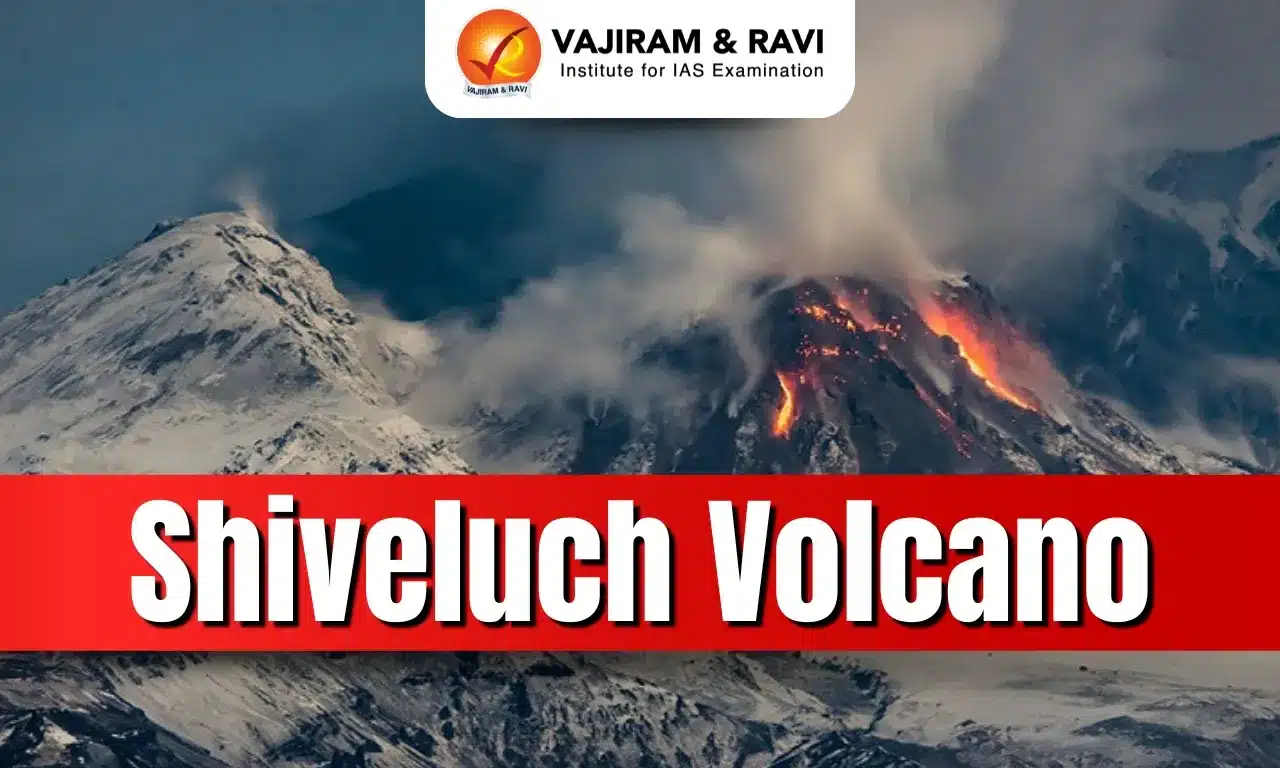
The Shiveluch Volcano in Russia's Far East erupted recently, sending ash plumes 10 km into the air and triggering red-level aviation alerts for the area.

About Shiveluch Volcano

  • It is one of the largest and most active volcanoes located on Russia’s Kamchatka Peninsula, one of the most intense volcanic regions in the world.
  • It’s estimated to be between 60,000-70,000 years old.
  • It is a stratovolcano—a steep-sloped volcano composed of alternating layers of solidified ash, hardened lava, and volcanic rocks.
  • It sports a summit reaching 3,283 meters (10,771 feet).
  • The summit is truncated by a broad 9-km-wide caldera. The lava dome complex was constructed within the large open caldera. 
  • Many lava domes occur on the outer flanks.  
  • Frequent collapses of the dome complex have produced debris avalanches; the resulting deposits cover much of the caldera floor. 
  • It has had more major eruptions than any other volcano in our current period of geologic time,  with an estimated 60 substantial eruptions in the past 10,000 years.
  • The volcano has been continuously erupting since August 1999, but occasionally undergoes powerful explosive events.
  • It has been spewing ash and steam intermittently—with occasional dome collapses, pyroclastic flows, and lava flows, as well—for the past decade.

Source: IS

Shiveluch Volcano FAQs

Q1: Where is the Shiveluch Volcano located?

Ans: On Russia’s Kamchatka Peninsula.

Q2: What type of volcano is Shiveluch?

Ans: A stratovolcano.

Q3: Why is Shiveluch considered one of the most active volcanoes?

Ans: It has had more major eruptions than any other volcano in the current geologic period.

Q4: Is Shiveluch known for frequent dome collapses?

Ans: es, frequent dome collapses are a characteristic feature of the volcano.

Enquire Now