ASPIRE Scheme

ASPIRE Scheme

ASPIRE Scheme Latest News

India’s ASPIRE scheme is helping transform rural livelihoods by supporting aspiring entrepreneurs with training, incubation and business development assistance. 

About ASPIRE Scheme

  • ASPIRE (A Scheme for Promotion of Innovation, Rural Industries and Entrepreneurship) scheme was launched in 2015.
  • It promotes entrepreneurship and employment generation, particularly in rural and agro-based sectors.
  • It provides financial, technical, and mentoring support to entrepreneurs through incubation centres and cluster-based development.
  • Nodal Ministry: Ministry of Micro, Small & Medium Enterprises 

ASPIRE Scheme Features

  • It promotes rural entrepreneurship and innovation through incubation support.
  • It focuses on establishing Livelihood Business Incubators (LBIs) in rural and underserved areas.
  • It encourages the development of agro-based and rural enterprises with high employment potential.
  • It supports Technology Business Incubators (TBIs) to promote innovation and technology-driven start-ups.
  • It provides financial assistance for setting up incubators through capital grants.
  • It offers grant support up to ₹1 crore for Government and PSU incubators.
  • It provides grant support up to ₹75 lakh for private or PPP incubators.
  • It provides one-time financial support up to ₹1 crore for operational expenses of incubators.
  • It offers seed capital and risk funding support for early-stage innovators and start-ups.
  • It strengthens enterprise clusters to improve productivity and market access.

Eligibility for ASPIRE Scheme

  • It is open to Government institutions, Public Sector Undertakings (PSUs), and private or PPP organizations for establishing incubators.
  • It is available to MSMEs with valid Entrepreneurs Memorandum (EM) registration.
  • It supports individual innovators and entrepreneurs through incubation and mentoring services.
  • It gives priority to start-ups working in agro-based, rural, and technology-driven sectors.
  • It requires institutions to have adequate infrastructure and technical capability for incubation activities.

Source: PIB

ASPIRE Scheme FAQs

Q1: What does ASPIRE stand for?

Ans: A Scheme for Promotion of Innovation, Rural Industries and Entrepreneurship – launched 2015 by Ministry of MSME

Q2: What is the main objective of ASPIRE?

Ans: Promote entrepreneurship & employment in rural & agro-based sectors + strengthen MSME competitiveness via innovation

Rewa Sundarja Mango

Rewa Sundarja Mango

Rewa Sundarja Mango Latest News

Recently, the Agricultural and Processed Food Products Export Development Authority (APEDA) has facilitated the first commercial export of Rewa Sundarja Mangoes from Madhya Pradesh to the United Arab Emirates (UAE). 

About  Rewa Sundarja Mango

  • It is a highly esteemed variety of mango cultivated in Madhya Pradesh.
  • It is known for ripening only after the first monsoon showers.
  • It received the Geographical Indication tag in 2023.

Features of  Rewa Sundarja Mango

  • Its vibrant yellow flesh is fibreless and smooth, providing a rich, creamy texture.
  • The distinct vanilla-like aroma enhances its taste, making it ideal for both fresh consumption and culinary preparations.
  • It has a balanced sugar-acid ratio, contributing to its unique flavour profile.
  • It has thick peel and has excellent shelf life, ensuring suitability for transportation.
  • Its lower sugar content makes it suitable for diabetic patients while still retaining its natural sweetness.
  • It is known for its exceptional sweetness, rich aroma, fibreless pulp and distinctive flavour.

Key Facts about APEDA

  • It is a statutory body established by the Government of India under the Agricultural and Processed Food Products Export Development Authority Act in December, 1985.
  • Nodal Ministry: It works under the Ministry of Commerce and Industry.
  • Objective: To develop and promote the export of scheduled products.
  • APEDA is headed by a Chairman appointed by the Central Government.
  • Headquarters: New Delhi.

Source: PIB

Rewa Sundarja Mango FAQs

Q1: What is Rewa Sundarja Mango?

Ans: GI-tagged mango from Rewa, Madhya Pradesh – fiber-free, sweet aroma; grown mainly in Govindgarh

Q2: When did Sundarja Mango get GI tag?

Ans: GI tag in 2023

Corporate Mitra Scheme

Corporate Mitra Scheme

Corporate Mitra Scheme Latest News

The Corporate Mitra scheme will commence with 2,000 participants, including 200 people from the North East region, according to the Corporate Affairs Ministry. 

About Corporate Mitra Scheme

  • It was announced in the Union Budget 2026-27. 
  • It aims to empower India’s Micro, Small, and Medium Enterprises (MSMEs) through trained and certified paraprofessionals called Corporate Mitras, who will serve the MSMEs. 
  • Corporate Mitras will provide affordable and accessible support in areas such as regulatory compliance, GST, accounting, financial guidance, cost accounting, and secretarial services.
  • This ensures that MSMEs can focus on innovation and growth while meeting the regulatory compliance requirements with ease. 
  • To ensure reach beyond metropolitan hubs, Corporate Mitras will primarily operate in Tier-II and Tier-III cities.
  • The scheme shall be implemented in collaboration with following Professional Institutes (PIs):  
    • The Institute of Chartered Accountants of India (ICAI).
    • The Institute of Company Secretaries of India (ICSI).  
    • The Institute of Cost Accountants of India (ICoAI). 
  • Through this scheme, youth will undergo a 6-month Academic Course and 6 months of On-the-Job training providing exposure to real-life business environments and employment opportunities. 
    • Academic Course will consist of 144 hours of online structured learning and 6 hours webinar/ physical learning). 
  • Eligibility Criteria for Candidates: 
    • Age Limit: Candidates must be up to 30 years.
    • Education Qualification: 
      • Graduates from any recognized university or 
      • Students currently in their final year of graduation (will be provided Corporate Mitra Certificate only after completing graduation successfully). 
  • The PIs will recognize and award the best-performing candidates/recognized firms/LLP for engaging Corporate Mitra for On-Job training. 
  • The candidates will be free to select any professional firm/ LLP recognized as “member in practice” by the PIs for On-job training.
  • A minimum prescribed stipend as per ICAI/ICSI/ICoAI norms will be paid by the professional firms/LLP offering on-job training. 
  • The scheme will be implemented through the online Swayam Plus portal. 
    • The Portal will serve as a centralized platform for end-to-end implementation of the Corporate Mitra Scheme.

News: ET

Corporate Mitra Scheme FAQs

Q1: What is the main objective of the Corporate Mitra Scheme?

Ans: To empower India's Micro, Small, and Medium Enterprises (MSMEs) through trained and certified paraprofessionals called Corporate Mitras.

Q2: Who are Corporate Mitras?

Ans: Trained and certified paraprofessionals who provide professional support services to MSMEs.

Q3: What type of support will Corporate Mitras provide to MSMEs?

Ans: Support in regulatory compliance, GST, accounting, financial guidance, cost accounting, and secretarial services.

Q4: What is the duration of the training under the Corporate Mitra Scheme?

Ans: 6-month Academic Course and 6 months of On-the-Job training.

Q5: Which firms are eligible to provide on-the-job training under the scheme?

Ans: Professional firms or LLPs recognized as "member in practice" by the Professional Institutes.

PM RAHAT Scheme

PM RAHAT Scheme

PM-RAHAT Scheme Latest News

The requirement for facial identification of an accident victim to claim relief under the PM RAHAT Scheme has been removed, informed Dakshina Kannada District Health and Family Welfare Officer (DHO) recently.

About PM-RAHAT Scheme

  • PM RAHAT (Road Accident Victim Hospitalization and Assured Treatment) is a Central Sector Scheme under the Ministry of Road Transport and Highways (MoRTH).
  • Under the Scheme, every eligible road accident victim on any category of road will be entitled to cashless treatment up to ₹1.5 lakh per victim for a period of seven days from the date of accident. 
  • This statutory scheme will take precedence over any other Central or State-level schemes. 

Salient Features of the Scheme

  • Every road accident victim shall be provided with stabilization treatment for up to 24 hours in non-life-threatening cases and up to 48 hours in life-threatening cases at designated hospitals, subject to police response. 
  • It has been successfully implemented through the amalgamation of two existing platforms. 
    • eDAR (Electronic Detailed Accident Report) used by police officials for reporting accidents
    • TMS 2.0 (Transaction Management System) of the National Health Authority (NHA), used by hospitals for treatment, claim submissions, and processing of payments. 
  • While initiating the treatment, police authentication of the victim will have to be initiated on the TMS platform. 
  • The hospital would generate the treatment ID(s) on TMS and push them to the district police through eDAR. 
  • The time available with police for responding on eDAR shall be up to 24 hours, or 48 hours in life-threatening situations, as decided by the hospital administrator. 
  • It will be integrated with the Emergency Response Support System (ERSS) 112, enabling victims, Good Samaritans to dial 112 to locate the nearest designated hospital and request ambulance assistance.
  • Reimbursements to hospitals will be made through the Motor Vehicle Accident Fund (MVAF).
    • In cases where the offending vehicle is insured, payment will be drawn from contributions made by general insurance companies.
    • In uninsured and hit & run cases, payment will be made through budgetary allocation by the Government of India.
  • A complete digital trail for the Scheme will exist from the time of accident reporting through the 112 ERSS platform to victim admission, treatment, police authentication, claim processing, and final payment. 
  • Grievance Redressal: Grievances will be addressed by a Grievance Redressal Officer nominated by the District Road Safety Committee chaired by the District Collector/District Magistrate.

News: TH

PM-RAHAT Scheme FAQs

Q1: What is the PM-RAHAT Scheme?

Ans: It is a Central Sector Scheme under the Ministry of Road Transport and Highways (MoRTH).

Q2: Who are the beneficiaries of the PM-RAHAT Scheme?

Ans: Eligible road accident victims on any category of road.

Q3: What is the maximum amount of cashless treatment available under the PM-RAHAT Scheme?

Ans: ₹1.5 lakh per victim.

Q4: For how many days is cashless treatment available under the PM-RAHAT Scheme?

Ans: Seven days from the date of the accident.

National War Memorial (NWM)

National War Memorial (NWM)

National War Memorial Latest News

The names of six military personnel — five from the Indian Army and one from IAF — who died in the line of duty during Operation Sindoor have been recently inscribed on a wall at the National War Memorial as a tribute to the fallen heroes.

About National War Memorial

  • The National War Memorial (Rashtriya Samar Smarak) was established in January 2019.
  • It is a national monument built for giving honour to our brave soldiers. 
  • It is located in New Delhi.
  • It is a commemoration of the sacrifices made by Indian soldiers since Independence.
  • The main structure has been built in the form of four chakras, each signifying different values of the armed forces, with the eternal flame and obelisk located in the inner-most chakra (also called Amar Chakra)
  • The obelisk stands at a height of 15.5 metres and is visible even from a distance as one enters the complex. 
  • Surrounding it is Veerta Chakra with six bronze murals depicting different battle actions. Each mural weighs between 600 kg and 1,000 kg. 
  • Tyag Chakra which surrounds it has been made entirely of granite bricks, each bearing the name of a fallen soldier since Independence. 
  • The final chakra — Rakshak Chakra — surrounds the other three and consists of over 600 trees that will act as a wall and represent the soldiers who protect the country.
  • Adjacent to the main complex lies a tribute to the 21 Param Vir Chakra awardees.
    • Each recipient is honoured by a bronze bust surrounded by a lush green patch, complete with pathways and informative plaques on the courage they displayed during battle.

News: TH

National War Memorial FAQs

Q1: When was the National War Memorial established?

Ans: January 2019.

Q2: Where is the National War Memorial located?

Ans: New Delhi.

Q3: Why was the National War Memorial built?

Ans: To honour the brave soldiers of India and commemorate their sacrifices since Independence.

Q4: In what form has the main structure of the National War Memorial been built?

Ans: The main structure has been built in the form of four chakras, each signifying different values of the armed forces.

Brachybacterium netajii

Brachybacterium netajii

Brachybacterium netajii Latest News

A team of researchers recently discovered a tough, new species of bacteria named Brachybacterium netajii in the waters of the River Ganges.

About Brachybacterium netajii

  • It is a new species of bacteria.
  • It was discovered from the Hooghly (a distributary of the Ganges) region of West Bengal.
  • It possesses a remarkable ability to break down toxic chemicals and survive heavy metal pollution. 
  • It can safely degrade p-nitrophenol (PNP), a toxic industrial chemical, and boasts extreme resilience, surviving high concentrations of toxic heavy metals like arsenic, cadmium, lead, and mercury.  
  • It is also halotolerant, meaning it can withstand highly salty environments containing up to 9% salt.  
  • Its cellular makeup is unique. It features specific fatty acids in its cell structure, notably ones known as C11:0 and C10:0 2-OH, which are absent in its closest relatives.  
  • Its genome is packed with unique genomic islands, chunks of DNA likely absorbed from other organisms.
    • They contain instructions for producing industrial enzymes and natural protective shields, such as a compound called ectoine that helps it survive extreme environmental stress.

News: RM

Brachybacterium netajii FAQs

Q1: What is Brachybacterium netajii?

Ans: It is a newly discovered species of bacteria.

Q2: Where was Brachybacterium netajii discovered?

Ans: In the Hooghly region of West Bengal.

Q3: What remarkable ability does Brachybacterium netajii possess?

Ans: It can break down toxic chemicals and survive heavy metal pollution.

Q4: Is Brachybacterium netajii halotolerant?

Ans: Yes, it is halotolerant.

Seychelles

Seychelles

Seychelles Latest News

Recently, the Prime Minister of India embarked on a three-day state visit to Seychelles. 

About Seychelles

  • Location: It is an archipelagic island country located in the western Indian Ocean.
  • It is located to the northeast of Madagascar and east of mainland Africa. 
  • Other major islands near Seychelles include Comoros and Mauritius to the south, and Maldives to the east.
  • It consists of an archipelago of 115 islands (only 8 are permanently inhabited).
  • Capital City: Victoria

Geographical Features of Seychelles

  • Climate: The climate is tropical oceanic, with little temperature variation during the year.
  • It is composed of two main island groups: the Mahé group which are mountainous granitic islands and a second group are coralline islands. 
  • Mahe Group is volcanic with a narrow coastal strip and rocky, hilly interior; others are relatively flat coral atolls, or elevated reefs; sits atop the submarine Mascarene Plateau.
  • Highest Point: The highest point in Seychelles is Morne Seychellois

Source: News On Air

Seychelles FAQs

Q1: What UNESCO site is in Seychelles?

Ans: Aldabra Atoll

Q2: Where is Seychelles located?

Ans: Western Indian Ocean

Lonar Lake

Lonar Lake

Lonar Lake Latest News

At a time when water levels in reservoirs and lakes are receding and groundwater is depleting across Maharashtra, the Lonar crater-lake is throwing up a mystery — its water level is rising.

About Lonar Lake

  • Lonar Lake (also known as Lonar Crater) is situated in the Buldhana district of Maharashtra.
  • It is less than 1.6 km in diameter, and sits in a nearly circular bowl.
  • It sits inside the Deccan Plateau—a massive plain of volcanic basalt rock leftover from eruptions some 65 million years ago.
  • Its location in this basalt field suggested to some geologists that it was a volcanic crater. 
  • Today, however, Lonar Crater is understood to result from a meteorite impact that occurred around 50,000 years ago.
  • It is the only known impact crater lake in basaltic rock in the world.  
  • It is the only known saline crater lake in the world. Its water is seven times saltier than seawater due to the presence of basalt rock.
  • The basin is surrounded by steep slopes and centuries-old temples.  
  • It has several springs around the lake that supply water to the lake. 
  • It has several vents around the lake that release gases such as methane, carbon dioxide, hydrogen sulphide, etc. 
  • One of the most striking aspects is its color, which changes from green to pink depending on the season and the water conditions. 
    • This is caused by the presence of microorganisms that thrive in the saline and alkaline environment of the lake.
  • It finds its inclusion in the Puranas and other ancient scriptures, including the Aaina-i-Akbari.

News: DH

Lonar Lake FAQs

Q1: Where is Lonar Lake located?

Ans: In the Buldhana district of Maharashtra.

Q2: How is Lonar Lake formed ?

Ans: It is understood to result from a meteorite impact that occurred around 50,000 years ago.

Q3: What makes Lonar Lake unique in the world?

Ans: It is the only known impact crater lake in basaltic rock.

Q4: Why is the water of Lonar Lake highly saline?

Ans: Due to the presence of basalt rock.

Q5: What is one of the most striking features of Lonar Lake?

Ans: Its changing colour.

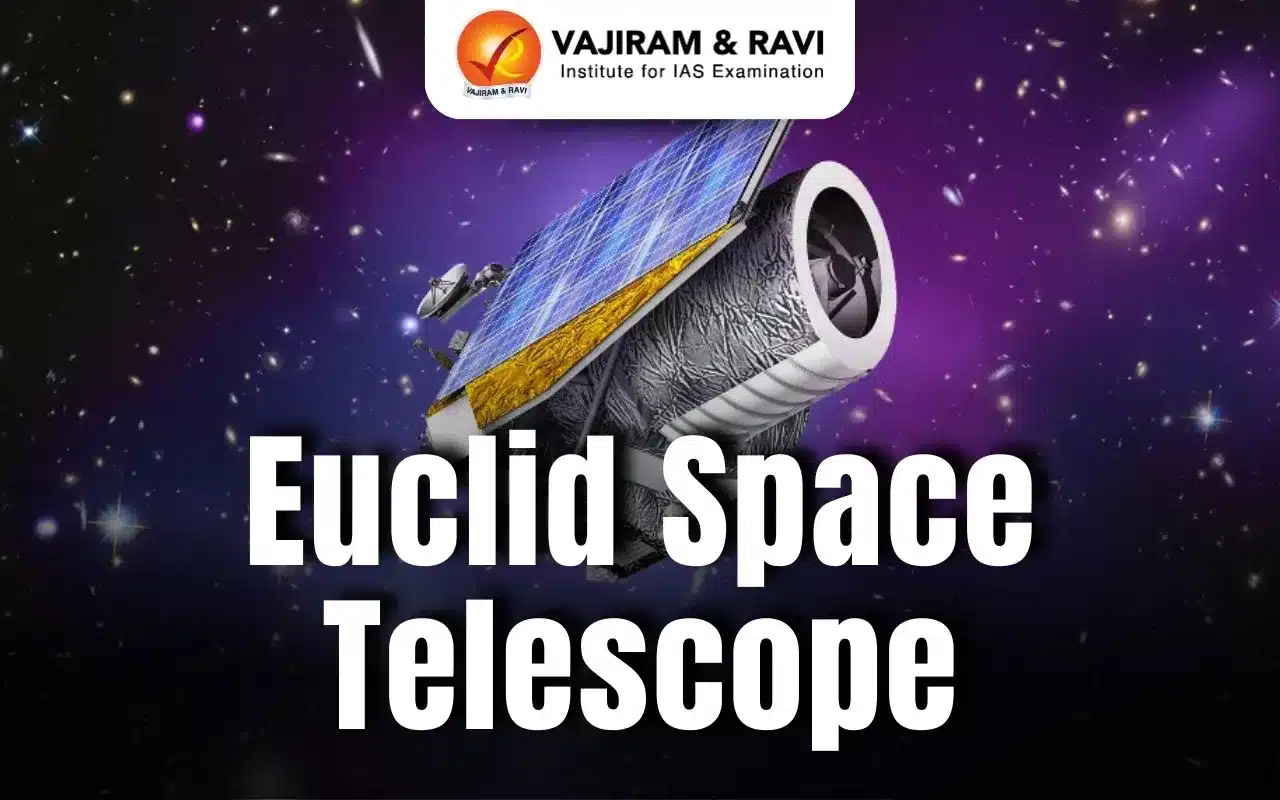
Euclid Space Telescope

Euclid Space Telescope

Euclid Space Telescope Latest News

Recently, the Euclid space telescope has delivered one of the most detailed views ever captured of the Milky way galaxy's crowded heart and revealed more than 60 million stars in a single extraordinary image.  

About Euclid Space Telescope

  • It is a 1.2-metre telescope launched in 2023 by the European Space Agency.
  • Objectives
    • It is designed to map large spatial structures, like galaxies, in our universe and help reconstruct how the universe expanded and how galaxy structures are shaped the way they appear today.
    • It is designed to explore the composition and evolution of the dark Universe.
    • The space telescope will create a great map of the large-scale structure of the Universe across space and time by observing billions of galaxies out to 10 billion light-years.
    • It explores how the Universe has expanded and how structure has formed over cosmic history, revealing more about the role of gravity and the nature of dark energy and dark matter.

Payloads of Euclid Space Telescope

  • It has two scientific payloads: Near-Infrared Spectrometer and Photometer (NISP) and Visible Imager (VIS).
  • Visible-Wavelength Camera (VISible Instrument – VIS)
    • It captures high-resolution images of galaxies.
    • Helps detect tiny distortions in galaxy shapes caused by gravitational lensing—a method used to study dark matter.
  • Near-Infrared Spectrometer and Photometer (NISP)
    • It measures how fast galaxies are moving apart, providing insight into the influence of dark energy over time.
    • Developed with NASA’s contribution, including sensor-chip electronics and detectors

Source: IT

Euclid Space Telescope FAQs

Q1: Why is L2 chosen for Euclid?

Ans: It is because of stable thermal & gravitational environment.

Q2: When & where was Euclid launched?

Ans: It was launched on 1 July 2023 on SpaceX Falcon 9 from Cape Canaveral, Florida to Sun-Earth L2.

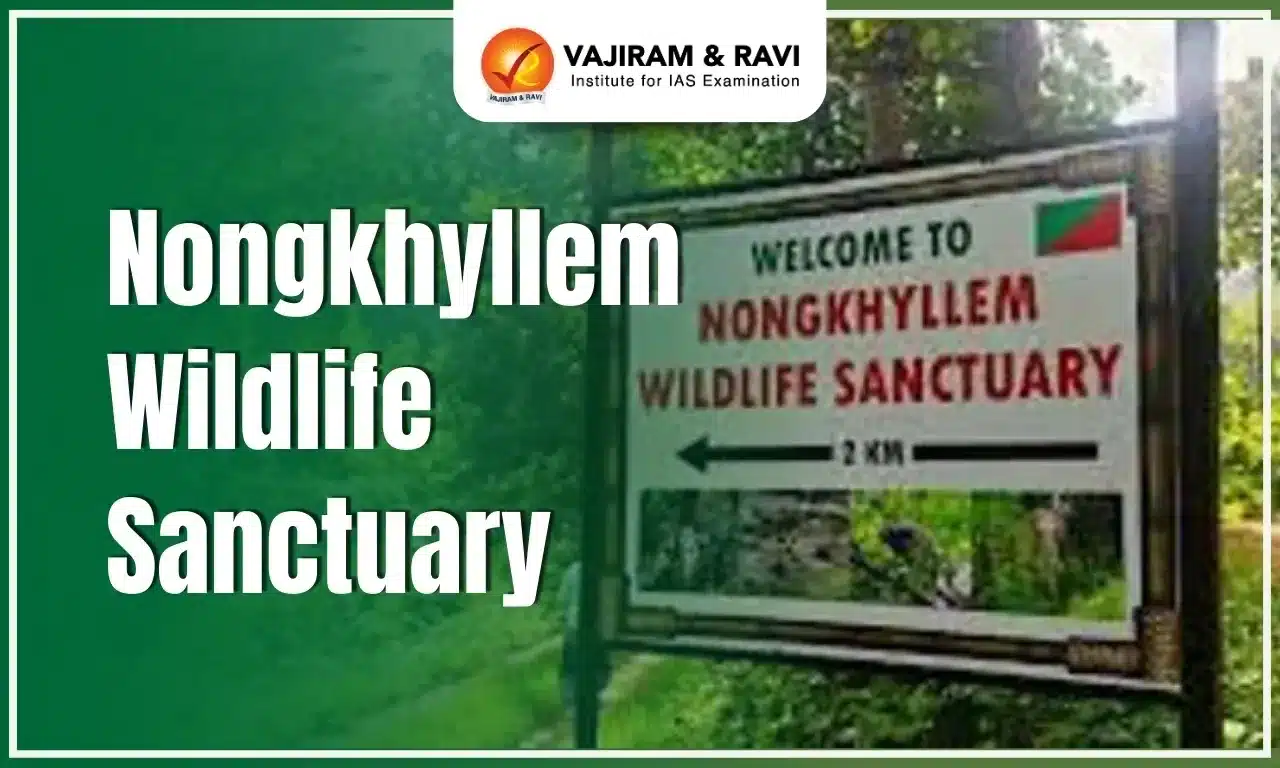
Nongkhyllem Wildlife Sanctuary

Nongkhyllem Wildlife Sanctuary

Nongkhyllem Wildlife Sanctuary Latest News

Recently, a rescued Chinese pangolin (Manis pentadactyla) and an Asian palm civet () have been released into Nongkhyllem Wildlife Sanctuary.

About Nongkhyllem Wildlife Sanctuary

  • Location: It is located in the state of Meghalaya, within the Eastern Himalayan Global Biodiversity Hotspot.
  • It was established in 1981 as a protected sanctuary under the Wildlife Protection Act, 1972.
  • Topography: Features undulating plains, low hills, and rugged terrain shaped by the Umtrew River and its tributaries (Umran, Umling, Umtasor).
  • Vegetation: The major part of the habitat is Tropical Moist Deciduous forest with patches of Tropical Semi-evergreen forest.
  • River: Umtrew River, forming the western boundary of the sanctuary.
  • Flora: Dominant species include Shorea robusta, Tectona grandis, Terminalia myriocarpa, and Gmelina arborea.
  • Fauna: Home to over 400 bird species, including the endangered Rufous-necked Hornbill, and mammals like the Clouded Leopard, Elephant, and Himalayan Black Bear.
    • Four species of hornbills occur in the area, including the Great Pied, Indian Pied, and Wreathed Hornbills.

Source: IT

Nongkhyllem Wildlife Sanctuary FAQs

Q1: What are important water bodies in Nongkhyllem?

Ans: Birbah natural lake

Q2: Which near-threatened bird is flagship of Nongkhyllem?

Ans: Rufous-necked hornbill

Enquire Now